Bed

September 02, 2022

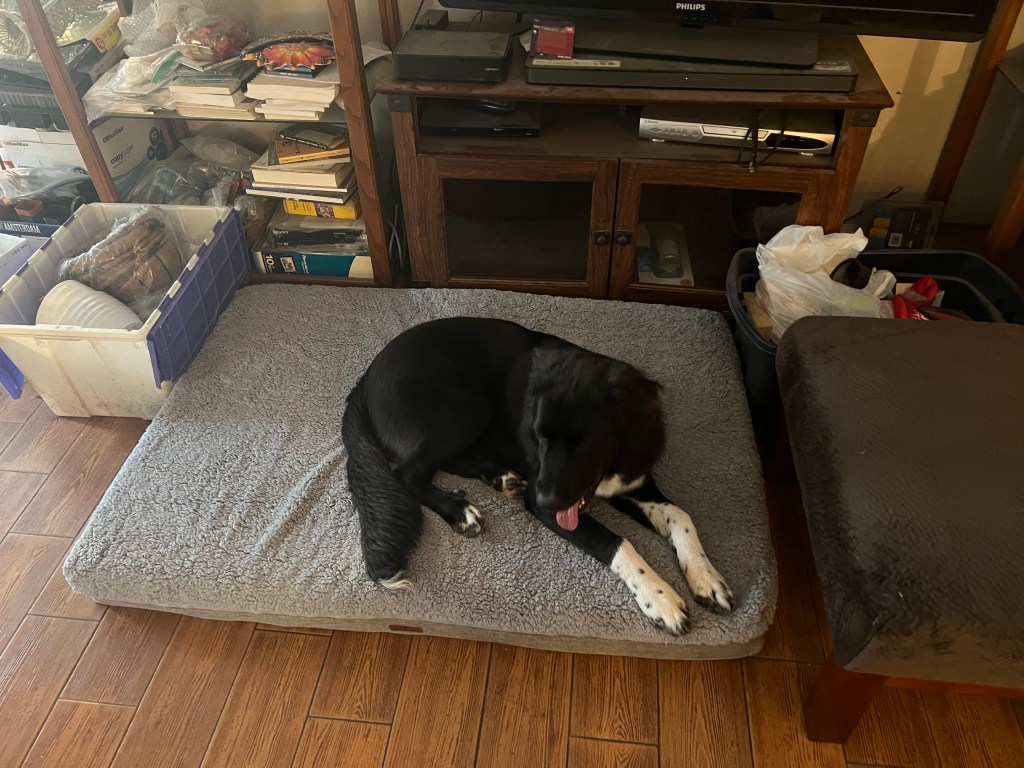
Finding a bed for Zena has been an ongoing search over the last six months.  She was only 20 pounds (9 kg) when we brought her home and she easily fit in Bella’s (our previous dog) bed.  Zena has put on 40 pounds (18 kg) since then and has outgrown several beds along the way.  Melissa first bought a larger bed that Zena loved to lay in and play with.  This had a satin bottom that could be switched over during the summer for her to stay cool and a cotton fleece to keep her warm in the winter.  Zena made a game out of chewing on the satin and dragging the bed around the house.  We tried a larger elevated bed next, but the first time Zena jumped on it the bed shot across the floor and she never trusted it after.  She went back to her old bed and her game of attack until the inevitable happened last month and the satin seam split.  I noticed Zena became quiet in the next room, and when I checked on her there was the inside stuffing all over the living room.  Zena next commandeered the beanbag I spoke of last month.  While this worked as a temporary bed, she could rarely get more then half of her length in the bed, and often ended up on the floor with just her back in the bed.  Today, a new bed for large dogs arrived.

When I looked online, I found the dog bed is now part of what has become “pet furniture”.  Pet furniture refers to furniture specifically designed for use by animals and includes pet beds, doghouses, hammocks, dog coolers, cat trees, parrot tents, and extravagant play equipment.  The global pet furniture market size is thought to be valued at US$3 billion by 2025 and is expected to grow at a compound annual growth rate of 5.2% during that period.  This will result in increased availability of a wide range of multiuse and fashionable furniture for pets on a global level.  The rising spending on pet care in developed economies like Germany, UK, France, and North America is projected to be a key trend, and consumer demand for innovative and fashionable pet accessories like furniture is on the rise.  Over the past few years, furniture has evolved across the world and manufacturers in the industry are focusing on multi-functional and stylish product innovation to serve the requirements of pet owners.  They are following a design-driven approach, which complements the home décor of the pet owner.  We are a long way from throwing a blanket in the doghouse on a cold night.

The bed Melissa purchased complies with this trend and is specifically designed for large breed dogs.  The bed has a large area (51 by 36 inches/130 by 90 cm) for a large or even multiple smaller dogs to rest.  The bed has a high-density orthopedic egg-crate foam that is 5 inches (13 cm) high.  It is assured this would provide “maximum support and comfort for your pet’s spine and body and relieves achy joints for pain-free restorative nap and sleep times.”  The bed included a cotton fleece top for winter warmth that can be removed to provide a cool summer sleep.  The cover is removable so you can wash it without disturbing the dog’s slumber.  The bed is made of anti-tear sofa linen (we will see if that lasts) and the inner casing is waterproof so it will not hold odors.  There is a five-year guarantee with replacement or repair free of charge for one year since purchase.  I bet that does not include being ripped to shreds.

THOUGHTS:  I was not surprised to learn that North America was the largest regional market for pet beds or animal furniture, accounting for 40.0% share in 2018.  Around 68% of the US households owned a pet in 2017, with dogs and cats the most popular and accounting for more than 80% of the domestic animal population.  Fish, birds, reptiles, and horses are also adopted in significant numbers.  Many US consumers own a combination of animals, and as of 2018, 46% of the household owns more than one pet with 32% of households owning a combination of dogs and cats.  The number of pet owners markedly rose during the pandemic as no one wanted to be alone.  It seems many these owners never bothered with a pet bed and allowed the animal to curl up next to them.  Still, they must need someplace to go when the owner is away, right?  Act for all.  Change is coming and it starts with you.
eDNA

September 01, 2022

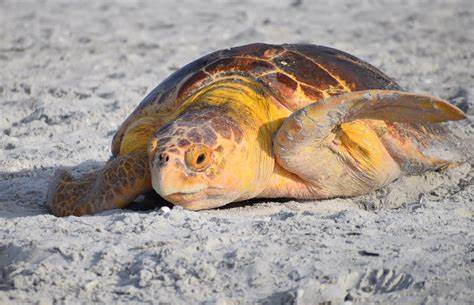
Hidden in the back pages of the front section of my local newspaper on Monday was a USA article on how eDNA is being used to unlock some of the world’s oldest mysteries.  While crime shows have used trace amounts of DNA (Deoxyribonucleic acid) to solve cold cases and tabloid talk shows have used it to identify the real father, ecological researchers have been using similar tests to determine the biodiversity of ecosystems.  One example was new information on the elusive loggerhead sea turtle (Caretta caretta).  While the loggerhead’s tracks on the beach are hard to miss, they also leave invisible trails of skin, scat, and saliva.  This environmental DNA (eDNA) can be collected in samples of sand to provided insight into the habits and diets of these reclusive turtles.

When I looked online, I found the use of eDNA began 14 years ago with a study of the invasion of the American bullfrog, (Rana catesbeiana) into Europe, a species that is considered a major cause of decline for native amphibians.  Since the historical data on the invasion was scarce, the study used population genetics data (a partial sequence of the mitochondrial cytochrome b gene) to infer the invasion history and to estimate the number of founders of non-native populations.  The science of eDNA also made a splash during the pandemic when researchers found they could track virus outbreaks (and variants) in municipal wastewater systems.  Identifying eDNA is now being used to verify the biological diversity in areas from the Brazilian Rain Forests to the slopes of Mount Everest.

According to Tracie Seimon, director of the wildlife molecular lab at the Bronx Zoo, the most intriguing aspect of eDNA is being able to learn about rare species without having to disturb them.  Seimon and her colleagues developed a test to amplify eDNA samples to rapidly detect species while reducing the size of the equipment to fit into a backpack.  Seimon’s team found evidence of 187 taxonomic orders in the 5.28 gallons (20 liters) of water collected on Mount Everest at elevations from 15,000 to 18,000 feet (4572 to 5486 m).  Once a baseline inventory is established, they will be able to monitor changes over time.  The non-profit XPRIZE holds competitions to encourage technological development to benefit humanity.  The XPRIZE Rainforest competition challenged teams to develop autonomous technology for rapid appraisal of the forest’s biodiversity, and a lot of interest has been shown using eDNA.  Methods include overland robots traveling the understory and aerial robots flying above the canopy.

THOUGHTS:  Anyone infected with covid sheds the virus each time they wash hands or use the toilet, even if they do not have symptoms.  Scientists have been tracking the virus using eDNA in wastewater for early clues about infections in cities and towns.  A team of researchers designed a system to get more detailed information about the virus variants from wastewater and built a computer program that quickly recognizes small pieces of the genetic material.  This not only picked up new variants like Delta and Omicron weeks before they showed up in clinical tests, but also found variants rarely seen in the clinic.  While this does not identify individuals, it can profile the whole city.  The team is now expanding the program to track other viruses.  Applications for using eDNA can provide early detection for the spread (pathogens) or decline (species) of genetic material.  As with any technology, the critical step will come determining how to use the information.  Act for all.  Change is coming and it starts with you.
Zombie

August 31, 2022

White Zombie is a 1932 American horror film based on The Magic Island by William Seabrook, staring Bela Lugosi as the zombie master “Murder” Legendre, and Madge Bellamy as his victim.  White Zombie is considered the first feature length zombie movie and gave birth to cinematic voodoo.  Revolt of the Zombies was a loose sequel in 1936 that was periodically followed by six more zombie releases until 1959, including the comedy Zombies on Broadway in 1945.  The genre took off in the early 1960’s with seven films released in four years and then began in earnest in the 1970’s.  Zombie films seem to have morphed from low budget B movies into the apocalyptic or space movies and TV shows that proliferate today.  These “living dead” creatures are portrayed as cannibalistic, and often prefer to eat human brains.  You can imagine my surprise when the world section of my local paper headlined the “zombie ice” that is our latest apocalyptic threat to survival.

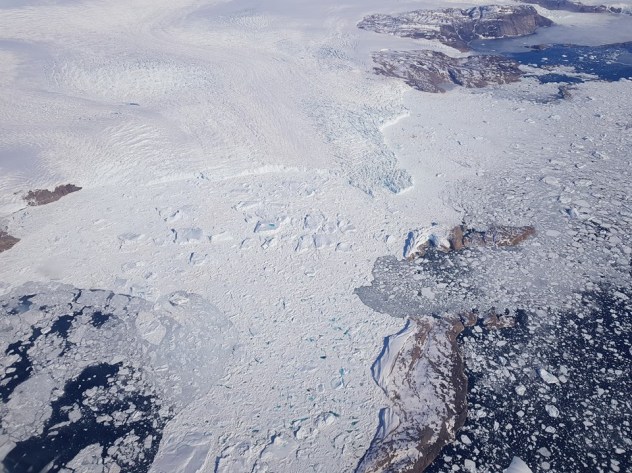
When I looked online, I found “zombie ice” refers to the Greenland ice sheet which will lose at least 3.3% of its total mass in the coming years.  The zombie ice is causing Greenland’s glaciers to melt faster than experts previously predicted and causing sea levels to rise.  A new study published Monday in the journal Nature Climate Change shows that over time that rise could be 10 inches (30 cm) or more.  The study co-author William Colgan, a glaciologist at the Geological Survey of Denmark and Greenland (GEUS), described zombie ice as dead ice that will melt and disappear from the ice sheet regardless of what climate (emissions) scenario we take.  Researchers say the zombie ice is an “ice budget deficit” that occurs when glaciers stop receiving enough snow to replenish the ice already melting each year.  In an ideal situation, yearly snowfall would easily be able to compensate for the ice that naturally melts on the edges of glaciers.  Emissions since the 1980’s have made that impossible.

While an ocean rise of 10 inches (30 cm) is inevitable, it could be up to 30 inches (90 cm) if preventative measures are not taken.  The absolute minimum ice loss means 120 trillion tons of water will melt off the Greenland ice sheet, or enough to cover the entire US in 37 feet (11.3 mm) of water.  According to the National Aeronautics and Space Administration, glaciers in northwestern Greenland have been losing about 4 to 8 billion tons of ice per year from accelerated warming.  That is more than the peripheral glaciers in southeastern and southwestern Greenland are losing, but less than in northern Greenland, where peripheral glaciers have been losing as much as 29 billion tons per year since the early 2000’s.  An important aspect of this new study is that it is based entirely on recorded measurements taken over the last 20 years combined with satellite measurements, not simulations or computer models.  The catch is the method lacks a specific timeframe.  Exactly when the 10 inches of sea level rise will happen is unknown, but observations suggest most of the committed sea level rise will occur this century.  The study also only considers the melting in Greenland and does not factor in other zombie ice melting in the Arctic and Antarctic ice sheets.  That may not matter, as data from Greenland’s zombie ice suggests we already have one foot in the grave.

THOUGHTS:  While the predicted zombie ice melt would cover the entire US in 37 feet of water, it would not be distributed evenly due to altitude.  Conservative estimates say coastal cities around the world could witness more than 6 feet of flooding by the year 2100.   While some would be unaffected others might disappear underwater, including New Orleans, Miami, Huston, and parts of New York City.  That ocean front property in Arizona is looking better all the time.  We could follow the example of the dikes and pumps in the Netherlands or the flood barriers in Venice.  Or we could admit climate change is real and seek global solutions.  Act for all.  Change is coming and it starts with you.

Artemis

August 30, 2022

The front page of today’s paper announced the scheduled liftoff of the Artemis 1 rocket was scratched yesterday after back-to-back technical issues.  The team of engineers were unable to get the rocket’s engines to the proper temperature required to start the engines and ran out of time in the two-hour launch window.  The four RS-25 engines must be thermally conditioned before the super cold propellant begins flowing through them for liftoff.  Launch controllers condition them by increasing the pressure on the core stage liquid hydrogen tank to bleed a portion of the -423F (-253C) liquid hydrogen to the engines.  During the countdown, launch controllers worked through several other issues, including area storms, a leak at the quick disconnect on the 8-inch (20 cm) line used to fill and drain core stage liquid hydrogen, and a hydrogen leak from a valve used to vent the propellant from the core stage tank.  The earliest possible date for the next launch attempt is Friday, September 2nd.  The mission team will convene Tuesday afternoon to discuss the data and develop a plan forward.

When I looked online, I found the Artemis program is an international human space-flight program with a goal to return humans to the Moon by the year 2025.  The flight will include the first woman and a person of color as the thirteenth man to land on the moon.  Artemis 1 is an uncrewed Moon-orbiting mission and the first flight of the agency’s Space Launch System (SLS) rocket and the complete Orion spacecraft.  The Artemis 1 mission will last six weeks and will test all the rocket stages and spacecraft that would be used in later Artemis missions.  After reaching orbit and performing a trans-lunar injection (burn to the Moon), the mission will deploy ten CubeSat satellites and the Orion spacecraft will enter a distant retrograde orbit of the moon for six days.  The Orion spacecraft will then return and reenter the Earth’s atmosphere.  The craft is protected by a new design for the heat shield that failed when the space shuttle Columbia broke apart on re-entry on February 1, 2003.  The capsule will finally splash down in the Pacific Ocean.

The planned launch date for Artemis 1 was December 2016, but that has been delayed at least sixteen times due to technical issues with the SLS and the Orion spacecraft.  The program is also suffering from cost overruns (the main criticism of the SLS) and budget limits imposed by the federal government.  This will be the first lunar landing since Apollo 17 in 1972, which was the final lunar mission of the Apollo program.  The Artemis program began December of 2017 by bringing together other programs that the US had started since 2009.  The hope for Artemis is for a continued presence of humans on the moon and that one day the program might take humans to Mars and throughout the Solar System.  NASA has been joined in the Artemis program by private companies and international organizations like the European Space Agency.  The Artemis 2 mission will perform a crewed lunar flyby and Artemis 3 will perform a crewed lunar landing, five decades after the last Apollo mission. 

THOUGHTS:  After being challenged to put a man on the moon by John F. Kennedy in 1960, NASA named the ship being designed to accomplish the feat Apollo, as the Greek god’s chariot was said to ride across the sky with the sun.  Apollo’s twin sister Artemis is the Greek goddess of the Moon, and is the name given to the mission to bring humanity to the moon and planets.  While congress has constantly decried the cost overruns accompanying the space program, it should be noted the task has always been to create an end by developing the means.  Modern computers, cell phones, and much of our technology is the result (directly and indirectly) of these developments.  When Jules Verne wrote “From the Earth to the Moon” in 1865, he envisioned a giant cannon which would propel the craft.  The cost estimate to win this US$1,000 bet was US$4 million, but it ended being US$5.5 million.  It seems even a cannon can have cost overruns.  While it is prudent to manage the costs of such projects, it is unfathomable to image where we would be without them.  Act for all.  Change is coming and it starts with you.
Toad

August 29, 2022

When I took Zena outside yesterday, she went through her general snuffling routine.  Even if she stops right off the sidewalk, she will usually follow the same pattern to continue snuffling.  We go to the snowball bush to see if there is anything interesting, proceed toward the street, and then walk along the curb as far as I will let her go.  While Zena usually wants to enter our neighbor’s yard, I restrain her, and she begins to sniff her way down toward the fence.  From there it is back to the side of the house, across the flower bed, and then along the front until she gets back to where she started.  This is her perimeter zone, and she makes sure it has not changed since the last time we went out.  This time was different, as I had not yet been out to get the paper.  It was lying in the drive, and we walked over to retrieve it.  As I picked up the paper, I noticed movement out of the corner of my eye.  There was a small toad (1 inch or 2.5 cm) working its way across the driveway with intermittent hops. 

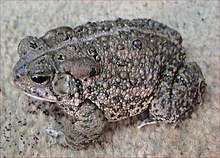
When I looked online, I found Woodhouse’s toad (Anaxyrus woodhousii) is a medium-sized true toad native to the United States and Mexico.  Woodhouse’s toad was first described in 1854 by the French herpetologist Charles Frédéric Girard who gave it the name Bufo woodhousii in honor of the American physician and naturalist Samuel Washington Woodhouse.  The large genus Bufo was split in 2006, with the North American species being included in the genus Anaxyrus and this toad became A. woodhousii.  Woodhouse’s toad is a stout amphibian and can grow to a maximum snout to vent length of 5 inches (127 mm).  The head has prominent cranial crests in front of and in between the eyes.  The dorsal surface of this toad is grayish-brown or yellowish-brown and it is speckled with small dark spots.  There is a narrow pale line running along the spine.  The belly is paler and is usually unspotted.  The male has a single vocal sac on his throat and his 1-3 second call resembles the bleat of a sheep.

When I saw the toad I immediately though that Zena might attack it.  When insects or caterpillars move into her range, she will generally pounce on them several times.  Like other toads, the noxious secretions from the warts found on the skin afford protection against some predators, but toads may be found with the scars of mammal bites or bird pecks from unsuccessful attempts to make them food.  Woodhouse’s toads also rely on their general resemblance to the sand and dirt they live in, along with immobility, to escape detection.  The toad’s normal gait is both walking and hopping but it becomes energetic hopping after it has been detected.  Our toad hopped several times, remained still as I took its picture, and then quickly hopped under the car when I turned away.  Zena never noticed it, and now it was safe.

THOUGHTS:  While the woodhouse’s toad (A. woodhousei) lives in central North America (plains to Rockies) the fowler’s toad (A. fowleri) lives along the east (coast and inland to the plains).  The fowler’s was originally classified as a subspecies of the woodhouse’s until later research elevated it to a species.  The area of Arkansas where we live is on the cusp of the range of both the woodhouse’s toad and the fowler’s toad.  Another species of toad in the same area is the East Texas toad (A. speciosus) which was originally thought to be a hybrid of the two and was described as a subspecies.  It has also been elevated to full species and the idea of being a hybrid has been dismissed.  Genetic tracing has made significant changes in the classification of both the plant and animal worlds.  Changing the names does not alter the species’ role in the environment, but it does change our perception.  While a rose by any other name may smell as sweet, call it a weed and it can be torn out and discarded.  That goes for how we understand and talk about people as well.  Act for all.  Change is coming and it starts with you.
Tiles

August 27, 2022

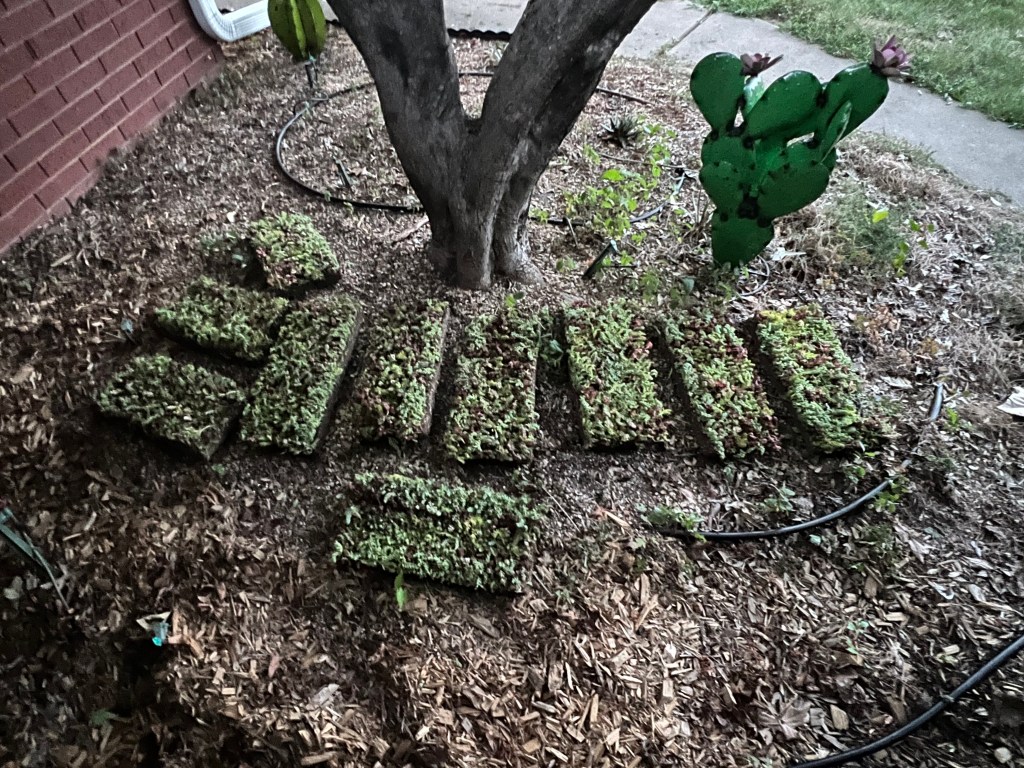
Melissa has planted a variety of sedum in the front beds we are trying to turn over to the succulents.  I wrote in May how the pink stonecrop (Sedum ewersii) in the front driveway bed had begun to flourish even while others have not survived the winters.  We had replaced the mulch in the front beds with pea gravel as it provides good drainage for the succulents, but the gravel does not do much to keep out the weeds.  Melissa has been holding back on buying additional succulents until she gets her business off and running, so I was surprised several weeks ago when two large boxes (back-to-back days) showed up at the front door.  I was told these were not business succulents, they were housing succulents.  These sedum carpet tiles had been purchased from a grower friend to start ground cover and keep down the weeds.

When I looked online, I found examples of the sedum carpet tiles we purchased.  Each tile contains multiple varieties of sedum in a tightly packed mesh.  The seller guaranteed them to be drought tolerant and to have the ability to overwinter in growing zones 3-8.  The sedums will grow from 1 to 6 inches (2.5 to 15 cm) high depending on the variety, and although they grow slowly, should hopefully (eventually) spread over the entire bed.  Each tile uses a coconut fiber base to ensure effective rooting.  The tiles just need to be placed on a prepared bed or growing medium with sufficient moisture.  The colorful foliage will flower from late summer to fall with white star-shaped blooms.  The site said this can add color and interest to the garden and creates beautiful landscapes when paired with other perennials.  Since we will not plant perennials, I am hoping it will also work well along with the established pink stonecrop.

When the boxes of tiles showed up, it was unclear where they were going to be placed and they sat in the front hall for several days.  When we were predicted to have rain last week Melissa placed them outside under the Japanese Maple for some water.  I knew two of the tiles were supposed to go in with the stonecrop and today I decided it was time to put them in place.  Melissa was uncertain how well they would transport, so she got a flat and placed the tiles on it so I could move them.  Turns out it did not matter.  The 17 by 10 inch (42.5 to 25 cm) tiles had the coconut fiber base I had seen online and then a third-of-an-inch netting beneath the fiber to hold the tile together.  Rather than falling apart, I struggled to cut through the layers.  I brushed back the pea gravel, set the half tiles on the ground, then spread the gravel back around the sides.  Two tiles in, eight more to go.

THOUGHTS:  While I had never laid sedum tiles before (or heard of them) it is a lot like laying sod, which I did do for a landscaping outfit one summer.  We would grow and cut our own sod in 40 by 12 inch (100 by 30 cm) rolls.  The sod was laid in an alternating pattern, flattened in place with a roller, and watered in.  The biggest part of the job was preparing the ground (tilling and leveling) prior to laying the sod.  Good preparation meant a smooth and even lawn.  Shoddy preparation meant an undulating lawn that collected water in pools that killed the grass.  Preparation is the key for most good outcomes in life.  We had prepared for the Ebola virus in 1976 and the Zika virus in 2015 and stopped them before they widely spread.  We were not prepared and ignored the warnings for covid, and it became a pandemic.  We can be sure another virus will arise and with globalization may spread.  Ignorance is not bliss, and it may kill you.  Act for all.  Change is coming and it starts with you.

Shark

August 25, 2022

After posting yesterday’s blog on the megalodon shark I found a front page feature in my paper about the discovery of an 80 million year old “sea dragon” (mosasaur).  The fossil remains were found by a researcher in northern Mississippi while showing his wife the area where he had done his field research.  He had taken her on a tour of the area and were on their way back to the car when he noticed the large skull and several vertebrae exposed on the surface.  They had apparently stepped right over the fossils on their walk in.  When most sea creatures die their bodies are spread about by scavengers and currents.  This mosasaur had remained intact since it had settled to the seabed, and now lay exposed in the rocks of a small gully.  Even though the article did not say, I immediately wondered if the timing of this report might not be associated with the recent much publicized Shark Week on TV.

When I looked online, I found Shark Week is an annual, weeklong TV programming block on the Discovery Channel which features shark-based programming.  The promotion premiered July 17, 1988, and has continued to air annually in July or early August.  The shows were originally devoted to efforts at conservation and correcting misconceptions about sharks.  The promotion has grown in popularity and since 2010 has been the longest-running cable television event in history and is aired in over 72 countries.  Shark Week has also evolved into more entertainment-oriented and sometimes fictional programming.  This fictitious programming is known as docufiction and includes titles like “Megalodon: The Monster Shark Lives”.  The strategy was successful, as the megalodon program became one of the most watched shows in Shark Week history.  This was mainly for the controversy it generated, with critics even labeling it a mockumentary.  Since then, Discovery has increasingly been criticized for junk science, pushing dubious theories, creating fake stories, and misleading scientists as to the nature of the documentary being produced.  In 2017, the network heavily promoted a race between Olympic gold medal winner Michael Phelps and a great white shark that turned out to be computer generated (but based on actual speeds), and Phelps wearing illegal swim gear.  Phelps beat the CGI reef shark in a 50-meter match but lost to the CGI great white shark by two seconds.

It turns out the Mosasaur was not a shark, but a group of marine lizards containing a dozen or so different species that would have lived in the Western Interior Seaway of North America 75-69 million years ago.    The smallest-known mosasaur was Dallasaurus turneri, which was less than 3.3 feet (1 m) long.  Larger mosasaurs were more typical, with many species growing longer than 13 feet (4 m).  Mosasaurus hoffmannii is the largest known species and reached up to 56 feet (17 m).  Currently, the largest publicly exhibited mosasaur skeleton in the world is on display at the Canadian Fossil Discovery Centre in Morden, Manitoba.  The specimen, nicknamed “Bruce”, is just over 43 feet (13 m) long.  Mosasaurs breathed air, were powerful swimmers, and were well-adapted to living in the warm, shallow inland seas prevalent during the Late Cretaceous period.  Mosasaurs were so well adapted to this environment that they most likely gave birth to live young, rather than returning to the shore to lay eggs as sea turtles do.  Mosasaurs belong to a group of reptiles called Toxicofera, which includes today’s snakes as well as monitor lizards and Komodo dragons.

THOUGHTS:  A mosasaurus played a prominent role in the fourth instalment of the of the Jurassic Park franchise and the first in the Jurassic World trilogy.  This animal was depicted living in a huge Sea World-style arena.  The mosasaurus in the movie was big enough to eat a great white shark in a single bite.  While this was slightly exaggerated, it would not have been an unrealistic size.  Interestingly, there were no mosasaurs in either the Jurassic or Triassic periods.  The seas were dominated by two other groups of marine reptiles, the dolphin-like ichthyosaurs, and the long-necked plesiosaurs.  There are times when we become too critical of what we see and need to stop and remind ourselves, “It is only a movie.”    Act for all.  Change is coming and it starts with you.
Megalodon

August 24, 2022

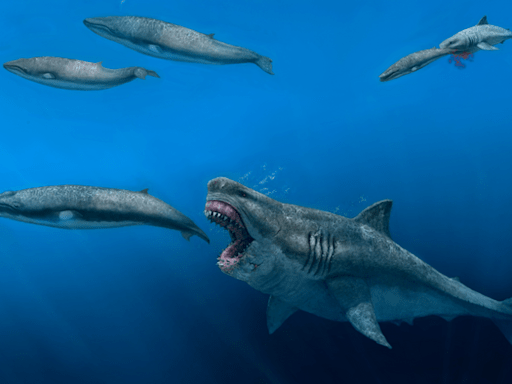
Yesterday’s NY Times reported the megalodon may have been larger and fiercer than previously thought.  A new study shows the megalodon was so big it could devour a 16 foot (5 m) killer whale and was the fastest cruising shark to ever swim the oceans.  The finds were revealed through a new 3D model of the extinct shark, based on data collected from fossilized teeth and vertebrae.  This has given scientists the best look yet at the size, speed, and diet of this “superpredator.”  In the new study, researchers combined measurements from an exceptionally well-preserved vertebral column uncovered in Belgium and a set of teeth found in the U.S. to create a rough blueprint of the megalodon’s skeleton.  The team then used body scans of a great white shark to fill in the gaps and estimate the amount of soft tissue that surrounded the megalodon’s bones.  The scientists then combined these data to create a digitally reconstructed 3D model.  Based on the model, “we estimate that an adult O. megalodon could cruise at faster absolute speeds than any shark species today and fully consume prey the size of modern apex predators,” the researchers wrote in the journal Science Advances published on August 17th. 

When I looked online, I found the Megalodon (Otodus megalodon), meaning “big tooth”, is an extinct species of mackerel shark that lived 23 to 3.6 million years ago, or from the Early Miocene to the Pliocene epochs.  The megalodon was originally identified as a relative of the modern great white shark (Carcharodon carcharias) but is now classified in the extinct family Otodontidae which diverged from the great white during the Early Cretaceous.  While regarded as one of the largest predators to ever live, the megalodon is only known from fragmentary remains.  Scientists differ on whether it would more closely resemble a stockier version of the great white shark, the whale shark (Rhincodon typus), the basking shark (Cetorhinus maximus), or the sand tiger shark (Carcharias taurus).  A recent estimate suggests a maximum length of 66 feet (20 m), although the average length is estimated at 34 feet (10.5 m).  Using the vertebral column and reconstructing a 3D model suggest a 52 foot (16 m) long individual may have reached more than 67.8 tons (61.5 metric tons).  The teeth were thick and robust, built for grabbing prey and breaking bone, and their large jaws could exert a bite force of 24,400 to 41,000 foot pounds (108,500 to 182,200 newtons).  You would not want to be swimming in their water.

Fossil records indicate the megalodon had a diverse distribution and probably targeted large prey.  Juveniles inhabited warm coastal waters and fed on fish and small whales.  While the great white attacks prey from the soft underside, megalodon probably used its strong jaws to attack the chest cavity and puncture the heart and lungs of its prey.  Since the megalodon preferred warmer waters, it is thought ocean cooling and lower sea levels from the ice ages may have resulted in the loss of suitable nursery areas contributing to its decline.  A reduction in the diversity of whales and a shift in their distribution toward polar regions may have also reduced megalodon’s primary food source.  If the megalodon’s stomach was a similar proportion to those of living apex sharks, researchers think the belly could have had a volume around 2,537 gallons (9,605 liters), an equivalent to 60 bathtubs.  The megalodon seems even more ferocious than recent movies indicate.

THOUGHTS:  Critics discredited Jurassic Park (1994) for the depicting the velociraptors (Velociraptor mongoliensis) hunting in packs as the main protagonists (not the larger T. Rex).  The Velociraptor is from Mongolia and appear to have been slow-witted and solitary, covered in feathers, and about the size of a chicken.  Others vindicated the film saying the Utahraptor (Utahraptor ostrommays) found near Moab, Utah, in 1975 may have looked and acted like the movie versions.  The “fossil record” depends on bones being preserved (fossilized) and found.  This is complicated for aquatic animals like the megalodon (and modern sharks) as they were chordates (cartilaginous) rather than bone.  That is why most remains have been skulls or teeth.  Chance discoveries still provide insights to our amazing world.  Act for all.  Change is coming and it starts with you.

Freya

𝘈𝘶𝘨𝘶𝘴𝘵 23, 2022

When I blogged about Dirk the Bison goring four individuals (separate occasions/animals) in Yellowstone National Park over a period of two months I was surprised they had not decided to euthanize the animals. The usual response for people doing stupid things that gets them injured is to kill the animal that was trying to protect itself. Later in July the Norwegian Ministry of Fisheries and Coastal Affairs shared a photograph of a crowd of humans standing within arm’s reach of a walrus they had named Freya, who was relaxing on the shore. On a different occasion, police had to physically block a bathing area after Freya chased a woman who had gotten too close to her into the water. Authorities said that humans had been seen swimming with Freya, throwing objects at her, and invading her personal space for photos. Unlike Dirk, Freya had not physically harmed any of these selfie seekers. The 1,320-pound female walrus was put down on Sunday, August 14 by Norway’s Directorate of Fisheries, “based on an overall assessment of the continued threat to human safety” (read, humans refused to leave her alone). Freya was the goddess of love and war in Norse mythology. The Directorate stated the people loved Freya so much they were forced to put her down. It seemed to be a love/hate relationship like the myth.

When I looked online, I found the walrus (Odobenus rosmarus) is a large flippered marine mammal with a discontinuous distribution about the North Pole in the Arctic Ocean and subarctic seas of the Northern Hemisphere. The walrus is the only living species in the family Odobenidae and genus Odobenus. The species is subdivided into two subspecies: the Atlantic walrus (O. r. rosmarus), which lives in the Atlantic Ocean, and the Pacific walrus (O. r. divergens), which lives in the Pacific Ocean. An adult walrus is distinguished by their prominent tusks and whiskers, and their considerable bulk. Adult Pacific walrus males can weigh more than 4,400 pounds (2,000 kilograms) and, among the pinnipeds, are only exceeded in size by the two species of elephant seals. Walruses live mostly in shallow waters above the continental shelves, spending significant amounts of their lives on the sea ice looking for benthic bivalve mollusks to eat. Walruses are relatively long-lived, social animals, and they are considered a “keystone species” in the Arctic marine regions.

The walrus has played a prominent role in the cultures of many Indigenous Arctic peoples, who have hunted the walrus for its meat, fat, skin, tusks, and bone. Skin and bone are used in some ceremonies, and the animal appears frequently in legends. During the 19th century and the early 20th century, walruses were widely hunted and killed for their blubber, walrus ivory, and meat, and the walrus population fell rapidly around the Arctic region. Their population has rebounded somewhat, though populations of Atlantic and Laptev walruses remain fragmented and at low levels compared with the time before human interference. Walruses are listed as vulnerable by the International Union for Conservation of Nature Red List of Threatened Species. However, several experts stated Freya’s death will have little impact on the walrus numbers. Try and tell that to Freya.

𝗧𝗛𝗢𝗨𝗚𝗛𝗧𝗦: Shortly after the Loma Prieta earthquake in 1989 a few sea lions began to arrive at Pier 39’s West Marina in San Francisco. By January of 1990 they had arrived in droves and the population grew to more than 300. The marina was closed, and the docks given over to the pinnipeds. Now each winter, the population can increase up to 900 sea lions, most of which are male. During the summer most of the sea lions migrate south to the Channel Islands for breeding season, but in recent years a small group has preferred to stay year-round. This has caused incidents when humans try and get too close to the animals, but rather than drive them away (or euthanize them), the city has made it illegal to approach or feed them. The sea lions have become one of San Francisco’s leading attractions. That was not the fate of Freya. Act for all. Change is coming and it starts with you.

Sandhill

August 22, 2022

Photo by: Patrick Donnelly/AP

I came across and AP article last week about a rare butterfly living in a remote area of northwest Nevada near the Oregon line.  Conservationists from the Center for Biological Diversity (CBD) says the project the Bureau of Land Management approved last year could ultimately lead to the extinction of the 2-inch-long butterfly.  The CBD is now petitioning the US Fish and Wildlife Service (USFWS) to list the bleached sandhill skipper under the Endangered Species Act at the only place it’s known to exist.  USFWS has 90 days to decide whether there’s enough evidence to conduct a yearlong review to determine if protection is warranted, so any formal listing is likely years away.

When I looked online, I found the sandhill skipper (Polites sabuleti), or Saltgrass skipper, is a butterfly in the family Hesperiidae found from southern British Columbia and eastern Washington, south through California and northern Arizona to Baja California, and east to south-eastern Wyoming, central Colorado, and north-eastern New Mexico.  It is also an introduced species in Hawaii.  The wingspan is 1-1¼ inches (22–32 mm).  There is one generation of adults on wing from June to August at high elevations and several generations from March to October in the southern part of its range and at low elevations.  The larvae feed on various grasses, while the adults feed on flower nectar.  While the sandhill skipper may be widely distributed, the bleached sandhill skipper is a subspecies found in only one place, in the meadows at Baltazor Hot Spring in Humboldt County, Nevada.  It is differentiated by its golden-orange wings.  There are no official government counts of the subspecies population, but scientific surveys from 2014-2019 indicate it is in decline and estimates place the numbers from fewer than 10,000 to hundreds.  The small geographic range and specific habitat of this subspecies make it highly vulnerable to extinction.

The Reno based firm Ormat Nevada wants to tap hot water beneath the earth to generate carbon-free energy the administration has made a key part of its effort to combat climate change with a shift from fossil fuels to renewable sources.  Opposition to those efforts in Nevada has come from conservationists, tribes and others who generally support greener energy.  The CBD and a Nevada tribe have been battling the Ormat in federal court since December over another power plant scheduled to begin operation in the Dixie Meadows 100 miles (160 kilometers) east of Reno.  The USFWS declared the quarter-sized Dixie Valley toad endangered on a temporary emergency basis in April.  The proposed power plant would sit outside the sandhill’s habitat, a single alkali wetland of around 1,500 acres (607 hectares) created by discharge from the Baltazor Hot Springs.  However, tapping the underground water would likely affect the flows that support the plants that host the larva that hatch from the butterfly’s eggs and provide nectar for adults.  While the original plans have been shifted so the geothermal plant is farther away from the butterfly’s habitat, no mitigation would offset the chances the project would alter the spring’s hydrology, potentially drying up the hot spring.  This would cause the bleached sandhill’s extinction.

THOUGHTS:  A report released by the US Department of the Interior’s Bureau of Land Management (BLM) forecasts they are on track to approve 48 wind, solar, and geothermal energy projects with the capacity to produce around 31.827 GW of electricity by the end of the fiscal 2025 budget cycle.  Most of these sites are in the Great Basin Desert of Nevada, Utah, and southeastern California.  The condition of high temperatures and arid landscape has historically made these areas unacceptable for most human habitation but have resulted in niche species and subspecies (like the bleached sandhill skipper and the Dixie Valley toad) who survive around the isolated water sources.  Taping geothermal is a good way to help wean the country off fossil fuels, but it cannot be done by disregarding the fragile environments we have neglected in the past.  Act for all.  Change is coming and it starts with you.