Butterfly

đ˜‘đ˜¶đ˜­đ˜ș 02, 2022

I am beginning to think we have created our own butterfly house with the different species that have been attracted to the inside of our screened porch.  I thought it was interesting as I had just commented on the butterfly houses located at the botanicas in both Fayetteville and Wichita, and to then go out on the porch yesterday and see a large black butterfly with orange tips on both its fore and back wings fluttering on the screens.  This was a butterfly I have seen frequently around the phlox and hydrangea in the front yard.  My thought was the succulent flowers must have attracted the butterfly into the porch, and now it was trying to get back out.  I was not surprised when I came out later and it was gone.

When I looked online, I found the Diana fritillary (Speyeria diana) is a fritillary butterfly found in several wooded areas in southern and eastern North America (primarily in the Arkansas River valley and along the Appalachian Mountain range).  The common name fritillary refers to the checkered markings on the wings, usually black on orange, and derives from the Latin “fritillus” meaning dice-box or chequerboard.  Most fritillaries belong to the family Nymphalidae.  The larvae of the diana feed on the leaves of wild violets (Viola odorata).  Dianas are unusual in that they do not lay their eggs directly on the host plant, and instead scatter the eggs around the base of the plant.  Upon hatching, the larvae burrow into the ground and over winter to emerge in spring to feast on the leaves.  Adults feed on flower nectar and dung.  The species exhibits marked sexual dimorphism, with males of the species exhibiting an orange color on the edges of their wings, with burnt orange underwing. Females are dark blue, with dark, almost dusty underwings, and are also larger than males.  I spotted a male.

On February 28, 2007, Act 156 of the Arkansas General Assembly designated the Diana fritillary as the official state butterfly.  Introduced by Representative John Paul Wells of Logan County, the legislation for making the butterfly a state symbol took note of the butterfly’s beauty, educational importance, and impact on tourism.  Arkansas is the only state to designate the Diana fritillary as its state butterfly, pairing it with its state insect, the honeybee.  The main threat to this magnificent butterfly species is the climate change which has altered and affected the butterfly’s natural habitat. The Diana fritillary population in the Appalachian Mountains and populations living out west are decreasing in number.  Other threats to the Diana fritillary butterflies include loss of habitat and agricultural development.  Overall, this butterfly species is expected to have a population decrease by the year 2050.  

THOUGHTS:  I have always thought it interesting that states would designate a “state insect”.  Only two   of the 50 US states do not have a state insect, along with the District of Columbia.  Of those, 14 states have selected the Honeybee and another 20 have a butterfly (6 Monarch and 10 with a species of swallowtail).  I was not surprised to learn ants and wasps did not make any of the lists.  It appears we prefer either aesthetic (butterflies) or economic (honeybee) representatives.  More than half of the insects chosen are not native to North America, because of the inclusion of three European species (European honeybee, European mantis, and 7-spotted ladybird), each having been chosen by multiple states.  This seems appropriate as 14% of US residents are foreign-born and over half of those are naturalized US citizens.  Taken back farther, only the Indigenous peoples were here prior to 1492 and they immigrated from Asia.  While we may not have melted together as one, we do make for a fascinating stew.  Act for all.  Change is coming and it starts with you.
Raccoon

July 01, 2022

I have mentioned that we have been having something rummaging around on our screened porch for the last several weeks.  This has resulted in the screens being pushed in and forced us to put the bird feed I have stored on the porch into plastic buckets with lids that can be sealed.  I had at first blamed the squirrels and had hopped it was not the occasional rat we find from the field behind the house.  Last night we heard a noise on the porch, and I went to investigate.  When I switched on the light, I saw an innocent little face peeking over the seed bucket it had knocked over and was trying to pry the lid off.  As he looked up at me, I could almost hear him say, “It wasn’t me!”  When I opened the door, the young raccoon sped off into the night.    

When I looked online, I found the raccoon (Procyon lotor), is a mammal native to North America.  It is the largest of the procyonid family, having a body length of 16 to 28 inches (40 to 70 cm), and a weight of 11 to 57 pounds (5 to 26 kg).  Its grayish coat mostly consists of dense underfur, which insulates it against cold weather.  Escapes and deliberate introductions in the mid-20th century have resulted in the raccoon being distributed across much of mainland Europe, the Caucasus, and Japan.  In Europe, the raccoon has included on the list of Invasive Alien Species of Union concern (the Union list) since 2016.  That means it cannot be imported, bred, transported, commercialized, or intentionally released into the environment.  Though once thought to be solitary, recent evidence shows the raccoon engages in social behavior.  Related females may share a common area while unrelated males can live together in small groups to keep out foreign males during mating season and guard against invaders.  After a gestation period of about 65 days, two to five young (kits) are born in spring.  The kits are raised by their mother until dispersal in fall.  Although captive raccoons have been known to live over 20 years, life expectancy in the wild is only 2 to 3 years.  Hunting and vehicular injury are the two most common causes of death. 

Three of the raccoon’s most distinctive features are its dexterous front paws, its facial mask, and its ringed tail.  These features form the themes in the mythologies of Americas indigenous people.  The raccoon is noted for its intelligence, and studies show that it can remember the solution to tasks for at least three years.  The raccoon is usually nocturnal and omnivorous, eating about 40% invertebrates, 33% plants, and 27% vertebrates.  The original habitats of the raccoon are deciduous and mixed forests, but because of their adaptability they have extended their range to prairies, mountainous areas, and coastal marshes.  In urban areas some homeowners consider them to be pests.  When they break through my screens and eat my bird seed, I would be one of them.

THOUGHTS:  When I lived in Berkeley, California, there was a raccoon who would fight the homeless people sleeping along the sidewalk for the food in their packs.  I walked the grounds as security guard, and they would tell me of the battles they had with the animal.  I lived along the street and opened my fence one night to find three sets of raccoon eyes staring at me.  I felt like Val Kilmer facing the lions in the Ghost and the Darkness.  Now that I know what is getting into my seed, I am bound to do something about it.  That means rearraigning the buckets so they cannot be knocked over and securing the screens.  Now that we know how to combat the virus, that should mean we do something about it.  That means vaccinations and monitoring our activity when we do not feel well.  The lions ate those who ignored the threat.  The virus seems to do the same.  Act for all.  Change is coming and it starts with you.
Bat

June 30, 2022

I received a post today from Vicki Brown, one of the members of the Arkansas Gardening Group that I follow.  Most of the posts are from fellow gardeners either displaying the uniqueness of their own yards or asking questions concerning how to control pests or grow vegetables.  This post took a different direction and contained pictures of one of the unique plats on display at the Botanical Garden of the Ozarks.  While most of the plants on display are native to the region, the black bat flower is not.  The plant derives its name from the fact that it tends to look like a bat.

When I looked online, I found Black Bat flower (Tacca chantrieri) is a species of flowering plant in the yam family Dioscoreaceae and was first described in 1901 by Édouard AndrĂ©.  The bat flower is unusual because it has black flowers.  The black bat grows to a height of 24-36 inches (60-90 cm).  The flowers are somewhat bat-shaped, are up to 12 inches (30 cm) across and have long ‘whiskers’ that can grow up to 28 inches (70 cm).  There are ten species in the genus Tacca.  Both the black and the white bat flowers (Tacca integrifolia) are native to the hilly regions of tropical and subtropical central Asia, in forests and valleys, along rivers in altitudes from 200 to 1300 meters above sea level.  They flourish in the understory of humid rainforests in shady spots.  Another Tacca called the white bat flower reaches up to four feet in height (120 cm), or almost twice the size of black bat flower.  The black bat flower was first thought to have been pollinated by flies seeking decaying organic material (since it was black) but study has found the plants are essentially self-pollinating.

The Botanical Garden of the Ozarks is in Fayetteville, in Northwest Arkansas and draws more than 70,000 visitors a year.  The Garden features 12 themed gardens and Arkansas’ only butterfly house.  The landscaped grounds display four seasons of native flora and fauna.  The public garden is dedicated to education and environmental awareness and serves as a community destination for a unique nature experience.  The Garden’s education programs include workshops, classes, and lectures for adults in horticulture, conservation, and other topics of interest to gardeners of all skill levels, and for others who admire the beauty and science of the natural world.  Most of the education programs are for children of all ages.  The Garden also cooperates with area school districts to provide hands-on nature and science learning experiences.

THOUGHTS:  When we lived in Wichita, Melissa and I were members of the local botanical garden, and my brother and his wife still are.   The garden did not have a bat flower of any kind on display, but that is not surprising as the plants are only hardy to zone 11.  Wichita is in zone six, but Fayetteville is only located in zone 7.  It makes me wonder how the Fayetteville Garden keeps the plant from freezing during the winter.  Botanical gardens serve several purposes.  They are repositories for local plants and small fauna (insects, amphibians, birds, mammals) and act as displays for unique species (like the black bat plant) that are not native.  They also serve to educate the public on the important role other species play in our ecosystems.  We are not alone and cannot act like we are.  Act for all.  Change is coming and it starts with you.
Dandelion

June 29, 2022

As Zena and I got to the far end our walk this morning we came across an unmown lawn that had dozens of yellow flowers individually spaced across the entire area.  While I am well familiar with the dandelions that dominated our lawn as a child, the stems and flowers of these plants seemed somehow different.  When I tried to identify the flower on my phone app it alternated between calling it flat weed and then saying it was a dandelion.  I took a picture so I could unravel the mystery for why different apps, and even the same app at different times, would provide contrary information on this simple unknown flower.

When I looked online, I found flat weed (Hypochaeris radicata or Hypochoeris radicata), is also known as cats-ear or false dandelion, and is a perennial, low-lying edible herb often found in lawns.  The plant is native to Europe but has been introduced to the Americas, Japan, Australia, and New Zealand, where it can be an invasive weed.  It is listed as a noxious weed in the northwestern US state of Washington.  Its name is derived from Greek “hypo” (under) “choeris” (young pig), so the name should rightly be spelled Hypochoeris.  The adjective radicata means “with conspicuous roots” in Latin (somehow, this plant did not appear to me as “under a young pig with copious roots”).  In English, cats-ear is derived from the words “cat’s ear”, and refers to the shape and fine hair on the leaves resembling the ear of a cat.  The plant is known as false dandelion because it is commonly mistaken for true dandelions.  Both plants carry similar flowers which form windborne seeds, but the cats-ear’s flowering stems are forked and solid, whereas dandelion stems are un-forked and hollow.  Both plants have a rosette of leaves and a central taproot.  The leaves of dandelions are jagged in appearance, whereas those of cats-ear are more lobe-shaped and hairy.  Both plants are said to have similar uses, and both are considered weeds.

All parts of the catsear plant are edible, but the leaves and roots are what are most often harvested.  The leaves are bland in taste but can be eaten raw in salads, steamed, or used in stir-fries.  Some recommend mixing them with other vegetables.  Older leaves can become tough and fibrous, but younger leaves are suitable for consumption.  In contrast to the edible leaves of dandelion, catsear leaves only rarely have some bitterness.  The root can be roasted and ground to form a coffee substitute.  I have been told since I was a child that the dandelion greens were poisonous, but that is not the case.  Dandelion is taken by some for its healing properties (unproven) and many people eat it as a vegetable.  You can eat all parts of the dandelion plant, including the flowers.  Dandelion root is often used as a dietary supplement, whereas dandelion greens are common in salads and soups.  Consumed in moderation or as a tea it may provide several interesting benefits that range from diuretic, detoxifying, and acne-fighting properties to protection against eye diseases, cardiovascular illnesses, and intestinal problems.  This seems to be the same go to list of benefits I have come across for other non-traditional health foods.

THOUGHTS:  One of the Cub Scout badges (arrow points) I earned dealt with wild edible plants, and one of the plants I tried to eat was the dandelion.  My (memory says) handbook said the leafy green leaves were edible, but you needed to blanch them several times to remove the toxins present.  I blanched the leaves, and the resulting greens had the texture and look of boiled spinach.  Perhaps that is why I still do not eat cooked spinach.  I have shared the story of my dandelion experience many times, and it was not until today that I realized the greens are not toxic and do not need to be blanched.  I still doubt I would have made dandelion greens a steady part of my diet, but now I know they are not toxic.  Misinformation is often provided through publications, friends, or social media which we take as fact because of the “trusted” source.  We need to learn just because “someone says so” does not make it true.  Act for all.  Change is coming and it starts with you.

Roseate

June 28, 2022

Last week the front page of my local newspaper carried a USA Today article concerning how the warmer climate was affecting the Roseate spoonbill population.  It began with a sighing of a flock of birds in the southwestern corner of Arkansas.  Photographer Jami Linder had photographed the big, pink birds living in a remote swamp on land near the Mississippi River.  The birds were known to live along the marshy coast lines, but the coast was over 200 miles to the south.  Spoonbill expert Jerry Lorenz, state director of research for Audubon Florida, attributes this remarkable expansion of the birds’ range to three things: they are recovering after being nearly wiped out more than a century ago; they are being pushed out of their shallow coastal water habitats by rising sea levels; and they are finding warmer temperatures to the north.  One of the photos taken by Linder proved to be groundbreaking as it was the first evidence of a roseate nest in Arkansas.  She continued to take phots and not only captured the roseate chicks, but also documented the first Arkansas nest of a white-faced ibis, another wading bird on the move.

When I looked online, I found the roseate spoonbill (Platalea ajaja) is a social wading bird of the ibis and spoonbill family, Threskiornithidae, who breeds in both South and North America.  The roseate spoonbill is 28–34 inches (71–86 cm) long, with a 47–52 inch (120–133 cm) wingspan, and a body mass of 2.6–4.0 pounds (1.2–1.8 kg).  The legs, bill, neck and spatulate bill all appear elongated.  Adults have a bare greenish head and a white neck, back, and breast and are otherwise a deep pink.  The adults’ heads turn “golden buff” and a tuft of pink feathers occur in the center of the breast when breeding.  Their pink color is diet-derived and is caused by two carotenoid pigments (canthaxanthin and astaxanthin).  The colors can range from pale pink to bright magenta, depending on age, whether breeding or not, and location.  Unlike herons, spoonbills fly with their necks outstretched.  The species feeds in shallow fresh or coastal waters by swinging its bill from side to side as it steadily walks through the water, feeding on the aquatic insects, crustaceans, frogs, newts, and very small fish.

The roseate spoonbill is yet another example that climate change is now and is not just coming.  While the roseate spoonbill’s habitat is vulnerable to even a moderate amount of sea level rise, the species has the advantage of mobility to move away from habitat destroyed by changing climate.  A large amount of the mangrove habitat predicted to be inundated by rising sea levels is expected to expand to new areas within the state, potentially creating areas of new habitat for the birds, but human land use patterns may conflict with natural mangrove expansion.  Between 25-50% of the roseate spoonbill’s range is expected to be impacted by a 15-32 inch (0.41 – 0.82 m) sea level rise, causing substantial loss to current sites.  New habitat may be created as marshes and large islands are fragmented.  Saltwater intrusion, management practices that affect the hydrologic regime, and tropical storm activity could change salinity levels in foraging sites and the roseate could suffer a decrease in nesting success due to less efficient foraging.  The species is highly mobile and can possibly move from the threats, but whether the new sites will serve in the long-term is yet to be seen.

THOUGHTS:  The roseate spoonbill was nearly hunted to extinction a 100 years ago to provide the colorful feathers for women’s hats, but the species has made a comeback.  Thirty years ago, 90% of Florida’s roseate nested in Florida Bay, but today it is less than 10% and continues to fall.  Pollution and rising sea levels forced the roseate to move but higher temperatures have allowed them to move north.  Lorenz said, “We’ve destroyed our coastal habitats and these birds have to go someplace else, but it also shows that these birds are resilient—Unlike us humans.  It’s good because spoonbills can adapt, but it’s not so good for us who live on the coast.”  Since the diet will change, will the distinctive plumage tied to diet also change?  Will it still be called roseate?  Act for all.  Change is coming and it starts with you.

Speed

June 25, 2022

Yesterday I noticed a traffic stop on the state road that goes past my work.  While we are located on the edge of town, the stopped vehicles were all moving toward the city limits, and not entering a reduced speed limit in town.  What surprised me was the police department only has one full-time and one part-time officer, and this was happening on a Sunday.  In the 2 œ years I have worked in this town I have only seen a city police car four times, and twice was when I stopped by city hall.  Several people gathered with me, and we watched as one vehicle after another was pulled over.  While the officer may have been issuing tickets, he did not seem to spend much time with any of the people stopped and may have just been issuing warnings.  Regardless, it appeared we were watching some sort of speed trap.

When I looked online, I found speed traps are a section of a road where police, radar, or speed cameras check vehicles’ speeds and then strictly enforce traffic regulations for appropriate speed limits or average speed.  These traps are often distinguished by hard-to-see speed limit signs and concealed traffic signs.  When most people talk of speed traps, they think of small-town police hiding behind billboards, or officers waiting to pick up drivers where the speed limit varies.  A speed trap is established to focus on collecting money rather than maximizing safety.  Most traps are made possible by speed limits below the current traffic flow.  The speed trap is then set at a point where the speed limit changes quickly, like at the edge of town where it drops from 55 mph down to 45 mph.  The trap can be watched by officers or mechanized traffic enforcement like speed cameras or red-light cameras.  An actual speed trap is when something genuinely illicit is going on.  Speed traps in the US cover about 4,000,000 miles of roadways, and there are an estimated 55,000 speed traps across the country.

The state of Arkansas has a very strict law prohibiting cities from running speed traps but there are still instances of the practice being used.  Act 364 was amended in 2019 to dissuade police departments from using their power to write citations for revenue over public safety.  A simple mathematic equation is used to see if a city is using citations for revenue and the Arkansas Speed Trap Law can be violated in two ways.  Either a police department’s fines exceed 30% of the city’s total revenue, or more than 50% of the speeding tickets are written for drivers going less than 10 miles per hour than the posted limit.  There have been two Arkansas cities investigated for operating speed traps since 2019.  If the State Police investigation reveals a violation of the Arkansas Speed Trap Law, the department faces sanctions.  Either the police department will no longer be able to write tickets, or the revenue from speeders goes straight to the schools.  Both departments were found guilty of the traps.  My town was not one of them.

THOUGHTS:  When I lived in Kansas, I traveled the interstate between my house and where my mom lived.  I would periodically see a sign posted along the highway warning “Drug Check Point Ahead”, but there was never one there.  I asked the Chief in my town if the check was real and was told it was illegal to set up a drug checkpoint on the highway, although DUI checkpoints were legal on less traveled roads and streets.  The signs were used to get illicit drivers to pull off the highway to avoid the check, and those vehicles were stopped for other traffic violations.  The debate regarding driver safety and speed limits is a polarizing issue, with those who believe in them and those who do not.  Police traffic stops are at best confrontational and can potentially be deadly for the driver and officer.  There are other ways to manage traffic control without putting either at risk.  Act for all.  Change is coming and it starts with you.
Swallowtail

June 25, 2022

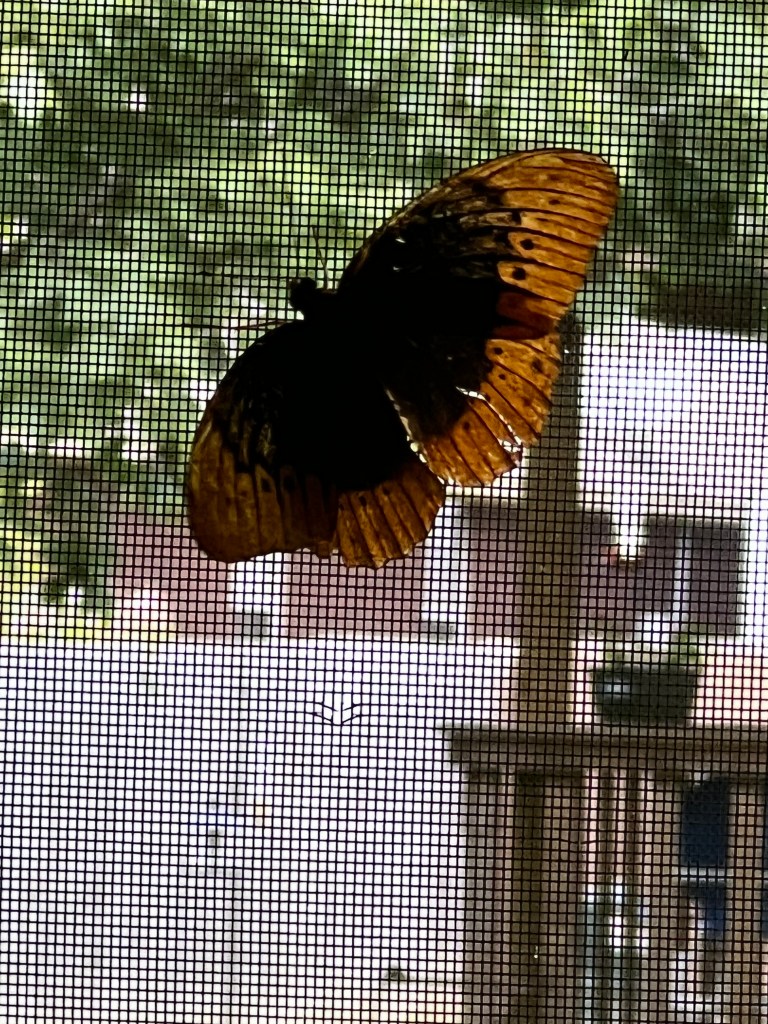
Yesterday I decided it was time to clean the front flower beds again.  I had hoped that by putting twice as much mulch on them than usual I would not have to do this, but I guess I still do not put enough on as the grass and weeds were again poking through.  Zena was getting antsy so I decided to stake her in the front yard on her long leash so she could play in a new area.  She has taken to lying in the shade under the snowball bush (Hydrangea arborescens) at the end of our morning walks, so I made sure she had access to the shade, her water, and where I was working.  It did not take Zena too long to get her leash wrapped around the bush.  I got up to help but she figured out how to unwrap herself before I got there.  I took this as an excuse to take a break and sat in the chair I had moved into the shade at the edge of the front entry.  As I sat down, I noticed a swallowtail butterfly working on the Garden Phlox (Phlox paniculata) flowers.

When I looked online, I found the (eastern) black swallowtail (Papilio polyxenes), also called the American swallowtail or parsnip swallowtail, is a butterfly found throughout much of North America and is the state butterfly of Oklahoma and New Jersey.  The species is named after Polyxena, a figure in Greek mythology who was the youngest daughter of King Priam of Troy.  The body of the butterfly is black with rows of small white dots running down its length.  The dorsal (back) view displays black forewings edged in two rows of white dots with two larger spots close to the edge.  The smaller, black hindwings also have two rows of white dots, but an iridescent blue is sandwiched between them, and each hindwing has a bright orange and black eyespot at the bottom near the body.  Long extensions form a ‘tail’ on each wing.  The black swallowtail ranges from southern Canada to South America but are more common east of the Rockies.  They are usually found in open areas like fields, parks, marshes, or deserts, and prefer tropical or temperate habitats.  Black Swallowtails can be found in gardens, meadows, forests, and other habitats.  Adults drink flower nectar and are attracted to fennel plants (like phlox) and flowering herbs like dill.  A similar-appearing species (Papilio joanae) occurs in the Ozark Mountains region.

I was excited when I first identified the butterfly on our phlox because I thought it was an Ozark swallowtail.  The Ozark was once considered an alternative expression of the black swallowtail and the two are almost identical.  This butterfly is indigenous to the Ozark Mountains in the US but is considered uncommon to rare in the region.  The Ozark may be seen from April to September and is usually found in cedar glades and woodland habitats.  The caterpillar is also morphologically like the black swallowtail caterpillar.  The two species are more easily distinguished by the different habitat and host plants on which the caterpillar feeds.  Despite the similarity, analysis of the Ozark’s DNA suggests it is more closely related to the Old World swallowtail (Papilio machaon) than the black.  One site suggested the only sure way to tell the difference was from a DNA test in the lab.  That did not happen.  Given the rarity of the Ozark and the fact I was not in a secluded forest glade, I am sticking with the black swallowtail.

THOUGHTS:  The Black Swallowtail looks almost identical to the pungent-tasting Pipevine Swallowtail and uses this mimicry as a defense against predators.  Mimicry is an adaptation in which one animal evolves to look like another.  Animals use mimicry to avoid predators, but some predators use mimicry to obtain food, and some parasites use mimicry to help them escape detection.  Mimicry is a very effective adaptation, and it is crucial to the survival of many species.  Humans have adapted mimicry in our clothing styles, speech, and actions to allow us to blend in with groups.  Long hair and cowboy hats used to be markers of opposite ideologies, but now that is not always the case.  It is time to move beyond first impression dismissal and get to know each other.  Act for all.  Change is coming and it starts with you.
Copi

June 24, 2022

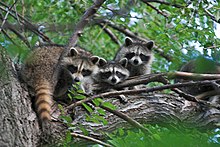
I came across a news release this week that said the state of Illinois had poartnered with others to kick off a campaign on Wednesday to rechristen four species of fish known collectively as Asian carp as “copi”.  The hope is this new label will make the fish more attractive to US consumers.  Turning carp into a popular household and restaurant menu item is one way officials hope to rein in a decades-old invasion threatening native fish, mussels and aquatic plants in the Mississippi Basin, as well as the Great Lakes.  The Great Lakes Restoration Initiative is funding the five-year, $600,000 project to rebrand the carp and make them widely available.  More than two dozen distributors, processors, restaurants, and retailers have signed on.  Most of the distributors are in Illinois, but some deliver to multiple states or nationwide.

When I looked online, I found several species of heavy-bodied cyprinid (carp) fishes are collectively known in the US as Asian carp.  Ten species of Asian carp have been significantly introduced outside their native range, and nine of those have been cultivated in Chinese aquaculture for over 1,000 years.  The Grass carp (Ctenopharyngodon idella), silver carp (Hypophthalmichthys molitrix), bighead carp (Hypophthalmichthys nobilis), and black carp (Mylopharyngodon piceus) are known as the “Four Domesticated Fish” in China and are the important freshwater food fish there.  Bighead and silver carp are the most important food fish worldwide in terms of total aquaculture production.  The Common carp (Cyprinus carpio), amur carp (Cyprinus rubrofuscus), and crucian carp (Carassius carassius) are also common food fishes in China and elsewhere.  Goldfish (Carassius auratus) are mainly cultivated as pet fish.  The Common carp are native to both Eastern Europe and Western Asia and are sometimes called a “Eurasian” carp.  Although they are an important food fish throughout Asia, they are rarely eaten and considered invasive species in the US.  Illinois is hoping being called copi will help.

These carp species were imported in the 1960’s-70’s to gobble algae from Southern sewage lagoons and fish farms.  They escaped and have infested most of the Mississippi River and many of its tributaries.  The fish are crowding out native species like bass and crappie and regulators have spent more than $600 million to keep them from the Great Lakes.  Officials estimate up to 50 million pounds (22.7 million kilograms) could be netted annually in the Illinois River, and even more are available between the Midwest and the Gulf Coast.  In the US carp are primarily known as muddy-tasting bottom feeders, but the targeted species live higher in the water column, feeding on algae, wetland plants, and small mollusks.  They are high in omega-3 fatty acids and low in mercury and other contaminants.  The fish is adaptable to a variety of cuisines including Cajun, Asian, and Latin, but this could be a hard sell.  The fish is notorious for its y-shaped bones that are harder to remove than fish with pin-shaped bones, and the boniness makes it harder to produce the fillets diners expect.  Many of the best recipe’s use chopped or ground “copi”.

THOUGHTS:  A Chicago communications design company called Span came up with “copi” as a wordplay on “copious”, referring to booming populations of these carp in the US.  Researchers considered several names but thought copi sounded catchy.  The next step is to get approval from the federal Food and Drug Administration, which says “coined or fanciful” fish labels can be used if they’re not misleading or confusing.  Similar examples are the “slimehead” ( Hoplostethus atlanticus) which it now marketed as orange roughy, and the Patagonian Tooth Fish (Dissostichus eleginoides) which is renamed the Chilean sea bass.  It seems that while a rose by any other name may still smell as sweet, Americans will not eat carp unless it is renamed, if even then.  Act for all.  Change is coming and it starts with you.

Invasive

June 23, 2022

Today’s NY Times morning feed referenced how invasive species were taking over the forests of Ohio. 

A new botanical survey of southwest Ohio found invasive species introduced to the US over the past century are crowding out many native plants.  Biologists from the University of Cincinnati are retracing two exhaustive surveys conducted 100 years apart to see how the areas plant diversity has changed over the past two centuries.  They focused their attention on undeveloped parts of cemeteries, banks of the Mill Creek, and public parks that have remained protected from development over the last 200 years.  The study was published in June in the open-access journal Ecological Restoration.  Horticulturists introduced most of the nonnative plants from Europe and Asia as ornamentals and their seeds spread in the wild.  The biggest culprit appears to be the Amur honeysuckle.

When I looked online, I found the Amur honeysuckle (Lonicera maackii) is a species of honeysuckle in the family Caprifoliaceae that is native to temperate western Asia.  The species name “maackii” is derived from Richard Maack, a Russian naturalist of the 19th century.  While the Amur is an endangered species in Japan, it escaped from cultivation and naturalized in New Zealand and the eastern US.  The plant is a large, deciduous shrub that grows to a maximum of 20 feet (6 m) tall with stems up to 4 inches (10 cm) in diameter.  The leaves are oppositely arranged and 2 to 3+1⁄2 inches (5–9 cm) long and 3⁄4 to 1 5⁄8 inches (2–4 cm) broad.  The flowers are produced in pairs, and commonly several pairs are produced together in clusters.  They bloom from middle of spring to early summer, beginning as a white color and later turning yellow or pale orange.  The fruit is a bright red to black, semi-translucent berry that contains numerous small seeds.  They ripen in the autumn and are eaten by birds, which disperse the seeds in their droppings.

The original survey on the area’s plant diversity was conducted by University of Cincinnati botanist Thomas G. Lea between 1834 and 1844.  Lea identified 714 species before he died in 1844and his work was published posthumously.  A century later the famed UC botanist E. Lucy Braun retraced Lea’s path and conducted a second plant survey in Cincinnati during 1934, finding more than 1,400 species.  Braun followed Lea’s meticulous notes to return to the places he visited, but many of the sites had been turned into roads, homes, or apartments.  The current study by UC biologist Denis Conover and Robert Bergstein retraced the steps of Braun and Lea in places where development did not pave the natural areas.  They found that many species purposely introduced as landscaping were flourishing in the wild.  Conover was quoted, “Native plants just don’t have a chance.  Everything that depends on the native plants — insects, birds — can be lost.”  Park managers and volunteers’ efforts to control invasive species has become a major part of their duties.  The study concluded the effort to control invasive species will be required in perpetuity and at great expense of both time and money.   

THOUGHTS:  Because of the invasive proficiency of the Amur honeysuckle growing the plant is illegal or controlled in parts of the US.  The species is named “invasive, banned” in Connecticut, “prohibited” in Massachusetts, as an invasive species in Tennessee, as an invasive species in Ohio, as a “Class B noxious weed” in Vermont, and as an invasive species in Wisconsin.  It has been suggested that plants growing outside their native range (eastern Asia) should be removed and replaced by non-invasive alternatives.  Talk about being unloved!  In the same vein, scientists are now concerned the first life we find on mars will come from the space junk we dump as spacecraft land on Mars after NASA’s small robotic helicopter Ingenuity captured images of mysterious wreckage last month.  You would think/hope we would learn.  Act for all.  Change is coming and it starts with you.
đ—˜đ—°đ—”đ—Č𝘃đ—Čđ—żđ—¶đ—ź

June 22, 2022

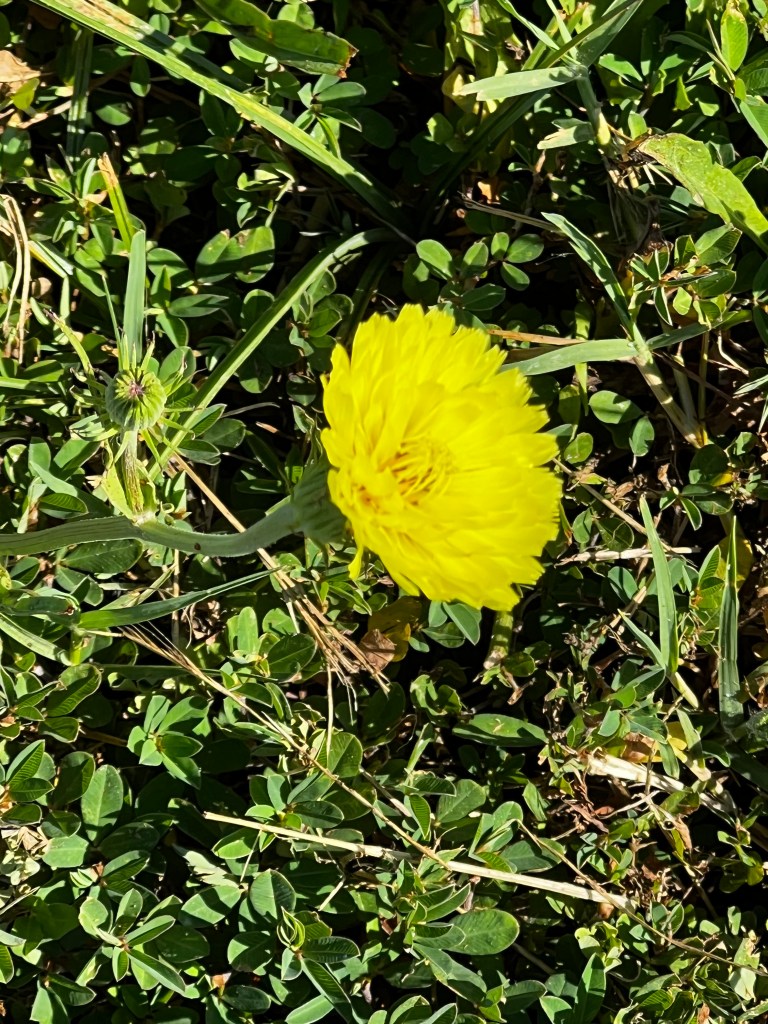
One of the succulents we took to the last Farmer’s market was an echeveria plant Melissa had been tending for the last two years.  The plant had slowly grown to expand into the brightly colored 8-inch (20 cm) pot Melissa had purchased from Mexico.  As the plant matured it sent out two 24-inch (60 cm) stems.  Since we were worried about the stems getting knocked over in transit, I propped them up with a section of fly rod I had closed in the car door and broken the tip off last year.  While I was disappointed the echeveria did not sale, perhaps it was for the best.  When I took Zena for a walk last night, I noticed the stems were now covered with bright orange flowers.

When I looked online, I found Echeveria “Curly Locks” is a succulent belonging to the Crassulaceae botanical family.  The plant is a rare hybrid and has a nursery origin, being artificially generated by Harry Butterfield starting from two specimens of Echeveria ‘Ruffles’ and Echeveria ‘Ripples’.  The curly locks are stemless and spineless and have a rosette of leaves which can grow up to 10 inches (25 cm) in diameter.  Leaves are fleshy, flat, elongated obovate, wavy at the apex, blue green in color, and when exposed to bright sunlight the ruffled edges turn pinkish red.  At maturity the rosette grows a tall bare stem to support the flowers.  Blooming occurs in late spring and early summer and blossoms are borne by the long stalks.  The flowers are bell-shaped, thin, bright yellow inside and pale pink outside.  All echeveria need bright sunlight to maintain their colors and compact rosette form.  They will not survive a hard frost, and if they are grown in areas where temperatures drop below 50F (10C) it will need to be placed indoors on a sunny windowsill or under a grow light.  That would be Arkansas.

The name Echeveria comes from Atanasio Echeverria y Godoy, a naturalist, botanist, and Mexican artist of the late 1700’s who painted and assisted on the discovery and cataloging of Mexico’s natural flora.  The genus Echeveria was named in his honor by Augustin Pyramus de Candolle.  EcheverrĂ­a joined Martin de SessĂ© y Lacasta and Mariano Mociño SuĂĄrez de Figueroa in Mexico City in 1787 on their Royal Botanical Expedition to New Spain.  The goal of the venture was to compile an inventory of the flora and fauna of New Spain.  In 1791, Echeverria continued onto the California portion of the expedition, where he made images of 200 different plant species.  In 1794, EcheverrĂ­a traveled to the Caribbean with SessĂ© and botanist Jaime Senseve.  The group landed in Havana, Cuba, and later traveled to Puerto Rico, but the political instability caused by the Napoleonic Wars meant the project was not completed and EcheverrĂ­a left the expedition in 1797.  EcheverrĂ­a joined the Guantanamo Commission under Conte de Mopox y Jaruco and traveled across Cuba collecting 3,700 specimens and describing 27 new species.  Later, EcheverrĂ­a briefly traveled to Madrid before returning to Mexico to become art director at the Academy of San Carlos.  His descriptions and images of the echeveria were invaluable.

THOUGHTS:  Echeveria is also known as “Mexican Hens & Chicks” and can produce new offsets or “chicks” around the base of the mother plant.  These chicks can be left to form a tidy cluster or removed and transplanted.  While Echeveria are one of the easiest succulents to propagate, curly locks is a hybrid and propagation can only be done by cutting.  Cutting is best done in spring as the plant begins to come out of winter dormancy.  One of the pleasures we have had this year is seeing the different succulents bloom after the hardships they went through last year.  While I was disappointed the curly locks did not sell, I was rewarded by the blooms that would have occurred at someone else’s house if it had.  The pandemic has produced major hardships and disappointment for a vast number of people.  It also forced many to step back and re-evaluate their priorities.  Even disappointment can lead to other joys.  It is about attitude and being willing to look.  Act for all.  Change is coming and it starts with you.