Varients

March 08, 2022

Variants

March 08, 2022

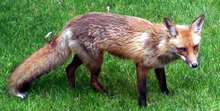
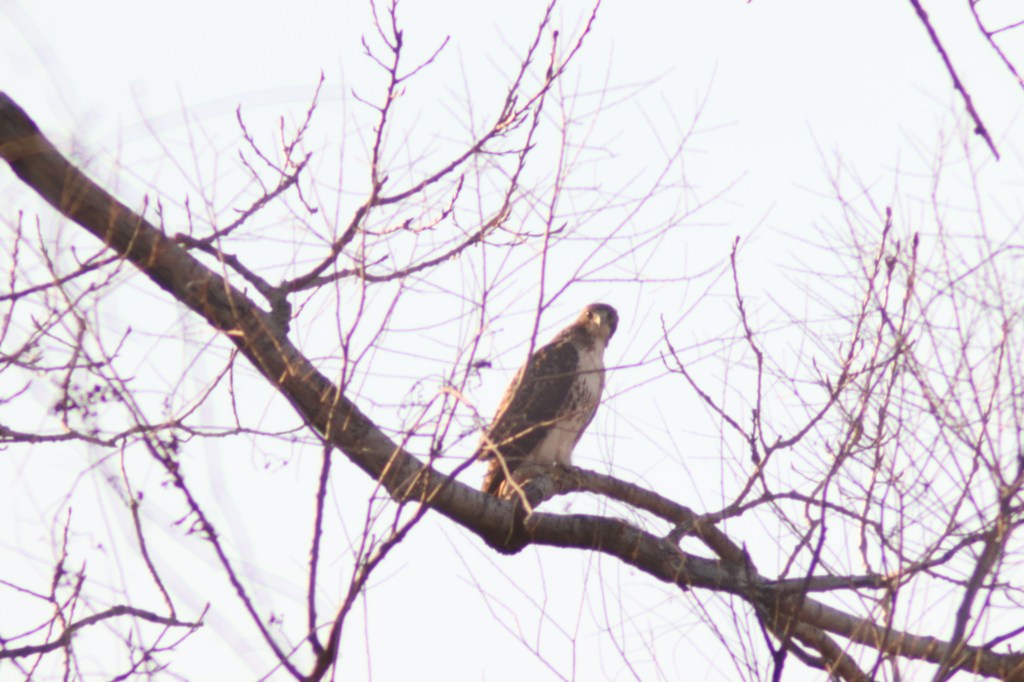
One of my favorite birds is the red-tailed hawk.  I have been enamored by raptors since my early college days and even (briefly) dreamed of being a raptor veterinarian in Alaska, until I was stymied by the memorization required by Chemistry I, II, and III.  While the majestic eagles soaring on the thermals are often the main attraction, the hawks were more common in the prairie state where I grew up.  Since becoming an Arkansas birder I have struggled to identify the hawks I see perched on tree limbs or power lines along the road.  I would take a picture and then compare it to the images in my guides.  What I finally realized is these “different birds” are all variants of the same species, my beloved red tail.

When I looked online, I found the red-tailed hawk (Buteo jamaicensis) is a bird of prey that breeds throughout most of North America, from the interior of Alaska and northern Canada to as far south as Panama and the West Indies.  It is one of the most common members within the Buteo genus in North America or worldwide.  The red-tailed hawk is one of the largest members of the Buteo, typically weighing from 1.5 to 3.5 pounds (690 to 1,600 g), measuring 18-26 inches (45–65 cm) in length, and with a wingspan from 3’7” to 4’8” (110–141 cm).  The species displays sexual dimorphism in size, with females averaging about 25% heavier than males.  The bird occupies a wide range of habitats and altitudes, including deserts, grasslands, coniferous and deciduous forests, agricultural fields, and urban areas.  Red tails are legally protected in Canada, Mexico, and the US by the Migratory Bird Treaty Act.  There are 14 recognized variants that differ in both appearance and range.

When I tried to identify the different hawks I photographed, their colors ranged from brown backs with a dirty white mottled front, to brown with full white breasts, to nearly white with a pinkish tail.  My research indicated that red tails are often strongly polymorphic, with individuals ranging from almost white to nearly all black.  These variants explained my different birds.  The red-tailed hawk is one of three species colloquially known in the US as the “chicken hawk”, though it rarely preys on standard chickens.  The diet of red-tailed hawks is highly variable and reflects their status as opportunistic feeders, but most often they are predators of small mammals such as rodents, and prey that is terrestrial and at least partially diurnal is preferred.  Like many Buteo species, they often hunt from a perch, but they can vary their hunting technique where prey and habitat demand.

THOUGHTS:  While speaking with my mom last week she mentioned the “chicken hawk” that had roosted on the tree outside her window.  This was joined by another smaller bird, and both were the same variants.  This must have been a female (larger) and her mate (smaller).   While I grew up hearing the term “chicken hawk”, I did not realize (until today) they were probably red tails.  When the pandemic began researchers struggled to identify the corona virus.  Once the virus’ genome was mapped, they began to identify later variants.  Like my red tails, none look quite the same on the microscopic level, but they are all covid.  So far, the vaccines have been effective against these variants.  Follow the science.  Change is coming and it starts with you.
Patrol

March 07, 2022

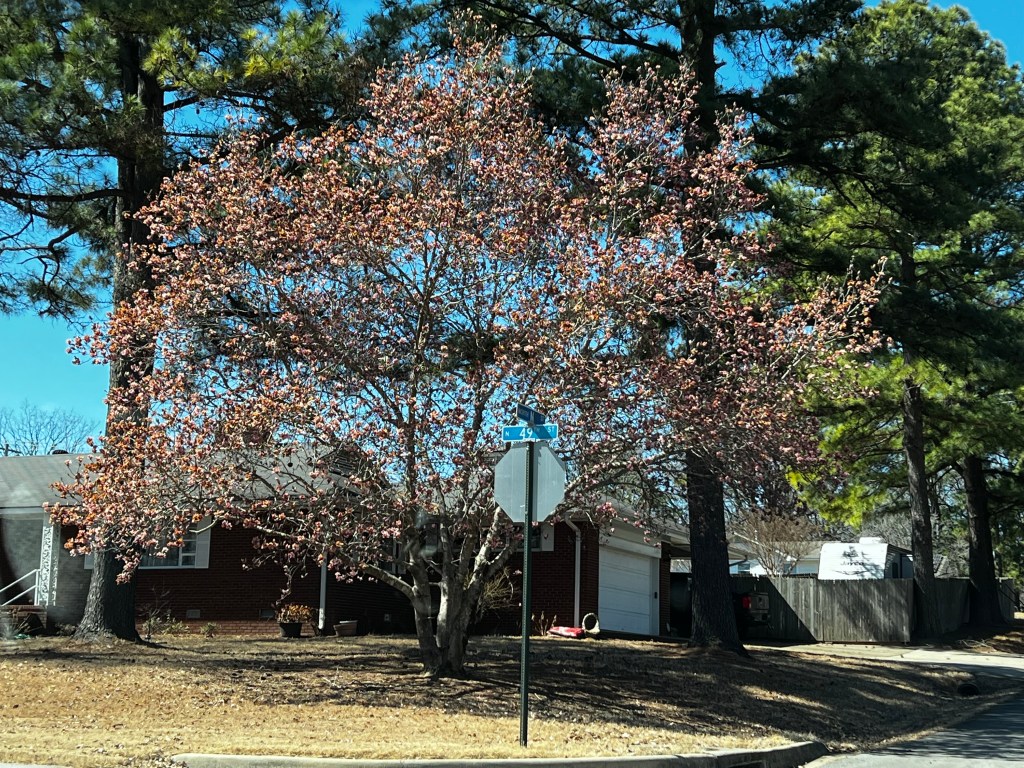
I have mentioned how we have been puppy sitting our friend’s Sheltie over the last week.  The routine he began with has altered as he has become more comfortable with the surroundings.  When he first arrived, he was met by the cat next door (at our front window) and challenged by the two dogs behind our back yard.  Initially, he would patrol the front by prancing along the edge of the yard when we let him outside.  The change came when the neighbor’s cat showed up across the street and he ran into their yard, forcing us to call him back.  Eddie now seems to think anywhere in the cul-de-sac is fair game.  That means he will take off on a wider patrol and we call him back to keep him close.  At least he is willing to return.

When I looked online, I found many animals identify territories or ranges they patrol.  Ethology is the scientific study of animal behavior, usually with a focus on behavior in natural conditions, and viewing behavior as an evolutionarily adaptive trait.  In ethology, territory is the area that a species of animal normally defends against related animals, and animals that defend the areas they patrol are referred to as territorial.  Territoriality is not shown by most species, and more common is for a group of animals to confine to an area (not defend) of home range.  These home ranges often overlap with different groups of animals, and the groups tend to avoid each other.  Members of the group use vocalization to advertise their territory and scent marking to let others know of their presence.  That is why a dog sniffs everything, to find who has been there.

Eddie is also used to having a large, fenced backyard at his house, which we do not have.  Still, he does enjoy being on patrol on our back patio.  There were some lively “vocalizations” in the beginning when our neighbor’s dogs were outside.  Now more often, these dogs will continue to bark and stir up the entire neighborhood, while Eddie stands and watches or even ignores them.  He seems to be confident in his own space and does not need to create a vocalized claim.

THOUGHTS:  I find it interesting how Eddie’s behavior has changed in the week he has been with us.  When he arrived in this new territory, he quickly made his presence known.  Still, he stayed close and limited his area to patrol.  Now that he is comfortable, he has a greater range and seeks new smells and challenges.  At the same time, he no longer seems to need to challenge the other dogs, knowing they are unable to enter his space.  Humans hold this same instinct to create and defend territory.  At times this is done with saber rattling (vocalizations) and at times by drawing lines in the sand (scent marking).  Unlike the animal groups which recognize and avoid interaction, human interaction may result in physical violence toward the other.  Humans are one of the few species willing to kill to exert territorial control.  War never creates a lasting peace.  Instead, it requires a willingness of both sides to listen.  Do the work.  Change is coming and it starts with you.
Green

March 04, 2022

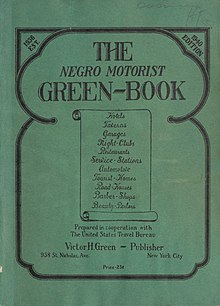
As Black History Month came to an end the Sunday edition of my local newspaper printed a front-page article on the Green Book and its impact on Black History in our area.  Tour Guides have been a popular way to direct travelers to needed services since the Middle Ages.  These were originally designed for the European rich, but in the US westward expansion, then trains, and later automobiles made these vital sources of information for the masses.  While cars opened travel for the Black middle class, Jim Crow laws and discrimination limited available amenities.  The Green Book listed locations that were friendly (or at least tolerant) of Black travelers.  Most of these sites were located near larger cities, but attention was also given to ways to traverse between cities.  Arkansas had around 230 listings, including four tourist homes in Fort Smith.  Two of these homes are still standing.   

When I looked online, I found the Negro Motorist Green Book (The Negro Motorist Green-Book, The Negro Travelers’ Green Book, or the Green Book) was an annual guidebook for African American travelers.  It originated and was published by a Black New York City mailman named Victor Hugo Green from 1936 to 1966.  This was during the Jim Crow era when open and often legally prescribed discrimination existed against Blacks and other non-whites.  Although racial discrimination and poverty limited Black car ownership, the emerging Black middle class began to buy automobiles during the late 1920’s to avoid the discrimination of mass transit.  Blacks still faced a variety of dangers along the road, including refusal of food and lodging and arbitrary arrest.  In response, Green wrote his guide to services and places relatively friendly to Blacks travelers, and eventually founded a travel agency.

From a New York-focused first edition in 1936, Green expanded the work to cover much of North America, including most of the US and parts of Canada, Mexico, the Caribbean, and Bermuda.  While the Green Book became “the bible of black travel during Jim Crow”, enabling black travelers to find lodgings, businesses, and gas stations that would serve them along the road, it was little known outside the Black community.  The Green Book was intended to make life easier for those living under Jim Crow, but its publisher looked forward to a time when such guidebooks would not be necessary.  Green wrote, “there will be a day sometime in the near future when this guide will not have to be published.  That is when we as a race will have equal opportunities and privileges in the United States.  It will be a great day for us to suspend this publication for then we can go as we please, and without embarrassment.”  Shortly after passage of the Civil Rights Act of 1964, publication ceased, and the book fell into obscurity.

THOUGHTS:  The Green Book inspired a 2018 movie of the same name that won three Academy Awards, including Best Picture and Best Supporting Actor.  The Green Book was a vital aid to travel for some, while nearly unknown to others.  Even though the book included locations around my birth state, the movie was the first time I recall hearing the term.  While the Green Book ceased publication, the discrimination it addressed still exists.  Not having a book does not make discrimination go away.  That only happens when we all change our attitude.  Do the work.  Change is coming and it starts with you.
Inoculations

March 03, 2022

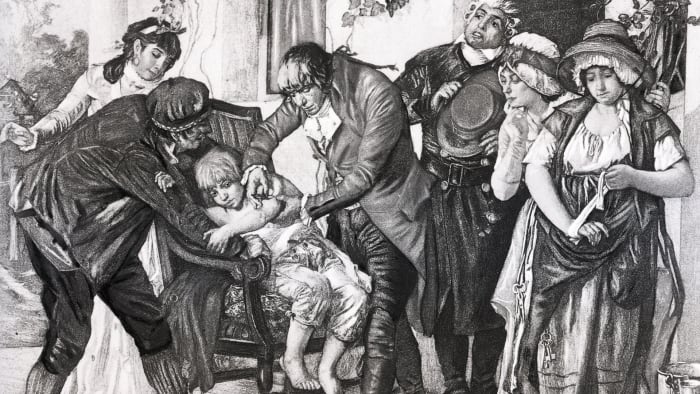
Today’s NY Times Morning feed posted an article on the difficulty of getting the 80 million eligible persons in the US to receive inoculations against the covid virus.  The first interest in inoculations in America came from an enslaved man brought to Boston from West Africa.  Onesimus had lived in an area of West Africa where inoculations for smallpox were common.  He had been deliberately infected with smallpox to make him immune to the severe version.  Onesimus told his owner, Cotton Mather, about the practice.  Mather was one of the colonies’ most prominent religious leaders in the 1720’s, as well as having a keen interest in science.  When smallpox began spreading in Boston in the 1720’s, Mather campaigned for inoculations.  Mather was met with fierce criticism as some argued the inoculations violated God’s will and others debunked it as folklore.  Arguments against inoculations were powerful because their use is counterintuitive.  Mather claimed people could avoid getting sick by getting sick.

Another early evangelist for inoculations was Benjamin Franklin, stemming from his own brush with smallpox.  As disease swept Philadelphia in 1736, the Franklin’s decided not to inoculate their 4-year-old son as he was sick with a cold.  Their son contracted smallpox and died, and rumors spread that Franky had died from the inoculation rather than the disease.  Franklin wrote the true story in his newspaper, The Pennsylvania Gazette, and in the following years tried to persuade others to avoid his mistake.  In a pro-inoculation pamphlet Franklin wrote, “Surely parents will no longer refuse to accept and thankfully use a discovery God in his mercy has been pleased to bless mankind with.”

Modern inoculations are not as counterintuitive as we now know drugs can teach the immune system to respond to a deadly virus without having to use the actual virus.  Inoculations are still considered strange by some, as an unknown cocktail of foreign substances are injected into the body.  Every new vaccine has had its skeptics and historically the two most effective responses to skepticism have been government mandates and relentless, calm persuasion.  Covid mandates are unrealistic in the US today, although it has been tried on a lesser scale, and persuasion will be required.  Persuasion means taking seriously the concerns of skeptics and creating opportunities for doctors, nurses, relatives, friends, and other trusted people to explain why inoculations can be counterintuitive yet lifesaving.  Dr. Vivek Murthy, the surgeon general, said “You build trust by listening to people, helping them feel they’re respected and valued.”

THOUGHTS:  Vaccine mandates have been used by governments since the 18th century and have been tried in recent years in response to disease outbreaks (smallpox and polio).  The covid death toll in the US exceeds 950,000, and many of those deaths occurred after inoculations were available.  Congress approved the National Childhood Vaccine Injury Act (NCVIA) in 1986 and established the National Vaccine Program within the US.  There are ten mandated vaccines that are routinely given to protect infants or children from the ravages of disease.  Since covid is not on the list, listening to concerns and respecting feelings is the best way to save lives.  Follow the science.  Do the work.  Change is coming and it starts with you.
Mardi Gras

March 02, 2022

Yesterday was the last night of Mardi Gras, or Shrove Tuesday.  The festival season varies from city to city, and traditions such as New Orleans, Louisiana, consider Mardi Gras to stretch the entire period from Twelfth Night (Epiphany) to Ash Wednesday.  Others treat only the final three-day period before Ash Wednesday as Mardi Gras.  Epiphany always occurs 12 days after Christmas (remember, “The Twelve Days of Christmas”?) on January 6th and marks the traditional arrival of the three magi (Wise Men) at Jesus’ house in Bethlehem (not a manger).  The final day of celebration changes from year to year and is tied to the Jewish Passover, or Pesach.  While the Pesach always begins on the on the 15th day of the month of Nisan on the Jewish (lunar) calendar, this correlates with a variable time during March or April on the Gregorian (solar) calendar.  Do not even get me started on the 40 days.

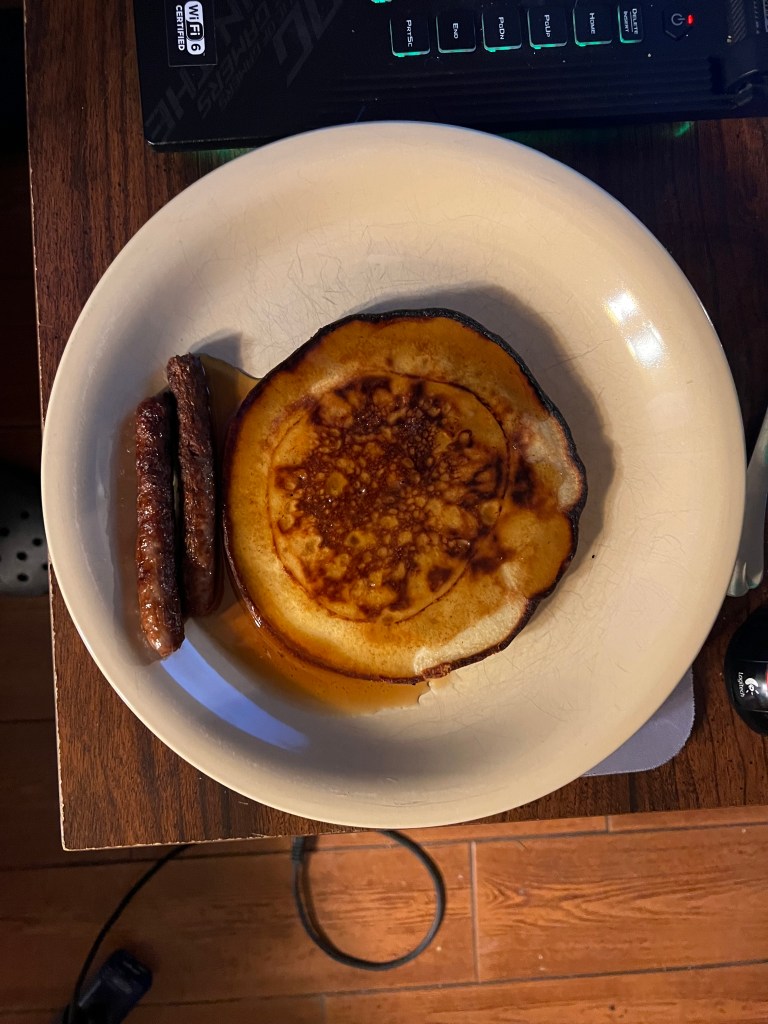
When I looked online, I found the term Mardi Gras is French for “Fat Tuesday” and reflects the practice of the last night of eating rich, fatty foods before the ritual sacrifices and fasting of the Lenten season.  That meant all the meat, milk, and butter needed to be removed from the house.  Rather than throwing these valuable comedies away, people would cook slabs of meat (collops) and eggs on Monday and then pancakes on Tuesday.  The word Shrove became associated with the observance in England, and is derived from the word shrive, meaning “to administer the sacrament of confession to; or to absolve.”  Not surprising, this is also called Pancake Tuesday.

Several years ago, we checked off one of Melissa’s “bucket list” items when we attended the final weekend of Mardi Gras in New Orleans.  I had not paid much attention to the celebrations but was smart enough to purchase grandstand seating for several of the parades.  The scarcity of items thrown from the floats along most of the route was countered by the plentiful beads and medallions thrown as the krewes who sponsored the parade passed the grandstands.  The wild celebrations and costumes the celebration is known for abruptly end with the clearing of Bourbon Street at midnight on Tuesday night.  Rather than end, this seemed more like, “You don’t have to go home, but you can’t stay here.”  When we walked the street the next morning the only others there were the crew hosing the sidewalks and sweeping the streets.

THOUGHTS:  After a year hiatus, the parades and celebrations of Mardi Gras returned to New Orleans this year.  One treat associated with Mardi Gras is the King cake.  King cakes can be found as “rosca de reyes” in many Spanish-speaking countries and “galette de rois” in France. This is a slightly sweet cinnamon bread decorated with purple, yellow, and green icing, and usually comes with a trinket hidden inside.  In the 1950’s, a New Orleans bakery popularized hiding a porcelain baby inside the cake, a practice that reportedly traces back to 18th-century France to supposedly represent Jesus.  Today, the plastic figurine is hidden inside the king cake, and the person who finds the baby in their slice is responsible for providing next year’s cake.  While we did not have king cake, we did have pancakes.  Hopefully we can venture out again.  Follow the science.  Do the work.  Change is coming and it starts with you.
Daffodils

March 01, 2022

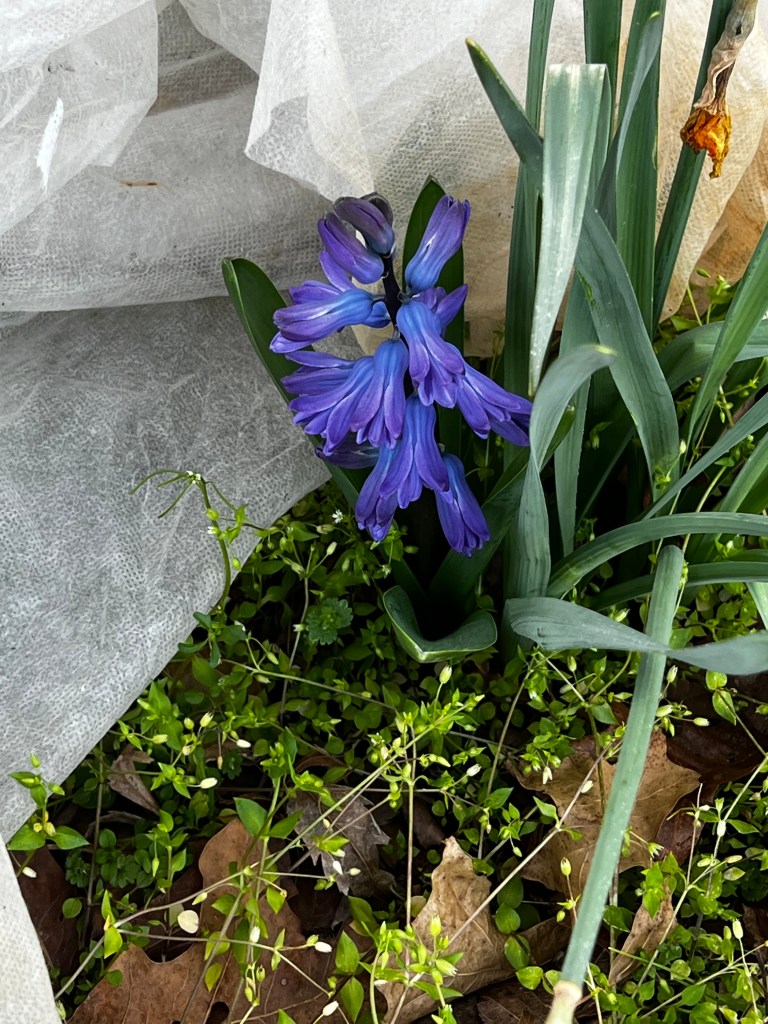
I am always amazed how amid the bitter cold, freezing rain, and sleet, the flowers still rise if there is a warm day to set them off.  Prior to converting our front bed to succulents, Melissa and her mom had planted the area under the Japanese red maple with ground cover and daffodil bulbs.  When we transformed the bed to succulents, we took out the mulch, added pea gravel, and waited to see what would come up.  We have also been forced to put garden mesh over the bed over the last two winters as we try and preserve the succulents beneath.  Last week I noticed the daffodils had bloomed under the cover of mesh.

When I looked online, I found that Daffodils (Narcissus spp. or “various species”) are one of the earliest spring-blooming flowers.  These hardy perennials grow in most regions of North America, except in the hottest, wettest areas, such as South Florida.  Daffodils are a fall-planted bulb which then bloom in late winter or early spring.  The traditional daffodil flower may be a showy yellow or white, with six petals and a trumpet-shape central corona, but many cultivated varieties (“cultivars”) exist today.   The cultivar planted in our bed are the Daffodil Large Cupped Red Devon.  This award-winning heirloom daffodil was bred in Devonshire, England and was first introduced in 1943.  Red Devon attracts the eye from yards away with its brilliant yellow petals and flashy orange cups.  This is said to be a dependable performer and great naturalizer.  It has adapted well to several of our beds.

Narcissus is the proper name for all daffodils.  While the exact origin of the name Narcissus is unknown, but it is often linked to a Greek word for intoxicated (narcotic) and the myth of the youth of that name who fell in love with his own reflection.  It is called a narcotic because its bulb houses a toxic substance, and the Greek word ‘narcissus’ means ‘numbness’, so it is a reference to its narcotic nature.  The English word “daffodil” appears to be derived from “asphodel”, a flower with which it was commonly compared.  The most common symbolic meanings attributed to the narcissus flower are rebirth, renewal, and the coming of spring.  It can also mean good luck, happiness, prosperity, and wealth.

THOUGHTS:  Echo and Narcissus is a myth from Ovid’s Metamorphoses, a Roman epic from the Augustan Age.  The myth tells the story of the mountain nymph Echo and the beautiful youth Narcissus with whom she falls in love.  Echo is rejected (fading into the wind) and Narcissus falls in love with his own reflection (and becomes a one of the daffodils).  The introduction to the myth appears to be of Ovid’s own invention and Ovid’s version influenced the presentation of the myth in later Western art and literature.  Narcissus’ vanity came from ego and a focus on self.  We need to make sure we do not become the myth.  Do the work.  Change is coming and it starts with you.

Totals

February 28, 2022

The Great Backyard Bird Count (GBBC) is over and the totals have been tallied.  There were over 320,000 checklists submitted representing the 192 countries who participated in this year’s count.  The count identified 7,095 species worldwide.  The country of Columbia had the most species identified with 1,239 species in the 1,847 checklists submitted.  Ecuador ranked second in number of species with 1,039 on 584 checklists.  India was third with 1,020 species and ranked second for checklists with 39,204.  While the US ranked eighth overall for the number of species with 689 it was first in number of checklists with 195,167.  That was followed by India and Canada was third with 28,601 checklists identifying 256 species. 

When I looked online at the Audubon website it stated each checklist submitted during the GBBC helps researchers at the National Audubon Society, Cornell Lab of Ornithology, and Birds Canada learn more about how birds are doing, as well as how to protect both the birds and the environment we share.  Over the last 25 years the totals from submissions have created the largest instantaneous snapshot of global bird populations ever recorded.  During this four-day event birdwatchers all around the world are invited to count and report details of birds in the area in which they live.  Data is submitted online and compiled for use in scientific research.  Data collected during the event is subjected to verification by experts to overcome any potential shortcomings from the (mostly) amateur participants.  The totals resulting from the event raises awareness about changes in population and habitats of common birds.

While awards are not given, bragging rights are still possible.  The top birder honor world-wide went to Guillermo Saborío Vega (Columbia) with an incredible 299 species observed on 24 checklists over the four-day period.  Top birder in the lower 48 states of the US was Brandi Fox with 196 species, narrowly edging out James Leone with 195.  Arkansas had 138 species observed on 1,273 checklists representing 69 of the 75 counties.  Daniel Mason took top birder honors with 82 species reported.  I was close (not), with 12 species observed on my three checklists.  I was still glad I was able to participate.

THOUGHTS:  I admit I was overwhelmed when I looked at the statistics for number of species and number of checklists submitted across the world, across the lower 48 states of the US, and even across my own state of Arkansas.  However, as I went deeper into the totals it changed my perception.  My county had 50 different species identified on 13 checklists.  I accounted for 12 of the species and 3 of the 13 checklists.  Like so many things, perspective makes a difference.  Statistics are great to provide snapshots of averages, means, and trends, but it is easy to get lost in the big picture.  Real change in the ethical treatment of others happens one person at a time.  Do not swayed into thinking you cannot make a difference.  Keep working one day, and one person, at a time to build unity.  Do the work.  Change is coming and it starts with you.
Thunder

February 25, 2022

We have been trapped inside by the ice storm that descended on our state on Wednesday.  We received a heavy layer of ice that was repeated throughout the day on Thursday.  Melissa has her home office set up in our Bay window in the kitchen and watched as the few cars and trucks that tried to brave the storm slid into the ditch trying to make a turn.  Since I do most of my work from home, I do not normally get out every day, but being confined by the storm somehow made it feel different.  I was in my office yesterday when I heard thunder amid the sleet falling in the storm.  While most thunder is associated with rain, I have rarely heard it during snowstorms.  This was the first I recall hearing thunder during a sleet storm, but sleet is just short of snow.    

When I looked online, I found thundersnow, or a winter thunderstorm, is an unusual kind of thunderstorm with snow falling instead of rain.  Thermodynamically, it is not any different from other thunderstorms, but the top of the cumulonimbus cloud is usually quite low.  In addition to snow, graupel (snow pellets or corn snow) or hail may fall.  It is unlikely to see lightning during a thunder snowstorm.  First, you must be in the right place when a rare thunder snow happens.  It is estimated that only six snow thunder events occur in the US each year.  Second, in most cases it is not possible to see the lightning because the snow already makes the sky bright and white.  You may hear a rumble of thunder, but the significant snow associated with these storms will muffle the sound.  Typically, the thunder can only be heard within a couple of miles.

The cause of thunder has been the subject of speculation and scientific inquiry for centuries.  Early explanation was it was made by the gods, but the ancient Greek philosophers attributed it to natural causes, such as wind striking clouds (Anaximander, Aristotle) and movement of air within clouds (Democritus).  The Roman philosopher Lucretius held it was from the sound of hail colliding within clouds.  In the mid-19th century, the accepted theory was that lightning produced a vacuum and the collapse of that vacuum produced the sound known as thunder.  In the 20th century a consensus evolved that thunder begins as a shock wave due to sudden thermal expansion of the plasma in the lightning channel.  Experimental studies of simulated lightning have produced results largely consistent with this model, although there is continued debate about the precise physical mechanisms of the process.  I am always happy to hear the thunder, as it is the lighting strike that proceeds the thunder that will kill you.

THOUGHTS:  I faced another bout with winter thunder in Utah years ago.  We were skiing and made the last lift to the summit before it closed due to wind.  The fog and light snow caused the visibility to be about 30 yards, and this was a Blue run I had never skied.  As I dropped below the fog, I realized I was skiing into a bowl with a dense line of trees on the far side.  I cut too close to a tree and a powder drift exploded around my fall.  In that instant, lightning struck, lighting the sky around me, followed by a loud boom of thunder, and then silence.  My thought was, “If this is the Rapture, why am I still here?”  While the noise of thunder may be frightening, it rarely causes permanent damage.  Too bad the same cannot be said for the noise that comes from politicians.  Do the work.  Change is coming and it starts with you.
Bully

February 24, 2022

This morning we had a lull in the ice storm that hit our state yesterday.  I noticed there was no action on my feeders and assumed they had filled with ice.  I went cautiously out on the ice sheet covering our patio and sure enough, the feeders had a 2-inch (5 cm) sheet of ice covering the seed the birds had not been able to salvage before the storm began.  The ice filled several of the feeders to the brim.  I was unable to remove the solid blocks of ice, so I decided to just put new seed on top.  It was not more than two minutes when 25-30 birds showed up to attack the feeders or the seed that spilled off the ice onto the ground.  Usually, the different species fuss among themselves and the larger birds bully the smaller ones.  The birds today all concentrated on getting as much seed as they could before the storm retuned.

When I looked online, I found birds at a feeder display dominance and even bully other birds.  Three dominance-related behaviors happen at a feeder.  Displacement occurs when one bird leaves to get out of the way of another bird or when one bird waits nearby for another bird to finish eating.  Within a species males tend to dominate females and older birds dominate younger ones.  At feeders, larger birds tend to dominate smaller ones.  Threat displays are used when the dominant bird does not displace the subordinate.  Examples are the bill-up display of the Carolina chickadee (Poecile carolinensis) or the wing-spread display of the White-breasted Nuthatch (Sitta carolinensis).  Subordinate birds make appeasement displays by de-emphasizing their size or by leaning or looking away from a newly arrived bird, often while crouching or folding their wings.  When the dominant bird leaves, the subordinate bird will resume its normal posture.  Several dominant species will also bully other birds at the feeders.

Feeder bully birds are often those that are highly social and feed in flocks, as well as larger, more aggressive species.  Examples are the Brown-headed cowbird (Molothrus ater), Common grackle (Quiscalus quiscula), European starling (Sturnus vulgaris), and Red-winged blackbird (Agelaius phoeniceus) who are often found intermixed together in flocks.  One or two of these birds at your feeders does not imply a bully problem, but when the flocks grow and the feeders are crowded, other birds will have difficulty feeding and the bully can take over completely.  In a flock, you eat fast, or you do not eat at all.

THOUGHTS:  Another bully we have on our feeders is the blue jay (Cyanocitta cristata).  The jays drive other birds away from our squirrel feeder and then pick their way through the corn, sunflower seed, and peanuts I tried to use to keep squirrels out of the other feeders (it does not work).  When a squirrel does find this feeder, he ignores the jay.  While some people are like the squirrel and find it easy to ignore a bully, others find it more difficult.  According to the CDC, suicide is the third leading cause of death among young people, resulting in 4,400 US deaths per year, and for every suicide there are at least 100 attempts.  Being a bully is not child’s play.  Do the work.  Change is coming and it starts with you.
Chocolate

February 23, 2022

I thought it was appropriate as I sat in my office watching the sleet storm this morning to have an article forwarded to me concerning the difference between hot chocolate and hot cocoa.  While the terms are used interchangeably, they are two distinct drinks.  Hot chocolate is exactly what it sounds like.  It is small pieces or shavings of chocolate that you mix with hot water, milk, or cream.  Drinking hot chocolate is like drinking a melted chocolate bar, and the type and amount of liquid you use will determine how thick it is.  Hot cocoa is instead made with cocoa powder, which is dried and ground cocoa solids.  Cocoa is what is left after you press cocoa butter out of cocoa beans.  Most of the hot cocoa mixes at the supermarket contain added sugar and powdered milk.  Unless you make your own, you probably drink hot cocoa rather than hot chocolate.

When I looked online, I found the history of chocolate can be traced to the ancient Mayans, and even earlier to the ancient Olmecs of southern Mexico.  While “chocolate” may bring images of sweet candy bars and luscious truffles, today’s chocolate is unlike the chocolate of the past.  Originally, chocolate was a sacred, bitter beverage, not a sweet, edible treat.  Chocolate is made from the fruit of cacao trees, which are native to Central and South America.  Each fruit pod contains around 40 cacao beans.  The beans are dried and roasted to create cocoa beans.  Hayes Lavis, cultural arts curator for the Smithsonian’s National Museum of the American Indian, says ancient Olmec vessels from around 1500 BCE were discovered with traces of theobromine, a stimulant compound found in chocolate and tea.  Since the Olmec kept no written history (at least that we can decipher), opinions differ on how they used cacao in their drinks.

When I lived in the Bay Area, I would visit the chocolateries just off the Wharf District of San Francisco.  While these stores produce “bean-to-bar” chocolate, they created chocolate suited to American tastes.  American Chocolate is regulated by the US Food and Drug Administration, who mandates the levels of cocoa solids contained in the varieties of chocolate.  European chocolate adheres to EU standards and require a higher level of cocoa.  The main difference is US chocolate is sweeter than European chocolate, with less cocoa and more sugar or other sweeteners.  I visited one shop that did not make chocolate but sold chocolate bars and baking chocolate with various percentages of chocolate.  They offered samples and the higher the percentage of chocolate the lower the sweetness.  I found anything over 80% intolerable.

THOUGHTS:  Modern chocolate production comes at a cost.  As many cocoa farmers struggle to make ends meet, some turn to low-wage or slave labor, or even child trafficking, to stay competitive.  This has prompted grass roots efforts for large chocolate companies to reconsider how they get their cocoa supply.  It has also resulted in appeals for chocolate which is created in an ethical and sustainable way.  The West has created a demand for all kinds of luxury products (coffee, tea, chocolate, clothes, drugs) that are produced by unregulated practice.  We cannot afford to turn a blind eye to reduce the cost of our pleasure.  Fair Trade and Sustainably Sourced are more than just words.  Do the work.  Change is coming and it starts with you.