Job

February 15, 2022

AP Photo/Alex Menendez

Melissa forwarded me a feed about how Los Angeles Rams offensive lineman (right guard) Austin Corbett helped lead his team to victory Sunday against the Cincinnati Bengals, 23-20.  Corbett got the starting job for the Rams in 2021 and was on the field late for the game-winning score with 1:25 remaining to give the Rams their first NFL title since the 1999 season, and their first representing Los Angeles since 1951.  What made Corbett unique was he is a citizen of the Walker River Paiute.  The previous Native to win the Super Bowl was Kansas City’s James Winchester of the Choctaw Nation in 2020.  Now Corbett holds that title.  

Corbett was born in Nevada and attended Edward C Reed High School.  He received little interest from college programs but managed to find playing time as a walk-on for the University of Nevada.  Corbett steadily improved for the Wolfpack, earning an honorable mention in the 2015 All-Mountain West team, second team in 2016 and then first team in 2017.  After his senior year at Nevada, Corbett was invited to the 2018 Senior Bowl and was drafted 33rd overall by the Cleveland Browns in the 2018 NFL draft.  Corbett struggled with the Browns and started just one game before being traded to the Rams midway through the 2019 season.  During the last two seasons with the Rams Corbett surrendered only four regular-season sacks and held the starting job for every game for the Rams this season.  He was named Bleacher Report’s “best kept secret” on the Rams roster prior to the Super Bowl.  Corbett become a free agent after the game, and that means for now, he is out of a job.

Two different pictures came out of last week’s job data release from the Bureau of Labor Statistics (BLS).  One told a story of a stunning job report, the other showed the job market is leaving Indigenous people behind.  According to a new report from the Brookings Institution, “While the nation’s topline unadjusted unemployment rate was 4.4% in January, the . . . rate among Native American workers was an extraordinarily high 11.1%.”  The report is striking because the monthly BLS report does not make Native unemployment even available.  That means there was a gap in how the economy was doing because it excluded Native people in general.  The Brookings report shows Native Americans had a higher unemployment rate (7.5%) than other racial groups before the pandemic, and with the pandemic the rate jumped to 28.6%, or comparable to national unemployment during the Great Depression.  Even with the recovery, Native American unemployment is two and a half times higher than the national level.  That would be considered a crisis if we tracked this information.

THOUGHTS:  Robert Maxim of the Brookings Institute said one cause of high unemployment is that health disparities, magnified by the pandemic, lead to worse economic outcomes.  “If you’re not healthy enough to work, if you’re just trying to stay alive, you can’t even think about your economic well being.”  Even this job data only identifies people that self-identify as American Indian or Alaskan Native alone, while 61% of Native people identify as two or more races, the highest of any racial or ethnic group.  That means it excludes three out of every five people in data about Native individuals.  What we do not know can hurt us.  Do the work.  Change is coming and it starts with you.

Stresses

February 14, 2022

Since today is Valentine’s Day the comics in my local paper all seemed to make comments on the stresses of the day.  Each cartoonist took a different nuance, but they revolved around the stresses felt to find just the right gift for a significant other.  That was true for Beatle Baily giving a last-minute heart shot on the rifle range, to Garfield pledging never to lie and then telling one to explain why he did not give chocolates, to Dagwood providing Blondie with a food-based perfume.  Melissa and I had concentrated on the Super Bowl this weekend and aside from a card, we had not succumbed to the stresses of finding the appropriate gift.  Instead, we decided to celebrate by taking off early and go to the wildlife refuge to do some birding.  Maybe I will sneak in some flowers later in the week when they are not expected.

People are not the only ones who face the stresses of life.  Melissa showed me her campfire plant that had changed from green to a bright red from stresses faced on our patio greenhouse.  When I looked online, I found the Campfire plant (Crassula capitella), also called the Red Flames or Red Pagoda, is a perennial succulent native to southern Africa.  The succulent herb grows to 10-16 inches (15-40 cm) in height.  The stems are either erect or rambling and mat-forming.  Each stem forms roots at its internodes, and these take root if the stem lies against the ground.  Campfire is mostly biennial, blooming in the summer with small white, star-shaped flowers forming all around each upright stem.  The stems may be damaged when exposed to temps below 30F (−1 °C).  The stresses facing Melissa’s campfire has created a beautiful change.

While there are a variety of environmental changes that stress succulents, there are three types that increase the production of anthocyanin or carotenoid which cause the plants to change colors.  These are changes in exposure to the sun, temperature fluctuations, and changes in water levels in the soil.  Each type of stress will cause a plant to change its production of anthocyanin, and these are the pigments (flavonoids) that give the plants their rich colors (red, purple, and blue).  Plants increase these pigments when they face more sunlight to protect from damage due to ultraviolet (UV) rays.  The flavonoid also provides protection from dropping temperatures, and scarcity of water will cause the plant to increase its production of anthocyanin.  Growers are known to provide these stresses to the plant to give it a rich color prior to sale.

THOUGHTS:  When stresses are applied to plants it can cause them to flourish.  There are species like the Jack pine (Pinus banksiana) in the north central and northeastern US, and Lodgepole pines (Pinus contorta) across much of the West, that have very thick, hard cones that are literally glued shut with a strong resin.  These serotinous cones are only opened by fire.  Still, intense, and repeated fires may cause greater stresses than the trees can sustain.  Humans may also thrive in stress, but like the trees we cannot sustain stress indefinitely.  We need to find ways to deal with the stresses of our social and ecological environments.  Unless the stresses are reduced, we will continue to face burnout.  Do the work.  Follow the science.  Change is coming and it starts with you.
Coral

February 12, 2022

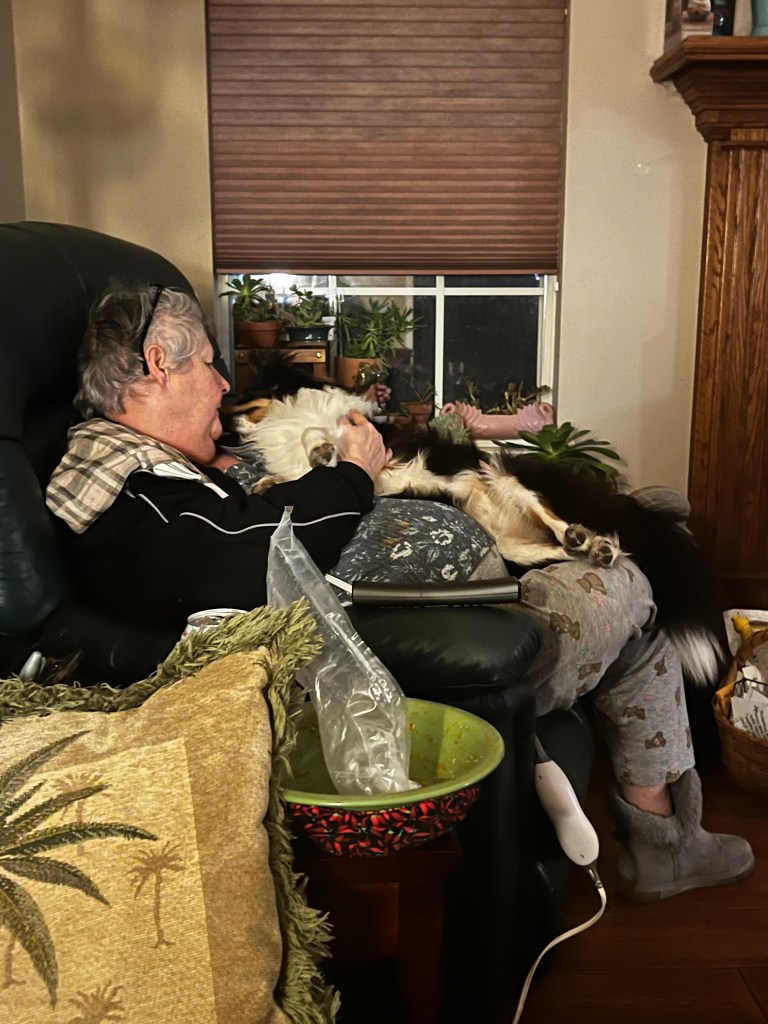
Several months ago, I blogged how our four hanging baskets of Holiday Cactus all burst into glorious blooms.  The information I found on them noted they would stay in bloom for several months, and while they are not as glorious, they are all still blooming.  Recently another of Melissa’s winter bloomers has burst into flower.  One of her succulents decided it was time to produce small white flowers on the ends the narrow round stems that characterize the plant.  The small yellow tips in the photo are flowers ready to bloom.  When they do, they will cover the plant with beautiful white blooms.  When Melissa showed me the stems and blooms, I was struck how much they looked like living coral when the polyps come out of their skeletons to feed.

When I looked online, I found the coral cactus (Rhipsalis cereuscula), also called the rice cactus, is a small cactus native to South America.  It is often found in the dappled sunlight beneath large trees in regions of Brazil and Uruguay.  Although called a cactus, the coral is an evergreen and epiphytic (tree-dwelling) succulent.  Rhipsalis cereuscula gets its name from its interesting looking foliage.  Rhipsalis is an ancient Greek derivative for the word meaning “wickerwork” and cereuscula means “small torch or small candles” which refers to the shape of the plant.  The Rhipsalis succulent gets the nickname coral cactus from the branching appearance of the arms.  The plants tend to grow in intertwining clumps that give it the appearance of aquatic corals.  The coral is epiphytic, meaning it lives on other plants without harming them.  It tends to grow in precarious places along rocky edges where the branching arms hang freely.  It has short, branching, leafless stems with white flowers on their tips.

When Melissa first identified the plant, she called it a Dancing bones (Hatiora salicornioides), or bottle cactus.  The bones plant gets its common name as the segmented digits that form the stems look like long fingers.  Bones look much like the coral cactus, being a small, shrubby succulent plant with slender, segmented stems.  The bones cactus is also a native of Brazil and is an epiphytic species that thrives in the rainforest.  The stems are spineless, although older plants may develop a few spiny growths at the base.  A mature bones cactus reaches heights of 12 to 18 inches (30-45 cm.).  While the coral and bones cactus appear similar, particularly when small, they are easily distinguished by the yellow orange (rather than white) blooms that appear on the bottle-shaped stem tips in spring.  Many succulents of the same family are hard to distinguish from each other.  Melissa has learned the different shapes and colors of their flowers make them easier to distinguish.  You just need to get them to bloom.

Thoughts:  As I researched the bottle cactus, I kept finding images of bright yellow flowers on the tips of long slender stems.  I initially wrote my blog trying to justify the yellow flower images with the white flowers on our plant.  Something never felt right, so I asked Melissa for her opinion.  When she found an image of the bottle cactus online, she immediately knew ours was mislabeled.  It did not take 30 seconds for her to reidentify the plant as a coral cactus.  Some have questioned the experts as they provide changing information on the virus and the different variants that have appeared.  The difference between experts and those who provide false information is experts recognize changes or different approaches and revise their recommendations.  False analysts make an initial response and stick to it regardless of the facts.  Follow the science.  Change is coming and it starts with you.
Crack

February 11, 2022

It is appropriate after I posted on sand this week that I encountered sand on the road.  The ice and snow we received last week had been countered by a variety of treatments, and one of them was sanding the roads.  I am always careful after the roads are sanded as there is an increased likelihood that the small particles of rock will be kicked up by tires and sent crashing into my windshield.  The threat is intensified as the outside air temperature is cold and the windshield is warmed by my defroster, making it easier to crack.  I thought I had made it safely as I got off the interstate and headed down the last stretch of divided highway toward home.  I was following a pickup truck as I cautiously moved along side one of the semi-trailers that frequent the highway when I heard a crack.  I slowed to avoid further debris thrown from the pickup and did a quick survey of my windshield.  I did not see a crack.

When I looked online, I found the Arkansas Department of Transportation (ARDOT) uses several treatments to prepare for an upcoming ice storm.  This usually means preparing the roads with salt brine, or a mixture of water and salt.  Since rain was predicted prior to the ice, ARDOT was worried the rain would wash the brine away, so they used rock salt instead.   Once the ice and snow arrive, the snowplows traversed the roads to remove as much of the accumulation as possible.  A mixture of salt and sand is scattered on the road to help with the melting process (salt) as well as to provide traction (sand).  After the ice dissipates the sand is often still on the road.  Vehicles traveling at high rates of speed can throw the rock pebbles, causing windshields to crack.

Cracks in vehicle windshields may be the result of several different conditions.  Extreme temperatures and sudden fluctuations from hot to cold can cause stress to the glass, causing the windshield to crack.  Temperature changes may result from fluctuations in the outside air or from the defroster used to defog the windshield.  Sunlight can have a similar effect as the heat causes the outer edges of your auto glass to expand faster than the center of the glass.  A stress crack can occur when the air pressure fluctuates.  This damage can be caused by travelling at high speeds or from objects pushing against the windshield.  Finally, you can be traveling a road and have a rock thrown into your windshield causing it to crack.  If a crack occurs in your windshield it will continue to grow until it is repaired.

Thoughts:  While I did not see a crack in my windshield on impact, the damage had been done.  When I drove the following day, I noticed a crack that was about 3 inches (8.5 cm) long in the lower left of the glass.  I assume this had happened overnight as the temperature dropped and then warmed again.  As I continued to drive my eyes were again diverted to the small crack, which had now grown to 4 inches (11 cm) and had taken off at an angle.  By the next day, the crack had expanded to almost 7 inches (17.5 cm) and I knew it was time to get the crack fixed.  Actually, I knew it was time to get the crack fixed when I first noticed it.  The crack was too large to be repaired and the glass would need to be replaced, causing me an inconvenience (time and money), so I put it off.  Many have treated our response to the virus in the same manner.  It is an inconvenience to get a vaccine, isolate, or wear a mask.  As a result, the crack has continued to grow.  Follow the science.  Change is coming and it starts with you.
Tracks

February 09, 2022

I mentioned that after it snowed last week, I had gone outside to check my feeders.  As I opened the back door, I noticed a single line of tracks in the new fallen snow.  They were obviously made by one of the small birds that frequent the feeders.  Several of the birds have a habit of picking through the seed and throwing whatever they do not like out onto the ground.  This is gobbled up by the morning doves (Zenaida macroura) and dark-eyed juncos (Junco hyemalis) that prowl beneath the feeders.  While one junco has the habit of scavenging close to the house, most stay closer to the fence.  When I approached the fence (carefully stepping over the first line of tracks) I found a flurry of tracks beneath the feeders.  Since the feeders were filled with ice and snow, the birds were hoping to find seed on the ground.  This had been covered by the same blanket of snow which contained the junco tracks.

When I looked online for animal tracks identification, I found the owner(s) of all the tracks on my patio were indeed the junco.  Plate #5 of the 30 common identifications showed the tracks made by the dark-eyed junco.  I also found it interesting that nearly all the tracks shown were made in snow.  This made sense, as the light snow provided good contrast between the imprint and the snow.  While deeper snow left an imprint, it was easily lost as the tracks collapsed into the impression.  Another medium for the tracks was mud, which needed to be a light layer for the same reason.  Some of the larger animals had pencil drawings of the footprints rather than pictures of the tracks.

The snow also held the attached impression posted on my birder site.  Comments identified this as one of the common bird tracks found after a snowfall.  They belong to a raptor (owl or hawk) that captured its prey (mouse or vole) on top the snow.  As the bird flew up from the snow, it left the feather marks as the wings flapped to gain lift.  The tracks remind me of representations of the mythical Phoenix found throughout the Mediterranean and central Asian countries.  The phoenix was revered as sacred as it was depicted as dying in a bright flame and then being reborn from the ashes.  This was one of the earliest resurrection stories across human culture.  Analogies of this myth exist around the world, including the Indigenous peoples in the Americas.

Thoughts:  The Cherokee Phoenix (Cherokee: ᏣᎳᎩ ᏧᎴᎯᏌᏅᎯ, romanized: Tsalagi Tsulehisanvhi) is the first newspaper published by Native Americans in the US, and the first newspaper published in a Native American language.  Editor Elias Boudinot named the paper Cherokee Phoenix as a symbol of renewal, after the mythical bird that rose to new life from ashes of fire.  The paper was founded to gather support and to help keep members of the Cherokee Nation united and informed.  The first issue was published in English and Cherokee on February 21, 1828, in New Echota, capital of the Cherokee Nation (Georgia).  The paper continued until 1834 (Trail of Tears) and was revived in the 20th century.  Today the Phoenix publishes both print and Internet versions.  The Phoenix has risen and continues to make tracks in the lives of the people.  Do the work.  Change is coming and it starts with you.
Sand

February 08, 2022

Over the last three years I have taken notice of the small sand bar that sits near the bridge across the Arkansas River that I travel going north to work.  The sand is held together by the grass and trees that have managed to take a hold.  The size of the sand bar varies depending on the height and velocity of the river’s current.  This section of the river is part of the US river navigation system, and there is a sand plant nearby that will occasionally dredge the river bottom to remove the excess silt and sand that accumulates.  The sand bar sits out of the main channel, so it has continued to survive.

When I looked online, I found that sand is a granular material composed of finely divided rock and mineral particles.  Sand has various compositions but is defined by its grain size.  Sand grains are smaller than gravel and coarser than silt.  The composition of sand varies on local rock sources and conditions.  The most common sand in inland continental settings and non-tropical coastal settings is silica (silicon dioxide, or SiO2), usually in the form of quartz.  The second most common type of sand is Calcium carbonate (CaCO3), which has been created over the past 500 million years by various forms of coral and shellfish.  More rarely, sand may be composed of calcium sulfate (CaSO4), such as gypsum and selenite, found in places like White Sands National Park and Salt Plains National Wildlife Refuge in the US.  Sand is a non-renewable resource over human timescales, and sand suitable for making concrete is in high demand.  Fifty billion tons of beach sand and fossil sand is used each year for construction.

Sand is the second most-consumed natural resource on the planet besides water.  The concrete used to construct shopping malls, offices, and apartment blocks is primarily made of sand.  The concrete or asphalt used to build the roads that connect these structures are largely made of sand.  The glass in every window, windshield, and smart phone screen is made of melted sand.  Even the silicon chips inside our phones, computers, and nearly every other piece of electronic equipment are made from sand.  The plentiful desert sand is useless for building as it is eroded by wind rather than water, forming a smooth surface that does not adhere well in concrete.  The more angular grains of sand are found in the beds, banks, and floodplains of rivers, and in lakes and on seashores.  The demand is so intense that riverbeds and beaches are being stripped and farmlands and forests are torn up to get the sand.  

Thoughts:  The demand for sand has spawned criminal gangs who capitalize on the trade of black-market sand.  This has resulted in a wave of violence during the 21st century around the struggle for construction sand, and our addiction to sand is growing.  Scientists are working on ways to replace sand in concrete with other materials (including shredded plastic) and developing concrete that requires less sand.  Other researchers are looking at more effective ways to grind down and recycle concrete.  Many Western countries have begun to phase out river sand mining but getting the rest of the world to this restriction will be tough.  The West has abused the planet’s resources for 500 years, and now expects underdeveloped countries to limit progress to preserve the environment.  This will not happen unless developed countries are willing to take the first (and several) steps in our own reduction.  Follow the science.  Change is coming and it starts with you.
Sleet

February 05, 2022

We have been getting predictions of a major storm expected to hit our area for over a week.  By Thursday afternoon, the snow was falling heavily from St. Louis to Indianapolis to Cleveland and even into western New York.  In Texas, officials are urging residents to stay home as ice, sleet, and snow accumulate on roads and the Dallas Fort Worth International Airport suspended operations.  Arkansas, Tennessee, and Kentucky were expecting a thick layer of ice, and ice storm warnings were in effect through Friday morning from Arkansas to Ohio.  One of the dangers of this system was the temperature dropped as the storm came through.  That meant it began as rain, turned to sleet, both froze into ice, and then snow covered it all.  Where we live in the River Valley did not get the accumulations of snow that fell farther north, but we did get sleet.  Our patio became a sheet of ice, and the chain-link fence and trees all had a good coating by late Thursday.  Can you say slick?

When I looked online, I found that the difference between snow, freezing rain, and sleet had to do with the temperature of the air.  For snow, the temperature from the clouds to the ground needs to be below freezing.   Freezing rain occurs when rain falls from warmer air in the clouds then passes through colder freezing air closer to the ground where it freezes on contact.  Freezing rain can be dangerous because it is able to coat trees, powerlines, and cars with a layer of ice.  Sleet also falls as rain but is different in that it hits below-freezing air quicker, causing it to hit the ground more solid than freezing rain.  Rather than freezing on an object or the ground, sleet bounces off the objects it strikes.  As sleet falls it fills in the empty spaces between the grass or ground rather than riding on top.  This makes it harder to gauge the amount of sleet that falls relative to snow. 

By the time I got up on Friday the storm had passed.  We were left with a layer of ice covered by about 2 inches (5 cm) of snow.  Since the ground was under a blanket of snow, I was surprised that we did not have any birds in our feeders.  I had filled the feeders prior to the storm on Thursday knowing the birds would be hungry.  I read my paper and then went back to my office to see what others were saying.  My birding site was lit up with stories and pictures of birds flocking to other feeders across in my area and the state.  At first, I could not understand why others had birds while I did not.  Then I remembered the sleet.  When I checked the feeders, they were filled with snow.  When I knocked the snow off, there was a half inch (1 cm) of ice covering the seed.  I knocked the ice out as best I could and refilled the feeders.  I barely got inside before the birds began to arrive.

Thoughts:  By Friday the storm had moved east and was raging from Ohio to Maine.  My sister in Maine told me they also got rain and sleet prior to the snow, on top of the snow they already had.  Adam Douty, a senior meteorologist at AccuWeather, said the snow, ice, and even the tornado that came with the storm were not out of the ordinary for this time of year.  While there was a large amount of icing in Tennessee and Arkansas, 8 to 12 inches of snow for much of the Midwest is not uncommon.  “It’s a good snowstorm . . . but it’s nothing unusual.”  While the temperature fluctuations we are experiencing are all within the range of normal, shifting back and forth from well above the average high to well below the average low is not.  Statistically, averages and means tend to flatten the extremes over longer periods of time.  Humans have learned to adapt and change for these extremes.  Plants and animals are not so lucky.  It is harder to adapt to forage when your seed is covered by three inches of ice and snow.  Follow the science.  Change is coming and it starts with you.
Online

February 04, 2022

When I was trying to chase down sweetener for Melissa last week, I noticed the shelving in the back third of our local market were gone and the groceries moved.  This was a concern as this was the area where they kept my water and Melissa’s soda.  Several employees were still working on the project, and I asked one what was happening.  I was told the area was being converted to freezers and walk in coolers to support online shopping.  Last year the market had made a similar transition when they marked 20 prime parking spots with signs indicating they were reserved for online pickup.  Over the last year I have never seen more than four or five of the spots have cars waiting to receive their orders, and I often notice drivers get out of their cars and enter the store.

When I looked online, I found that Walmart announced last week that it plans to expand its use of high-tech systems that quickly pick and pack online grocery orders.  The company anticipates shoppers’ demand for pickup and delivery will outlast the pandemic.  Dozens of stores will become fulfillment centers, with a portion of those stores’ footprints turned into small, automated warehouses.  Walmart declined to say how many stores will receive the technology or say how much it will spend on the upgrades, but the investment is a key part of how the nation’s largest grocer hopes to fend off rivals competing for online buyers seeking same-day availability, speed, and price.  Expansion to these high-tech systems mean they can schedule same-day delivery or pickup and have the groceries ready faster.

During the pandemic, Walmart and other retailers have seen demand for online grocery delivery soar. Walmart’s growth in pickup and delivery peaked at 300% and new service customers quadrupled in the early days of lockdowns.  To respond, Walmart boosted slot capacity by 40%.  The company is banking that when and if customers feel comfortable returning to stores, they will continue to use the ease and convivence of online delivery.  Walmart has made “unlimited grocery deliveries” a central perk of Walmart+, its new membership program.  Online grocery orders have pressured grocers’ profits as it forced them to pick, pack and ship orders that customers typically retrieve and transport themselves.  It is hoped the bots will make the process less expensive for retailers.

Thoughts:  When I pulled into our market’s parking lot, I noticed a car in one of the online stalls with its truck lid up ready to receive groceries.  A woman stood unmasked next to the car in conversation with an employee who had pulled down her mask to talk.  I drove past the reserved spaces so I could find an open non-reserved stall further away from the store.  As I walked back toward the store, I again passed the pair still in casual conversation.  They were not talking about groceries.  Two things became clear.  One, the driver’s motive was about convivence and not safety.  Two, although she did not want to “waste time” shopping, she still craved the human interaction of getting out of the house to go to the store and talk to another person.  Analytics may need to figure human contact into the automation equation.  Do the work.  Follow the science.  Change is coming and it starts with you.

Pigs

February 03, 2022

When I lived in the San Francisco Bay Area I was amazed by the length’s residents go to accommodate the diversity of local wildlife.  Turkeys, mountain lions, deer, bobcats, and foxes mix with the skunks, racoons, and squirrels that are all treated on laissez-faire terms by humans.  However, the line is being drawn on feral pigs.  They are tearing up lawns, ripping through golf courses, threatening drinking water, and disturbing the harvests at Napa vineyards.  “They are a pest to just about everybody,” said Eric Sklar, member of the California Fish and Game Commission who introduced a bill last week in the state legislature that would make it easier for hunters to kill feral pigs. 

Feral pigs have been a menace across the south for decades.  The US Department of Agriculture (USDA) estimates the pigs cause $2.5 billion in damage every year.  Now, in what one federal official called a “feral swine bomb,” the pigs are threatening states to the north and west.  Some Northeastern states say they have eliminated their feral pig populations, but at least 30 states still have wild pig populations.  In California, 56 of the state’s 58 counties have wild pigs. Hundreds of pigs have invaded the creek beds that feed into the San Leandro reservoir, which provides drinking water to cities across the East Bay.  The East Bay Municipal Utility District, which manages the water system, spends $50,000 a year trapping pigs, and on average captures and kills 60 to 70 pigs a year.  Last year it culled a record 226 pigs.

The USDA estimates there are 6 million feral pigs in the US. They are often hybrids of domestic pigs brought by European explorers five centuries ago and Eurasian or Russian wild boar imported in the 1900’s for sport hunting.  These hybrids have since become a super invader.  The California legislation introduced on January 19th would remove the need for hunters to purchase a $25 “tag,” which gives the legal right to kill one pig.  Some experts believe the nomadic pigs will just move to areas where hunting is not allowed.  Animal rights and conservation groups are opposed to culling of pigs, but more typical is the nuanced view of Brendan Cummings, conservation director at the Center for Biological Diversity, an organization that focuses on the protection of wildlife and endangered species.  These are “individual living animals that we should treat as ethically as possible.”  At the same time, he is not opposed to culling or hunting pigs in places where they are an invasive species damaging the environment.

Thoughts:  Most Americans do not understand, or choose to ignore, how our food arrives on the table.  While most complain when there is a shortage at the market, we may cringe at the thought of an animal (mammal, bird, fish, shellfish) being “culled” for our consumption.  Chris Davies is a licensed trapper who hunts feral pigs in the Bay Area.  He distributes the dead pigs to locals who butcher them into pork chops and sausage, yet others are unsure about eating the pigs.  One woman who struggles with the destruction the pigs cause said, “Honestly, if somebody said to me, ‘Would you like a pig carcass?’  I’d be like, what?  No, I’ll go to Safeway, thanks.”  The source of food is less specific when it is wrapped in plastic.  Do the work.  Follow the science.  Change is coming and it starts with you.

Lightning

February 02, 2022

Hidden among the World News of my local paper I noticed an article on a lightning bolt that occurred during 2020 that set a new world record.  The single flash extended 477.2 miles across Texas, Louisiana and Mississippi in April 2020, the World Meteorological Organization said Monday.  That beat the old record set in 2018 in Brazil of 440.6 miles.  Also in 2020, a single lightning flash over Uruguay and northern Argentina lasted 17.1 seconds, nipping the old record of 16.7 seconds.  Normally lightning does not stretch farther than 10 miles and lasts less than a second, said Arizona State University’s Randall Cerveny, chief of records confirmation for the meteorological organization.  Both flashes were cloud-to-cloud and several thousand feet above the ground, so no one was in danger.  Neither was linked to climate change.  The two flashes were spotted and confirmed by new satellite tracking technology.  Both regions are two of the few places in the world prone to the intense storms that produce “megaflashes”.  It seems appropriate that both events occurred in 2020.

When I looked online, I found that lightning is a form of electricity.  Thunderclouds are made up of cold air that forms ice crystals and warm air that forms water droplets.  During a storm, these crystals and water droplets collide to create an electrical charge in the clouds.  The charges separate with the positive charges or protons at the top of the cloud and the negative charges or electrons at the bottom.  When the negative charge gets strong enough, energy is released from the cloud and goes through the air to a place with an opposite charge, such as the ground, a tree, or even a person.  Lightning kills an average of 49 people each year in the US, and hundreds more are injured.  Some survivors suffer lifelong neurological damage.  According to the National Weather Service, as lightning passes through air, it can heat the air to 50,000F (27,760C), or about 5 times hotter than the surface of the sun. 

I remember learning about lightning growing up.  My first experience was at Boy Scout camp where we encountered a thunderstorm.  The Scout Master taught us to listen for the thunder to see how far the lightning was away.  Since sound travels at 820 feet per second (252.3 mps), you can count the seconds since the flash and times the seconds since you hear the sound by 820.  It takes sound just under 6.5 seconds to travel a mile (1.5 kilometers).  The second learning came while I was on a family hike.  We were above the tree line when a lightning storm overtook us.  That meant we were the “tallest tree” on the side of the mountain.  There were precarious moments until we escaped into the forest below.

Thoughts:  Lightning strikes somewhere in the US nearly 25 million times a year.  Although summer months are the prime season for lightning, people can get struck any time of the year.  John Jensenius is a lightning specialist for the National Weather Service and says 80 percent of lightning fatalities occur in men.  He suggested several possible explanations.  Either men are unaware of the dangers associated with lightning (doubt it), are more likely to be in vulnerable outdoor situations (choose unprotection), or they are unwilling to be inconvenienced by the threat (better things to do).  I believe the same could apply for not getting a vaccine.  Follow the science.  Change is coming and it starts with you.