Chicken

November 06, 2021

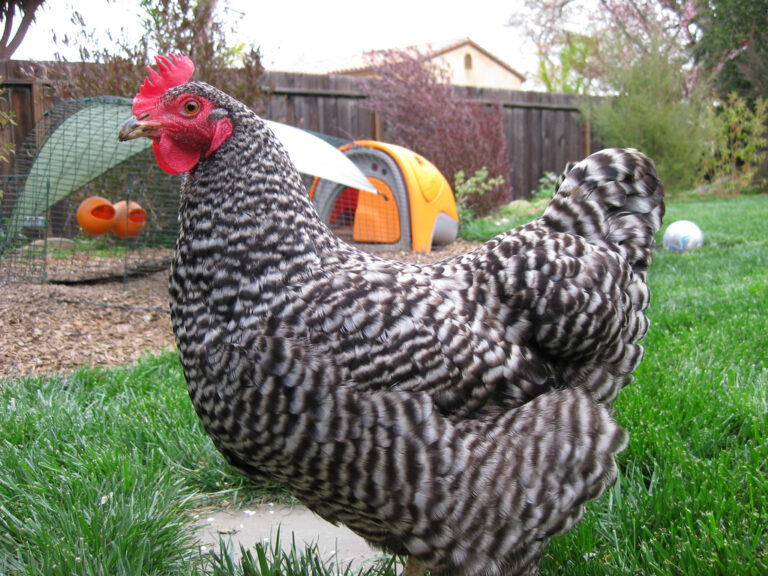
As Melissa and I drove into town this last week we were surprised to see a chicken standing in the middle of the road on the other side of the four-lane divided highway.  At the time the bird was in the center of the lane and since it was rush hour the cars were whizzing by on either side.  I decided to try and turn around and see if we could get the chicken off the road to keep it from being hit.  As we drove up to the area where we had seen the chicken, we noticed it had attempted to get back off the highway and had been run over.  It was now ranked among the armadillos, possums, and squirrels we often see lying at the side of the road.

When I looked the chicken up online, I found the Barred Plymouth Rock (Gallus gallus domesticus) is an American breed of domestic chicken.  It was first found in Massachusetts in the nineteenth century, and for much of the early twentieth century was the most popular chicken breed in the US.  It is a dual-purpose breed, raised both for its meat and for its large brown eggs.  It is resistant to cold, easy to manage, and a good sitter.  Plymouth Rock chickens come in several varieties, but the most common is the Barred Rock.  Barred Rocks have a unique look, complete with black and white stripes that lets them stand out in a mixed flock.  These large and hardy birds are ideal on small farms because they are gentle yet highly productive.  Barred Rocks can weigh up to 8 pounds (3.6 kilograms).  Cocks have striping of equal width while hens have wider dark bars.  This was a cock who had drifted away from a local flock.

I had a friend who lived in a very affluent community who raised chickens in her back yard.  Her property backed up onto a designated green space and she had made a pathway for her chickens to go through the fence, allowing them to become free range chickens during the day.  She also raised several roosters to escort the flock of around 20 hens.  When I visited, I would often hear the roosters crow.  When I asked how she was able to raise chickens in the city, she told me she had been raising chickens for 40 years, and they had been grandfathered (grandchickend?) in.  Since her neighbors had all moved in after her, she guessed they knew what they were getting into.

Thoughts:  I was able to answer another age-old question when I saw the chicken on the highway.  Why did the chicken cross the road?  It did not.  It only made it halfway then turned back.  You do not need a rooster for your chickens to lay eggs, and the hens will lay just as many eggs whether there is a rooster or not.  There are some benefits to having a rooster, as it offers significant protection for the flock.  The rooster will guard against predators and sound the alert if there is any perceived danger.  Another advantage is allowing your hens to live as normal a life as possible with a rooster in the mix.  Roosters break up hen fights, find and give treats to the hens, encourage egg-laying, and even monitor the nest boxes.  All animals, including humans, succeed best when life is normal.  Normal has been hard to achieve during the pandemic and the resulting stress accounts for much of the craziness we see on the nightly news.  We need to relax, take a deep breath, and get to the other side of the road.  Do the work.  Follow the science.  Change is coming and it starts with you.

Plastic

November 05, 2021

It was mid-October of last year when we first installed the 10-mil plastic on our screened porch to create a makeshift greenhouse for Melissa’s succulents.  We worried about freezing throughout the winter and used a space heater on the porch when it got too cold.  While the outside overnight temps dipped as low as -20F (-28.8C), the temperature on the porch never got below 24F (-4.4C).  Although several of our inground succulents suffered, most that we had covered survived.  I cannot say as much for protecting the inside plants during the summer.  Melissa was unable to care for them for long stretches and we lost about a third of our plants to heat, disease, and on the outside to ants.  I was glad when the weather cooled off, but now it has jumped from too hot to near freezing at night.  We reinstalled the plastic on the porch this week and are beginning the cycle once more, albeit this time with more confidence.

When I looked online, I found that plastic consists of a wide range of synthetic or semi-synthetic materials that use polymers as a main ingredient.  Their plasticity makes it possible for the plastic to be molded, extruded, or pressed into solid objects of various shapes.  This adaptability, plus the plastic being lightweight, durable, flexible, and inexpensive to produce, has led to widespread use.  Dozens of different types of plastic are produced, such as polyethylene, which is widely used in packaging, and polyvinyl chloride (PVC), used in construction and pipes because of its strength and durability.  While most modern plastic is derived from fossil fuel-based chemicals, recent industrial methods use variants made from renewable materials, such as corn or cotton derivatives.  Worldwide, about 22.7 pounds (50 kg) of plastic is produced annually per person, with production doubling every ten years.

Melissa offered to help put up the plastic for our windows again this year.  Last year I had finished most of the labor-intensive parts of the process, like cutting the plastic sheets and designing and placing the Velcro on the windows and plastic.  When I took down the plastic last year, I marked the upper corner so I could tell which sheet belonged where.  Then I had stored the plastic on the porch and hoped it would be usable for one or two more years.  I was surprised by the durability of both the plastic and the Velcro straps that held the greenhouse together.  We only encountered minor repairs and the sheets rehung easily.  With Melissa’s help, the job that took several days last year took less than 30 minutes.

Thoughts:  While the slow decomposition rate in my screens allowed me to reuse the plastic, this same feature has caused widespread environmental problems.  Toward the end of the 20th century, the plastic industry promoted recycling to ease environmental concerns, yet continued to produce virgin plastic.  Since the main plastic producing companies doubted the economic viability of recycling, the viability has never improved.  Plastic collection and recycling are largely ineffective because of the complexity to clean and sort post-consumer plastic for effective reuse.  Most plastic produced ends in landfills or persists as plastic pollution, including much of the “recyclable” plastic.  Plastic pollution can be found in all the world’s major water bodies, creating garbage patches in all the world’s oceans, and contaminating terrestrial ecosystems.  We can no longer afford a throwaway society.  If you make it, you should be required to collect it, or find an alternative.  Follow the science.  Change is coming and it starts with you.

Turkey

November 04, 2021

While driving through west central Arkansas last week Melissa and I passed several long and low sheds that appeared to be chicken houses.  Melissa pointed out that in this part of the state these were used to house turkey.  In many European countries, roast turkey has long been a customary Christmas dish, but in the US the bird is mostly associated with Thanksgiving.  That makes turkey production mostly seasonal, although in the US and some other countries turkey is available in various forms throughout the year.  The most raised commercial variety is the Broad-Breasted White, but other varieties are available.  The different “breeds” of turkey all originate from the North American wild turkey (Meleagris gallopavo).  While nice to look at, most of these strains do not grow as fast, as efficiently, and have a lower percentage of white meat compared to the commercial strain turkey.  They do not make the cut.

When I looked online, I found that Penn State Extension recommended small-flock turkey production as “a satisfying educational activity as well as a source of economical, high-quality meat for your family and friends.”  Turkey production lends itself to small-scale and part-time farming operations.  A small flock of turkeys can be raised at a scale that fits your available labor and uses existing facilities.  Turkey raising is easily started by hatching eggs or raising young poults.  Producing turkey close to local markets appeals to locally sourced customers.  English colonists introduced European-bred strains of the turkey to eastern North America in the seventeenth century.  Turkeys were bred mainly for their colored plumage until about 1935, after which the breeding emphasis changed to their meat qualities.

The buildings we saw as we drove the rural countryside were eight or nine sheds that housed thousands of turkeys.  Tyson has been working with poultry farmers on a contractual basis since the late 1940’s and there are currently about 6,000 contract farmers who raise poultry for the company.  Tyson supplies the birds, feed, and technical advice, while the poultry producer provides the labor, housing, and utilities. According to the website, “This means the farmer is insulated from the risk of changing market prices for feed . . . and is ensured a consistent price no matter what grocery markets are doing.”  The birds are raised in large houses with thermostatically controlled heaters in winter and automatic fans to keep the birds cool in summer.  Automatic dispensers provide water and feed for the birds.  This was hardly small-flock turkey production.

Thoughts:  Commercial production of turkey and chicken faces the same backlash as feedlots for cattle and pigs.  Animal agriculture accounts for roughly 80% of ammonia emissions in the US from animal waste, 14.5% percent of global greenhouse gas emission, acid rain from the waste collecting lagoons, smell for nearby residents, and health risks from release of hydrogen sulfide for the workers.  In addition, when factory farm waste decomposes it releases airborne particulate matter along with the harmful gases, including dry manure, feathers, bits of feed, and animal dander.  While corporate producers claim to be “stewards of the animals”, they are ultimately raising animals to be killed and eaten.  It is interesting that cattle and pigs are not even sold as animals, but as beef or pork.  I wonder if my fall off the bone ribs are worth the cost.  Follow the science.  Change is coming and it starts with you.
Sawmill

November 03, 2021

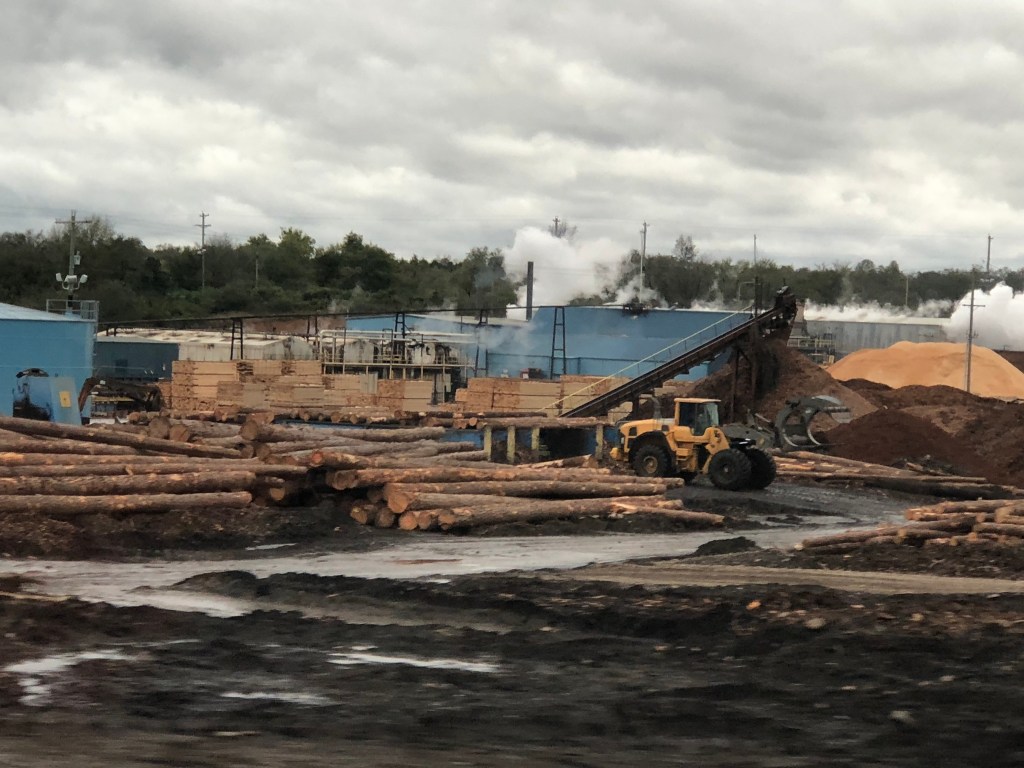
While Melissa and I drove down to look at furniture we passed a sawmill located just off the road on Hwy 71.  The sawmill had thousands of cut and stripped logs stacked and ready to be cut.   There were others piles of cut lumber that had been processed stacked and ready for shipping.  Other huge piles held the saw dust that was the result of cutting the logs into useable sections, and then into the right size planks for use in construction projects.  You could see the steam rising from the drying kilns and smell the fresh cut logs in the air.  I was surprised by the piles as I did not know Arkansas had a sawmill.  That is a lot of trees.

When I looked online, I found Sawmills are important to the economy throughout the nation.  According to the American Forest and Paper Association, the US forest products industry manufactures almost $300 billion in products a year and employs about 1 million workers.  Privately-owned forests support over 2 million jobs and provide 91% of the wood harvested and sent to a sawmill in the country.  The US is a major exporter of forest products, selling products such as wood pellets, sawn wood, pulp for paper, and paper and paperboard.  The demand for lumber continues to be strong, and industry experts expect it to grow with new housing construction and remodeling projects.  The average (?) 2,400-square-foot home needs over 16,000 feet of lumber for framing.  Each American consumes the equivalent of a 100-foot-tall tree each year in wood and paper products.  That is a lot of paper.

According to IBISWorld market research, there are over 3,000 businesses in the United States in the sawmill and wood production industry.  That includes hardwood and softwood lumber, as well as wood chips and wood product preservation. The US Lumber Coalition states there are 550 lumber sawmills in the country.  In Arkansas, the Ouachita Mountains of southwest Arkansas had six sawmills, the southern Ozark Mountains just north of the Arkansas River had two, another was in the southeast of the state, and there was even one located in Fort Smith.  Arkansas ranks as the sixth largest lumber producing state in the US, and according to Global Wood Markets Info, the Canadian company West Fraser who owns four of the state’s sawmills, is the largest softwood lumber supplier in the world, producing 6.6 billion board feet of lumber products in 2018.  That is a lot of boards.

Thoughts:  Working in the lumber industry is extremely dangerous.  The equipment poses numerous hazards as massive weights and sliding logs can be dangerous.  Operation of a sawmill is also dangerous.  Employees suffer lacerations, amputations, severed fingers, and blindness. The wood dust and chemicals used for finishing products cause respiratory and skin diseases.  Sawmill hazards are more dangerous when environmental conditions like rough terrain, inclement weather, and isolated work cause difficulties to access health care.  According to a recent study, logging is the most dangerous job in America.  The rate of fatal accidents in the logging industry is 98 fatalities per 100,000, or 28 times higher than the all-worker rate of 3.5 fatalities per 100,000 full-time equivalent workers.  That is a lot of people.  Do the work.  Change is coming and it starts with you.
Furniture

November 02, 2021

Last week Melissa decided it was time for us to break down an buy a new sofa.  The sofa and love seat we have was bought during the 2000’s so they are around 20 years old.  During this time the sofa springs had worn out and it had a plywood strip under the cushions to keep you from sinking.  The fabric was still nice, but it did look dated.  Since I am the one who sits on the sofa every night, Melissa thought it would be nice if I choose the style and researched where to find the best price.  After pouring over several alternatives, I came to the point where I needed to sit in a sofa to make a furniture decision.  We went 40 miles south to “the store we always go to” to get a better idea.

When I looked online, I found the latest trend in furniture is Microsuede, or microfiber.  This is a man-made polyester fabric that gives the look of leather.  Polyester can be made from both natural products, such as plant cuticles, and synthetics.  Microsuede is a knit blend created from fibers that are very fine, sometimes a hundred times finer than human hair.  These delicate fibers are tightly woven together to create a dense fabric that has many of the same qualities as suede leather yet is easier to clean than real suede and is usually much softer.  It is also a good alternative to leather for people who prefer to use non-animal products.  The problem I find with leather is that it retains heat and makes it easier to sweat on the hot days of summer.  Leather and water are never a good combination for looks over time.

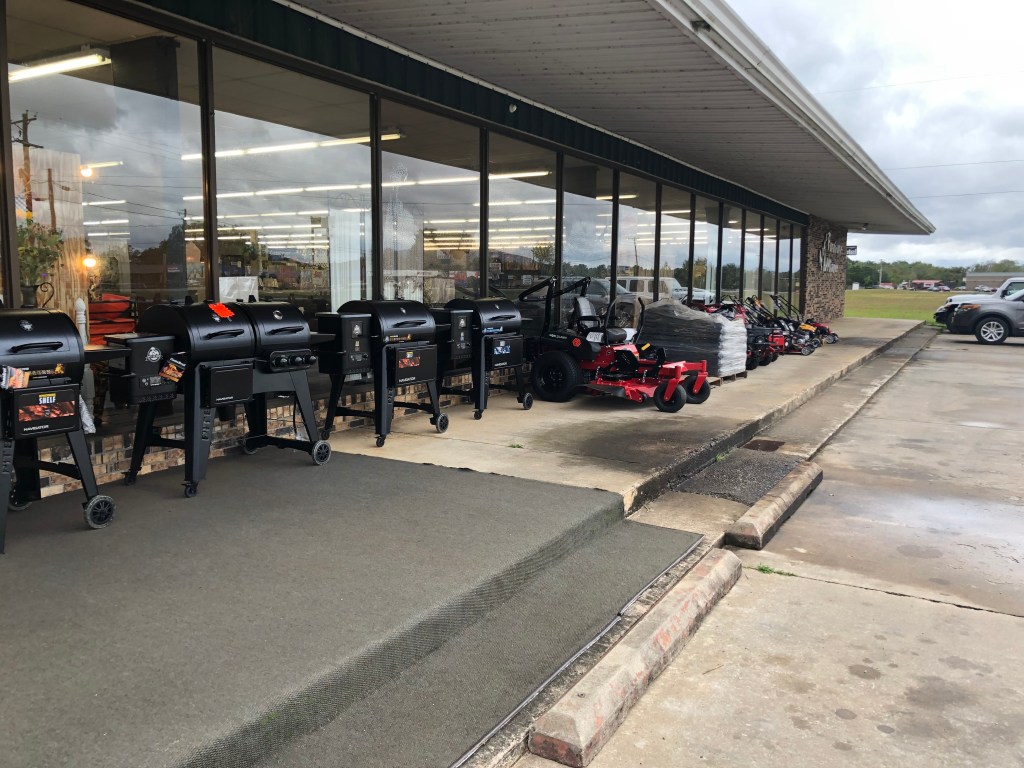
After making the trip south I was not prepared for the display they had in front.  Being in a small town, it made sense they carried more than just furniture.  They also carried a line of bar-b-ques and smokers.  There was a large display inside the store offering the accoutrements that could allow you grill to perfection.  While that sort of made sense, I was confused by the lawn mowers that also graced the front of the store.  I could find no reference to them inside.  I guess someone had to sell mowers.  When I spoke with my mom last week, I mentioned that I was being drawn to furniture covered with the microfiber.  Apparently, she had just purchased a chair with the same fabric.  She said it was soft and was told by the salesperson that it would hold up well.  While the prices were appreciably lower, the store did not have what we really wanted.  We are still looking.

Thoughts:  When we moved to Arkansas, we decided to donate our mission style furniture to the camp where I worked.  It was still nice and gave a rustic feel to the house that was going to be rented as an additional small conference center.   We already had a house full of furniture where we were moving in Arkansas.  While I have regretted that since, it would have been more trouble to move it with us.  We all make decisions that seem right at the time, but we begin to question later.  Much of what has happened over the last several years fits this category.  People made decisions that seemed right at the time, but later proved to be wrong, and some of them tragically so.  With other decisions, we still have time to change and make it right.  Do the work.  Follow the science.  Change is coming and it starts with you.

Treats

November 01, 2021

I was able to participate in our Fall Festival last Saturday Night.  Due to continuing restrictions from covid this was different than previous Festivals.  We have held the event indoors and focused on a variety of games to provide treats to the children who attend.  While this still served as the basis for the celebration, this year we held the event outside and based most of the games out of the trunks of the decorated cars that lined the parking lot where I work.  We had a good turnout and gave out a lot of treats to the children (and adults?) who attended.  We had a much better turn out than last year when we were forced to cancel due to covid (ha-ha).

Fall Festival has become synonymous for Halloween over the last several decades.  When I looked online, the word “Halloween” comes from All Hallows’ Eve and means “hallowed (or sacred) evening.”  While we generally no longer celebrate November 1st, this day is known as All Saints Day.  The combination of Halloween and All Saints Day was celebrated as a time to remember the saints who have died.  Trick-or-Treating comes from hundreds of years ago when people dressed up as saints and went door-to-door.  This was the beginning of Halloween costumes and trick-or-treating in Europe.  The tradition of knocking on doors for treats did not begin for most of America until the mid-1940’s, or after the end of World War II.  Rather than a focus on the dead, it represented a return to prosperity.

The treats that were originally given were spiced cakes rather than candy.  These little cakes were called “soul cake,” and were a popular treat in Europe during the Middle Ages.  The cakes were made from saffron, currants, and other expensive spices and were given to honor the dead.  They eventually became a treat for poor beggars who would knock on the doors of wealthier folks, offering to pray for their household’s deceased in return for these tasty cakes.  Rather than saying trick-or-treat, the poor would instead say “A soul cake, a soul cake, have mercy on all Christian souls for a soul cake!”  Few today remember to say trick-or-treat without parental coaxing, as the tradition continues to evolve. 

Thoughts:  I have fond memories of going door to door for treats in the small town of my childhood.  I especially prized the home-made popcorn balls, cookies, and caramel apples.  We would remember those houses and make sure to get there early before they ran out.  As a child I could make my treats last for months, tiding me over into Christmas.  Home-made treats are now discouraged, and any found in a child’s sack are immediately thrown away to protect them from harm.  Safety is also the reason for Fall Festival and trunk-or-treat events.  They provide a safe place for children to put on costumes, have fun playing games, and still receive the treats they pursue.  During covid we have been forced to make many adaptations to long-held traditions.  This does not mean they are not as fun or enjoyable, it just means they are different.  Even I would be wary if someone put a soul cake in my sack.  Follow the science.  Do the work.  Change is coming and it starts with you.
Hiring

October 29, 2021

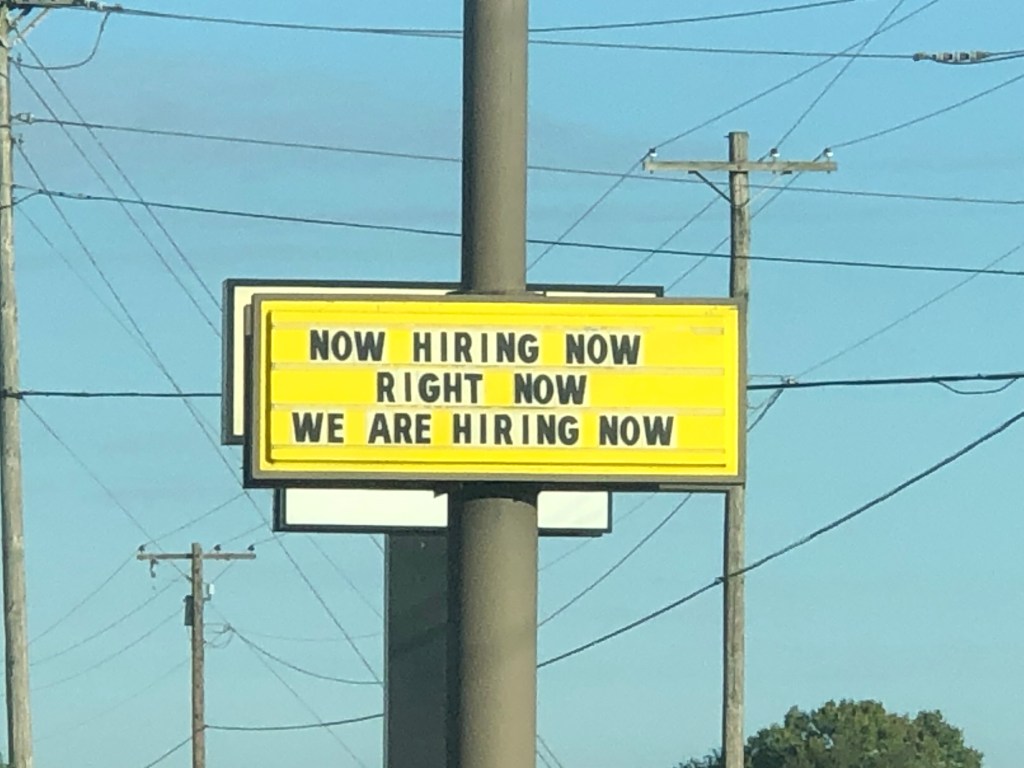
When Melissa and I pulled through the drive through of one of our local fast-food restaurants we were confronted by the marquee.  The sign declared in bold letters that the restaurant was hiring workers.  They were NOW HIRING NOW, RIGHT NOW, WE ARE HIRING NOW.  Apparently, the chain was not only hiring, but having a problem getting people to apply.  As covid cases decline and safety restrictions loosen, fast-food chains are looking to return to business as usual.  The problem is, they cannot find enough workers.  I had to resist the urge to go inside and ask the manager if they were hiring.  Luckily the restaurant was closed to indoor dining.

While some blame the hiring crisis on government programs that provide greater benefits and extended times for receiving them, a better reason may be the low wages paid and the working conditions workers face.  The current Federal Minimum Wage is $7.25, and the Arkansas state minimum wage is $11.00 per hour, and workers are entitled to be paid the higher state minimum wage.  The minimum wage applies to most employees in Arkansas, but there are exceptions, including tipped employees, some student workers, and other exempt occupations.  The Arkansas minimum wage was last changed in 2008, when it was raised from $6.25 to $11.00 per hour.  Tipped wages are set at $2.63 per hour.  That means working 40 hours a week for the non-tipped minimum provides $22,880 a year.  Working 40 hours a week for tipped wages provides $5470.40 a year.  Minimum wage increases are based on a voter approved initiative on November 4, 2014.  Previously, Arkansas had not updated their minimum wage since 2006, and the Federal Minimum Wage took precedence.

Credit Suisse analyst Lauren Silberman says fast-food industry struggled to find enough employees for years before the latest stimulus package.  Restaurants are an “exceptionally difficult business” to work in, Silberman said.  Employees face a high rate of sexual harassment and assault on the job, while Bureau of Labor and Statistics data shows that the median pay is $11.63 per hour.  Workers increasingly have more options outside the restaurant industry that offer a guaranteed $15 per hour, such as Amazon or Target, or more flexibility, like Uber or DoorDash.  And working in restaurants has only become more dangerous and difficult over the last year.  “These are still frontline workers, and we are still in the midst of a pandemic.”

Thoughts:  When I looked online, I found the definition of poverty in the US is an individual with income less than $34 per day ($12,410 per year) or a family of four with income less than $69 per day ($25,185 per year).  When you figure poverty rates in the US by racial classification, 31.9% of Blacks, 29.6% of Hispanics, 29.1% of Pacific Islanders, 23.5% of American Indians, 14.2% of Asian, and 14.1% of whites live in poverty.  Arkansas ranks 46th in Poverty Rate at 18.1%, which is meaningfully higher than the national average of 14.6%.  That means over half a million Arkansas residents (524,211) lived below the poverty line last year.  This includes 20.1% (1 in 5) children.  Systemic poverty is not the result of fast-food restaurants not hiring enough people or paying $15 and hour.  Neither is it the result of stimulus subsidies.  It is the result of an attitude of legislatures and individuals which deem poverty as individual failing, rather than a societal flaw.  Do the work.  Change is coming and it starts with you.

Salmon

October 29, 2021

My ESPN feed this week highlighted the Seattle Kraken who are in their inaugural year for the 2021-22 NHL season.  Like most new teams they are trying to adopt local traditions into their game.  One that hockey fans are loving is the Kraken postgame salmon toss.  The postgame salmon toss is awarded as an honor to the team’s three stars of the night.  The Kraken give the standout performers at a home game a distinction in a cool way beyond just putting them on the video board.  The toss consists of the Seattle players tossing salmon (rubber or stuffed, not real fish) over the glass and into the fans after the game.  The Pike Place Market is one of the biggest attractions in Seattle where you can see vendors and fishermen tossing fish to one another as they are being packaged and sold.

When I checked online, I found the Pike Place Market is a public market in Seattle, Washington.  The Market opened on August 17, 1907, and is one of the oldest continuously operated public farmers’ markets in the US.  Located on the Elliott Bay waterfront on Puget Sound, it serves as a place of business for many small farmers, craftspeople, and merchants.  It is named for its central street, Pike Place (yes, like the coffee), which runs northwest from Pike Street to Virginia Street on the western edge of Downtown Seattle.  Pike Place Market is Seattle’s most popular tourist destination and the 33rd most visited tourist attraction in the world, with more than 10 million annual visitors.

When Melissa and I visit our son and his family just outside of Seattle, we like to also browse through the Pike Place Market.  The street level of the Market contains fishmongers, fresh produce stands and craft stalls operating in the covered arcades.  Local farmers and craftspeople sell year-round in the arcades from tables they rent on a daily basis.  The Market is built on the edge of a steep hill and has several lower levels below the main level.  Each level features a variety of unique shops like antique dealers, comic book and collectible shops, small family-owned restaurants, and one of the oldest head shops in Seattle.  Pike Place Market is also home to nearly 500 residents who live in eight different buildings throughout the Market.  Most of these buildings have been low-income housing in the past. 

Thoughts:  The fish market at Pike Place sells a variety of locally caught fish and is a great place to buy fresh salmon.  The buyer will select their fish, the monger will grab it, throw it 20 feet (18.5 meters) to be caught by the person at the scale where it is weighted, wrapped, and priced.  I have never seen a fish dropped.  While I enjoy watching the mongers throw fish, it is more fun to watch the tourists.  The mongers rig certain fish with microphones and fishing line to make them move and talk to the tourists (ala, Billy Bass).  Even when you know it is going to happen, it still startles the unwary.  As we approach our second Halloween during the pandemic, we need to remember that even being startled by the events of the world, we do not have to be overcome by them.  Follow the science.  Do the work.  Change is coming and it starts with you.
Display

October 28, 2021

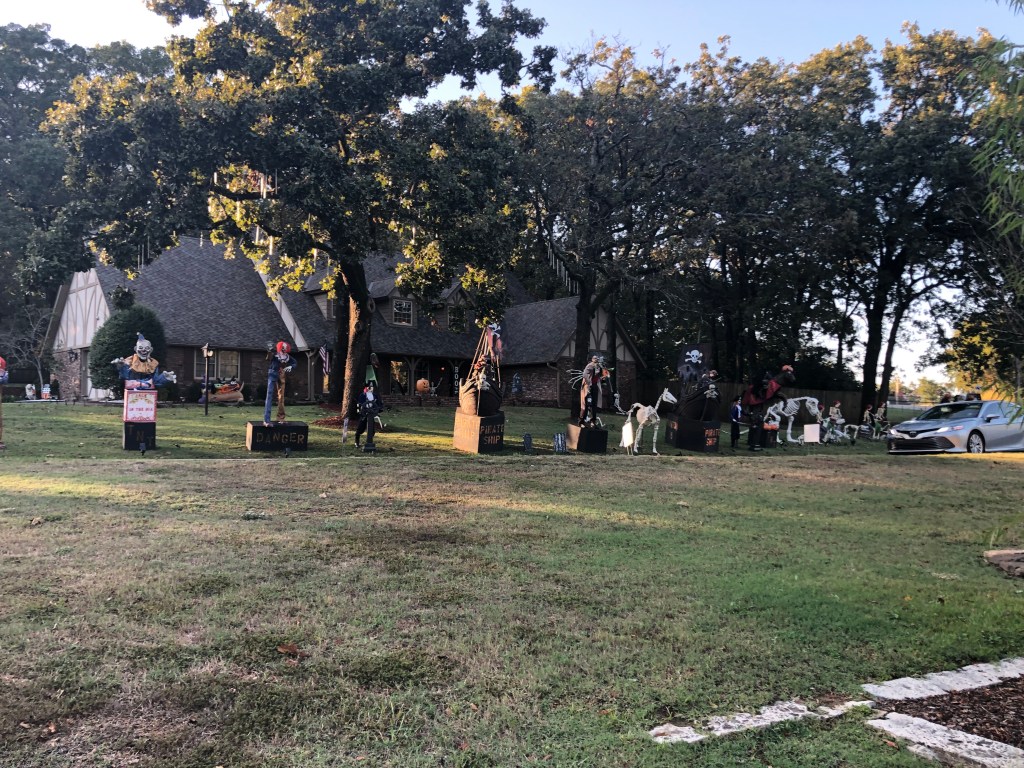
As Melissa and I were driving along one of the main streets of our nearby town we came across a yard filled with dozens of spooky figures arraigned in a display across the front of a residence.   I figured this was a photo op so I asked Melissa to pull over so I could get a shot.  She dutifully pulled off the main throughfare and onto the side street allowing me to get get the perfect shot of the Halloween display.  While we were trying to get the shot, a resident of the subdivision pulled up behind us and rather than going around, decided to honk to get us to move.  We took our photo and moved on.

I received a post on my ESPN feed concerning a similar display on the lawn of retired defensive lineman, Bruce Smith.  Smith spent nearly two decades terrorizing opposing quarterbacks in the NFL and now has a Halloween display to prove it.  The Hall of Fame defensive end put his career on display by decorating his front lawn with 76 tombstones, representing the 76 quarterbacks he sacked during his career with the Buffalo Bills and Washington Football Team.  Smith was inspired by Cleveland Browns defensive end Myles Garrett, who started the trend by putting tombstones and taking a shot of them on his front yard of the quarterbacks he sacked during the 2021 season.  During his time in the NFL, Smith became one of the most feared defenders to play the game as part of the Bills’ four AFC title teams in the early 1990’s.  Smith is the NFL’s all-time sacks leader with 200 during his 19-year career.  Smith and his impressive graveyard now reside in Virginia Beach, Virginia.

The annual fall ritual of Halloween and autumn decorating includes brightly colored pumpkins, dried corn stalks, hay bales, scarecrows and autumn leaves which are on display on porches, doorways, and yards throughout communities.  The scarier and more frightening Halloween decor comes along with fall decorations as well, and many people add their own personal vibe to the spooky flair of Halloween.  In Northeast Ohio they have even dedicated a webpage to identify local yards they believe to be “over the top” with their display.  These include inflatables, statues, lights set to musical scores, and scary scenes.  The page encourages visitors to drop by the various locations, and to share an additional display if you think it is worthy.  It seems Halloween is competing with Christmas.

Thoughts:  Thousands of years ago there was an end of the summer festival that was known as Samhain.  Samhain tradition had many deep supernatural practices that were an integral part of the annual festival.  The uneducated people of the time were fearful of the season and believed that the end of the harvest and the onset of winter created an opportunity for the spirits of the deceased to return and mingle with the living.  I am not sure if that could have been any worse than getting sacked by Bruce Smith.  Samhain and Smith represent two of humanities greatest fears, fear of the unknown and fear of the known.  We seem to be more frightened by the unknown we allow our minds to imagine all the “what if’s” that are possible.  When we know what our fear is we can face it.  We are at a point where we can face the pandemic and overcome the frightening aspects.  Now we just need to do it.  Follow the science.  Change is coming and it starts with you.
Creep

October 27, 2021

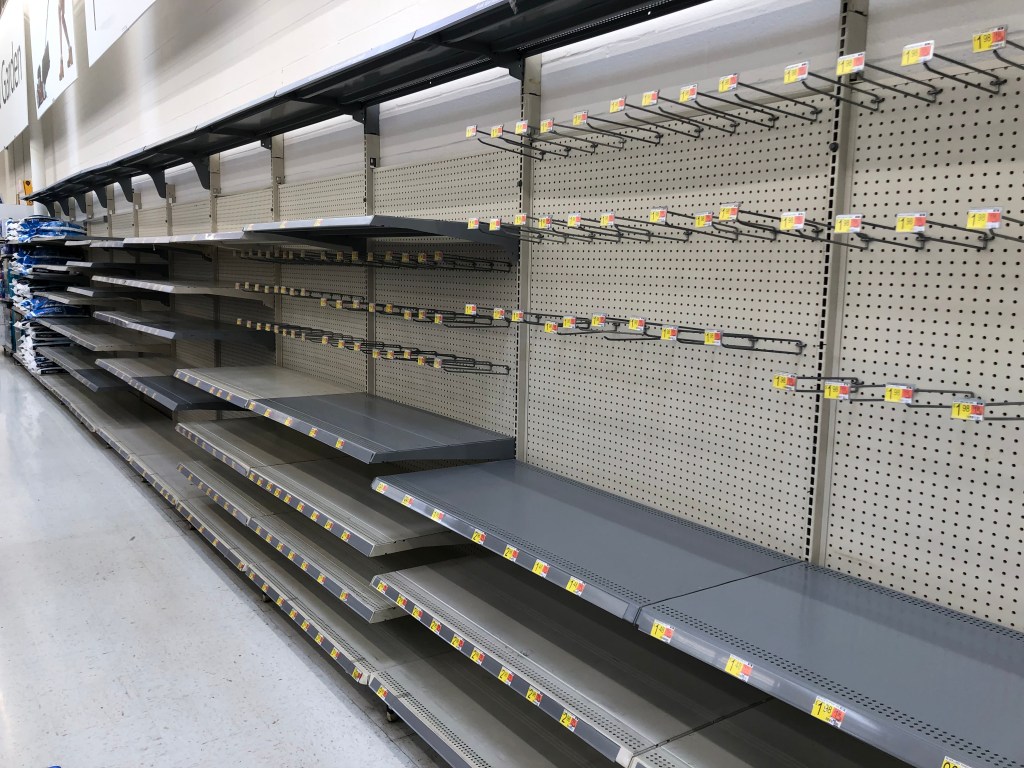
While I did not write about it, I was surprised (not shocked) when I saw the bird food I came in to buy in late September had been downsized and moved to interior shelves in the market I frequent.  The shelves were now empty, but they had all been labeled with the products that were expected to shortly fill them.  The bird food aisle had been designated to accept the new Christmas lights that will soon adorn the houses of our community.  I recalled this experience because last night I noticed the first of the Christmas commercials that will soon dominate our TV ads.  I am not saying they were the first, but at least they were the first to creep into my notice.

When I checked online, I found that a lot of people seem to have the feeling that Christmas marketing seems to get earlier every year.  It is still the beginning of fall and most of us are focused on Halloween, but there are already Christmas and holiday products hitting shelves.  This phenomenon is known as “Christmas Creep.”  Christmas creep refers to the sense that the holiday season is gradually lengthening, beginning earlier each year, typically in early fall.  The term was added to Merriam Webster’s “Words We’re Watching,” who commented: “It seems to never be employed in celebratory fashion but rather functions as a shorthand for the existential dread and disgust that many people feel at the apparent increasing commercialization and banality of the season.”  Ya think?

According to retail expert Andrew Smith, co-founder and managing partner for the Americas of Think Uncommon, the creep is more imagined than real.  “Over the last 20 years it has certainly been brought forward in stores slightly, but generally speaking it’s the same most years.”  However, he added that pressure on supply chains during the pandemic has sped up the shift to e-commerce, leading retailers to try to creep the Christmas period back to help boost sales.  During 2020, shoppers were concerned about potential lockdowns, and many began shopping for the holiday season even earlier.  During 2021 the concern has shifted from lockdowns to supply chain issues.  As I found recently, the merchant may sell the product, then caution they cannot guarantee when it will arrive.  Sitting in the port is not the same as on the shelf.  

Thoughts:  I found another interesting shift in holiday shopping that began in 2020 that will likely continue through at least 2021.  Many shoppers wanted to get gifts early but were unsure or even unable to find the items they wanted.  That gave rise to an increase in local gift cards.  The gift card allows the recipient to go to the store at their leisure and pick their choice of items that existed on the shelves.  This has pros and cons.  It is hard to get excited over my new bike on Christmas morning when it comes wrapped in an envelope holding a gift card.  Then again, you never worry about getting Bunny Suit Pajamas from Aunt Clara.  Whether the December holiday is Hanukah, Christmas, or Kwanza, the point is not about gifts but about the love included in sharing.   It may not be so bad to allow this gift to creep back into the rest of the year.  Do the work.  Change is coming and it starts with you.