
Mowing

August 21, 2021

Since it was a relatively cool morning, I decided to tackle one of the items on my to-do list, mowing the lawn.  Like most simple chores, mowing the lawn requires more than just mowing the lawn.  I generally feel obligated to do at least some preliminary weeding.  I have found if I weed a bed or two before mowing, I can convince myself I have gotten something done without feeling obligated to take on the entire yard.  The same is true for weed eating.  I always start with the intention of going all the way around the house, then hitting the sidewalks, drains, and curbs.  Even on a cooler (heat index 96F) day like today I seem to get distracted about halfway through the job.  If I come back to the weed eater and it does not start, I assume it is telling me it has had enough for the day and dutifully put it in the garage.  Somehow, I always manage to get the front, street, and north side of the house finished.  Since this is the only lawn others can see, it is a nice place to call it good.

When I looked online, I found the Middle English word “launde” originally referred to a glade or opening in the woods, but later designated artificial stretches of land that resembled such glades.  The earliest lawns were the grasslands around medieval castles in France and Britain which were kept clear of trees, so guards had an unobstructed view of approaching (hostile) visitors.  The term also referred to the village “commons” where villagers could graze their sheep and cattle.  Closely mowing grass lawns first emerged in 17th century England at the homes of wealthy landowners.  While sheep often still did the mowing, landowners increasingly depended on human labor to tend the grass closest to their homes.  Before lawnmowers, only the rich could afford to hire the hands needed to scythe and weed the grass.  A lawn was a mark of wealth and status.  Now my zero-turn riding mower provides the same status.

As I was working on weed eating the back of the house it began to sprinkle.  I had waited until late morning to allow the grass to dry from last night’s light rain.  With the high humidity I was already damp, so I figured it would not hurt to ride the mower in the drizzle.  I put up the weed eater and moved to the mower.  It only takes 20 minutes of mowing to finish the job with my riding lawn mower.  I had set the deck on a high setting since I figured I would need to weed the beds early next week and would again be mowing.  As the drizzle continued the grass began to get wet and clumped on my lawn rather than mulching.  While I hate the “mowed hay” look, I figured it would not be long before I did it again.  While the rain did make me damp, I was not sure it was any worse than the humidity.   

Thoughts:  I have mentioned that I like the calm provided while mowing on a riding mower.  I usually put in my music headphones and don the noise dampening headphones I received with my chain saw.  It creates a pleasant oasis in the chaos of the day while I ride around mowing.  Melissa mentioned that since our neighbor retired, he has replaced his steering-wheel mower with a new zero-turn unit to do the mowing for the three yards he has in our cul-de-sac.  Once you buy a zero-turn you will never go back to mowing the old way.  During the pandemic we have found that even as things reopen, we are not able to go back to the old way of doing things.  It is predicted that will not change until at least 2022.  Others ask why we want to go back to the old way.  Wearing masks resulted in fewer cases of colds and flu.  Follow the science.  Change is coming and it starts with you.

Carb

August 20, 2021

I have mentioned before how I struggle to come up with something to fix for dinner.  While we are not on a low carb diet, we do try and be carb conscious.  A low-carb diet limits carbohydrates and stresses foods high in protein and fat, reducing or eliminating grains, starchy vegetables, and fruit.   Melissa has been good about cutting down on the bread but is still tempted by potatoes.  My downfall is rice and pasta.  The problem I have with dinner is potatoes, rice and pasta are the easiest quick meals to make.  I generally default to one of the three as the basic ingredient for our evening meal.  Even though I add the protein and vegetables to make it more nutritious it is hardly low carb.  Occasionally I tire of this routine and look for low-carb alternatives for a meal.

When I looked online, I found while a low-carb diet is generally used for weight loss, some low-carb diets have health benefits beyond weight loss, including reducing your risk of type 2 diabetes and metabolic syndrome.  Carbohydrates are grouped as simple natural (lactose in milk/cheese and fructose in fruit), simple refined (table sugar), complex natural (whole grains or beans) and complex refined (white flour).  In general, complex carbohydrates are digested more slowly and they have less effect on blood sugar than refined carbohydrates do.  They also provide fiber.  Common sources of naturally occurring carbohydrates include grains, fruits, vegetables, milk, nuts, seeds, and legumes (beans, lentils, peas).  Another way to say this is, everything I like to eat.

After looking for quick meals I came across an interesting alternative to nachos.   This was a low carb version that was based on green bell peppers.  The peppers were cut into quarters and then piled with the same toppings usually found on nachos.  That included taco meat, onions, beans, cheese, and olives.  The “nachos” were then baked in the oven at 425F for 10 minutes.  When we tried the dish, it was different to say the least.  It tasted nowhere like nachos, and I later thought the peppers should have been blanched to soften before they were placed in the oven.  Melissa’s reaction was priceless.  To make the dish more palatable, she ate these low carb nachos with tortilla chips.

Thoughts:  When I lived in Berkeley, I had the habit of ordering nachos as a late-night appetizer.  I enjoyed the different ways they were fixed and the variety of toppings that would be loaded onto the pile of chips that were provided.  One of my favorites were the stone fired nachos I found in a local pub that also served individual pizzas.  One night I ordered nachos from one of the national chains and instead of a pile of chips, there were 12 individual chips that had been loaded with toppings.  This was immediately dubbed “designer nachos” (by me).  I did not appreciate these any more than last night’s low carb bell pepper nachos.  Tracking the virus spread has identified obesity as one of the key factors in the virility of the contagion.  Yet another reason to eat low carb.  Follow the science.  Change is coming and it starts with you.
Wildflowers

August 19, 2021

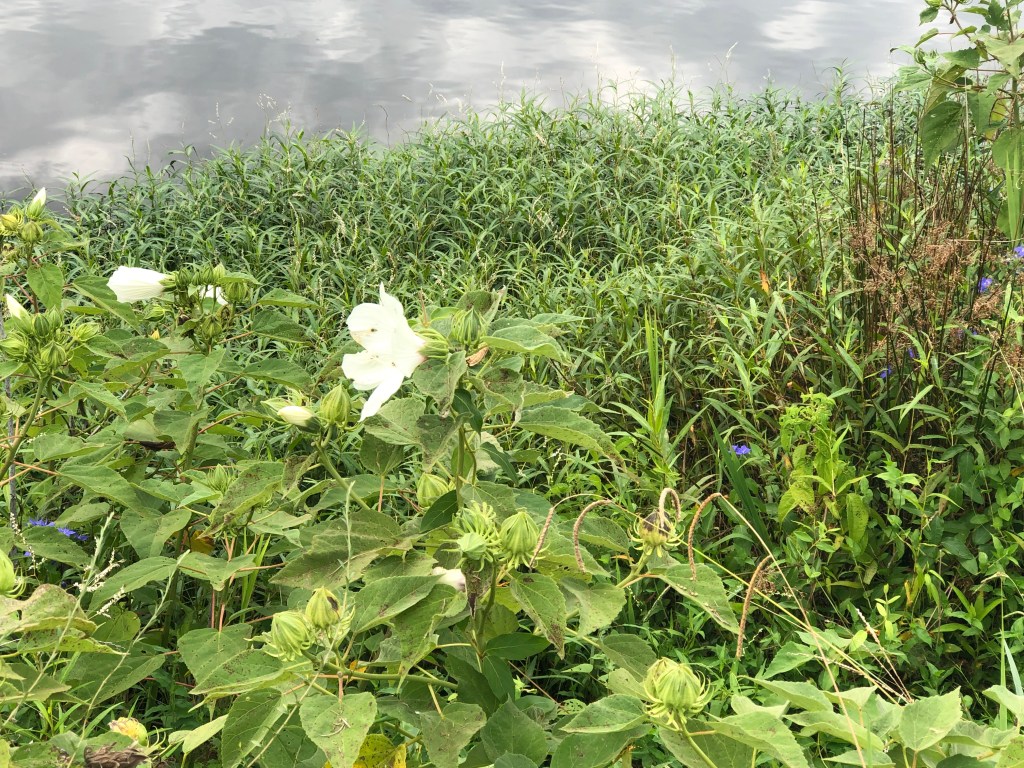
When the temps got down to 88F last Saturday I decided to try my luck in the afternoon at a local lake I usually fish for catfish.  As I left home, I realized I had not brought the red worms that have been so effective on this water.  I have often used my fly rod for the bluegill and winter trout (stocked), so I was not worried.  The hot weather we have been having has been accompanied by scattered rains and high humidity.  The grasses and wildflowers along the shore had taken off and there were only a few places you could get near the water.  I fished for about 30 minutes before I admitted the humidity was too much for me, and apparently for the fish as I got no bites.  I shifted my attention to the wildflowers.

When I checked online, I found the Rose Mallow (Hibiscus lasiocarpus) is a rare native perennial herb that grows as a wildflower in Northern, Southern and Central California, primarily in the Sacramento and San Joaquin Valley regions.  Common names are the Common rose mallow, swamp mallow, swamp hibiscus, dinner plate hibiscus, and shares the name hardy hibiscus with Hibiscus syriacus.  While new growth is slow to emerge from dormancy in spring, the plants shoot up rapidly once they take off.  Rose Mallow can grow as much as an inch per day and thrive in full sun and swampy areas.  The plants bloom from midsummer until the first frost, and even though the flowers only last a day or two, the Rose Mallow is a prolific rebloomer.  The Rose Mallow flourishes in zones 4-9, and although it was not native, I found the plant offered by several greenhouse sites.  The plant has spread prolifically in the US.

The lake I was fishing is a perfect setting for the Rose Mallow.  The banks were in full sun and low along the water, meaning they were marshy.  I was surprised to see 15 or more blooms and numerous pods in a 30-yard stretch along the lake.  Last spring, State Parks had planted seedlings to help with erosion along the bank.  I understand the logic for this, but they put the new trees in areas used by fisherpeople to get near the water.  The combination of the new willowy bushes and the abundant grass and wildflowers now makes it difficult to fish.  I guess if it was easy, it would not be a sport.

Thoughts:  Making difficult feats easy is a booming business.  At 29,031.69 feet (8,848.86 m) above sea level Mount Everest reigns as the highest mountain on earth.  Since the first ascent in 1953 reaching the summit of Everest has been considered one of the greatest achievements in mountaineering.  Now the route is clogged with trash and packed by climbers.  The cost to climb Mount Everest in 2017 averaged around $45,000.  The price of a standard “supported climb” (group led by guides) ranges from $28,000 to $85,000.  A custom climb (private and accommodates requests) can cost up to $115,000.  High-risk climbs (without guides) price around $20,000.  As one website stated, this is a once in a lifetime experience, isn’t it worth the extra cost to ensure your safety?  I would make the same claim for getting the vaccine, except it is free.  Follow the science.  Change is coming and it starts with you.
Catch

August 18, 2021

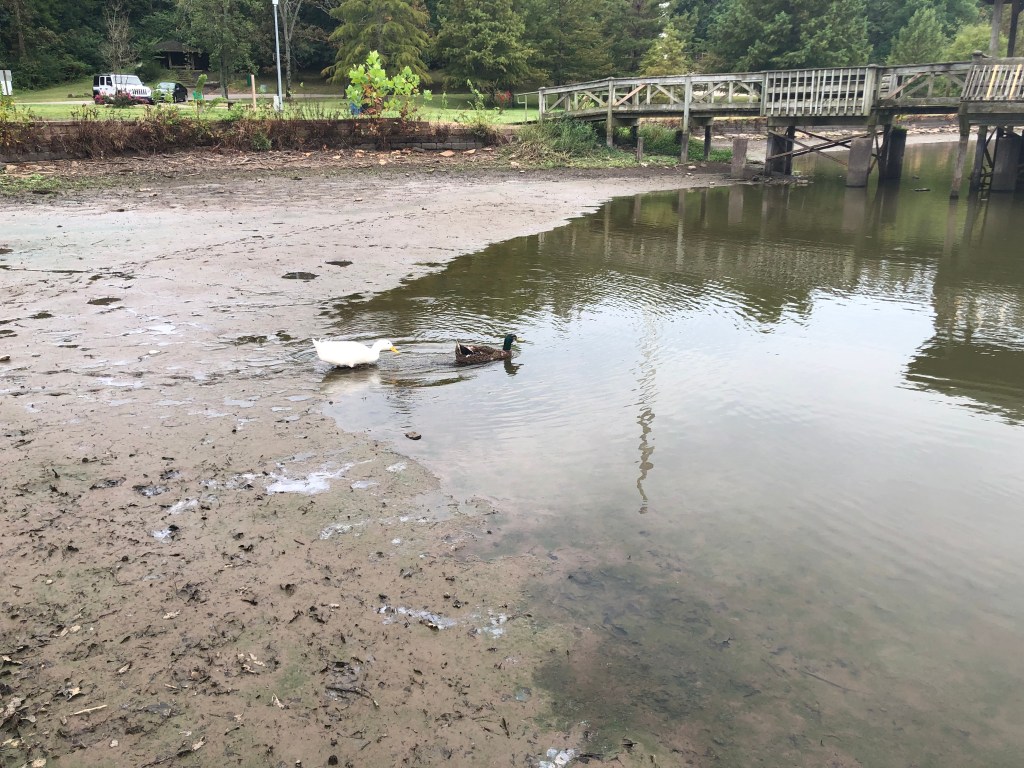
After dropping Melissa off for an appointment, I decided to spend the wait time fishing.  When I pulled into the mallard lake I have been frequenting, I saw the water level had dropped over two feet.  The heat and evaporation had apparently taken its toll on the water.  I had not originally planned on fishing so while I had my poles (kept in my car) I did not have bait.  That was not a problem since I wanted to fly fish.  I had broken down my pole and put away the fly the last time I fished and did not initially find the trout magnet I was hoping to use.  Instead, I rigged up a wooly with a cadis fly drop and tossed into the shallow water.  The shallow lake seemed to concentrate the fish and they were hitting my flies on every cast, including landing five.  I was hoping to catch the bass that have been tempting me along the shore.

The Killer Whale or Orca (Orcinus orca) is a toothed whale and largest member of the oceanic dolphin family.  It is easily recognized by its black-and-white patterned body.  Orca whales are found in all the world’s oceans and range from Arctic and Antarctic regions to tropical seas.  I have watched videos of Orca Whales using a catch technique called surfing for seals.  The Southern Elephant seals (Mirounga leonina) and Sea Lions (Otariidae family, various) use the rocky shores of Punte Norte, Argentina, to birth and rear their young.  The Orcas swim close to shore and wait for the perfect alignment of the tides, the seals, and shore, to strike.  The Orca surfs a wave onto the shore, grabs a seal pup in its teeth, then rolls its body and uses another wave to pull it back to deeper water.  In one study of this behavior, none of the observed whales were stranded permanently and 34.4% of their attempts ended with the catch of a seal.

As I fished for the bass at my lake, I was struck by another feeding technique used on the minnows along the shore.  These small fish had schooled in the shallows, and the bass would swoop in and catch the scattering fish.  Since they were along the shore, there were few escape routes and I assume the bass were effectively feeding.  While the Bass were not beaching like the Orcas, the water was so shallow that the dorsal fins and backs of the Bass were completely out of the water as they made their runs.  I do not recall ever seeing this behavior previously, but it must be common, at least in deeper water.  While small mouth bass are not orcas, they seem to have learned how to herd and catch the minnows.  I could not get the bass to bite on my wooly setup.

Thoughts:  The Orcas’ innovative hunting strategies are not limited to seal surfing.  Orcas around the world are estimated to catch and feed on over 140 species, such as sharks (including great whites), squids, sea otters, dolphins, bony fish, turtles, seabirds, and even baleen whales.  The strategies used to catch this diverse prey are almost ritualistic in nature and are passed down from one generation to the next.  Orca hunting may be considered an integral part of orca culture, with different populations continually recycling their group’s hunting “traditions.”   Whether it is Orcas or Great Apes, the language, tools, and cooperation that used to define what it meant to be cognizant are being questioned as we research the behaviors of “dumb” animals.  Perhaps we should rethink our dominance.  Follow the science.  Change is coming and it starts with you.

Expedition

August 17, 2021

Melissa shared a news feed she receives that highlight what happened on this day in Native American history.  August 14th, 1559, noted the arrival of several priests, 500 soldiers and 1000 settlers in Pensacola Bay in present day Florida.  The expedition met with tragedy as a hurricane struck not long after arrival and many of the people were either killed or later starved.  The post had a side note that 6 of the original 13 ships had recently been discovered.  The real cause of the tragedy was they had not unloaded the tools and food and it was destroyed by the hurricane.  The original settlement has now been rediscovered in a single-family subdivision and is being excavated.

When I looked online, I found Tristan de Luna y Arellano was born into a noble family, came to New Spain, and in 1559 was sent on an expedition to colonize Florida.  In August he established a temporary colony at modern-day Pensacola.  On arrival Luna sent two search parties inland to search for other inhabitants before unloading the supplies and cargo.  On the night of September 19, 1559, a hurricane and storm surge swept through and destroyed most of the ships and cargo.  Most of the men traveled inland to the abandoned village, and named the town Santa Cruz de Nanipacana, where they remained through the end of June 1560.  The Viceroy in Mexico sent two relief ships in November with the promise of more aid in the spring.  When the relief did not come Luna sent 200 men upriver to the Coosa chiefdom (Coça) in Northwest Georgia, where they remained through November.  The increasing tensions between Luna and his remaining officers and men prompted the Viceroy to replaced Luna with a new governor, who arrived in April 1561.  The Luna settlement was occupied by a small detachment through August 1561 when they were picked up and returned to Veracruz.  The Pensacola area was not populated again by Europeans until 1698.  The Luna colony was the earliest multi-year European settlement in the continental US. 

The site of Luna’s colony was re-discovered by local historian Tom Garner in October 2015 and is being investigated by an expedition from the University of West Florida archaeology program under principal investigator John Worth.  The location is not published to keep unwanted visitors out of the area.  Having worked on archaeological expeditions I have found crowd control is a serious matter.  Visitors have a habit of showing up to see what is going on.  I have witnessed people not only walk to the edge of the excavation (walls do collapse) but even enter the dig itself.  Visitors not only get in the way, but the bigger issue is the questions.  Being the expert onsite means you are bombarded with all sorts of questions that you are expected to stop and answer.  I was tempted to say, “just read the book,” but I knew it would not be out for several years.

Thoughts:  When I read about the ill-fated expedition the irony of the story struck me.  As the colony searched for food, they came across an abandoned village.  This was probably one of the villages that had been wiped out by the disease spread to the Americas by colonists.  Part of the group was saved by wintering with another Native village who shared their food with them.  Descendants of these Natives would later be forced from their homes and marched across the south on what came to be called the Trail of Tears.  What is it they say about no good deed going unpunished?  Do the work.  Change is coming and it starts with you.
Hottest

August 16, 2021

Along with all the gold medals and records broken during the Summer Olympic Games in Tokyo, I heard the world broke another major record in July.  July was the hottest month ever recorded, according to data released Friday by the National Oceanic and Atmospheric Administration (NOAA).  The record highlights the “unenviable distinction” that could ratchet up anxiety about climate change.  While July is typically the world’s warmest month of the year, July 2021 outdid itself as the hottest July and month ever recorded.  The combined land- and ocean-surface temperature around the world was 1.67F above the 20th century average of 60.4F, according to NOAA.  That makes July the hottest month since record-keeping started 142 years ago.

Daniel Arkin of NBC News reported the combined temperature last month was 0.02F higher than the previous record logged in July 2016, which was then tied in 2019 and 2020, the NOAA said.  In the Northern Hemisphere, the land-surface temperature was the hottest ever recorded for July at 2.77F above average, scorching past the previous record set in 2012.  Asia saw its hottest July on record and Europe recorded its second hottest, NOAA added.  NOAA’s news release featured a collage of photos illustrating the damaging effects of climate change, including floods, heat waves, drought, hurricanes, and wildfires.  The news arrives four days after the United Nations issued an alarming report about the urgent threat of climate change.  UN Secretary-General António Guterres called the findings a “code red for humanity.”

The last five Julys have been the five hottest of all time, and last month marked the 415th consecutive month with above-average global temperatures, according to scientists at NOAA’s National Centers for Environmental Information.  Alaska, Central Europe, northern and southwestern parts of Asia, and parts of Africa and Australia suffered the most intense temperatures above normal highs and experienced their hottest year to date.  A deadly heat wave gripped more than half of the US in mid-July, causing at least six deaths.  Europe faced life-threatening heat last month, with France, Germany, Belgium, the Netherlands, and Britain all hitting record temperatures, including 109F in Paris, the hottest ever recorded.  On the last day of the month, the heat wave moved from Europe to Greenland, melting its ice sheets at dramatic rates.  Eleven billion tons of ice melted across the country in just one day.  This is the biggest melt of the season.

Thoughts:  Melissa and I were watching our Friday night comedy talk show and the UN and NOAA reports concerning the hottest month record was addressed.  The point was raised that we have been getting similar reports on global warming since the 1970’s.  While for some it reinforces the urgency to confront climate change (50 years later), it has made others indifferent (old news).  The world’s approach is to lower greenhouse gasses by 2050.  Both reports say by 2050 we will have reached the point of no return.  Now is the time to act.  Follow the science.  Change is coming and it starts with you.
Scavenger

August 14, 2021

During my sophomore year of High School one of my favorite games was the Scavenger Hunt.  The idea is to make a diverse list of items needing to be found.  Teams are sent out with instructions that you could use any means necessary to find the items, and the first team back with all the items is declared the winner.  While I was not yet old enough to drive, there was always someone who was of age.  Four or five people of a mixed group of boys and girls would pile into the car and the hunt was on.  Some of the items on the list were readily available, while others were more difficult to find.  This was not only a good way to get to know someone of the opposite gender, but it also tested the groups ingenuity to scavenger the various items.  I liked finding the harder items best.  

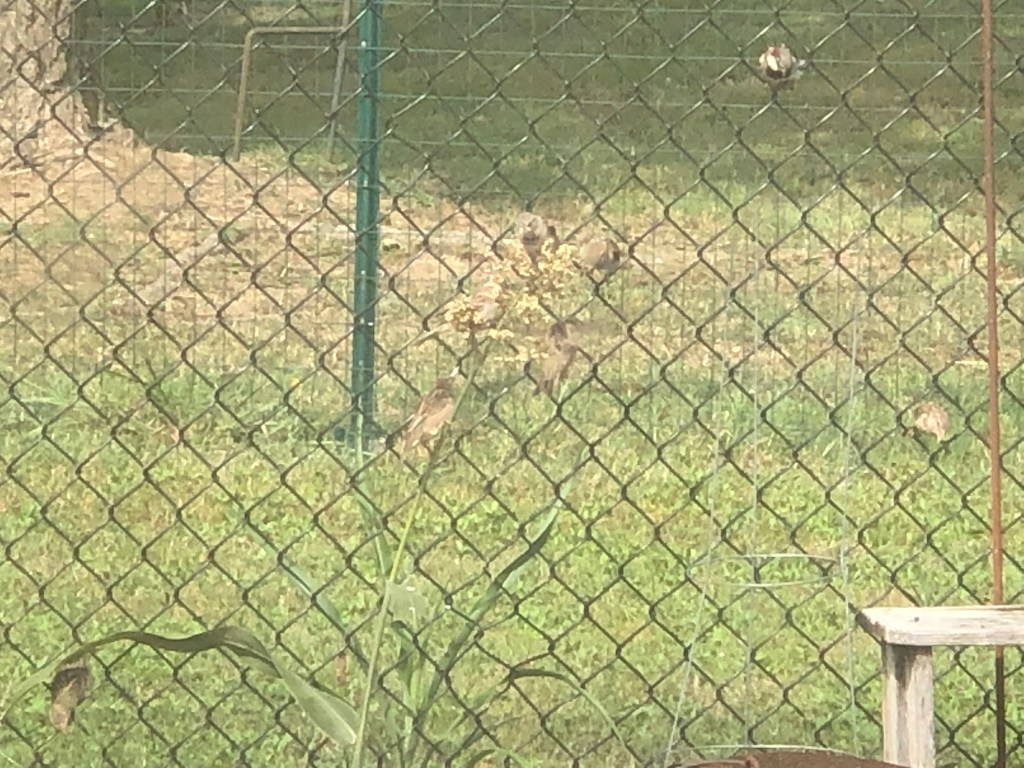
The Song Sparrow (Melospiza melodia) is a medium-sized New World sparrow.  It is easily one of the most abundant, variable, and adaptable species among the native sparrows in North America.  Song Sparrows tend to flit through dense, low vegetation or low branches, but occasionally move into open ground after food.  Flights are short and fluttering, with a characteristic downward pumping of the tail.  Scientists recognize 24 subspecies of Song Sparrows and have described some 52 forms.  In general, the coastal and northern birds are darker and streakier, with southern and desert birds wearing paler plumages.  The Song Sparrow is a common scavenger of bird feeders and are abundant on ours.

You may recall that I misidentified the Durum wheat (Triticum turgidum subsp. Durum) that had grown beneath the feeder on the east side of our back fence as millet.  In my defense, wheat was not listed in the ingredients of the bird seed, so I had ruled it out while the plants were young.  Browntop millet (Panicum ramosum) is a native of India and was introduced into the United States in 1915.  It is grown in the southeastern US for hay or pasture and for the birds and quail to scavenger on game preserves.   It is a cheap staple in many of the bird seed packages I find at the market.  The millet has replaced the wheat that I cut earlier at our house, and several plants thrive just inside the fence on the north of the patio.

Thoughts:  One of the Millet stalks had headed several weeks ago and had continued to ripen.  I watched its progress but did not think much about it.  When I got up yesterday the Song Sparrows had discovered the large head and were fighting over who would scavenger the seed.  There were 2-3 birds hanging on the head and another 10-15 sitting in the fence even as more arrived.  The birds would fill their beaks with seed, flit to the ground, spit the seed out, and then eat the seeds one at a time.  Early humans thrived because they were good at being scavengers.  While we are now at the top of the food chain, our scavenger heritage keeps much of the human population alive.  I found it funny when the sparrows clamored around the meager food available on my porch.  It is not so funny when we see humans struggle to find food near their homes.  Do the work.  Follow the science.  Change is coming and it starts with you.

Friday

August 13, 2021

Yesterday I was reminded by Melissa that today was Friday the 13th.  While we do not claim to be superstitious, we do seem to keep up on the relevant superstitions of “others.”  This superstition occurs when the 13th day of the month falls on a Friday.  This happens at least once every year but can occur up to three times in the same year.  During 2015 there were three Friday the 13th’s, 2017 through 2020 had two Friday the 13th’s, and 2021 and 2022 both have one occurrence each.  Friday the 13th occurs in any month that begins on a Sunday.   The longest period that occurs without a Friday the 13th is 14 months, and the shortest period that occurs with a Friday the 13th is just one month.  There seems to be a lot of regularity in our superstition.

I had mentioned last November 13th about going online to research the origins of Friday the 13th in Western superstition.  There are three suggested theories, and all revolve around a tragic meal and death.  While the origin is unclear, what is known is that there is no reference to the 13th being unlucky until the 19th Century.  An early documented English reference is Henry Sutherland Edwards’ 1869 biography of Gioachino Rossini.  “He [Rossini] was surrounded to the last by admiring friends; and if it be true that, like so many Italians, he regarded Fridays as an unlucky day and thirteen as an unlucky number, it is remarkable that on Friday 13th of November he passed away.”  It is possible that the publication in 1907 of Thomas W. Lawson’s popular novel Friday, the Thirteenth, contributed to at least a partially to disseminating the superstition.  The novel tells of an unscrupulous broker who takes advantage of the superstition to create a Wall Street panic on a Friday the 13th

While it was not on the 13th, Jay Gould (president) and Jim Fisk (vice president) of the Erie Railroad are credited as the masterminds of a gold buying scandal in 1869 that became known as Black Friday.  The pair tried to corner the gold market and the scheme was joined by others.  When Gould and Fisk heard that President Grant was set to break their corner, they began secretly selling off their gold.  When the market broke the price of gold fell from $160 to $133.  The stock market joined the plunge, dropping 20 percentage points, and bankrupting or inflicting severe damage on some of Wall Street’s most venerable firms.  Thousands of speculators were financially ruined, at least one committed suicide, foreign trade ground to a halt, and farmers saw the value of their wheat and corn harvests drop by 50 percent.  While the pair may have served as inspiration for Lawson 38 years later, the result did predict the vulnerability of the market that crashed in 1929.  That was on a Thursday.

Thoughts:  In Italian popular culture, Friday the 17th (and not the 13th) is considered a day of bad luck.  Friday the 17th occurs on a month starting on Wednesday.  The origin of this belief could be found in writing the number 17 in Roman numerals (XVII).  By shuffling the digits of the number one can easily get the Latin word VIXI (“I have lived”), implying death in the present and an omen of bad luck.  The number 13 in Italy was considered lucky, but due to Americanization, young people now consider Friday the 13th unlucky.  Superstitions are attempts to control the future, or at least avoid pitfalls.  Today, many hold superstitious ideas about the covid vaccine.  Instead of controlling their future, they are risking the future of others.  Follow the science.  Change is coming and it starts with you.
Climate

August 12, 2021

We received the three screens several days ago taken for repair when our gutters were installed two weeks ago.  Melissa suggested I should get the screens back up as the birds are coming into our porch and creating havoc by knocking over the succulents on the shelving.  I had been intending to do this, but like most things it involved a process.  Even though we have a brick house, the eaves and trim are composition siding.  When the new gutters and soffit were installed, I noticed the outside of the house needed to be painted.  Since the screens were down and I need to paint I thought it might be good to paint the porch windows prior to reinstalling the screens.  What kept me from painting is the extreme climate we have experienced since the screens were returned.  While I knew I needed to do the work, I was reluctant to take the risk of working in the heat.  I installed the screens despite the heat.

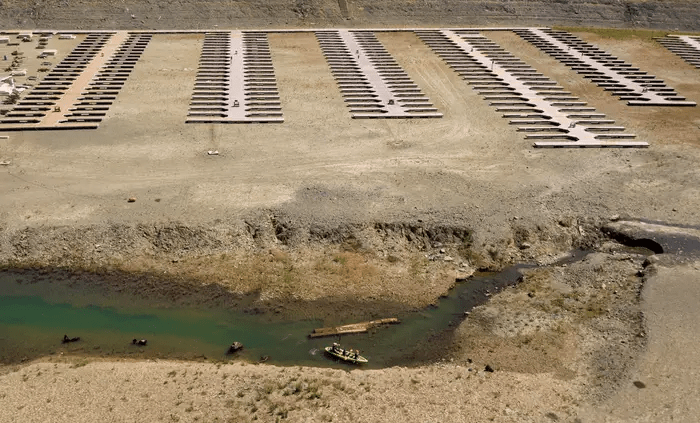
This week the Intergovernmental Panel on Climate Change (IPCC) released its first major report in nearly a decade, warning the Earth could face runaway global temperature changes unless drastic efforts are made to reduce greenhouse gases.  The IPCC says humans are “unequivocally” to blame for the climate crisis, which has already caused “widespread and rapid changes.”  Scientists concluded the average global temperatures will likely rise to 2.7F (1.5C) above preindustrial levels by 2040 based on carbon emissions already in the atmosphere.  The report also warns temperatures will continue to rapidly warm after 2040 unless immediate action is taken now.  According to the lead authors of the IPCC report, “The changes we’re seeing now are widespread.  They’re rapid.  They’re intensifying.  They’re unprecedented in thousands of years.”  Those who dispute the effect of climate change have taken an approach like that of the Storm Trooper in Star Wars, “Nothing to see here, move along.”

After spending a week with extreme heat warnings, Arkansas dipped to below average for a week.  Now we are again caught in extreme heat warning during this week.  Arkansas currently averages about 30 dangerous heat days a year.  The state is projected to see nearly 90 such days a year by 2050.   Excessive heat brings other changes as well.  Greater weather extremes at both ends of the spectrum relates to a simple physical relationship.  The higher the air temperature, the more water vapor it can store.  Rainfall can be heavier (floods), but then results in severe droughts (and fires) elsewhere.  Many consequences of global climate change are already irreversible, at least for decades.  Increased ocean temperatures have killed off massive swaths of coral reefs and sea levels have risen one inch every decade for more than a century.  Catastrophes on a global scale have begun (melting ice caps and shifting Gulf Stream) and will only get worse without addressing climate change.  Seems there really is something to see.

Thoughts:  One of the sites I checked stated the amount of climate change to expect and went on to cite ways to adapt to this new reality.  While ideas to mitigate the heat and adapt are good (planting trees and vegetation to replace the concrete and asphalt), I was left thinking we have already given up.  The heat will alter bird migration patterns and cause warmer species to move north.  Sea level rise will flood coastal cities and crowd the existing interior.  Perhaps the old song is closer than we think,” I’ve got some ocean front property in Arizona.”  Combatting climate change involves a process.  Some of the effects may already be irreversible but doing nothing will only make things worse.  Follow the science.  Change is coming and it starts with you.
Grey

August 11, 2021

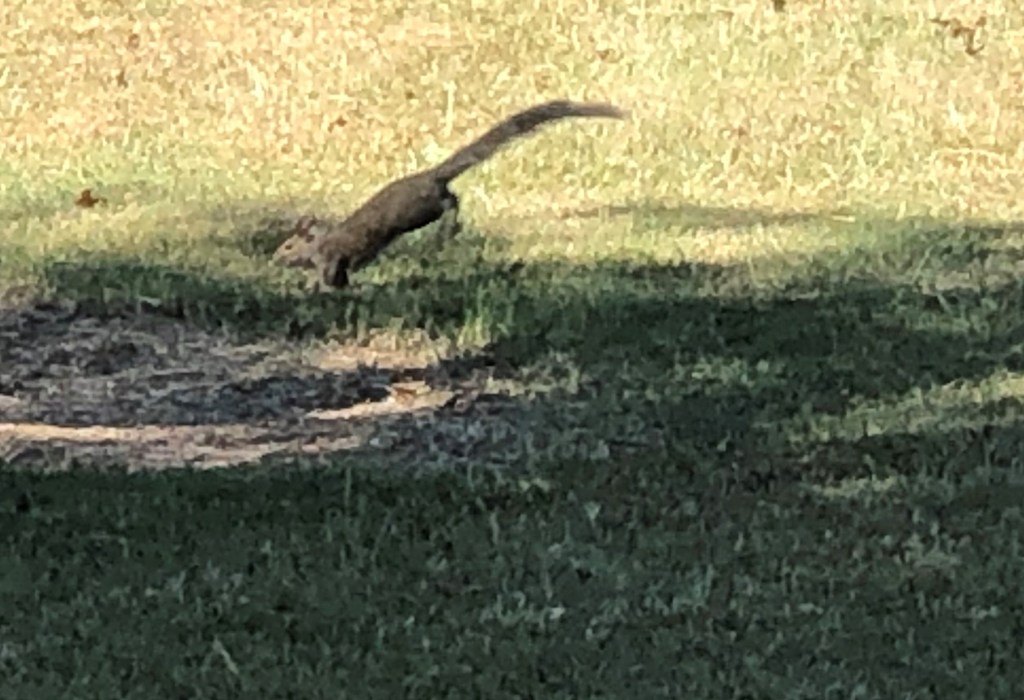
As I was leaving work yesterday, I noticed a squirrel playing around the oak tree at the front of our property.  Several weeks ago, I commented on the red squirrels that are more prevalent in the River Valley where I live.  In contrast, it is the gray squirrels that are abundant in the Ozarks where I work. 

The Eastern Gray Squirrel is one of very few mammalian species that can descend a tree head-first.  It does this by turning its feet so the claws of its hind paws are backward-pointing and can grip the tree bark.  While my Fox Squirrels are adept climbers and climb headfirst down my fence, they are unable to do the same on trees.  Apparently different squirrels have unique features.

When I looked online, I found the Eastern Gray Squirrel (Sciurus carolinensis), also known as the grey squirrel, is a tree squirrel in the genus Sciurus.  It is native to eastern North America, where it is the most prevalent.  Like many members of the family Sciuridae, the eastern gray squirrel is a scatter-hoarder; meaning it hoards food in numerous small caches for later recovery.  Some caches are temporary and located near the site of a sudden abundance of food.  These caches can be retrieved within hours or days for reburial in a more secure site.  Other caches are more permanent and are not retrieved until months later.  Each squirrel makes several thousand caches each season.  The squirrels have very accurate memory for the locations of these caches and use landmarks to retrieve them.  Smell is used to uncover the squirrel’s own caches, as well as to find other squirrels’ caches.  If the ground is too dry or covered in snow, it can result in lost caches.  The lost caches are why the Gray Squirrel is known as an essential natural forest regenerator.  The grey has a habit of losing caches of nuts and seeds.

Squirrels sometimes use deceptive behavior to prevent other animals from retrieving their cached food.  They pretend to bury the “object” if they feel that they are being watched.  They prepare the spot as usual by digging a hole or widening a crack, mime the placement of the food, but conceal it in their mouths, then covering up the “cache” as if they had deposited the object.  The Grey is also known to hide behind vegetation while burying food or hide it high up in trees (if their rival is not arboreal).  This complex repertoire suggests the behaviors are not innate (inborn) and imply a theory of intellectual thought used by the Grey.  It always amazes me what “dumb” animals can learn.

Thoughts:  The Gray has been widely introduced to other parts around the world.  On mainland Britain, they have almost entirely displaced native red squirrels.  On the European continent, the Gray has been included in the list of Invasive Alien Species of Union concern (the Union list) since 2016.  This specifies the species cannot be imported, bred, transported, commercialized, or intentionally released into the environment in the whole of the European Union.  Until recently, visitors from the US held a similar distinction due to the covid virus.  Perhaps we should take time to emulate the animals and learn something.  Follow the science.  Change is coming and it starts with you.