Fruit

June 12, 2023

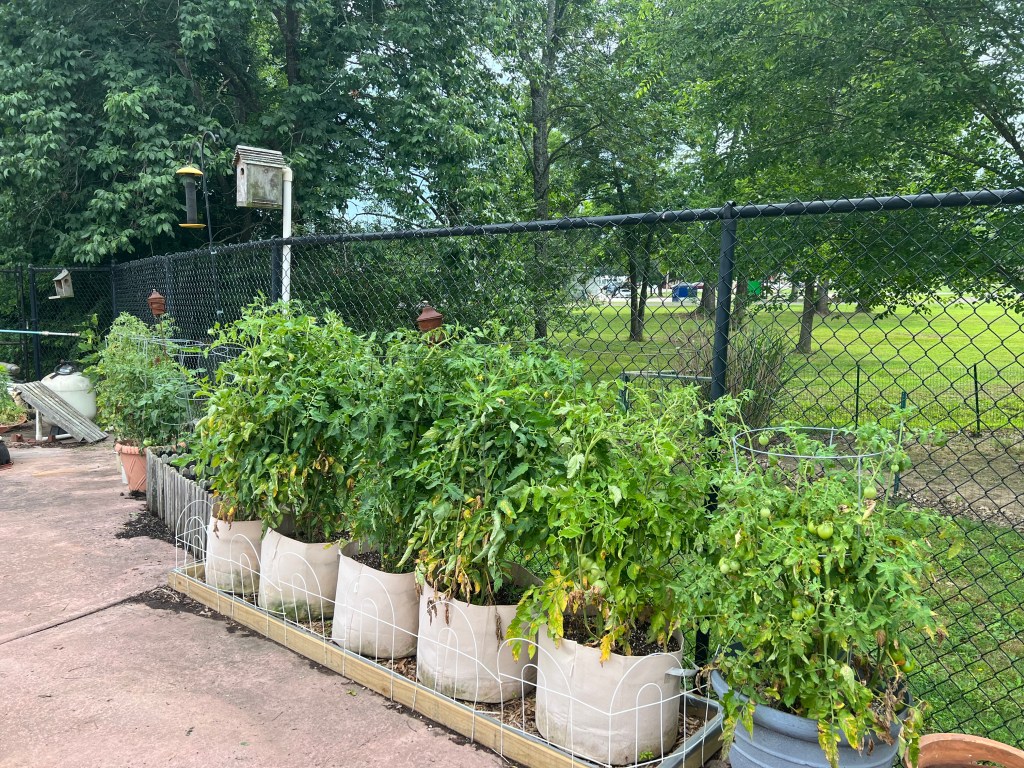
Last summer I blogged on the sparse fruit produced by the tomatoes and peppers in my container garden.  My only comfort was everyone in my Arkansas Gardeners group had the same complaint.  It was a bad year for gardens in Arkansas.  I ended up with several handfuls of garden fruits.  This year I added grow bags to my containers.  Despite getting the plants into the ground late and ignoring them for two weeks while I was in Kansas, the tomato plants have taken off and now I am having the opposite problem.  The foliage and green tomatoes are combining with the wind and rain (wet soil) to cause the plants to tip over in their cages.  I battled one of the cages earlier this week but this morning all nine of the cages were either tipping or toppled.  I attached the top of each cage to the chain link fence they sit in front of to give them more stability.  While I was at it, I harvested two jalapenos and a dozen super sweets.  The season is just starting, and I already have nearly as much fruit as last  year.

When I went online, I found the wild ancestor (Solanum pimpinellifolium) of the modern tomato is native to Mexico and western South America.  Modern tomatoes are all varieties of the cultivated plant (Solanum lycopersicum).  The name comes from the Nahuatl (Aztec) word “tomatl”, which gave rise to the Spanish word “tomate”, and in English became “tomato”.  Tomato plants typically grow anywhere from 3 to 10 feet (1 to 3 m) in height.  The plants are vines and typically have a weak stem that sprawls unless it is supported (like mine).  There are two types of tomatoes.  The indeterminate tomato plants are perennials in their native habitat and produce fruit throughout the growing season.  In cultivation they are treated as annuals and are replanted every year.  The other type of tomatoes are determinate (bush) plants that are true annuals.  They stop growing at a certain height and produce their crop all at once.  I have indeterminates and am hoping to have a lot of fruit throughout the summer. 

The oldest surviving depiction of tomato fruit and leaves (Solanum lycopersicum var. lycopersicum) comes from a page from the En Tibi Herbarium (1558).  En Tibi herbarium is short for En tibi perpetuis ridentem floribus hortum (Here for you a smiling garden of everlasting flowers) which is a 16th century herbarium.  This book contains 473 dried plant specimens, belonging to 455 species and subspecies and 97 families, and is one of the largest and oldest known of its kind.  An herbarium is a collection of preserved plant specimens and associated data used for scientific study.  The specimens may be whole plants or plant parts which are usually dried and mounted on a sheet of paper but may also be stored in boxes or kept in alcohol or other preservatives.  The specimens are often used as reference material in describing plant taxa.  The 16 3/4 by 11 1/2 inch (42 by 29 cm) En Tibi Herbarium features a fine leather binding, blind and gold embossed ornamentation, along with gilt and gauffered page edges and was owned by the Emperor of Habsburg, Rudolph II in the 1500’s.  The book is currently held in the treasure room of the Naturalis Biodiversity Center in Leiden.

Thoughts:  The Spanish saw the tomato used in cooking by the Aztecs and brought the plant to Europe.  Botanists in France, Italy, and northern Europe saw the tomato as a relative of the deadly belladonna nightshade (Atropa belladonna).  The tomato’s reputation got worse as its acidic juice interacted with the pewter plates.  The tomato was later deemed safe and during the 16th century went along with European colonization to other parts of the world.  The tomato met with suspicion for its looks and association, but when people got to know it, the fruit became a staple.  Humans often mistrust new or different things (and people) and make assumptions without taking the time to know them.  We need to treat people by their fruit rather than our impression.  Like the tomato, everyone deserves a chance.  Act for all.  Change is coming and it starts with you.

Neighbor

June 10, 2023

I received a post today on my local Nextdoor app that identified a new neighbor who had moved into our area.  Our subdivision abuts the hills and wooded area along the northeast side of town and is named for the small creek that winds throughout.  It is not uncommon to periodically receive posts as someone either joins the local app or moves into the neighborhood and wants to say “Hi!” to introduce themselves.  What made this post different was it was not posted by the neighbor, but instead by another who spotted them in the community.  This new neighbor did not stop to say “Hi!”, but instead was just going about their own business.  The post accompanying their photo said, “Shocked to see this!”  When I clicked on the small photo in the corner of the site, I saw the large American black bear (Ursus americanus) who had been identified in one of the trees near our house.  While I was not shocked by the appearance of this new neighbor, I was glad it was in someone else’s yard.       

When I checked online, I found that Nextdoor Holdings, Inc. is an American company which operates a hyperlocal social networking service to connect with your neighbor.  Nextdoor was founded in 2008 and is based in San Francisco, California.  The company launched throughout the US in October of 2011, in July of 2012 raised US$18.6 million in venture capital funding, and by February of 2014 had over 80 employees.  Users of the app are required to submit real names and addresses to the website, but these are not verified for accuracy.  Advertising was added to the platform, including real estate advertising, in 2017, and this includes posts inside users’ feeds about business services and products.  Nextdoor has acquired other social network services (Streetlife in the UK, and Hoodline in the US), and became a publicly traded company in November of 2021.  As of May of 2023, this neighbor connection service is available in 11 countries. 

Historically, it would have been the humans who spread as a new neighbor into the territory of the American black bear.  Historically the bear occupied most of North America’s forested regions, but now they are limited to sparsely settled, forested areas.  The current range of black bears in the US is constant throughout most of the Northeast and the Appalachian Mountains, in the northern Midwest, the Rocky Mountain region, the West Coast, and Alaska.  The bears are increasingly fragmented in other regions but seem to have expanded their range during the last decade.  Thousands of black bears are hunted legally across North America (200 per year in Arkansas), some poached illegally, and collisions with vehicles claim more lives annually.  California has an estimated 25,000-35,000 American black bears, making it the largest population of the species in the contiguous United States.  Mexico is the only country where the American black bear is classified as “endangered”.  Except for the rare confrontation with an adult brown bear (Ursus arctos) or a gray wolf (Canis lupus) pack, adult American black bears have little natural predation.  Today, black bear fatalities are mainly attributed to humans. 

Thoughts:  Black bears were eradicated from Arkansas early in the 20th century, but the Arkansas Game and Fish Commission reintroduced 254 black bears from Minnesota and Manitoba, Canada, into the Ouachita and Ozark Mountains between 1958 and 1968.  Now the number of black bears in the state is increasing.  The return of black bears to Arkansas is historically significant and symbolizes the revival of the wilderness, even as it provides increased recreational opportunities.  Some fear the return of black bears because of potential loss of livestock and pet depredation.  Black bears rarely attack humans.  Our neighbor bear is probably a young male searching for a safe home.  If so, he deserves to be left alone.  Act for all.  Change is coming and it starts with you.

Hydro-Quebec

June 09, 2023

As I perused today’s local paper, I came across an article on an attempt to make the US energy grid less reliant on fossil fuel by tapping into the abundant hydroelectric power generated in Canada.  As the New England states shift to green energy most is currently produced by hydroelectric plants in northern Quebec Provence and then sent south along huge transmission lines.  A new study by the Montreal Economic Institute published in May predicted that by the end of the decade these large hydroelectric systems will fall short of the generating capacity to meet the demand for power in Quebec Provence.  This is forcing some New England lawmakers to question plans to construct new transmission lines across their states, despite the Canadian energy giant Hydro-Quebec’s insistence it will still be able to meet its obligations.  Over the last decades Hydro-Quebec has built a series of electric generating facilities in northern Quebec and construction of the dams and the resulting flooding of lands behind them have drawn protests from indigenous and environmentalists on both sides of the boarder.  These dams now provide half of the renewable hydroelectric energy generated in North America.

When I checked online, I found Hydro-Québec is a public utility that manages the generation, transmission, and distribution of electricity in the Canadian province of Quebec, as well as the export of power to portions of the Northeast United States.  The energy giant was established by the Government of Quebec in 1944 from the exportation (i.e., taking by the state for public use) of private firms.  This was followed by massive investment in hydro-electric projects in northern Quebec resulting in 63 hydroelectric power stations having a combined output capacity of 37,370 megawatts.  Extra power is exported from the province and Hydro-Québec supplies 10% of New England’s power requirements.  Hydro-Québec is a Crown corporation (state-owned enterprise) based in Montreal. In 2018, it paid CAD$2.39 billion in dividends to its sole shareholder, the Government of Québec.  More than 40% of Canada’s water resources are in Québec and Hydro-Québec is the fourth largest hydropower producer in the world.  The company’s residential power rates are among the lowest in North America.

Connecticut’s Department of Energy and Environmental Protection Commission has stated hydroelectric power is only one part of the solution to achieve clean energy.  The New England states are working together to decarbonize the electric systems using other means, including offshore wind turbines.  Hydro-Quebec has expressed interest in transmission lines capable of moving power in both directions.  This would allow hydro to be transmitted from the north and wind generated in New England to be transmitted to Canada for storage later use, particularly during the winter when reliability is not always assured.  The 211 mile, 1,200 megawatt line is estimated to cost US$2 billion.  Investment in clean power is not cheap.  

Thoughts:  Hydro-Quebec invested US$4.3 billion in the construction and maintenance of their transmission system in 2022 alone.  In return they posted a net income of US$4,557 million.  While clean power may not be cheap, it appears to be profitable.  Moving to clean energy sources has always been met with pros and cons.  The projects can have impacts on the lands where they are built (dams flood land, turbines kill raptors, construction may impact critical environments.).  These are legitimate concerns and need to be considered when approving the projects.  Continuing to use fossil fuels does not appear to be an alternative that is sustainable in either the long (non-renewable) or short run (climate change).  The most cost effective and environmentally sound action would be for all of us to use less energy.  Act for all.  Change is coming and it starts with you.
Yard Waste

June 08, 2023

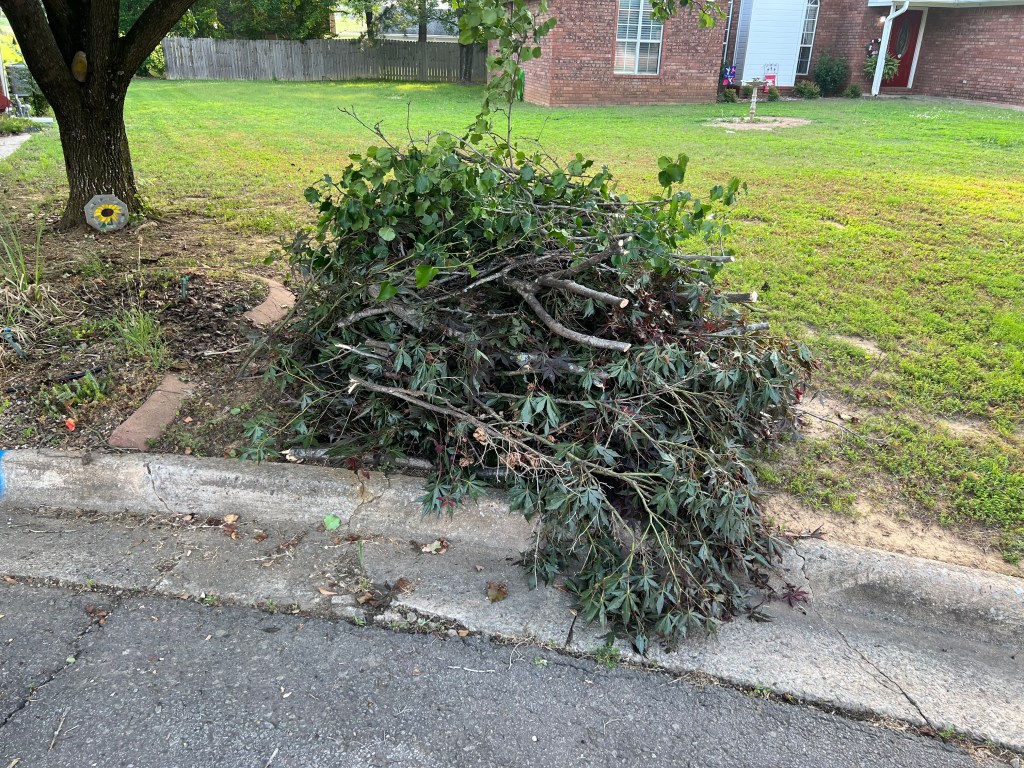
I have been trying to get my mower repair person on the phone for the last two weeks.  The mower would start and work well until it got into any high grass, where it would sputter and die.  Since I have not been able to mow, the grass is now all in the “high” state.  I prefer this repair service as he is local (always my preference), but also “mobile”, meaning I do not have to worry about getting the mower to his shop.  I was able to contact him on Tuesday and he agreed to drop by yesterday afternoon.  I putzed around inside the house during the morning but decided I might as well work on the outside during the afternoon while I waited for him to arrive.  One task Melissa had asked me to complete was to trim the Japanese Maple (Acer palmatum) that dominates the bed in the front of the house.  Since I do not own a chainsaw, I took loppers and a camp saw (backpacking) and began to cut away the limbs and branches overhanging the roof and draping the sidewalk and entryway.  As I cut off the limbs, I neatly stacked them in a pile along the front curb as yard waste.

When I checked online, I found that yard waste materials are comprised of grass clippings, leaves, and yard trimmings, and make up approximately 10% (by volume) of the municipal waste stream.  Yard waste can account for 50% or more of residential solid waste during the active growing season.  While yard waste is biodegradable, landfills do not get the oxygen and water needed for breakdown, as they are built to prevent the movement of air and moisture to protect the surrounding environment.  These materials can be better used to enhance gardens and landscapes through composting.  There are some communities with established municipal composting facilities to efficiently manage large quantities of yard waste, but gardeners can reduce the amount of yard waste generated (mulching and composting) and recycle the rest.  Composting on site can have a great impact, both economically and ecologically.

When we moved back to Arkansas, I did a lot of work trimming the trees and along the back hedgerow.  I knew yard waste was not permissible in the regular garbage pickup.  Melissa told me that rather than burning the debris (which is allowable), and since we do not own a trailer or pickup to haul the yard waste to the tree dump, she and her dad had always thrown the limbs into the hedgerow.  That meant every time I trimmed the trees, I had to drag the debris from the front yard to the back of the house.  Last year I noticed our neighbor across the street cut down one of his trees, and rather than hauling it off he cut it into smaller pieces and stacked it in a pile in front of his house.  When I asked, he told me if the trees were not trimmed or cut by a commercial company, the city will come on the first week of every month and remove the yard waste.  However, there are criteria for this to happen.  The brush needed to be cut in lengths no longer than 4 feet (1.2 m), stacked no more than 2 feet (0.6 m) from the curb, and the pile could not be in the gutter.   I tried this earlier this spring and was pleased to see the pile was picked up.  This time I created a larger pile of yard waste, and I hope it will happen again.

Thoughts:  I have tried composting in the past but never thought of putting the limbs and branches into a pile as yard waste.  For leaves and grass clippings I use a mulching blade on my mower to recycle the yard waste back into the lawn.  In the past I bought a composting barrel and used it in several yards where we lived but never had much luck creating any compostable material.  Whether it is composting yard waste or recycling plastic or cans, there is always thought, planning, and at times added expense that need to occur.  This is worth the time and expense if we can make an impact economically and ecologically.  Maybe it is time to rethink how to compost my yard waste.  Act for all.  Change is coming and it starts with you.
D-Day

June 06, 2023

Last December my brother and his wife took a river cruise from Paris to northwestern France.  He had gotten his degree in history and spent a semester in southern France but was unable to visit the towns and beaches he had read about as part of the Allied invasion of Normandy.  The cruise was booked months in advance and described the places in Normandy which were included.  As the cruise time approached, he learned the itinerary changed during the Christmas holiday.  Rather than touring the history around Normandy, the Christmas festivals along the route were the featured attraction.  They did extend their time in Paris, but rather than seeing the sights there they chose to visit Normandy.  Today marks the 79th anniversary of what became known as D-Day.

When I checked History.com, it said today marks the invasion of the beaches at Normandy in northern France by the combined Allied forces during World War II.  The German army occupied northern and western France in June of 1940 and the southern portion was occupied in November 1942.  The D-Day assault (Operation Overlord) landed 156,000 Allied soldiers on five different beaches by the end of the day.  The Allies encountered light opposition on four of the beaches, but the US forces met with heavy resistance on Omaha Beach.  More than 4,000 Allied troops lost their lives in the D-Day invasion, and thousands more were wounded or missing.  The D-Day invasion was the largest naval, air, and land operation in history to date.  Within a few days 326,000 troops, 50,000 vehicles, and 100,000 tons of equipment had landed.  Two months later northern France was liberated, and Berlin fell to the Soviet army on May 2.  The Allies formally accepted Germany’s unconditional surrender on May 8, 1945.  Historians often refer to D-Day as the beginning of the end of World War II.

While the historic facts around the D-Day invasion are well known, Sarah Rose in her book, D-Day Girls: The Spies who Armed the Resistance, Sabotaged the Nazis, and Helped Win World War II, focused on the stories of the female agents who contributed to the Allied victory in Normandy and the liberation of Western Europe.  Andrée Borrel, Lise de Baissac, and Odette Sansom were among 39 female agents who served in the Special Operations Executive (SOE), a secret intelligence agency established by Prime Minister Winston Churchill in 1940.  Borrel left France to train as a nurse with the Red Cross.  She returned to help over 65 Allied troops escape France to Spain over the Pyrenees.  She narrowly escaped herself, then parachuted back in September of 1942, becoming the first female combat agent to do so.  She was captured and spent a year in a concentration camp before being executed a month after the D-Day invasion.   Baissac left Paris on June 5, biking through the German lines for three days to bring news of the invasion to her brother in the French Resistance.  She continued to gather intelligence which helped the US forces break through the German front seven days after D-Day.  Sansom was born in Normandy but married a British soldier and lived in England.  She answered the call to return to her homeland to become a courier for the Resistance in southeast France.  She was arrested in 1943 and survived over a dozen torture sessions.  After the war her testimony was used to convict the camp commander and other SS officers of war crimes.    

Thoughts:  While the historic facts are often known, the stories behind them are what spark our interest.  My brother wanted to see the towns and sights he had read about.  Rose told the stories of the women and added insight to the intelligence behind the D-Day invasion.  History is more than names and dates.  It is the story of people living the best they can in circumstances often beyond their control.  When we hear the stories of others, we can learn how to live our own lives.  That is why even boring history matters.  Act for all.  Change is coming and it starts with you.

Leaf-footed

June 03, 2023

I have not been feeling well lately and have been neglecting to water my container garden.  Yesterday I decided to push through and get water on my plants.  I have gotten most of what I originally intended in the ground (or pots).  This includes Poblano (Capsicum annuum var.) and Jalapeno (Capsicum annuum var.) peppers, Supersweet 100 (Solanum lycopersicum) and Arkansas traveler (Lycopersicon lycopersicum ) tomatoes, and Yukon gold potatoes (Solanum tuberosum var.).  While I was planting the potatoes last week, I noticed one of the russets (Solanum tuberosum var.) in the pantry had gone to seed.  I cut the sprouted portion off the potato and planted it in a spot where the Yukon I had planted the week before did not sprout.  As I was dutifully making my rounds watering among the various plants, I noticed a large beetle perched on the fence by the bird feeders.  It was a leaf-footed bug.

When I looked online, I found the Leaf-footed bug (Acanthocephala femorata) is found in the continental US and Mexico and is considered a pest by orchards and gardeners.  The genus name Acanthocephala means “spiny head” and comes from the pointed tylus at the tip of the head.  The lower rear legs are wider than the upper legs, with serrations and are especially pronounced in the male.  The bug has long, slim, curving antennae with distinctive orange tips.  The body is reddish brown to nearly black.  Leaf-footed bugs are one of the common pests found throughout the southern US.  Although the infestations are rarely serious, they feed on a variety of crops, causing damage to fruits, vegetables, grains, nuts, and ornamentals.  They can be a major pest in citrus groves and cause significant fruit damage and loss.  Leaf-footed bugs have many predators and biological control is generally enough to keep their populations in control.  Many leaf-footed bugs do not make it past the larval stage, as parasitic flies often lay their eggs within the developing larvae, paralyzing them.

Leaf-footed bugs are most active during the warmer months.  In home gardens the bugs puncture ripening fruit, which causes secondary infections and rot.  Their piercing-sucking mouthparts allow them to suck nutrients from the stems, leaves, and fruits as they move from plant to plant.  Since the adults are winged, they can be very difficult to control.  The more I read on the leaf-footed bug the more I began to worry about a possible infestation.  Integrated pest management (IPM) strategies are effective in controlling leaf-footed bugs.  One important principle of IPM is knowing your “action threshold,” and deciding when to intervene.  Minor damage may not warrant any action except continued observation.  Prevention can be used by applying row covers to keep flying adults from entering and laying eggs.  Keeping plants healthy, well-watered, and appropriately spaced also serve as control.  If damage reaches an unacceptable level, start handpicking the bugs off the plants.  Destroying the eggs, nymphs, and adults by hand is a very effective method of leaf-footed bug control.  The University of Florida recommends to only use insecticides if you are unable to control the leaf-footed bugs with other methods, and even then, to spot treat the infestation.  Treating large areas that are not infested will kill beneficial insects, including bees.

Thoughts:  The leaf-footed bug I encountered on my patio posed no threat to me and only a minimal threat to my tomatoes.  I left it alone to go about its business.  I may have felt different if I had found it attacking one of my early developing tomato fruits.  I am committed to using pesticides only as a last resort.  They often kill the good insects along with the invaders and left over residue can be ingested by humans.  That means I may have a few marked and pitted vegetables, but the biological controls in my garden ecosystem will be much healthier.  Using more is never a good thing for your vegetables or the environment.  Act for all.  Change is coming and it starts with you.
Treaty

May 30, 2023

The Nation & World section of today’s local newspaper headlined the United Nations talks happening now in Paris.  Nearly 200 countries have agreed to start negotiations on an international agreement to act on the “plastic crisis”.  UN members are tasked with developing an over-arching framework for reducing plastic waste across the world amid a growing concern that discarded plastic is destroying habitats, harming wildlife, and contaminating the food chain.  While positive, there appears to be little agreement on the outcome of these talks.  This is the second of five talks to complete negotiations by the end of 2024.  Supporters describe this as one of the world’s most ambitious environmental actions since the 1989 Montreal Protocol which phased out ozone-depleting substances.  There are more than 2000 participants, including governments and observers.  One of the major issues under debate is how to determine the system of voting on the decisions by each nation.

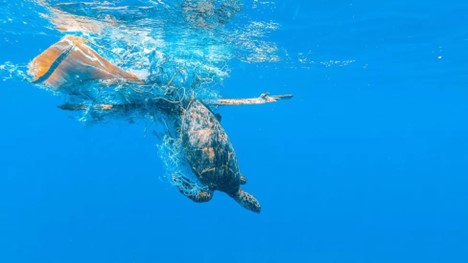
When I looked online, I found a set of facts concerning the world’s plastic pollution.  More than five trillion pieces of plastic are in the world’s oceans, all of which can take years to break down.  Humanity produces more than 430 million tons of plastic each year and 40% of that is single use plastic or used once before being thrown away.  Over eight million tons of plastic enter the world’s oceans each year and most escape from land.  Not all plastic can be recycled, some because of the way it is made and others because it is considered too expensive or difficult to do so.  Plastic pollution can harm animals on both land and sea as they get trapped in carrier bags, food packaging, or mistake plastic for food.  Steve Fletcher of the University of Portsmouth is an advisor for the UN Environment Program (UNEP) on plastics issues.  Fletcher stressed the plastic problem spans international borders and boundaries.  “One country can’t deal with plastic pollution alone, no matter how good its policies are.  We need a global agreement to enable us to deal with the widespread challenges that plastic gives us as a society.” 

Global plastic waste is set to triple by 2060, with about half slated to end up in landfills and only one fifth being recycled (the other third scatter across the planet?).  As with any global treaty, there are several power players who are lining up to protect their right to make plastic even as they work to curtail the waste.  A “high ambition” coalition led by Norway and Rwanda want limits on plastic production and restrictions on some of the chemicals used to make plastics.  A coalition of plastic producers and oil and gas exporters, including the US, Saudi Arabia, and China, wants to address waste and scale up recycling.   The International Council of Chemical Associations, the World Plastics Council, and American Chemistry Council want to eliminate plastic pollution while “retaining the societal benefits of plastics.”  Finally, the International Pollutants Elimination Network wants a treaty to restrict chemicals to make plastics that are harmful to health and the environment.  World leaders have until 2024 to agree on the plastic pollution treaty, including which elements will be legally binding and how the deal will be financed.  There will be additional pressure to help countries in the global south deal with plastic problems created in the global north.

Thoughts:  It is interesting to note the UK not only supports the resolution but described the agreement as “truly historic”.  That is even though no treaty or even a framework for one has been drawn up.  During one lifetime humans have caused unimaginable damage to the global ocean with plastic pollution.  Right now, there is no text to negotiate, only ideas.  Until “something” is on paper, nothing will happen.  They have until 2024.  Act for all.  Change is coming and it starts with you.

E. coli

May 25, 2023

Several years ago, I blogged on the meaning behind Memorial Day as an American holiday observed on the last Monday of May honoring the men and women who died while serving in the US military to remember their service.  Following the American Civil War this was known as Decoration Day, but the name was changed to be Memorial Day, and was made a federal holiday in 1971.  The day has officially set aside to honor veterans, but many Americans observe Memorial Day as a time to visiting cemeteries or hold memorials to remember family members.  This day also marks the unofficial beginning of the summer season and like most American holidays, this morphed into Memorial Day Weekend.  Our State and Federal Parks are booked well in advance as families and friends come together for camping, fishing, boating, and swimming in the pristine Arkansas lakes.  However, the big news in northwest Arkansas this last week has been the discovery of E. coli contamination in one of the area’s large lakes.   

When I looked online, I found E. coli is a bacterium that originates from the waste of animals or humans.  High numbers of E. coli in a pond could come from septic systems, runoff from barnyards, or from wildlife (especially waterfowl).  Ponds and lakes used for swimming and other recreation should have less than 126 colonies of E. coli bacteria per 100 mL (3.4 oz) of water.  High levels of E. coli bacteria can be reduced by limiting animal access to the pond, maintaining nearby septic systems, and redirecting runoff from barnyards and other areas where animal waste accumulates.  The parks have taken restrictive measures to reduce their use by domesticated animals and do not allow feed lots in their vicinity.  The problem appears to be the large number of waterfowl that migrate through the area during the spring.  This is compounded by the Canada geese (Branta canadensis) who nest at the lake.  Swimming in water with high levels of E. coli can make you sick causing nausea, vomiting, and fever.

Beaver Lake is managed by the US Army Corps of Engineers (USACE) and they announced the closing of three beaches on the lake due to “higher than acceptable E. coli levels.”   The USACE does baseline testing at the beginning of the year and test before each of the major holidays to make sure the swim beaches are safe.  Large amounts of rain (like we have been having) can wash the shore fecal matter into the lake and create unsafe conditions.  Beaver Lake has a total of 14 swimming beaches and the Corps only tests those areas.  Three of the swimming beaches at Beaver are closed for E. coli and the beach at Horseshoe Bend is closed because of high water.  The Corps says they must get two consecutive tests back indicating the water is safe before reopening a swimming beach. The Corps took a water sample on Monday and another Tuesday in hopes of reopening the swimming beaches in time for the weekend.  As of today, at 3:16 pm, after tests showed acceptable E. coli levels for the beaches, they have been reopened.  Apparently Memorial Day Weekend has been saved.

Thoughts:  The Environmental Protection Agency (EPA) develops criteria to protect people from viruses and bacteria and their associated toxins in water bodies.  State and tribal governments “can use” the recommended criteria as guidance when setting their own water quality standards to protect human health.  The problem with trying to protect people is the way levels of contaminants are determined to be acceptable.  An acceptable level does not mean the contaminant does not exist, but confirms the contaminant is present.  Studies are conducted to determine the amount of contaminant that is the acceptable limit.  I am not sure how different the effects will be if there are 125 colonies of E. coli rather than 126.  At least now we can all swim safely.  Act for all.  Change is coming and it starts with you.

Shredded

May 21, 2023

I had blogged several months ago about my dog Zena tossing her bed around in the living room while I was working on my crossword in the kitchen nook.  This was a favorite game she played by herself, and I did not think too much about it until I noticed the noise had gone quiet.  I got up to check on her and found she had managed to rip the seam of her dog bed and had shredded the stuffing which now lay scattered about the floor.  It looked like a bomb had gone off in the living room.  I restuffed the bed and put duct tape along the length of the seam (fixes everything, right?).  The bed survived and now Zena’s little brother Loki has claimed the bed for daytime sleeping.  Last week Loki was playing behind me while I was working in my office when I again noticed the silence.  When I turned around, I saw Loki had emulated Zena, except it was my newspaper that had been shredded.  As I cleaned up the mess, I was relieved to see he had chosen a paper where I had already filled in the crossword.

When I looked online, the website Dog Discoveries said many dogs enjoy creating shredded paper as much as playing with a chew toy.  Watching a dog shred paper into pieces can be fun, but not if it involves your homework, your daily newspaper, or important documents that you then need to try and piece back together.  All dogs tend to shred paper, but puppies and young dogs are always looking for anything that can be shredded to provide sensory enjoyment.  Mail can be interesting because it is covered in scents, and bubble mailers can be popped and then shredded into pieces.  The site suggested tearing paper into pieces fulfills a dog’s ancestral need to eviscerate and tear apart prey animals in the wild.  While dogs (Canis lupus familiaris) are domesticated, they have an instinct that draws them to the old days of the hunt, and paper may fulfill a dog’s needs to grab, bite, shake, and dissect.  Paper-related products are extremely inviting and may unveil the “tissue paper predator” in a dog.

According to Forrest Wickman the popular excuse “my dog ate my homework” possibly originates from as early as 1905, when a clergyman pulled his clerk aside after a service to ask him whether his sermon seemed long enough.  The clerk reassured him that it was fine and of the right length.  The relived priest said, “I am very glad to hear you say that because my dog got a hold of my sermon and ate some of the last pages.”  Word of the episode got around, and the saying got quite popular and went on to become the infamous excuse used by countless students when they failed to turn in their homework.  While I have never tried the dog ate my homework excuse, I have sat through several sermons that could have used a dog to have shredded several pages of the manuscript.

Thoughts:  Another reason both Zena and Loki shredded their respective materials is they were bored.  They were left to play by themselves, and they found an activity to keep occupied.  When I caught both, they seemed to look at me sheepishly as if knowing their activity was not acceptable.  As parents raising young children there are times when we need to find time away for ourselves.  Whether this is filling the crossword over a morning cup of coffee or relaxing with a book while the kids play in the next room, if you can hear them (and periodically check on them), they are probably all right.  As any parent knows, when you really need to check on your kids is when they go quiet.  That is when the lipstick finds it way to the wall or big sister cuts little brother’s hair with toy scissors.  Pets and children both get bored when they are left unsupervised, and the level of what gets shredded goes up the longer they are left on their own.  Act for all.  Change is coming and it starts with you.

Sausage

May 19, 2023

While we were in Wichita my brother and I decided to renew the tradition we had prior to my moving to Arkansas and get together for breakfast.  Since my sister was also in town, we expanded this tradition and asked her to join us.  We had previously gone to the same roadside café located halfway between his town and mine, but since we were in the same city, we chose instead to eat at a quaint restaurant nearby.  I could not remember the exact address (or name) so I went on a driving tour the day before to find it before we met.  I texted the location to him and prepared for the following day’s breakfast and conversation.  We arrived at about the same time and were seated at a table toward the front.  Since I was on vacation (I really did not need an excuse) I decided to order the sausage platter.  The plate arrived with fried potatoes covered with eggs, toast on the side, and a humongous sausage draped across the top.  This was going to be a challenge.

When I looked online, I found sausage is a type of meat product usually made from ground meat (pork, beef, or poultry) along with salt, spices, and other flavorings.  Ingredients like grains or breadcrumbs may be included as fillers or extenders.  Used as a general noun, sausage can refer to the loose meat formed into patties or stuffed into a skin.  When referred to as “a sausage”, the product is usually cylindrical and stuffed in a skin or casing.  The casing is traditionally made from intestine but sometimes comes from synthetic materials.  Sausage-making is a traditional food preservation technique, and the meat may be preserved by curing, drying, smoking, or freezing.  Some cured or smoked sausages can be stored without refrigeration, but most fresh sausages must be refrigerated or frozen until they are cooked.  Sausage is made in a wide range of national and regional varieties which differ by the types of meats used, the spicing ingredients, and the manner of preparation.  Vegetarian and vegan varieties of sausage using plant-based ingredients (no meat and synthetic casing) are now widely available.

When my sausage platter arrived, it reminded me of the sausage I was served last year in Cologne, Germany.  The German sausage was lunch rather than breakfast and came with potatoes and sour kraut (and of course German beer) along with an equally enormous sausage.  The Germans were the largest European group who settled in Kansas and this heritage is seen in many Kansas town names.  Some of the Kansas Germans emigrated directly from Germany, but many also came from Russia, Switzerland, Austria, and other parts of the US, including the Pennsylvania Germans.  Germans represent several denominations, but were mostly Mennonites, Quakers, Calvinists, or Protestants.  Germans in Kansas did not always have it easy and were treated as outsiders for years, along with facing anti-German sentiment during World Wars I and II.  I was happy to see even though my favorite German restaurant had failed during the pandemic, the tradition of huge sausage was still alive and well.

Thoughts:  The Germans who immigrated to the US in the late 19th century were met with mistrust and animosity.  The way these immigrants made themselves comfortable was to continue German language newspapers (more than 60 in Kansas) and serving traditional foods, including sausage.  German sausages include Frankfurters or Wieners, Bratwürste, Rindswürste, Knackwürste, Bockwürste, and Currywurst (sausages with curry sauce).  More than a hundred years later most Germans have been assimilated by American culture (as have I), although the Mennonites and Amish are still distinguished.  Today’s Immigrants come with food and traditions that are different than what may now be the norm.  We should learn from our own immigrant past and give them the same 100 years before we complain of a lack of assimilation.  Act for all.  Change is coming and it starts with you.