Attention

September 06, 2022

I was in that deep REM (rapid eye movement) slumber you get right before you wake up in the morning when I felt something nuzzling my hand.  My hand was outside the covers and Zena had decided it was time for me to take her outside.  I had initially been good about hopping up when notified she needed out, but I have become lax now that she is older.  I ignored her hoping she would go lay down.  Rather than laying down I heard her nails click across the floor to the other side of the bed.  While I did not see this, Zena must have used a similar tactic with Melissa as I heard her rouse, but she did not sit up in the bed.  Having been ignored by both her peeps Zena decided to take matters into her own hands (paws?).  With a huge leap Zena landed in the middle of the bed.  This time she made herself clear.  I want some attention.   

When I looked online, I found Ben Parr of the Harvard Business Review had written on the seven best triggers to get someone’s attention.  Automaticity refers to sensory cues to automatically direct our attention.  This is one of our survival mechanisms that helps us react faster than our brains can think.  Framing refers to our view of the world shaped by our biological, social, personal experiences, and biases.  These tell us to pay attention to some ideas and to ignore other.  Disruption means we pay attention to anything that violates our expectations as we figure out whether this is a threat or a positive development.  Reward is provided by the neurotransmitter dopamine which is aligned with anticipation and motivation.  This fuels our desire to “want” and rewards us with self-satisfaction and a sense of purpose.  Reputation causes the decision-making centers of our brains to slow or even shut down while we are receiving advice from an expert, a phenomenon known as “directed deference.”  Mystery or wondering what will happen has a scientific term attached to it, the Zeigarnik effect.  Since we dislike uncertainty, we try and actively reduce it by any means possible.  Finally, acknowledgement is our need for validation and empathy from others and is one of our most vital human needs.  Understanding the science of attention is a prerequisite to success in both your business and personal life.

Most of us have experienced others using inappropriate ways to get our attention (yelling, “Heh.  You!”), but how do we teach children the right way to get another’s attention?  One way to start is by standing close to the person whose attention we seek.  Moving close to another’s personal space will allow them to subconsciously feel your presence, even if they are not looking at you.  If that does not work, you can gently tap them on the shoulder or say their name, and then wait for them to respond.  If all else fails, you can begin a conversation and hope they will participate.  My favorite way to get someone’s attention is to approach the group already in conversation, move just outside their personal zones so they know I am there but not intruding, and listen intently to the conversation.  Most will (at least eventually) accept or acknowledge your presence.  Now that you have their attention, you can ask your question.  Teaching children to politely get attention is a skill that should be taught and practiced keeping it fresh in a child’s mind.  While nuzzling the other person’s hand may be effective, it may not have the desired result.

THOUGHTS:  I recall talking with my sister at her daughter’s outdoor wedding when she noticed the mother of the groom in conversation about 100 yards (30 m) away.  She wanted to talk with her and asked me if I would be willing to get her attention.  I said sure, and loudly called out the woman’s name.  She turned around and looked, so I got her attention, but I am sure that was not my sister’s intention.  There are good and bad ways to get another’s attention.  In social situations it is most often appropriate to be polite.  How you get another’s attention will often determine the tone of the conversation and whether they will even listen to you.  While unity builds, conflict can only divide.  Act for all.  Change is coming and it starts with you.

Day Off

September 05, 2022

Shot of a group of friends having a barbecue in the yard

In my mind I have always seen the weekend as time off, or at least as a day off somewhere over the span of these three or four days.  Like so many workers, that does not mean I do not work, but it does mean I can be more subjective about what I do and when I do it.  Fridays are the day when I usually complete my last preparation for Sunday, but in the back of my mind I know if I do not finish, I still have Saturday.  Sunday afternoon is seen as a time of preparation for Tuesday but lately I have allowed most of this work to slide and wait to prepare on Monday morning.  That means Monday is no longer a full day off and at least the morning is a workday.  Still, the weekend does provide more fluidity and I am able to take a “day off” somewhere over the course of these four days, even if it is not a consecutive 24 hour period.  I mention this because today is a federal day off in the US.  This Monday is Labor Day.

I did not need to look online this year because I had written about Labor Day for last year’s blog.  I found Labor Day is a federal holiday in the US celebrated on the first Monday in September in any given year, and for most it represents a day off.  The date falls anywhere from September 1 through September 7.  The day was created to honor and recognize the American labor movement and the contributions and work of laborers.  Beginning in the late 19th century, trade unionists proposed a day be set aside to celebrate labor.  “Labor Day” was promoted by the Central Labor Union and the Knights of Labor, which organized the first parade in New York City.  In 1887, Oregon was the first state of the US to make it an official public holiday.  By the time it became an official federal holiday in 1894, thirty states in the US officially celebrated Labor Day.  Canada also celebrates Labor Day on the first Monday of September.

Since today is Labor Day and my unofficial day off, you would think I would be able to find time to do other things than work, and that is the case.  My flexibility allows me to work in the morning, take the afternoon to spend time with family, and then finish my preparation for tomorrow later.  While this may not be a full day off, it does provide the pause that gets us all through the work week.  That is why so many celebrate the weekend with the cry, “ThankGodIt’sFriday”. 

THOUGHTS:  When I retired, I assumed that meant everyday would be a day off.  Then the reality of retirement set in, and I found I needed to work to support my lifestyle and to provide a sense of purpose.  What retirement has done is provide the opportunity to be more flexible in finding a day off.  This is a privilege that many in America, and the world, do not have.  Labor Day was not given to the workers as a day off, it was taken as everyone failed to show up.  Now rather than sick days government, office, and manufacturing firms provide “personal days” where the workers do not need to be sick, but just need a day off.  That means Monday can be your TGIF.  Act for all.  Change is coming and it starts with you.
Stare

September 03, 2022

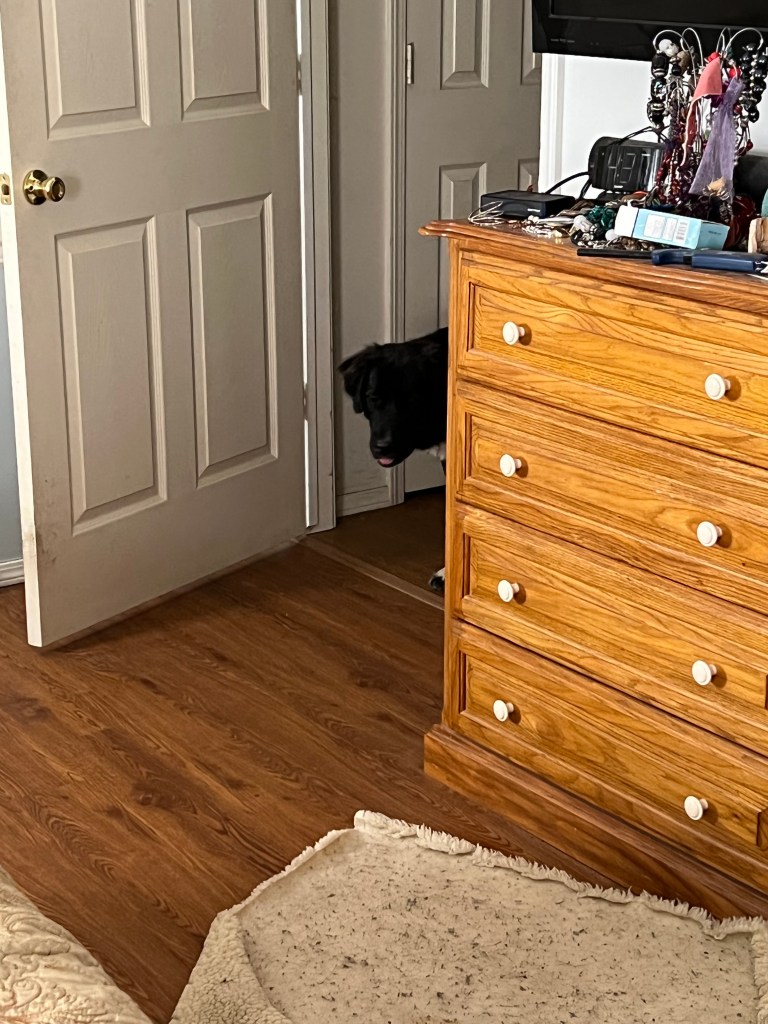
One of the habits Zena has acquired is to stare at either Melissa or myself trying to get our attention.  I have mentioned Melissa gets up earlier than I do and often when Zena thinks I have spent enough time in bed she will sit outside our bedroom and stare at the door.  I am usually awake and messing with my phone and can hear her quietly snuffling outside.  At other times the door will be open but rather than entering the bedroom, Zena will stop at the door and stare around the chest of drawers at me.  When she does, I will call her, and she will immediately come to the bed, followed by her licking my foot.  The other favorite time for Zena to stare is when I am working at my desk.  Zena will come into the office and place her chin on my thigh and stare up at me with those sad eyes.  It is obvious that she wants something.

When I looked online, I found dogs have many reasons to stare at humans, but most of the time they are trying to communicate with us or waiting for us to communicate with them and if you pay you can learn to tell the difference.  You can also teach your dog other ways to communicate that are not so puzzling if the stare bothers you.  One reason dogs stare is because they are reading our cues.  They sense our moods, follow our pointing gestures, and read information about what is going to happen next.  They stare at us waiting for us to do something that will impact them.  That is true for going on walks, meals, play time, car rides, and more.  Dogs also look for clues to perform specific behaviors like “sit” or “down” as these are chances to earn treats, especially if they are trained with positive reinforcement like Zena.  The stare also occurs when your dog is trying to get your attention or tell you something, like it is time to go out.  Some dogs will stare to manipulate their owners and get something they want, and this is common when begging at the table.  The dog will learn that if they stare long enough, their owner will hand over a scrap.  If you are aware of your reaction to your dog’s stare behavior and eliminate any rewards, your dog will eventually try new behaviors to get your attention.

Your pup also uses eye contact to express positive and negative emotions.  A stare for their wolf ancestors is considered threatening and rude, and some dogs retain that trait.  That is why you should never stare down strange dogs or hold dogs still to stare into their eyes.  If a dog gives you a hard stare, with unblinking eyes and a stiff posture, back away and do not make eye contact.  You might even see this in your own dog when there is a bone or other valued treat at stake.  Resource guarding often comes with a hard stare and aggressive body language.  Still, a lot of dog staring is an expression of love.  Just as humans stare into the eyes of someone they adore, dogs will stare at their owners to express affection.  In fact, mutual staring between a human and a dog releases oxytocin, known as the love hormone.  This chemical plays an important role in bonding and boosts feelings of love and trust.  This is the same hormone released when a new mother looks at her baby.  Is it any wonder our dogs like to stare at us?

THOUGHTS:  Dawn Kovell is an animal trainer and behaviorist from Marin Humane Society who says like the stare, interpreting dog nuzzling is also about context.  When your dog meets a stranger, they will sniff at them and if they like the smell, will nuzzle and rub their head against the person as an invitation of friendship.  However, when your dog nuzzles you, they could be establishing ownership.  Dogs have scent glands in their faces so when your dog nudges you with his head, he is marking you with his scent to signal other dogs to keep off.  Much like licking, nuzzling is a pacifying behavior that in dog to dog interaction ensures their survival and wellbeing.  Puppies nuzzle their mothers for comfort and when they grow up, they nuzzle their human owners.  Just like with your dog, it is considered rude for humans to stare at another.  Humans do have the ability to talk to each other to communicate.  That is a skill that needs to be perfected and practiced often.  Act for all.  Change is coming and it starts with you.

Bed

September 02, 2022

Finding a bed for Zena has been an ongoing search over the last six months.  She was only 20 pounds (9 kg) when we brought her home and she easily fit in Bella’s (our previous dog) bed.  Zena has put on 40 pounds (18 kg) since then and has outgrown several beds along the way.  Melissa first bought a larger bed that Zena loved to lay in and play with.  This had a satin bottom that could be switched over during the summer for her to stay cool and a cotton fleece to keep her warm in the winter.  Zena made a game out of chewing on the satin and dragging the bed around the house.  We tried a larger elevated bed next, but the first time Zena jumped on it the bed shot across the floor and she never trusted it after.  She went back to her old bed and her game of attack until the inevitable happened last month and the satin seam split.  I noticed Zena became quiet in the next room, and when I checked on her there was the inside stuffing all over the living room.  Zena next commandeered the beanbag I spoke of last month.  While this worked as a temporary bed, she could rarely get more then half of her length in the bed, and often ended up on the floor with just her back in the bed.  Today, a new bed for large dogs arrived.

When I looked online, I found the dog bed is now part of what has become “pet furniture”.  Pet furniture refers to furniture specifically designed for use by animals and includes pet beds, doghouses, hammocks, dog coolers, cat trees, parrot tents, and extravagant play equipment.  The global pet furniture market size is thought to be valued at US$3 billion by 2025 and is expected to grow at a compound annual growth rate of 5.2% during that period.  This will result in increased availability of a wide range of multiuse and fashionable furniture for pets on a global level.  The rising spending on pet care in developed economies like Germany, UK, France, and North America is projected to be a key trend, and consumer demand for innovative and fashionable pet accessories like furniture is on the rise.  Over the past few years, furniture has evolved across the world and manufacturers in the industry are focusing on multi-functional and stylish product innovation to serve the requirements of pet owners.  They are following a design-driven approach, which complements the home décor of the pet owner.  We are a long way from throwing a blanket in the doghouse on a cold night.

The bed Melissa purchased complies with this trend and is specifically designed for large breed dogs.  The bed has a large area (51 by 36 inches/130 by 90 cm) for a large or even multiple smaller dogs to rest.  The bed has a high-density orthopedic egg-crate foam that is 5 inches (13 cm) high.  It is assured this would provide “maximum support and comfort for your pet’s spine and body and relieves achy joints for pain-free restorative nap and sleep times.”  The bed included a cotton fleece top for winter warmth that can be removed to provide a cool summer sleep.  The cover is removable so you can wash it without disturbing the dog’s slumber.  The bed is made of anti-tear sofa linen (we will see if that lasts) and the inner casing is waterproof so it will not hold odors.  There is a five-year guarantee with replacement or repair free of charge for one year since purchase.  I bet that does not include being ripped to shreds.

THOUGHTS:  I was not surprised to learn that North America was the largest regional market for pet beds or animal furniture, accounting for 40.0% share in 2018.  Around 68% of the US households owned a pet in 2017, with dogs and cats the most popular and accounting for more than 80% of the domestic animal population.  Fish, birds, reptiles, and horses are also adopted in significant numbers.  Many US consumers own a combination of animals, and as of 2018, 46% of the household owns more than one pet with 32% of households owning a combination of dogs and cats.  The number of pet owners markedly rose during the pandemic as no one wanted to be alone.  It seems many these owners never bothered with a pet bed and allowed the animal to curl up next to them.  Still, they must need someplace to go when the owner is away, right?  Act for all.  Change is coming and it starts with you.
eDNA

September 01, 2022

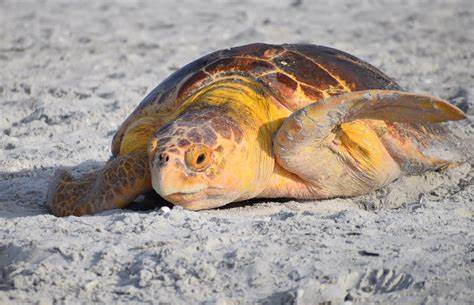
Hidden in the back pages of the front section of my local newspaper on Monday was a USA article on how eDNA is being used to unlock some of the world’s oldest mysteries.  While crime shows have used trace amounts of DNA (Deoxyribonucleic acid) to solve cold cases and tabloid talk shows have used it to identify the real father, ecological researchers have been using similar tests to determine the biodiversity of ecosystems.  One example was new information on the elusive loggerhead sea turtle (Caretta caretta).  While the loggerhead’s tracks on the beach are hard to miss, they also leave invisible trails of skin, scat, and saliva.  This environmental DNA (eDNA) can be collected in samples of sand to provided insight into the habits and diets of these reclusive turtles.

When I looked online, I found the use of eDNA began 14 years ago with a study of the invasion of the American bullfrog, (Rana catesbeiana) into Europe, a species that is considered a major cause of decline for native amphibians.  Since the historical data on the invasion was scarce, the study used population genetics data (a partial sequence of the mitochondrial cytochrome b gene) to infer the invasion history and to estimate the number of founders of non-native populations.  The science of eDNA also made a splash during the pandemic when researchers found they could track virus outbreaks (and variants) in municipal wastewater systems.  Identifying eDNA is now being used to verify the biological diversity in areas from the Brazilian Rain Forests to the slopes of Mount Everest.

According to Tracie Seimon, director of the wildlife molecular lab at the Bronx Zoo, the most intriguing aspect of eDNA is being able to learn about rare species without having to disturb them.  Seimon and her colleagues developed a test to amplify eDNA samples to rapidly detect species while reducing the size of the equipment to fit into a backpack.  Seimon’s team found evidence of 187 taxonomic orders in the 5.28 gallons (20 liters) of water collected on Mount Everest at elevations from 15,000 to 18,000 feet (4572 to 5486 m).  Once a baseline inventory is established, they will be able to monitor changes over time.  The non-profit XPRIZE holds competitions to encourage technological development to benefit humanity.  The XPRIZE Rainforest competition challenged teams to develop autonomous technology for rapid appraisal of the forest’s biodiversity, and a lot of interest has been shown using eDNA.  Methods include overland robots traveling the understory and aerial robots flying above the canopy.

THOUGHTS:  Anyone infected with covid sheds the virus each time they wash hands or use the toilet, even if they do not have symptoms.  Scientists have been tracking the virus using eDNA in wastewater for early clues about infections in cities and towns.  A team of researchers designed a system to get more detailed information about the virus variants from wastewater and built a computer program that quickly recognizes small pieces of the genetic material.  This not only picked up new variants like Delta and Omicron weeks before they showed up in clinical tests, but also found variants rarely seen in the clinic.  While this does not identify individuals, it can profile the whole city.  The team is now expanding the program to track other viruses.  Applications for using eDNA can provide early detection for the spread (pathogens) or decline (species) of genetic material.  As with any technology, the critical step will come determining how to use the information.  Act for all.  Change is coming and it starts with you.

Zombie

August 31, 2022

White Zombie is a 1932 American horror film based on The Magic Island by William Seabrook, staring Bela Lugosi as the zombie master “Murder” Legendre, and Madge Bellamy as his victim.  White Zombie is considered the first feature length zombie movie and gave birth to cinematic voodoo.  Revolt of the Zombies was a loose sequel in 1936 that was periodically followed by six more zombie releases until 1959, including the comedy Zombies on Broadway in 1945.  The genre took off in the early 1960’s with seven films released in four years and then began in earnest in the 1970’s.  Zombie films seem to have morphed from low budget B movies into the apocalyptic or space movies and TV shows that proliferate today.  These “living dead” creatures are portrayed as cannibalistic, and often prefer to eat human brains.  You can imagine my surprise when the world section of my local paper headlined the “zombie ice” that is our latest apocalyptic threat to survival.

When I looked online, I found “zombie ice” refers to the Greenland ice sheet which will lose at least 3.3% of its total mass in the coming years.  The zombie ice is causing Greenland’s glaciers to melt faster than experts previously predicted and causing sea levels to rise.  A new study published Monday in the journal Nature Climate Change shows that over time that rise could be 10 inches (30 cm) or more.  The study co-author William Colgan, a glaciologist at the Geological Survey of Denmark and Greenland (GEUS), described zombie ice as dead ice that will melt and disappear from the ice sheet regardless of what climate (emissions) scenario we take.  Researchers say the zombie ice is an “ice budget deficit” that occurs when glaciers stop receiving enough snow to replenish the ice already melting each year.  In an ideal situation, yearly snowfall would easily be able to compensate for the ice that naturally melts on the edges of glaciers.  Emissions since the 1980’s have made that impossible.

While an ocean rise of 10 inches (30 cm) is inevitable, it could be up to 30 inches (90 cm) if preventative measures are not taken.  The absolute minimum ice loss means 120 trillion tons of water will melt off the Greenland ice sheet, or enough to cover the entire US in 37 feet (11.3 mm) of water.  According to the National Aeronautics and Space Administration, glaciers in northwestern Greenland have been losing about 4 to 8 billion tons of ice per year from accelerated warming.  That is more than the peripheral glaciers in southeastern and southwestern Greenland are losing, but less than in northern Greenland, where peripheral glaciers have been losing as much as 29 billion tons per year since the early 2000’s.  An important aspect of this new study is that it is based entirely on recorded measurements taken over the last 20 years combined with satellite measurements, not simulations or computer models.  The catch is the method lacks a specific timeframe.  Exactly when the 10 inches of sea level rise will happen is unknown, but observations suggest most of the committed sea level rise will occur this century.  The study also only considers the melting in Greenland and does not factor in other zombie ice melting in the Arctic and Antarctic ice sheets.  That may not matter, as data from Greenland’s zombie ice suggests we already have one foot in the grave.

THOUGHTS:  While the predicted zombie ice melt would cover the entire US in 37 feet of water, it would not be distributed evenly due to altitude.  Conservative estimates say coastal cities around the world could witness more than 6 feet of flooding by the year 2100.   While some would be unaffected others might disappear underwater, including New Orleans, Miami, Huston, and parts of New York City.  That ocean front property in Arizona is looking better all the time.  We could follow the example of the dikes and pumps in the Netherlands or the flood barriers in Venice.  Or we could admit climate change is real and seek global solutions.  Act for all.  Change is coming and it starts with you.

Artemis

August 30, 2022

The front page of today’s paper announced the scheduled liftoff of the Artemis 1 rocket was scratched yesterday after back-to-back technical issues.  The team of engineers were unable to get the rocket’s engines to the proper temperature required to start the engines and ran out of time in the two-hour launch window.  The four RS-25 engines must be thermally conditioned before the super cold propellant begins flowing through them for liftoff.  Launch controllers condition them by increasing the pressure on the core stage liquid hydrogen tank to bleed a portion of the -423F (-253C) liquid hydrogen to the engines.  During the countdown, launch controllers worked through several other issues, including area storms, a leak at the quick disconnect on the 8-inch (20 cm) line used to fill and drain core stage liquid hydrogen, and a hydrogen leak from a valve used to vent the propellant from the core stage tank.  The earliest possible date for the next launch attempt is Friday, September 2nd.  The mission team will convene Tuesday afternoon to discuss the data and develop a plan forward.

When I looked online, I found the Artemis program is an international human space-flight program with a goal to return humans to the Moon by the year 2025.  The flight will include the first woman and a person of color as the thirteenth man to land on the moon.  Artemis 1 is an uncrewed Moon-orbiting mission and the first flight of the agency’s Space Launch System (SLS) rocket and the complete Orion spacecraft.  The Artemis 1 mission will last six weeks and will test all the rocket stages and spacecraft that would be used in later Artemis missions.  After reaching orbit and performing a trans-lunar injection (burn to the Moon), the mission will deploy ten CubeSat satellites and the Orion spacecraft will enter a distant retrograde orbit of the moon for six days.  The Orion spacecraft will then return and reenter the Earth’s atmosphere.  The craft is protected by a new design for the heat shield that failed when the space shuttle Columbia broke apart on re-entry on February 1, 2003.  The capsule will finally splash down in the Pacific Ocean.

The planned launch date for Artemis 1 was December 2016, but that has been delayed at least sixteen times due to technical issues with the SLS and the Orion spacecraft.  The program is also suffering from cost overruns (the main criticism of the SLS) and budget limits imposed by the federal government.  This will be the first lunar landing since Apollo 17 in 1972, which was the final lunar mission of the Apollo program.  The Artemis program began December of 2017 by bringing together other programs that the US had started since 2009.  The hope for Artemis is for a continued presence of humans on the moon and that one day the program might take humans to Mars and throughout the Solar System.  NASA has been joined in the Artemis program by private companies and international organizations like the European Space Agency.  The Artemis 2 mission will perform a crewed lunar flyby and Artemis 3 will perform a crewed lunar landing, five decades after the last Apollo mission. 

THOUGHTS:  After being challenged to put a man on the moon by John F. Kennedy in 1960, NASA named the ship being designed to accomplish the feat Apollo, as the Greek god’s chariot was said to ride across the sky with the sun.  Apollo’s twin sister Artemis is the Greek goddess of the Moon, and is the name given to the mission to bring humanity to the moon and planets.  While congress has constantly decried the cost overruns accompanying the space program, it should be noted the task has always been to create an end by developing the means.  Modern computers, cell phones, and much of our technology is the result (directly and indirectly) of these developments.  When Jules Verne wrote “From the Earth to the Moon” in 1865, he envisioned a giant cannon which would propel the craft.  The cost estimate to win this US$1,000 bet was US$4 million, but it ended being US$5.5 million.  It seems even a cannon can have cost overruns.  While it is prudent to manage the costs of such projects, it is unfathomable to image where we would be without them.  Act for all.  Change is coming and it starts with you.
Toad

August 29, 2022

When I took Zena outside yesterday, she went through her general snuffling routine.  Even if she stops right off the sidewalk, she will usually follow the same pattern to continue snuffling.  We go to the snowball bush to see if there is anything interesting, proceed toward the street, and then walk along the curb as far as I will let her go.  While Zena usually wants to enter our neighbor’s yard, I restrain her, and she begins to sniff her way down toward the fence.  From there it is back to the side of the house, across the flower bed, and then along the front until she gets back to where she started.  This is her perimeter zone, and she makes sure it has not changed since the last time we went out.  This time was different, as I had not yet been out to get the paper.  It was lying in the drive, and we walked over to retrieve it.  As I picked up the paper, I noticed movement out of the corner of my eye.  There was a small toad (1 inch or 2.5 cm) working its way across the driveway with intermittent hops. 

When I looked online, I found Woodhouse’s toad (Anaxyrus woodhousii) is a medium-sized true toad native to the United States and Mexico.  Woodhouse’s toad was first described in 1854 by the French herpetologist Charles Frédéric Girard who gave it the name Bufo woodhousii in honor of the American physician and naturalist Samuel Washington Woodhouse.  The large genus Bufo was split in 2006, with the North American species being included in the genus Anaxyrus and this toad became A. woodhousii.  Woodhouse’s toad is a stout amphibian and can grow to a maximum snout to vent length of 5 inches (127 mm).  The head has prominent cranial crests in front of and in between the eyes.  The dorsal surface of this toad is grayish-brown or yellowish-brown and it is speckled with small dark spots.  There is a narrow pale line running along the spine.  The belly is paler and is usually unspotted.  The male has a single vocal sac on his throat and his 1-3 second call resembles the bleat of a sheep.

When I saw the toad I immediately though that Zena might attack it.  When insects or caterpillars move into her range, she will generally pounce on them several times.  Like other toads, the noxious secretions from the warts found on the skin afford protection against some predators, but toads may be found with the scars of mammal bites or bird pecks from unsuccessful attempts to make them food.  Woodhouse’s toads also rely on their general resemblance to the sand and dirt they live in, along with immobility, to escape detection.  The toad’s normal gait is both walking and hopping but it becomes energetic hopping after it has been detected.  Our toad hopped several times, remained still as I took its picture, and then quickly hopped under the car when I turned away.  Zena never noticed it, and now it was safe.

THOUGHTS:  While the woodhouse’s toad (A. woodhousei) lives in central North America (plains to Rockies) the fowler’s toad (A. fowleri) lives along the east (coast and inland to the plains).  The fowler’s was originally classified as a subspecies of the woodhouse’s until later research elevated it to a species.  The area of Arkansas where we live is on the cusp of the range of both the woodhouse’s toad and the fowler’s toad.  Another species of toad in the same area is the East Texas toad (A. speciosus) which was originally thought to be a hybrid of the two and was described as a subspecies.  It has also been elevated to full species and the idea of being a hybrid has been dismissed.  Genetic tracing has made significant changes in the classification of both the plant and animal worlds.  Changing the names does not alter the species’ role in the environment, but it does change our perception.  While a rose by any other name may smell as sweet, call it a weed and it can be torn out and discarded.  That goes for how we understand and talk about people as well.  Act for all.  Change is coming and it starts with you.

Tiles

August 27, 2022

Melissa has planted a variety of sedum in the front beds we are trying to turn over to the succulents.  I wrote in May how the pink stonecrop (Sedum ewersii) in the front driveway bed had begun to flourish even while others have not survived the winters.  We had replaced the mulch in the front beds with pea gravel as it provides good drainage for the succulents, but the gravel does not do much to keep out the weeds.  Melissa has been holding back on buying additional succulents until she gets her business off and running, so I was surprised several weeks ago when two large boxes (back-to-back days) showed up at the front door.  I was told these were not business succulents, they were housing succulents.  These sedum carpet tiles had been purchased from a grower friend to start ground cover and keep down the weeds.

When I looked online, I found examples of the sedum carpet tiles we purchased.  Each tile contains multiple varieties of sedum in a tightly packed mesh.  The seller guaranteed them to be drought tolerant and to have the ability to overwinter in growing zones 3-8.  The sedums will grow from 1 to 6 inches (2.5 to 15 cm) high depending on the variety, and although they grow slowly, should hopefully (eventually) spread over the entire bed.  Each tile uses a coconut fiber base to ensure effective rooting.  The tiles just need to be placed on a prepared bed or growing medium with sufficient moisture.  The colorful foliage will flower from late summer to fall with white star-shaped blooms.  The site said this can add color and interest to the garden and creates beautiful landscapes when paired with other perennials.  Since we will not plant perennials, I am hoping it will also work well along with the established pink stonecrop.

When the boxes of tiles showed up, it was unclear where they were going to be placed and they sat in the front hall for several days.  When we were predicted to have rain last week Melissa placed them outside under the Japanese Maple for some water.  I knew two of the tiles were supposed to go in with the stonecrop and today I decided it was time to put them in place.  Melissa was uncertain how well they would transport, so she got a flat and placed the tiles on it so I could move them.  Turns out it did not matter.  The 17 by 10 inch (42.5 to 25 cm) tiles had the coconut fiber base I had seen online and then a third-of-an-inch netting beneath the fiber to hold the tile together.  Rather than falling apart, I struggled to cut through the layers.  I brushed back the pea gravel, set the half tiles on the ground, then spread the gravel back around the sides.  Two tiles in, eight more to go.

THOUGHTS:  While I had never laid sedum tiles before (or heard of them) it is a lot like laying sod, which I did do for a landscaping outfit one summer.  We would grow and cut our own sod in 40 by 12 inch (100 by 30 cm) rolls.  The sod was laid in an alternating pattern, flattened in place with a roller, and watered in.  The biggest part of the job was preparing the ground (tilling and leveling) prior to laying the sod.  Good preparation meant a smooth and even lawn.  Shoddy preparation meant an undulating lawn that collected water in pools that killed the grass.  Preparation is the key for most good outcomes in life.  We had prepared for the Ebola virus in 1976 and the Zika virus in 2015 and stopped them before they widely spread.  We were not prepared and ignored the warnings for covid, and it became a pandemic.  We can be sure another virus will arise and with globalization may spread.  Ignorance is not bliss, and it may kill you.  Act for all.  Change is coming and it starts with you.

Shark

August 25, 2022

After posting yesterday’s blog on the megalodon shark I found a front page feature in my paper about the discovery of an 80 million year old “sea dragon” (mosasaur).  The fossil remains were found by a researcher in northern Mississippi while showing his wife the area where he had done his field research.  He had taken her on a tour of the area and were on their way back to the car when he noticed the large skull and several vertebrae exposed on the surface.  They had apparently stepped right over the fossils on their walk in.  When most sea creatures die their bodies are spread about by scavengers and currents.  This mosasaur had remained intact since it had settled to the seabed, and now lay exposed in the rocks of a small gully.  Even though the article did not say, I immediately wondered if the timing of this report might not be associated with the recent much publicized Shark Week on TV.

When I looked online, I found Shark Week is an annual, weeklong TV programming block on the Discovery Channel which features shark-based programming.  The promotion premiered July 17, 1988, and has continued to air annually in July or early August.  The shows were originally devoted to efforts at conservation and correcting misconceptions about sharks.  The promotion has grown in popularity and since 2010 has been the longest-running cable television event in history and is aired in over 72 countries.  Shark Week has also evolved into more entertainment-oriented and sometimes fictional programming.  This fictitious programming is known as docufiction and includes titles like “Megalodon: The Monster Shark Lives”.  The strategy was successful, as the megalodon program became one of the most watched shows in Shark Week history.  This was mainly for the controversy it generated, with critics even labeling it a mockumentary.  Since then, Discovery has increasingly been criticized for junk science, pushing dubious theories, creating fake stories, and misleading scientists as to the nature of the documentary being produced.  In 2017, the network heavily promoted a race between Olympic gold medal winner Michael Phelps and a great white shark that turned out to be computer generated (but based on actual speeds), and Phelps wearing illegal swim gear.  Phelps beat the CGI reef shark in a 50-meter match but lost to the CGI great white shark by two seconds.

It turns out the Mosasaur was not a shark, but a group of marine lizards containing a dozen or so different species that would have lived in the Western Interior Seaway of North America 75-69 million years ago.    The smallest-known mosasaur was Dallasaurus turneri, which was less than 3.3 feet (1 m) long.  Larger mosasaurs were more typical, with many species growing longer than 13 feet (4 m).  Mosasaurus hoffmannii is the largest known species and reached up to 56 feet (17 m).  Currently, the largest publicly exhibited mosasaur skeleton in the world is on display at the Canadian Fossil Discovery Centre in Morden, Manitoba.  The specimen, nicknamed “Bruce”, is just over 43 feet (13 m) long.  Mosasaurs breathed air, were powerful swimmers, and were well-adapted to living in the warm, shallow inland seas prevalent during the Late Cretaceous period.  Mosasaurs were so well adapted to this environment that they most likely gave birth to live young, rather than returning to the shore to lay eggs as sea turtles do.  Mosasaurs belong to a group of reptiles called Toxicofera, which includes today’s snakes as well as monitor lizards and Komodo dragons.

THOUGHTS:  A mosasaurus played a prominent role in the fourth instalment of the of the Jurassic Park franchise and the first in the Jurassic World trilogy.  This animal was depicted living in a huge Sea World-style arena.  The mosasaurus in the movie was big enough to eat a great white shark in a single bite.  While this was slightly exaggerated, it would not have been an unrealistic size.  Interestingly, there were no mosasaurs in either the Jurassic or Triassic periods.  The seas were dominated by two other groups of marine reptiles, the dolphin-like ichthyosaurs, and the long-necked plesiosaurs.  There are times when we become too critical of what we see and need to stop and remind ourselves, “It is only a movie.”    Act for all.  Change is coming and it starts with you.