
Group

January 22, 2022

Melissa found an online group she thought I might be interested in called Arkansas Birders.  This is a “private” group with just over 9,000 members.  On Facebook private means only members of the group can see the information posted.  While anyone can find the group, there are two questions used to filter out spam accounts.   I joined several days ago and now receive information and photos from other Arkansas birders.  This lets me keep up with where different birds are gathered around the state and helps my identification skills as others post. While I am not a member of a lot of groups, this one provides entertainment and information on the local birding world.

When I looked online, I found a Facebook Group is “a place for group communication, letting people share their common interests and express their opinions.”  Groups let people join others around a common cause, issue, or activity.  The group can post photos and share content about their chosen topic.  Administrators (Admins) of the Group can designate certain members as Group Experts, and a badge appears next to their name so the group can easily identify their posts.  Both Admins and Experts have the ability collaborate on Q&A sessions, address concerns, and respond to questions.  Anybody can create and manage a Facebook Group, and you can join up to 6,000 other Groups.  That must take a long time to sort through the daily information.

Another group I joined is for my family sibs (and mom) on Messenger.  This is not only a great way to keep up with each other, but another way to share our experiences.  This week my sister posted a woodpecker which had been hammering one of the trees in her yard, along with an accompanying photo.  At first, she did not recognize the bird, but when she zoomed in on the photo, she identified it as a Pleated woodpecker (Dryocopus pileatus).  Pleated woodpeckers range from northern California up into Canada and back down into much of the eastern US.  My identification book says this woodpecker ranges throughout Arkansas.  I have yet to see one. 

Thoughts:  When my sister posted the photo to our Sibs group, my brother responded, “It’s Woody Woodpecker!”  Woody Woodpecker is an animated character that appeared in theatrical short films produced by the Walter Lantz Studio and distributed by Universal Studios between 1940 and 1972.   Lantz said Woody was patterned after the noisy Acorn woodpecker (Melanerpes formicivorus) who kept him awake at night on his honeymoon.  Woody shares characteristics with the pileated woodpecker in both appearance and his characteristic laugh (ha ha ha HA ha), which resemble the pileated call.  The artistic license of the creators has caused confusion within the birding community for those attempting to classify Woody’s species.  Not every cartoon, movie, or even post is meant to be taken seriously.  Do the work.  Follow the science.  Change is coming and it starts with you.
Xenotransplantation

January 21, 2022

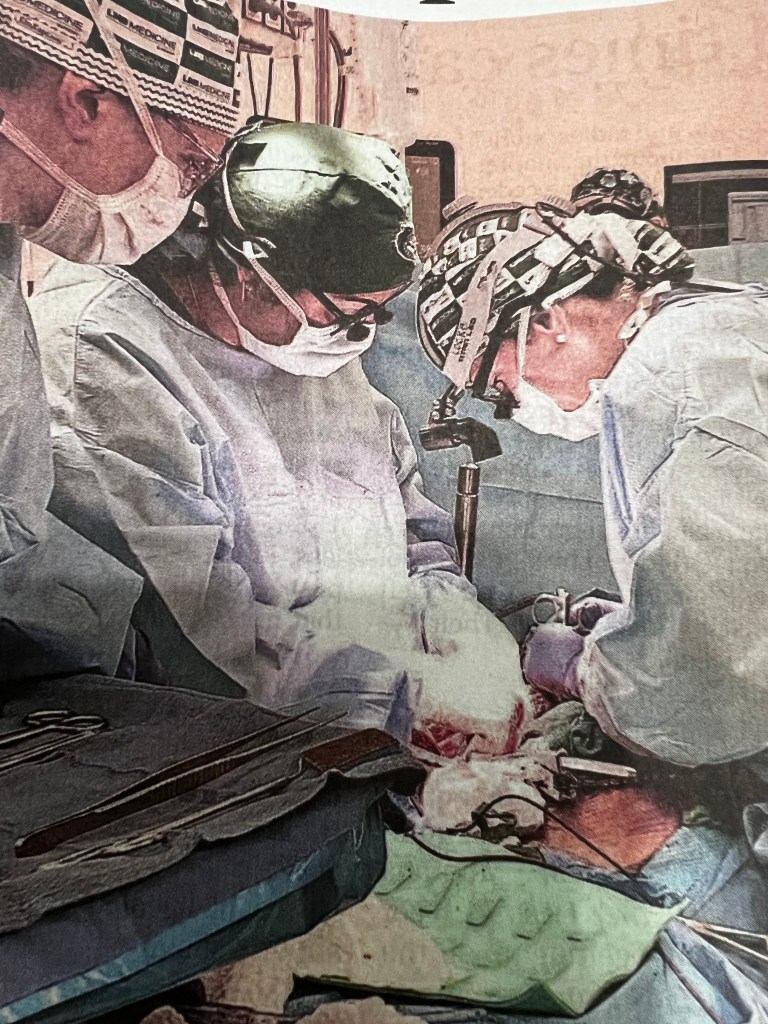
Hidden in the middle of the front section of my local paper this morning I came across an article on xenotransplantation.  Xenotransplantation refers to putting live tissue or organs from a non-human animal source into the human body.  Pigs have long been considered a potential source for transplants as the organs are similar in size to human organs, but rejection by the host has always been a problem.  Recent advances have allowed genetically engineered pigs to provide a heart for a man in Baltimore last month and two kidney transplants last September were given to different brain-dead recipients.  The development of xenotransplantation is primarily driven by the demand for human organs for clinical transplantation.  Currently 10 – 20 patients a day die in the US waiting for an organ transplant.

When I looked online, I found from early 2000 the introduction of Gal-knockout (galactosyltransferase) pigs, has made prolonged survival possible in heart and kidney xenotransplantation.  However, the remaining antibody barriers to non-Gal antigens continued to be a hurdle.  The production of genetically engineered pigs was difficult and required a long time.  Recent advances in gene editing have made the production of genetically engineered pigs easier and more available, and clinical trials have received an international consensus.  Although the potential benefits are considerable, xenotransplantation has raised concerns regarding the potential for infection of recipients and possible subsequent infection into the general human population.  Of public health concern is the potential for cross-species infection by retroviruses, which may be latent and lead to disease years after infection.  Who would believe cross-species viral infection could ever happen?

A related article reported the man who received the pig-heart xenotransplantation once stabbed a man leaving him paralyzed.  The victim’s sister told the BBC’s Today show she thought the recipient was unworthy of the surgery.  The transplant team said a person’s criminal past could never be grounds for refusing treatment.  The University of Maryland Medical Centre said, “It is the solemn obligation of any hospital or health care organization to provide lifesaving care to every patient who comes through their doors based on their medical needs.  Any other standard of care would set a dangerous precedent and would violate the ethical and moral values that underpin the obligation physicians and caregivers have to all patients in their care.”  The attack took place in April 1988 and the man was found guilty of battery and carrying a concealed weapon and was sentenced to 10 years in prison.

Thoughts:  While the xenotransplantation of a pig heart was reported on the national news, the kidney xenotransplantation came to light months later after it was published as a scientific paper.  The heart prolonged the recipient’s life, but the kidney transplants were considered test trials as both recipients were clinically dead.  Most human transplants involve death, but xenotransplantation is growing and harvesting the organs.  Organs are given according to strict rules that consider physical matching, tissue and blood type matching, medical criteria, waiting time, and severity of illness, and is blind to name, race, sex, and wealth.  Two principles determine who gets a transplant: (1) urgency, the sickest or most likely to die are prioritized, and (2) effectiveness, organs go to those with the greatest chance of success.  This clearly requires consideration of the “ethical and moral values” of the administrators.  Follow the science.  Do the work.  Change is coming and it starts with you.
Modoc

January 20, 2022

I was forwarded an article this week about the Modoc Tribe.  The ancestral home of the Modoc Nation consisted of over 5,000 square miles along what is now the California-Oregon border.  The Modoc were a culturally detached and unique band who would occasionally form war parties to drive out unwelcome visitors or raid neighboring tribes.  The arrival of white Americans in the early 19th century forever changed their lives.  Eventually the traders and miners gave way to farmers and ranchers.  The Modoc adapted and chose to live peacefully with their white newcomers, often working for them and trading for necessities.  The Modoc took on many of the settler’s ways, and eventually began to wear clothing patterned after the non-Indians with whom they socialized.  Even the names of the Modoc changed, and they became known to their own people by the names given to them by the white man.

This peaceful co-existence did not last, and a series of skirmishes erupted over the next decades, ending with the Valentine’s Day Treaty of 1864.  The various tribes agreed to live in peace and friendship with one another and the settlers in the region and the Modoc were not restricted to a reservation and could live within their homelands.  Unfortunately, the Valentine’s Day Treaty was not accepted by the US or even considered.  After more years of abuse, Captain Jack led an 18-month uprising pitting 60 Modoc against over 1,000 soldiers supported by artillery.  Captain Jack was hung for his participation in the uprising and became the only Native leader executed by Military Commission for participation in the US Indian wars.  On October 12, 1873, 155 Modoc (42 men, 59 women, and 54 children) were loaded on 27 wagons and taken to Fort Klamath, Oregon, then placed under military guard in Cheyenne, Wyoming, on the way to their eventual unknown destination on the Quapaw Agency, Indian Territory (Oklahoma).

In 1879, the government constructed a building on the Modoc Reservation that served as both a school and church.  The first marked grave in the Modoc Cemetery is inscribed as Rosie Jack (died April 1874).  Rosie was the daughter of Captain Jack and his wife Lizzie.  Many of the leading participants of the Modoc War are buried in the cemetery in unmarked graves.  The Modoc and Klamath tribes were terminated from federal supervision in 1954.  Years later the tribes in the northeastern corner of Oklahoma banded together to establish the Inter-Tribal Council, Inc. of Northeastern Oklahoma, and the Modoc formed a non-federally recognized tribal government.  The Modoc Tribe in Oklahoma were granted federal recognition in May 1978, making the Modoc eligible for Federal assistance.  An application was forwarded to the Department of Housing and Urban Development to purchase the Modoc Church and the four acres where it stands and to restore the church to its original structure.  The grant was awarded, and the Modoc church was listed on the National Register of historic Places in 1980.

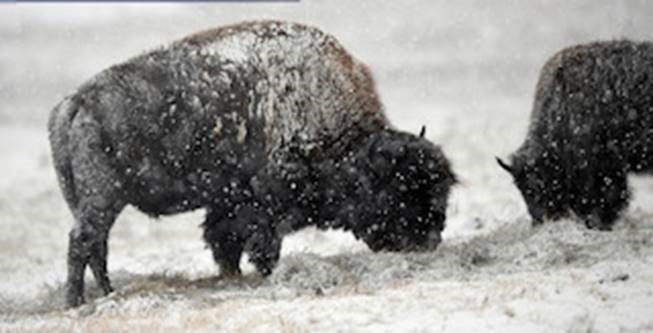
Thoughts:  There are 496 enrolled members of the Modoc Tribe residing in 27 states, with around 200 living on a small reservation in Ottawa County, Oklahoma.  This includes the 600-acres of the Modoc bison range.  The range hosts about 200 bison purchased as wild from the National Park Service.  The animals are grass fed and raised in a natural pasture similar to their wild environment.  Bison is known for its nutrient-dense protein and can be purchased through the Modoc Administrative Office.  The Modoc have again adapted, creating a thriving business selling bison they never hunted to those who originally drove them from their ancestral home.  Do the work.  Change is coming and it starts with you.
Straws

January 19, 2022

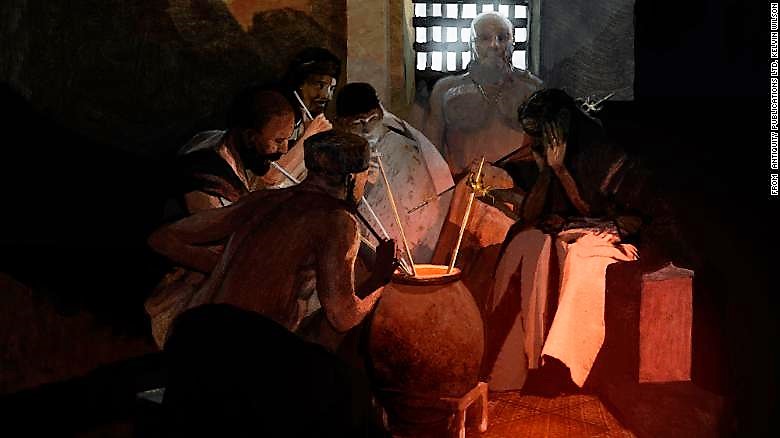
This morning I came across a news article from CNN posted yesterday relating to the revisioning of eight artifacts found at the Maikop kurgan, a prehistoric burial mound in the northern Caucasus in Russia.  The mound was excavated in the summer of 1897 by archaeologist Nikolai Veselovsky, a professor at St. Petersburg University.  Veselovsky found graves of three people within the mound belonging to elite members of Bronze Age society.  Along with hundreds of special artifacts, Veselovsky discovered a set of eight gold and silver tubes at the right hand of the skeleton.  Veselovsky assumed they were decorative scepters and that the perforations at the tip of each tube were used to attach ornaments or horsehair.  New evidence suggests the mysterious scepters could be giant drinking straws used to consume mass quantities of beer.

Over the last century, researchers have debated the purpose of the tubes.  One suggested the tubes were part of the structure for a folding canopy used during the funeral procession for the person in the burial.  Another thought they may be symbolic rods representing arrow shafts, given that arrowheads were recovered from the mound.  Viktor Trifonov, an archaeologist from the Russian Academy of Science’s Institute for the History of Material Culture, poked holes in the previous theories because those objects would have required solid metal pieces rather than hollow tubes.  “A turning point was the discovery of the barley starch granules in the residue from the inner surface of one of the straws.  This provided direct material evidence of the tubes from the Maikop kurgan being used for drinking.”

Each of the 5,000-year-old Maikop straws measure about 3.6 feet (1.1 meters) long, and researchers believe they were used to drink beer from communal vessels.  Four of the straws were decorated with bull figurines, and all eight include punctured metal pieces to filter out impurities in the beer.  The oldest evidence of straws being used to drink beer is depicted in art from Iran and Iraq dated to the fifth and fourth millenniums BCE, showing people using straws to drink from a communal vessel.  Using long straws to drink beer together was common for the later Sumerians from the third millennium BCE.  The Maikop straws looked remarkably similar when compared with the Sumerian depictions of straws, including the metal strainers.  The grave also contained one of the beer vessels used with the straws that was so large it would have enabled each of the eight drinkers to down seven pints a beer each.  Obviously, evidence of a Maikop keg party.

Thoughts:  One of my Old-World Archaeology professors specialized in Mesopotamia’s Sumerian period until the Iranian Revolution in 1979 closed the country to foreign archaeologists.  He told a story of the archeologists finding a recipe for beer among the cuneiform tablets.  Being the wags they were, they followed the recipe and fermented their own beer.  The result was not very good, and the unfiltered mash made it difficult to drink.  That must be why they drank using straws.  The Maikop straws came from a site that is hundreds of miles away from where straws were used in Mesopotamia, suggesting the use of straws spread between regions.  Globalization is not as new as we have been led to believe, it just used to take longer to spread.  We are all the same human species.  Do the work.  Follow the science.  Change is coming and it starts with you.
Multiplicity

January 18, 2022

Our yoyo weather continued today as temps rose to the mid-60’sF (18C) after dropping into the low 30’sF (0C) and snow over the weekend.  I had an early Zoom call for work but after lunch my seclusion got the better of me and I decided it was time to test the fishing waters again.  I dropped my recycling at the center that was closed yesterday and then loaded my fishing gear into the back seat.  One more stop to drop the donations at Goodwill and then I went to the lake to test my luck.  When I checked my app, I saw the trout have not been stocked since earlier this month.  I have mentioned they do not last long with all the anglers vying for them.  I was optimistic and figured there were a multiplicity of fish stocked in the lake.  Even if the trout were gone, I could still catch a bluegill or catfish.

Multiplicity is a 1996 American science fiction comedy film starring Michael Keaton and Andie MacDowell.  The point is a man being able to duplicate himself by machine, but each duplicate developed a different unique personality.  Despite the $45 million budget, the film received mixed reviews and only grossed a worldwide total of $21 million at the box office.  The plot has Doug Kinney (Michael Keaton) working in construction in Los Angeles and his job is constantly getting in the way of his family.  Doug meets a friendly scientist who has successfully developed a method for cloning humans.  Doug is cloned to take over the work and allow Doug to spend time with his family.  Ultimately three clones are made, and it becomes increasingly hard for Doug to hide his multiplicity.  The scheme falls apart and after order is restored the clones take off to Florida where they open a Pizza Parlor poising as triplets.  While the initial outcome of the multiplicity caused havoc, the clones reworked the outcome, so it was good for all four.

While I was not able to clone myself, I did use a multiplicity of ways to try and catch fish.  I fly fished for trout but there were none to been found.  I put out my bobber for bluegill or catfish, but they had escaped into deeper water.  At least I was vindicated as the man who arrived along with me did not catch fish either.  I noticed a few birds soaring above and since I had brought my camera, I was able to get photos of the seagulls and vultures.  I just needed to reinvent how and what I was doing to get a positive result.

Thoughts:  One of the great things about both fishing and birding is you get to enjoy nature while you do them.  If my goal had been to catch trout, or even fish, I would have failed.  Instead, my goal was to enjoy fishing which I did.  Since I brought my camera, it opened another opportunity and I added two birds to my annual list.  Even if I had not seen new birds, I was still outside enjoying the day which was my real goal.  Over the last several years I have noticed more people focusing on a specific outcome for events, and then denying the results if they are not what was desired.  When we approach life in its multiplicity, we can find positive results regardless of the outcome.  This does not mean lowering your expectations but finding joy and worth in the events themselves.  You can always learn from unexpected outcomes and work for different results next time.  Do the work.  Follow the science.  Change is coming and it starts with you.
Signs

January 17, 2022

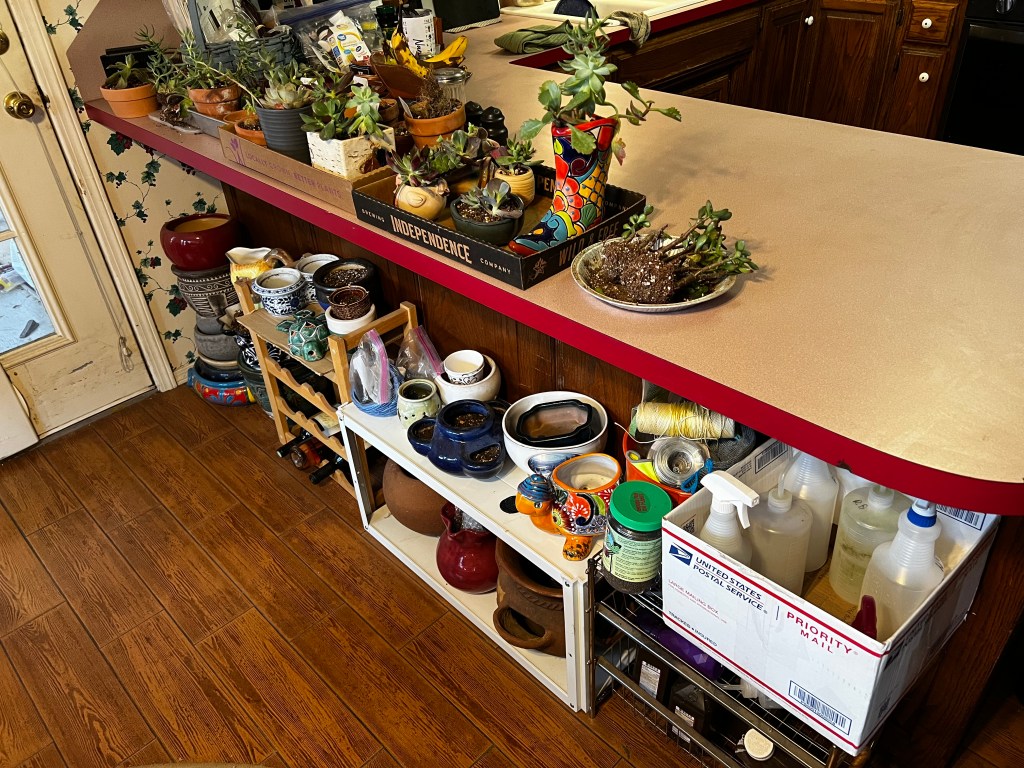
I mentioned last week how I get into cleaning mode when Melissa goes on a trip and then tend to use reverse prioritizing to decide the order to complete my tasks.  While I generally find this effective, it did not work as well this weekend.  Part of the problem was I needed Melissa’s input.  Melissa is like me when it comes to cleaning, “if you clean you can do it however you want.”  I knew that was not the case with her succulents.  While I felt comfortable moving pots to different locations, I knew most of the trays of plants were where they were for specific reasons.  I intended to paint the wall behind a stack of pots and then set up another shelf I had brought back from Kansas, but that meant moving plants.  I reached my mystical halfway point where I turn to the important tasks when I realized the signs were against me.  The second shelf was not going to happen.

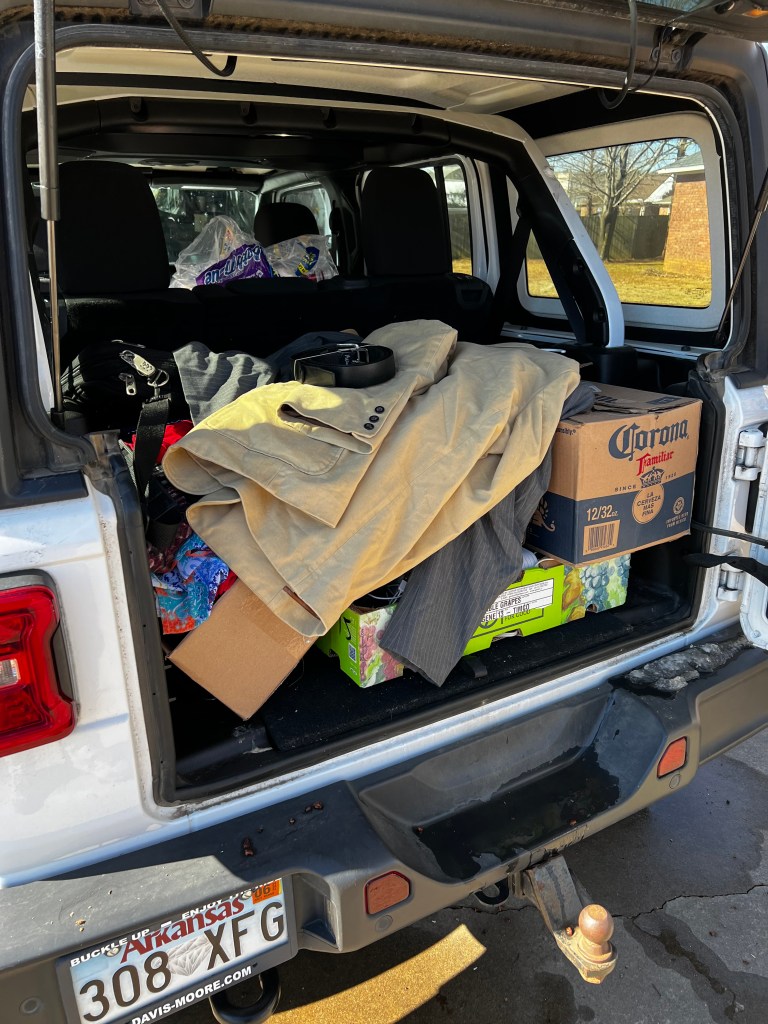
Another problem I ran into was Martin Luther King, Jr. Day.  I woke today fully intending to take a load of clothes and miscellany to the Good Will and loaded them in the back of the car.  I try to limit the number of trips I make and concentrate several tasks each time I venture out.  That way I can focus my time and not worry about having to be out of the house every day.  Part of my organizing had been breaking down boxes and sorting through old electronic equipment.  Our recycling center is one of the few I have found which accepts old electronics.  I packed the car with cardboard, threw in the plastic bottles, and stuffed the electronics in the back seat.  Driving to the center it hit me, this was MLK Day.  Not surprisingly, the signs said the center was closed.

My organizing weekend turned out like most of the time.  I started with a big push, had a day where I ignored everything, and then closed with a rush to beat Melissa’s return home.  We always try and keep each other informed of progress when we are traveling.  It not only allows us to live vicariously through the traveler, but it also lets the other know if something goes wrong.  The snowstorms combined with the airline sickouts to cause both flights and airports to close.  That meant there were a lot of irate travelers.  TSA had posted signs at the checkpoints and the ticket counters stating if you were aggressive or hit someone, you would receive a lifetime ban from flying the airline.  As tempers rose the agents quelled several disputes by pointing at the signs.

Thoughts:   Melissa told me that as she approached her (different) departure gate, there was a man on the floor being treated for head injuries from a fight.  When her group was later getting off the plane another fight broke out between two football fans from opposing teams.  Both the injured man and the two fans were being “assisted” by the police.  Apparently, none of these people had bothered to read the signs.  Signs are placed to direct people to either follow the law or to avoid causing accidents.  When we disregard the signs, it can lead to a lifetime ban.  Ignoring or disregarding the safety signs for covid puts everyone in jeopardy.  Follow the science.  Change is coming and it starts with you.

Birthday

January 15, 2022

When I was in the Middle East during the 1980’s one of the local Bedouins was having a birthday.  The custom was for the honoree to give a party for friends and hand out presents for those who attend.  At first this seemed odd given my own custom of having others give me a party and presents.  I was told the reason for the reverse custom was for the host to share their own joy and celebration of life with those around them.  I was privately told this meant you only worried had to remember to get birthday presents once a year, and while you may forget the day of your neighbor’s birthday, you always seem to remember your own.  The custom meant no one felt slighted when others did not wish them well for their birthday.  That made a lot of sense to me.

When I looked online, I found there are currently eleven national public holidays in the US designated in Title V of the United States Code (5 U.S.C. § 6103).  These holidays apply to all federal government entities, and state and city holidays may be observed concurrently with federal holidays.  On June 28, 1870, Congress created federal holidays “to correspond with similar laws of States around the District … and … in every State of the Union.”  Although at first applicable only to federal employees in the District of Columbia, Congress extended coverage in 1885 to all federal employees.  Only three of these eleven federal holidays are associated with a birthday.  Two are Martin Luther King, Jr.’s birthday (January 15) on the third Monday of January and George Washington’s birthday (February 22) celebrated on the third Monday of February.  The last birthday is celebrated on Christmas, representing Jesus’ birthday.  Jesus is the only birthday that does not comply with the Uniform Holidays Act.

The Holidays Act shifted the date of the commemoration of Washington’s Birthday from February 22 to the third Monday in February (between February 15 and 21).  This means the observed holiday never falls on Washington’s actual birthday.  Because of this, and the fact Lincoln’s birthday falls on February 12, many people refer to this as “Presidents’ Day” and use the day to honor all American presidents.  However, neither the Holidays Act nor any subsequent law changed the name of the holiday from Washington’s Birthday to Presidents’ Day.  Lincoln’s Birthday is still a legal, public holiday in some US states, but other states do not celebrate Lincoln’s birthday as a stand-alone holiday.  King’s birthday does periodically fall on the third Monday (between January 15 and 21), and since the celebration was commemorated after the Holidays Act it was never changed.  I guess we still have trouble remembering other people’s birthdays.  Btw: the plastic wrap keeps my favorite cake from getting freezer burn.

Thoughts:  Many of the “art” projects I remember from grade school were coloring pictures to be displayed along the walls commemorating the holidays.  This meant pictures of Santa and Turkeys late in the year, and portraits of Lincoln and Washington during February.  At this point my concern was keeping within the lines.  My state was one of those who recognized and celebrated both birthdays.  Now when you check the State’s webpage, neither birthday is listed as a holiday, and while President’s Day is commemorated, it is not a state holiday.  I bet the kids are still required to color the portraits.  We remember special days to honor the ones who have gone before or the special ones who are still with us.  Do not wait for others to celebrate your birthday.  Use the Bedouin approach and throw a party for others.  Do the work.  Change is coming and it starts with you.
Away

January 14, 2022

I am not sure why, but every time Melissa goes away on a trip, I find myself compelled to work on the house by painting or reorganizing.  I think part of the reason is because I am sheepish that I have not been doing the same thing while she is here.  Another reason is because I know I have a set number of days to finish the tasks before Melissa returns.  I work at my own slow pace and do not feel compelled to accomplish anything on any given day.  This morning I started strong but found myself wavering from one task to the next.  I felt like the lady on the commercial who wakes up the next day and finds seven different projects she had started the night before and had yet to finish one.  Still, there is more time as Melissa will be away for several days.

One of the life learnings I have kept are the principles of Stephen R. Covey’s book The 7 Habits of Highly Effective People, first published in 1988.  One of my takeaways is the quadrant for priorities developed on Habit 3, Put First Things First.  This habit involves having the discipline to prioritize your day-to-day actions based on what is most important, not what is most urgent.  This also means you need to plan so the important work is accomplished before it becomes urgent.  To do this will require you to be willing to say “no” to unimportant tasks, and to delegate other important tasks that you do not have time to complete.  While this makes sense, most people spend their time on urgent matters, and often urgent matters that are unimportant.  Then we tell ourselves we are at least getting “something” done.

All that said, it is not how I work on the house.  I have found it most effective for me to prioritize the tasks, and then begin working on those I want to accomplish, but that are not the most important.  I gauge my time until I am about half through Melissa’s time away before I work on the important tasks.  I know myself well enough to I realize the important things will get done primarily because I believe them to be important.  Yet it is often the unimportant frills that really make it “look” like I have accomplished something.  One of those tasks was to put together a shelf that has been sitting in our dining room since October.  It is assembled and now has pots sitting on it ready to be filled with succulents.  Sorry Stephen, while this may not work in business or even life in general, it works great for my reorganizing.

Thoughts:  One of my other gleanings from Habit 3 is that you should always maintain a primary focus on relationships and results, and only a secondary focus on time.  The real reason I work on completing tasks around the house when Melissa is away is about relationship.  Melissa and I often try and clean the house prior to going on a trip.  That way we are not overwhelmed by a mess when we get back.  While I am hardly a neat nick, it is nice to come home to a clean house.  For me this is especially true when you are not the one who cleaned it.  One of the things we seem to have lost over the last years is a primary focus on relationships and results.  We need to make all our relationships a priority if we are going to bring unity to our world.  Do the work.  Change is coming and it starts with you.
Tests

January 13, 2022

I have been hearing on the news about the big roll out of at-home tests to check for the virus.  This news began with the administration’s announcement of 500,000,000 tests being made available by the end of January, and then this week the number was raised to one billion tests.  These tests are to be distributed for free and tests purchased earlier are to be reimbursed by insurance.  My home state also purchased 1.5 million tests and plans to give them out for free at different locations around the state beginning this week.  Anyone in the state is eligible to get the tests but they are limited to one kit of two at-home tests per day, while each family has a daily limit of three kits that consist of six at-home tests.  More tests have been promised to arrive in the future.  Distribution of the at-home tests is happening on the honor system so recipients are being asked to keep others in mind when they come to claim their share.

When I looked online, I found the two main types of covid tests are rapid antigen tests and polymerase chain reaction (PCR) tests.  Antigen tests can be taken at home and return results in about 10 to 15 minutes.  PCR tests are more accurate but require lab work and generally do not provide results for at least 12 hours and can be up to 5 days.  Both tests typically use nasal swab samples, though some collect saliva.  The PCR tests administered by a professional may require a nasopharyngeal sample that involves a much deeper nostril swab.  Rapid antigen tests usually require swirling a swab in the nostril less than an inch deep.  PCR tests amplify genetic material from the collected sample up to a billion times to detect even the slightest amount of virus genes, making them highly accurate.  They are also more expensive at more than $100 apiece.  It is not surprising the rapid tests are given for at-home.

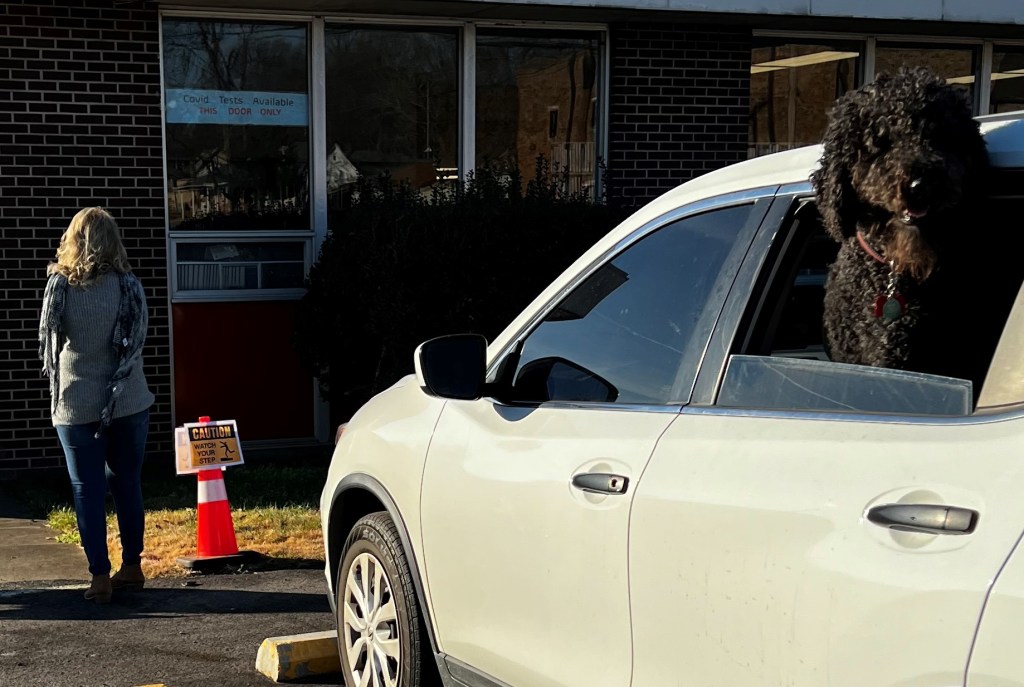
Melissa and I were notified by a friend that the tests were going to be distributed today at our city library beginning at 9:00 am.  The cold weather caused Melissa’s car battery to start “intermittently,” and I planned to get it checked this morning and still have enough time to get in line for our test kits.  The battery tested weak, and the dealer told me it was “up to me” whether to get a new one.  Since this was Melissa’s car, and she was taking it up north later in the day, I opted for the new battery.  When I arrived at the library, I was surprised to only see ten people standing in line.  I joined the other masked people to wait.  When 9:00 am arrived, the librarian told the group they had received and distributed 400 tests yesterday and no new tests had arrived.  Another 15-20 people pulled up expecting to receive the tests as she was relaying the news.  We got back in our cars and left.

Thoughts:  The reporting of at-home tests distribution emphasizes the trouble and expense being taken.  There are just over 3 million residents in the state of Arkansas.  As of Tuesday 600,000, of the 1.5 million at-home tests ordered have been delivered to Arkansas.  “The tests will be delivered periodically as the supply allows that to happen,” the governor said.  Best case scenario, that is enough tests for almost half of the people to take the test one time.  The 1 billion tests the federal government ordered will only test the nation’s 330 million people three times.  That implies you had better hold onto your tests until you really need them, like when you are preparing to take that cruise.  While testing is important to track spread, vaccination and wearing a mask is the only way to try and prevent spread.  Follow the science.  Change is coming and it starts with you.

Eagles

January 12, 2022

I came across a story in our local paper about an injured Bald Eagle that had been rescued and then ultimately released back into the wild in Louisiana.  The bird had been brought to the Louisiana State University School of Veterinary Medicine’s Wildlife Hospital by Wildlife and Fisheries after it had been hit by tractor-trailer truck.  A spokesperson for the hospital said they treat around 15 eagles each year, along with 1200 other mammals, birds, and reptiles.  After preforming bloodwork and radiographs on the eagle, the hospital surprisingly found there were no musculoskeletal injuries.  There was evidence the bird had been previously shot, as she had non-life-threatening pellets in her body.  These did not appear to affect her mobility. 

While it is illegal to shoot these birds under the Bald Eagle and Golden Eagle Protection Act of 1940, they are still targets of illicit hunting.  The bald eagle (Haliaeetus leucocephalus) is a bird of prey found in North America.  It is a sea eagle which has two known subspecies and forms a species pair along with the white-tailed eagle (Haliaeetus albicilla).  Its range includes most of Canada and Alaska, all the contiguous US, and northern Mexico.  It is found near large bodies of open water with an abundant food supply and old-growth trees for nesting.  The bald eagle is an opportunistic feeder that subsists mainly on fish which it snatches from the water with its talons.  Bald eagles are not bald, and the name derives from an older meaning of the word, “white headed”.  Adult birds are mainly brown with a white head and tail.  The sexes are identical in plumage, but females are about 25 percent larger than males. The yellow beak is large and hooked.  The plumage of the immature eagle is brown.  The bald eagle is the national bird of the US and appears on the country’s official seal.

In 2020 there were approximately 2,900 bald eagle nesting sites in the Mississippi Alluvial Valley of Louisiana.  The birds build the largest nest of any North American bird and the largest tree nests ever recorded for any animal species, up to 13 feet (4 m) deep, 8.2 feet (2.5 m) wide, and 1.1 short tons (1 metric ton) in weight.  Sexual maturity is attained at the age of four to five years and longevity in the wild is around 20 years.  The eagles will mate for life and the radiographs showed the injured bird was carrying an egg that her injuries made her unable to lay.  When released the eagle took a few hops and then flew away toward home.  Aspen Settle, a hospital veterinary student said, “She was attacked and then hit by a car . . . Hopefully she gets a new start.”      

Thoughts:  Like all carnivorous birds of prey (raptors), the bald eagles nesting was hard hit by use of DDT following World War II.  Despite DDT being banned in 1972, the eagles struggled to recover and by the late 20th century was on the brink of being lost to the contiguous US.  Populations have since recovered, and the species was removed from the US government’s list of endangered species on 12 July 1995 and transferred to the list of threatened species.  It was removed from the Endangered and Threatened Wildlife list in the contiguous states on 28 June 2007.  As large apex predators, myths still exist about eagles killing sheep and carrying off baby calves.  Even if you ignore the Protection Act, eagles are apt scavengers who will eat whatever they find on the ground and will clean up the waste left by humans and our own food sources.  Follow the science.  Change is coming and it starts with you.