FPV

May 13, 2026

@Mike Popp/TIMES RECORD

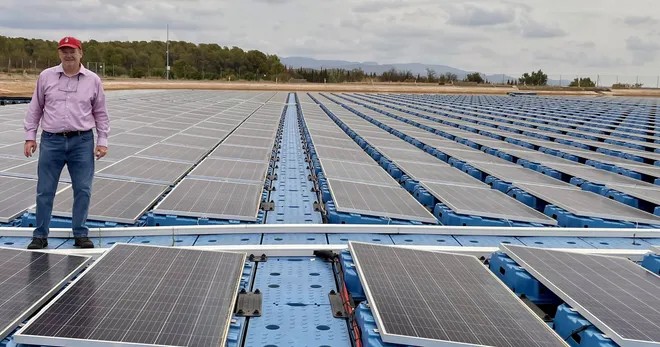
Several weeks ago, a front-page article in my local newspaper wrote about a study to save Arkansas farmlands. The study comes as solar leasing has become an increasingly attractive option.  Michael Popp, agricultural economist with the Arkansas Agricultural Experiment Station, said Utility-scale solar installations are projected to occupy about 0.2% of Arkansas’s 13.7 million acres (5,544,193 ha) of agricultural land, with some counties expected to see 1.7% of cropland converted.  Solar leases bring between US$450 and US$2,500 an acre, far outpacing traditional agricultural rental rates of US$50 an acre for non-irrigated cropland, US$150 for irrigated land, and US$20 for pasture.  Solar developers typically seek flat, well-drained land near transmission infrastructure, which tend to be the same characteristics that make productive farmland.  As solar competes with farmland across Arkansas, University of Arkansas researchers are testing whether a different approach could meet energy demands without taking acreage out of production.  A new project at the Rice Research and Extension Center is examining the feasibility of floating solar arrays (FPV) installed on irrigation reservoirs and waterways to reduce pressure to convert cropland while adding benefits for farmers.

When I went online, I found floating solar or floating photovoltaics (FPV) are solar panels mounted on a floating structure usually consisting of plastic buoys and cables placed on a body of water.  The systems can have advantages over land photovoltaics (PV) as water surfaces may be less expensive than land and there are fewer regulations for structures built on water not used for recreation.  Life cycle analysis indicates that foam-based FPV have some of the shortest energy payback times (1.3 years) and the lowest greenhouse gas emissions to energy ratio (11 kg CO2 eq/MWh) in crystalline silicon solar photovoltaic technologies reported.  FPV can be used to generate electricity for any application as well as to make green hydrogen via electrolysis on the same water they are floating on. Floating arrays also achieve higher efficiencies than PV panels because the water cools them.  The panels can have a special coating to prevent rust or corrosion while providing shade, slowing evaporation, and inhibiting the growth of algae in the water where they are installed.

Popp said the research is focused on balancing competing interests as solar expansion accelerates.  “The goals are to not convert agricultural land to solar panel use, save irrigation water and create a synergy between utility companies, solar investors, farmers and policymakers.”  Researchers say floating solar could offer a path forward in a debate that has increasingly pitted energy development against agricultural preservation, providing a way to do both without forcing farmers to choose.  Along with physical installation of FPVs, researchers are surveying Mid-South residents and farmers to gauge attitudes toward floating solar and willingness to pay to avoid converting farmland.  The project is a collaboration between agricultural economists, engineers and students with the University of Arkansas Division of Agriculture.  The survey is open through May 15, 2026.

THOUGHTS: Constructing FPV on waterways is one of several innovative ways being researched to provide increased use of land under a solar array.  Growing native wildflowers under and around PV (ecovoltaics) restore ecosystems and supports pollinators like bees and butterflies.  This boosts insect diversity, reduces long-term maintenance costs (vs turfgrass), and can increase crop yields on surrounding farms.  Growing crops or grazing livestock under and around solar arrays (Agrivoltaics) combines agriculture with energy production to boost land-use efficiency.  This symbiotic approach improves crop yields for certain plants by providing shade and reducing water loss, while the transpiration from plants cools the panels, increasing electricity generation.  Innovation is not “one or the other”, but can be both/and.  Act for all.  Change is coming and it starts with you.

Erosion

November 07, 2025

I have been going to a coffee shop to visit a friend every month or so.  I always enter from the rear of the building into the semi-outdoor seating area.  This is enclosed with glass doors that can be raised when the weather is appropriate, although I have never seen them raised.  Several years ago, they did some remodeling on the exterior to replace the concrete that backed up to the mini-mall parking lot where it was located.  The shop has an AC unit on top of the building and a downspout that channels the water off the roof and out to the street.  Over the years this has resulted in the water cutting a path from the spout to the parking lot.  When I arrived this last week, it impressed me with the power of water to cause erosion.  

When I went online, I found water erosion is the process of soil and rock being moved by water.  This erosion can be categorized into types.  Splash erosion comes from the impact of raindrops detaching soil particles.  Sheet erosion is the removal of a thin, uniform layer of soil across a slope.  Rill erosion is the small, channel-like cuts formed by runoff water.  Gully erosion is the larger, more-defined channels that develop from rills.  Stream-bank erosion is the wearing away of the banks of a stream or river.  Coastal erosion is the wearing away of land along the coastline, often caused by wave action.  This natural process shapes landscapes by carving out valleys and canyons, but human activities like deforestation and farming can accelerate it, impacting soil quality and water resources.  Techniques to control water erosion include keeping soil covered with vegetation, practicing conservation tillage, and building structures like terraces and grassed waterways.  The erosion at the coffee shop appears to be rill erosion.  I suppose if left long enough it would become gully erosion.

While erosion is a natural process, human activities have increased by 10 to 40 times the rate at which soil erosion is occurring globally.  At agriculture sites in the Appalachian Mountains, intensive farming practices have caused erosion up to 100 times the natural rate of erosion in the region.  Excessive (or accelerated) erosion causes both “onsite” and “offsite” problems.  Onsite impacts include decreases in agricultural productivity and even ecological collapse from the loss of the nutrient-rich upper soil layers and in extreme cases this can lead to desertification.  Offsite effects include sedimentation of waterways and an accumulation of nutrients (eutrophication) in a body of water.  Both can result in an increased growth of organisms that may deplete the oxygen in the water.  Intensive agriculture, deforestation, roads, anthropogenic climate change (global warming), and urban sprawl are among the most significant human activities regarding their effect on stimulating erosion.  There are also prevention and remediation practices that can curtail or limit erosion of vulnerable soils.

THOUGHTS: I recall being amazed when they had to shut down the 20-year-old spillway outlet at the reservoir where I fished in high school.  The outlet Shannel had two massive rows of 20-foot-high (6 m) concrete blocks that had suffered erosion from the water being released and were needing to be replaced.  Famous examples of water erosion include the Grand Canyon, formed by the Colorado River; the Mississippi River Delta, a large fan-shaped deposit of sediment; and Niagara Falls, which is slowly receding upstream due to erosion.  Water and wind erosion are the two primary causes of land degradation and are responsible for about 84% of degraded land globally, making excessive erosion one of the most significant environmental problems worldwide.  While erosion is a natural process, humans can choose to lessen (or increase) the effect by our actions.  It takes eons for the landscape to recover, if it does at all.  Act for all.  Change is coming and it starts with you.

TREES

December 02, 2024

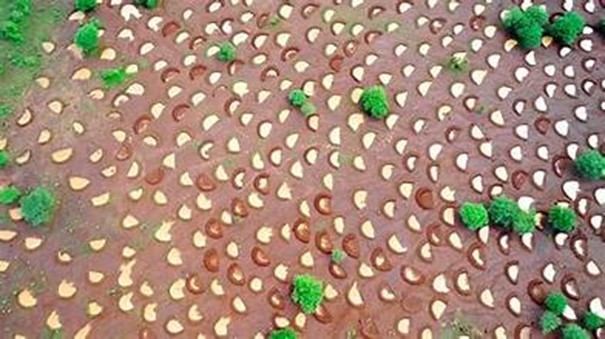
Last week my browser featured an effort sponsored by the UN that received designation as a Flagship project. The Flagship award is part of an effort by the UN Decade on Ecosystem Restoration to ensure that measurable progress is made on the UN’s environmental goals by 2030. When Africa’s fertile terrains become drylands, farmers are thrown into poverty and biodiversity shrinks. Trees for the Future (TREES) is successfully reversing this trend by assisting hundreds of thousands of smallholder farmers in several African countries to fight soil degradation, biodiversity loss, and climate change. TREES has restored 102,165.72 acres (41,345 ha) since 2014. The restoration supports over 50,000 households and captures 382.5 tons (347 metric tons) of CO2 per hectare through its model, the equivalent of emissions from over 26,420 gallons (100,000 liters) of diesel fuel. Restoration of the drylands helps increase the income and improve the health of farmers and their families. TREES is expecting to create 230,000 jobs by 2030 in Kenya, Mali, Senegal, Tanzania, and Uganda, and is recognized as one of the best large-scale ecosystem restoration efforts on the planet. Central to the TREES model is the creation of a series of structures known as a bund.

When I looked online, I found a bund, also known as a demi-lune or half-moon, is a rainwater harvesting technique consisting in digging semi-lunar holes in the ground with the opening perpendicular to the flow of water. The holes are oriented against the slope of the ground which generates a small dike in the curved area with the soil from the hole itself. The dikes capture the rainwater as it runs downhill, allows the water to seep into the subsoil, and prevents the loss of fertile soil by erosion. Semi-circular bunds are used to reforest arid zones with irregular rain patterns and allow the growth of plants and trees. The TREES initiative works closely with tens of thousands of farmers living in poverty on degraded lands following decades of unsustainable agriculture practices, deforestation, pollution, and climate change by providing training in a regenerative agroforestry technique called the Forest Garden Approach. In this four-year program, farmers receive training, seeds, and other resources, while planting thousands of trees and dozens of food and resource crops on their property. The small farmers typically own less than 2.5 acres (1 ha) of land.

TREES projects in Senegal and Mali are a part of the African Union’s initiative as part of the Great Green Wall. Elvis Tangem, Great Green Wall Initiative Coordinator, says, “Once it’s completed, the Great Green Wall will be the largest natural structure on the planet. It’s a massive undertaking, but the dedication and teamwork of organizations like TREES will ultimately make it a reality.” The Great Green Wall project was adopted by the African Union in 2007 to combat desertification in the Sahel region and hold back expansion of the Sahara Desert. The original dimensions of the “wall” were to be 9 miles (15 km) wide and 4,831 miles (7,775 km) long. The program has evolved to encompass nations in both northern and western Africa and promotes water harvesting techniques, greenery protection, and improving indigenous land use techniques, aimed at creating a mosaic of green and productive landscapes across North Africa.

THOUGHTS: TREES is recognized as one of the best examples of large-scale and long-term ecosystem restoration in any country or region, embodying the 10 Restoration Principles of the UN Decade on Ecosystem Restoration. The announcement was made ahead of the 6th UN Environment Assembly, held from February 26 to March 1, 2024. The Assembly convenes to address the triple planetary crisis of climate change, nature and biodiversity loss, and pollution and waste. This should represent an ongoing emphasis not just for the developing countries of Africa, but for the world. Act for all. Change is coming and it starts with you.