Planning

February 28, 2025

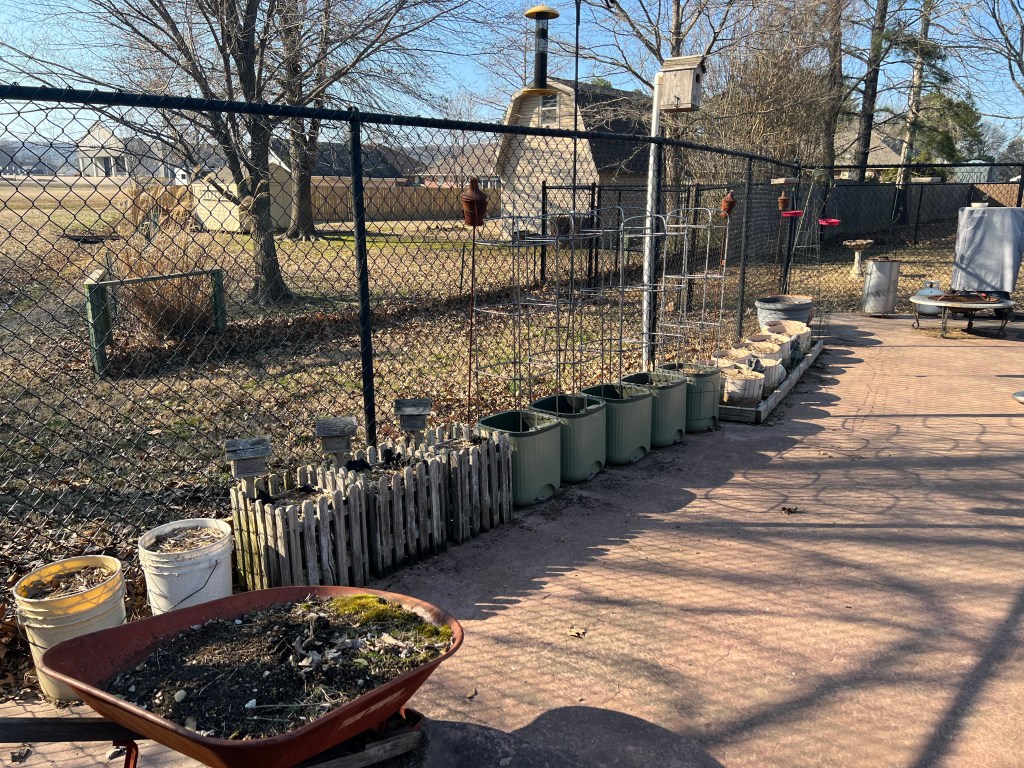
It was near or above 70’sF (21C) most of this week, and that after dropping to single digits a week ago.  Warmer temperatures have got me thinking about my garden.  This time last year, I was planning the garden layout and had seedlings under the grow lights.  My main push was trying to collect enough wood, fill, and dirt to create the four Hügelkultur raised beds.  Every step of the process turned out to be more work than I had imagined (and I imagined a lot of work).  This year will be more tweaking the beds and growing methods I already own.  When I started four years ago, I grew everything in container pots.  These were mostly 5-gallon (19-L) buckets, along with several wooden planters left from my mother-in-law and a few large flowerpots.  Now I have moved almost entirely away from my old containers.  This year’s plantings will go into a mix of raised beds and grow bags, along with the three in-ground beds.  I cleaned out the different planting medium when I shut down last fall.  I had also purchased three additional (5 total) rolling, self-watering tomato planters that I put together.   Then it was a matter of planning how to proceed, then cleaning up and placing the different containers along the back fence of my patio.

When I looked online, I found different sites that assured me they could help me with planning the perfect garden.  These ranged from pre-planned gardens (for beginners), to garden guides and layouts, and even complete kits selling seeds and directions for how to plant.  Several of the self-help guides were “old school” and allowed you to draw your plots on lined paper and then add cut-outs of the various plants so you could move them around to ensure the best placement.  Others were high tech with software to walk me electronically through the (same) planning process.  Being trained as an historian I am partial to paper that I could put my hands on, but I was not ready to revert to my elementary school days of cut and paste.  I decided what I needed to start my journey was a planning checklist to walk me through the stages in the proper order.  What I found was literally called, The Ultimate Garden Planning Checklist.  I printed a copy so I could hold it.

The checklist began telling me what to do 3 to 4 months prior to planting.  We are now 6 weeks from the last frost in zone 7, so I missed that part of planning.  I have an excuse as we were in Greece the first three weeks of February, and everything would have died had I started seedlings in January.  There were still some of the later seeds that could be started (6-8 and 2-4 weeks out) but I will have to push to get them going in time for the April 15 target date.  Last year I did not adequately harden off the seedlings and most of them died either on the screened porch or after planting.  I am going to try and do better this year.  It is not subsistence farming if you buy your plants from the greenhouse.  I need to refill parts of the raised beds, put compost and soil in the containers, and decide what I am going to do with the front beds.  I still have lots of planning left to go.

THOUGHTS: Taking time for planning is necessary if I want my garden to produce.  Each year I get a little better at both planning and deciding what and how to plant.  I am challenged as I see the hours spent by Melissa with her succulents.  I have mentioned how Melissa’s mom would spend hours a day working on the flower beds.  I know both are a labor of love.  I am at the stage where my garden is still a labor of like.  Being skilled at anything is a combination of talent and a lot of time spent doing it.  This is true in business, in sports, and especially in interaction with people.  You may get by on a labor of like in dealing with others, but real communication requires you practice until it becomes a labor of love.  Act for all.  Change is coming and it starts with you.
Wrap Up

November 18, 2024

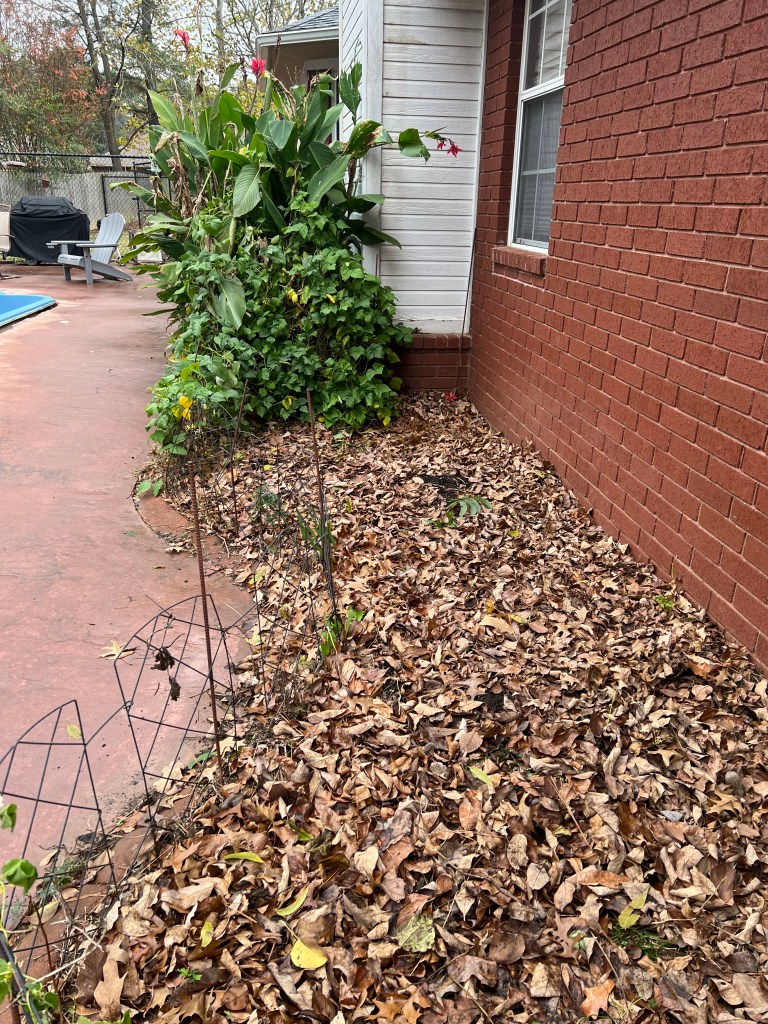
In the HOMES section of Sunday’s newspaper (delivered on Saturday’s) there was an article providing advice to want-a-be gardeners. October (missed it) and November are the best time to wrap up your gardens and prepare for your spring planting. Fall is also the best time to plant trees and shrubs to let them get established before the freeze sets in. Rather than raking leaves consider mulching them and collecting fallen branches in a pile to protect local wildlife (or the neighborhood cat). Deep watering trees and shrubs will send them into the winter well-hydrated and give them a jump-start in the spring. While we may be preparing the inside of the house to welcome holiday guests, it is important to wrap up the outside for this season of dormancy.

When I looked online, the Farmer’s Almanac cited 11 Steps to wrap up your vegetable garden in the fall. This began with removal of any spent plants and debris that may have accumulated. While much of this can be composted, any diseased plants need to be disposed of in the trash. Beans and peas should be chopped off at ground level to leave their nitrogen-fixing roots to feed next year’s crops. Disease/insect free material can be added to your compost pile. This is also a good time for a final weeding to prep for next spring. If you are planning on new beds this is the time to scalp the grass and lay down newspapers with a cover of compost and mulch to prepare the soil. The falling leaves are a great mulch and a good source of nutrition. Your beds could also use compost in the fall to allow microorganisms to break it down throughout the winter. Fall is the time to consider crop rotation for the coming year. It is never good to grow plants in the same family in the same place year after year as it could allow pests and diseases specific to that family to thrive and depleting the soil of the same nutrients each year. This is a good time to test your soil for nutrients and the proper pH for the new crop by contacting your local Cooperative Extension or garden center. You may want to plant a cover crop to protect the soil, and this provides additional nutrients when you till them into the ground in spring. October and November are the best times to plant garlic as the plants need cold temperatures to produce huge yields. Finally, remove all supports an cages and wash and spray them with a two-to-one solution of water and bleach to kill disease. I guess I have got some work to do before I can wrap up my gardening for the winter.

Preparing to wrap up the garden is also about taking care of your pots, tools, and equipment. The water hose needs to be turned off and drained and, in our area (zone 7), the spigots need to be covered to prevent freezing. Garden tools need to be cleaned, sanded, and oiled before storing them for the winter. Any frames or supports should be wiped down with soapy water and allowed to dry before being stored (inside) for the winter. Ceramic and clay pots need to be moved inside to prevent cracking during freezing temperatures. You can dump the soil in your beds and then sterilize the pots with a diluted (1/2 cup per gallon) bleach solution. It was suggested not stack these pots, as it may be hard to get them unstuck in the spring. So much to do before I can stop doing anything.

THOUGHTS: As I prepare to wrap up my garden I am still harvesting crops. My pole beans (Phaseolus vulgaris) produce several cups of fresh beans every couple of days, and I have nearly ripe tomatoes (Solanum lycopersicum) on most of my vines. I am giving them as long as possible to ripen before the coming big frost the weather people keep predicting. Still, I can complete most of these preparations. Preparing my pots and tools will clean and keep them from rusting as they sit on the back porch. Being willing to wrap up is both hard and necessary. That is true for gardening and in life. When I retired, I thought it was a wrap up. Instead, it was the start of my next assignment. Humans need to have a purpose to survive. Act for all. Change is coming and it starts with you.
Euphorbia Ingens

September 27, 2024

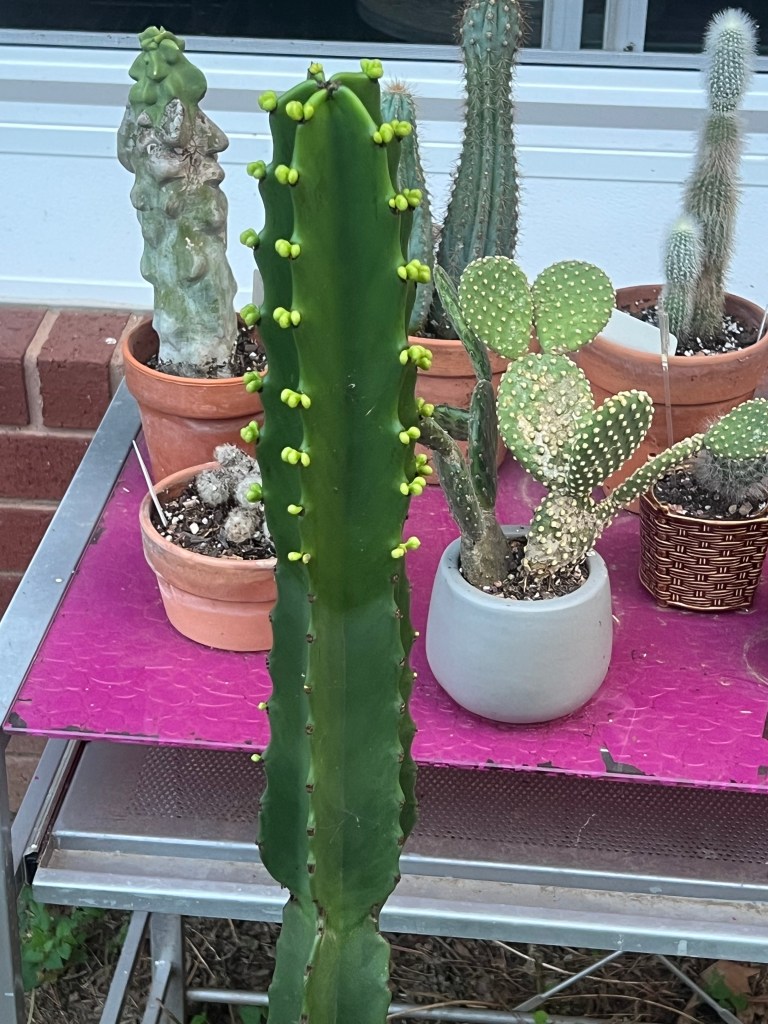
Melissa was working on her succulents over the weekend and called me out to see what was going on with her plants.  We had placed two tables in the flower bed on the north side of the house that we have yet to figure out what to do with.  Melissa decided in the short run this would be a good place to put some of her hardier cacti to take advantage of the outside.  Although these plants are visible through the porch windows, Melissa does not get out to physically check on them more than once a week.  As with most cacti and succulents, a good rule of thumb is to leave them alone and let them thrive on their own.  One of the plants has been growing particularly well over the last two years and is over 3 feet (1 m) tall.  The third section of the plant had developed greenish-yellow buds along its ridges which appeared to be ready to bloom.  When I asked, she told me this was a Euphorbia ingens (I sometimes think she uses the scientific names just to throw me off).   

When I looked online, I found the candelabra tree (Euphorbia ingens), or naboom, is a species of flowering plant in the family Euphorbiaceae native to dry and semi-savanna areas of southern Africa.  This tree is a tall succulent with green round-like branches resembling a balloon that grows to 19.5 to 26 feet (6 to 8m) tall.  The trunk of the candelabra is thick, and the stems have 5 ridges each and are 1-1/3 to 3 inches (3.5 to 7.5 cm) thick.  The segmented stems are dark-green and young sprouts have paired spines 3/16 to 5/64 inches (0.5 to 2 mm) long.  The plant blooms from autumn to winter and the small greenish yellow flowers sit on the ridges of the topmost segment.  A red, round, three-lobed capsule fruit turns purple when ripe.  The plant’s flowers are attractive for butterflies, bees and other insects, which pollinate them when gathering pollen and nectar.  The seeds are edible for birds, who also like to make their nests in the branches of these trees.  The light and solid wood of the main trunk is used in door, plank, and boat production.  The milky latex sap of the tree is highly poisonous and can cause blindness, severe skin irritation, and poisoning (when ingested) in humans and other animals.  The plant has few pests due to the toxic sap.

Euphorbia ingens grows well both indoors and outdoors and has become a popular choice for rock gardens and indoor houseplant collections due to its stately appearance and low maintenance.  In their natural environment, these succulents can grow up to 40 feet (12 m) tall, but they usually top out around 8 to 10 feet (2.5 to 3 m) tall when grown indoors.  Still, even this would take a high ceiling to accommodate a mature plant.  When grown indoors or in containers, it is extremely uncommon for this species of euphorbia to produce blooms.  Since Melissa’s plant has budded, we are waiting to see if it will break into full bloom.

THOUGHTS:  The buds on the Euphorbia ingens are only the latest of Melissa’s accomplishments.  Over the last two years she has repeatedly shown me the flowers that have bloomed on many of the succulents and cacti that are under her care.  In my case, with the exception of the ground cherry (Physalis angulate) that I did not plant and the red burgundy okra (Abelmoschus esculentus) I do not like to eat, I have often struggled with production of my plants (pole beans are another exception).  Melissa’s mom was a prolific gardener whose secret was to spend hours tending her flowers.  The same it true with Melissa who spends hours with her succulents.  I am willing to plant, water, and harvest.  Perhaps there is a lesson there.  When we are willing to put in the work, we can achieve most tasks.  That is true for gardening.  That is also true for creating positive human interaction.  Do the work.  Act for all.  Change is coming and it starts with you.