Lunar

January 30, 2025

Listening to the radio yesterday I was inundated by references to the start of the Lunar New Year on January 29th.  I was somewhat surprised as there is not a large Asian population in our state.  As of 2022 there were 47,413 (1.7%) Asian Americans living in Arkansas.  This was a national broadcast, but again it was a country music station.  Still, the references got me hankering for dumplings and egg rolls.  I texted Melissa on my way home and she agreed this sounded like a good dinner.  Not having a “go to” Asian restaurant in town I decided to buy a frozen variety from the market and cook them in the air fryer.  I realized this was not the same as dim sum (small bites) but it was the closest I could come to it on short notice.  I came home excited by the prospect of a tasty meal to kick off our unofficial celebration of the Lunar New Year.

When I looked online, I found there is a difference between Chinese New Year and Lunar New Year.   While they are can be used interchangeably, Chinese New Year is primarily celebrated in China, where it is a public holiday and one of the biggest celebrations of the year.  Countries like Vietnam, Malaysia, Indonesia, Brunei, Singapore, South Korea, and parts of southeast Asia instead celebrate this as Lunar New Year.  Traditionally, the celebration begins with a large family meal on Lunar New Year’s Eve and continues for the next 15 days, or until the following Lantern Festival (the next full moon).  Symbolic traditions include eating fish (associated with wealth) or noodles (for longevity).  People may also give red envelopes with money inside (hóngbāo) to express good wishes, set off fireworks and dragon dances to ward off evil spirits (Nian, the monster afraid of red), offer sacrifices to their ancestors for protection, and reunite with family to enjoy the celebrations.  In China and Vietnam, the event correlates with the start of spring so floral arrangements adorn houses, streets, and businesses.  In South Korea, bird decorations like paper cranes are hung up for longevity and good fortune.  In Tibet, children bring gifts to their elders, and in Mongolia, a pastry tower is made to represent Mount Sumeru (a holy mountain).  Many people with Asian heritage living in other parts of the world still participate in the Lunar celebrations.

Lunar New Year is a time to look towards a new year and good fortune but there are also plenty of superstitions around this time.  In preparation, people will “sweep out” the misfortune of the old year from their home and hang up poems on red paper (couplets) for good luck and prosperity.  It is widely believed you should avoid any washing or sweeping on the New Year to avoid “washing” the good fortune away, to avoid unlucky words like “illness” or crying, and to avoid colors associated with mourning such as black and white.  Door Gods (mén shén) are hung up in entranceways facing each other to ward off evil spirits.  Red is known as a lucky color and symbolizes happiness, prosperity, luck, and good fortune, and appears on envelopes, clothing, lanterns, and decorations especially during this time.

Thoughts: Our celebration of Lunar New Year was derailed by a major thunderstorm that repeatedly knocked out the power.  We did not want to risk a power surge on our new air fryer and decided to go to the local Chinese buffet instead.  The power was back on when we arrived, and I anticipated the egg rolls and pork dumplings.  To my dismay they had no dumplings, and the egg rolls were soggy.  The power flickered several more times before finally going out completely.  Several local police had also come for the buffet, and they turned on their flashlights and placed them around the restaurant so we could see to eat.  We left paying cash to the delight of the cashier (register was out).  Although the food did not rival the dim sum I experienced in the Bay Area, it was memorable.  I hope this inauspicious start will lead to a good year.  Act for all.  Change is coming and it starts with you.
Cabbage Roll

December 04, 2024

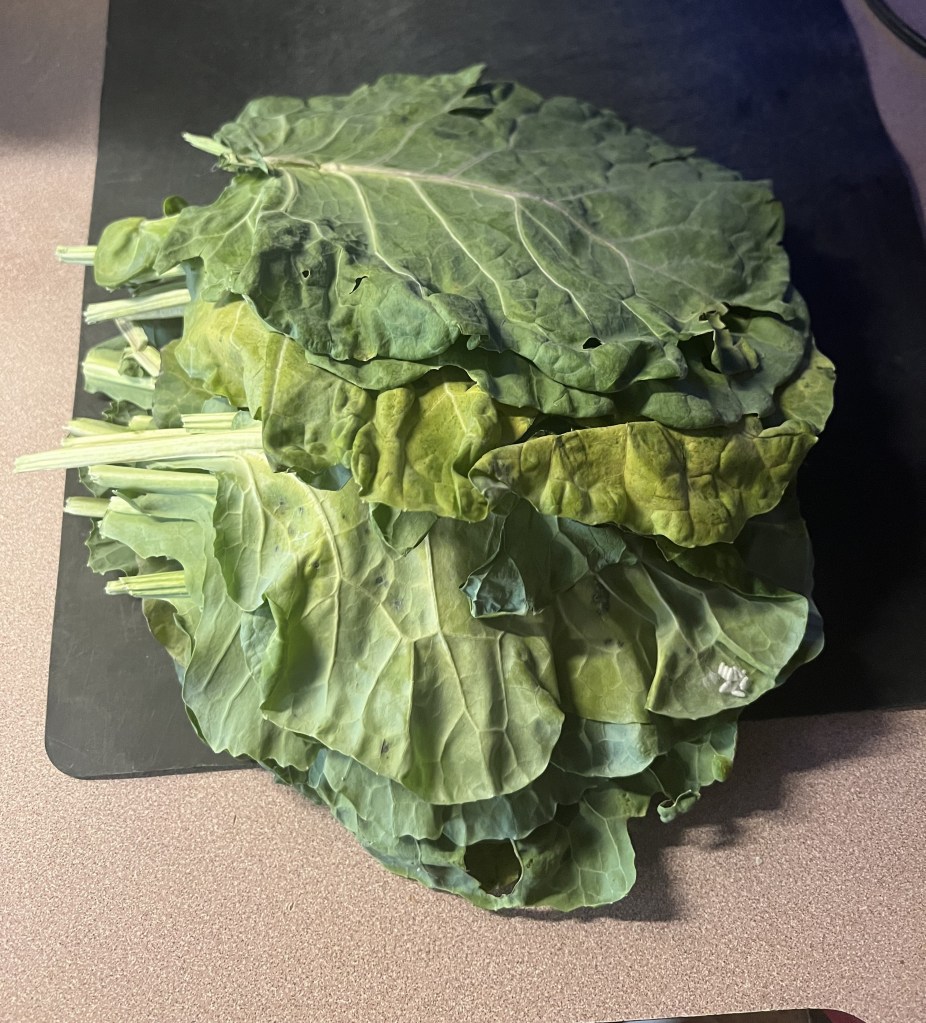
Last week I gave in and disbanded the remaining sections of my garden. That meant picking (hardly enough to qualify as a harvest) the last green tomatoes (Solanum lycopersicum) and removing the vines from their containers. I am looking for a green tomato recipe (other than fried) as Melissa said she will not allow the last of the lot to go into more salsa/Pico. I picked the remaining pole beans (Phaseolus vulgaris) and removed the final hill of plants. The beans had been bitten by the mornings of frost and had gone mushy and I ended up throwing them away. The only thing left was the three cabbage (Brassica oleracea) plants that had not matured enough to form a head. After I pulled them from the ground, I wondered what I could do with the leaves, as it seemed a waste to just throw them away. I made sauerkraut and Cole slaw from the four cabbages I harvested several weeks ago but wanted to do something different with this batch. That is when I hit on the idea of a cabbage roll.

When I looked online, I found a cabbage roll is a dish consisting of cooked cabbage leaves wrapped around a variety of fillings. This dish is common to the cuisines of Central, Northern, Eastern, and Southeastern Europe, as well as much of Western Asia, Northern China, and parts of North Africa (i.e., most anywhere except the Americas). Meat fillings are traditional in Europe, and include beef, lamb, or pork seasoned with garlic, onion, and spices. Grains such as rice and barley, mushrooms, and vegetables are often included in the roll. Fermented cabbage leaves are often used for wrapping in southeastern Europe. In Asia, seafoods, tofu, and shiitake mushrooms may be used, and Chinese cabbage (Brassica rapa) is often used as the wrapping. The cabbage leaves are stuffed with the filling and then baked, simmered, or steamed in a covered pot and generally eaten warm, often accompanied with a sauce. The cabbage roll can serve as the main course (often with mashed potatoes in Europe) or as a side dish. The recipe varies depending on the region.

I found a recipe on the Pioneer Woman website for cabbage rolls that said to start by boiling a large head of cabbage to remove the outer leaves. The small print indicated you could also use the large leaves that flaked off of the cabbage during preparation by boiling them in water for 2 minutes to soften. Since I only had leaves, I thought this might be worth a try. I made the stuffing combining hamburger, sausage, rice, and spices. Next, I boiled the leaves and laid them out on a towel to dry. A 1/3 cup of stuffing was placed in the leaf and tightly wrapped. The sauce consisted of crushed tomatoes, juice, garlic, and Italian spices. The recipe made enough (32) rolls for two batches for Melissa and me. I followed the advice and froze half prior to cooking and baked the rest (with all the sauce) at 350 F (176.6 C) for 90 minutes. I was unsure how the leaves were going to turn out (bitter) since they had not matured into a head. It made a delicious meal, even without the mash potatoes.

THOUGHTS: While I have tried my hand with stuffed grape leaves on several occasions, I have never made cabbage rolls. The cabbage leaves were actually easier to handle as they were stiffer than the grape leaves. Now that my garden is gone, I have reflected on the different ways I processed the fruits of my labor. This includes canning, freezing, and fresh produce in a variety of dishes. I would have never tried many of these dishes if I had not already grown the vegetables. I was pleasantly surprised how they all turned out. This reminded me to keep trying something new rather than being locked into what is known and comfortable. The same is true regarding the cultures and traditions different to your own. Until you participate, you will never know what you might be missing. Act for all. Change is coming and it starts with you.

Roasted

October 28, 2024

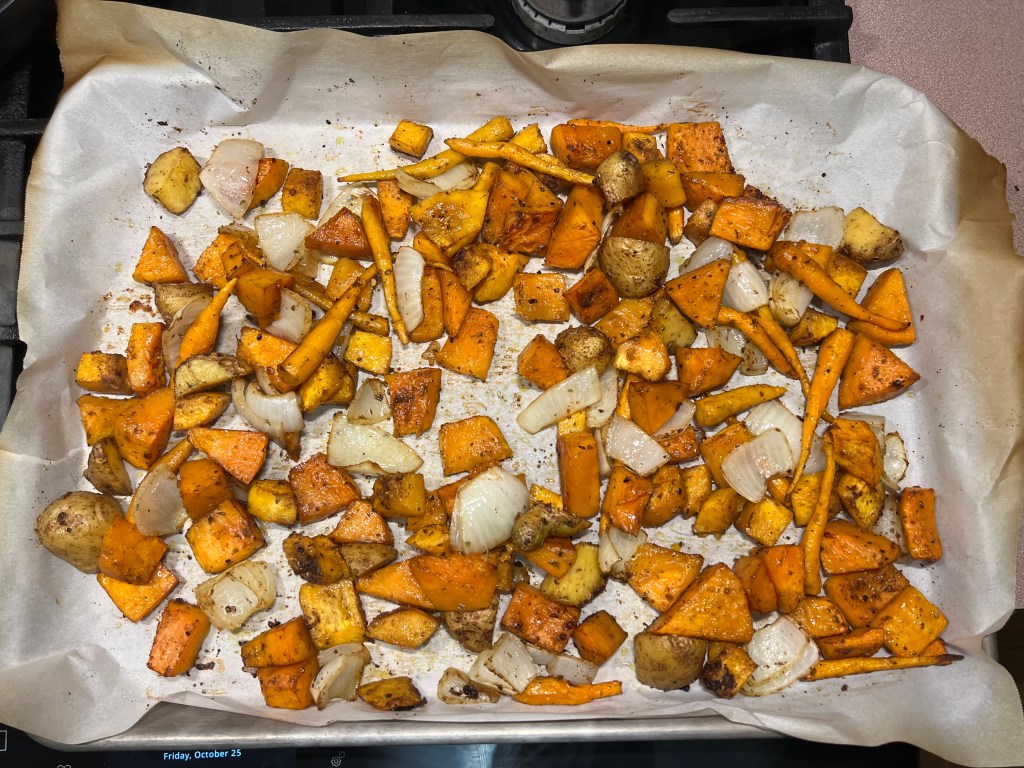
I have continued to be amazed how productive our Kentucky pole beans (Phaseolus vulgaris, var.) have been this year.  They got a late start as the second sister and tarried through most of the summer, but the cooler temps have brought them on.  I gave my niece a bag of prepared beans on Thursday and picked another 3 cups of prepared beans on Sunday.  While I decided to flash freeze most of the quart bags of green beans for later use, I like the ability to go directly from garden to table.  We had decided to put a mini-split HVAC unit on the porch to protect the succulents this year and while moving the racks on Saturday to allow the technician access I noticed several of the Butternut squash (Cucurbita moschata) I had stored on the racks on the porch had started to rot on the stem ends (obviously too warm).  I ended up throwing two away but the other two were still good.  It seemed this might be a good time to make some roasted vegetables.

When I looked online, I found there are many benefits to making roasted vegetables.  This is not only a fairly hands-off method to prepare them, but you do not even need a recipe, just some good cooking oil and some salt.  Roasting adds a savory depth of flavor only achieved once the amino acids and reducing sugars creates melanoidins (Maillard reaction), the compounds that give browned food its distinctive flavor.  The bit of caramelization and crispy edges also add a textural delight.  Boiled vegetables tend to be mushy somewhat bland, while roasted ones are slightly charred and sweet.  Even salad greens like romaine can be roasted and transformed into more complex and intensely flavored versions of their fresh selves.  The easiest way to roast vegetables is to cut them into similar sized pieces (for uniform cooking), toss them in enough oil to completely coat them.  Lay them out on a baking sheet and sprinkle them with salt and pepper and cook them on the middle shelf in your oven at 400F to 450F (204C to 232C), until they are fork tender and have crisped up at the edges.  The timing varies depending on the hardiness of the vegetables and can range from 10 to 20 minutes for soft yellow squash to up to 60 minutes for carrots and winter squash.  The real length of time varies on how small you dice them.

I diced the squash into 1 inch (2.5 cm) pieces, cut up the last of my Yukon Gold potatoes (Solanum tuberosum, var.), peeled the smallest of my carrots (Daucus carota), and added a medium onion (Allium cepa) to round out the roasted vegetables.  We purchased several seasoning packets from a spice store in Wichita and I added a packet of Tuscan seasoning to three tablespoons of oil to coat the vegetables.  An online recipe suggested it only took 10 to 20 minutes to roast the mixture, but I was skeptical (see above).  I put them in for 15 minutes at 425F (218C) and then checked.  They were not done.  I raised the temperature to 450F (232C) and put them back for another 15 minutes.  They were perfect.  Prior to making the roasted vegetables I made a pot of green beans.  This was another simple recipe, with the beans mixed with two russet potatoes (store-bought and diced), another medium onion, crumbled bacon, and a Southwest seasoning mix.  Melissa made a small corn bread to accent the roasted vegetables.  The whole meal turned out delicious, and most of it was grown by me.

THOUGHTS: The roasted vegetables and pot of green beans were simple to make, but what made the meal truly satisfying was knowing it came (mostly) from my garden.  It was nice to have some wins out of the time and expense put into raising the crops.  Since I waffled on planting a fall crop, this is the time to start thinking about what will go into my garden next year.  Like most of life, this is a process.  Life seems to have times of frustration and times of satisfaction.  The key is to focus on the latter and let the former slide away.  Act for all.  Change is coming and it starts with you.

Long-term

October 23, 2024

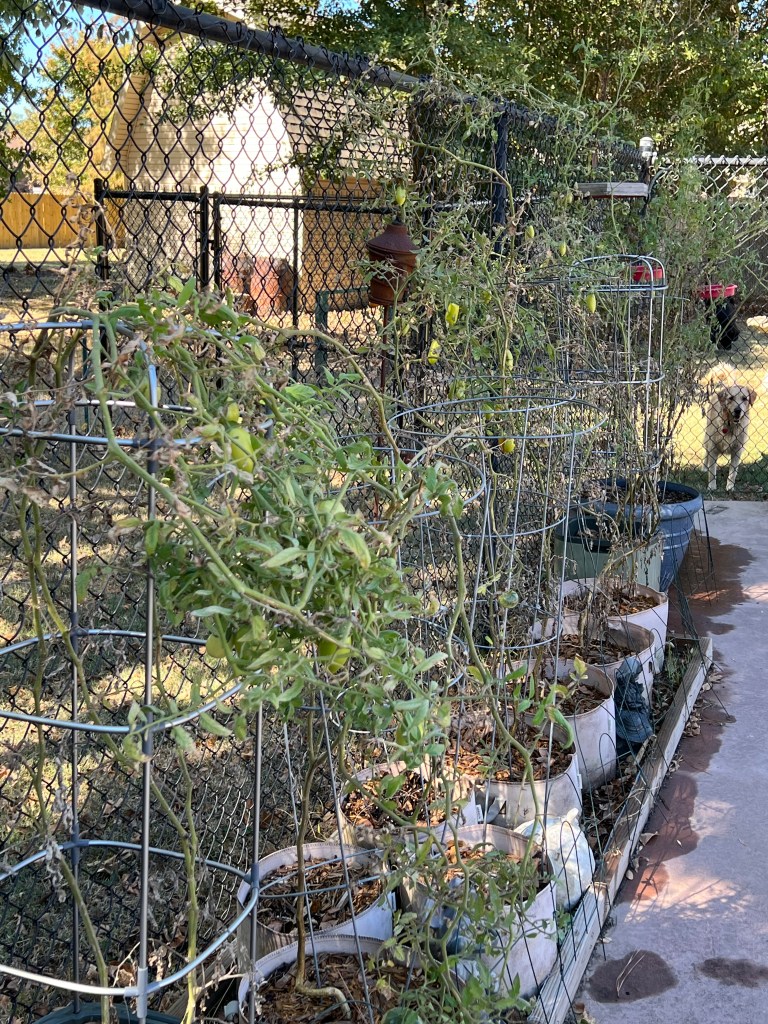
I have mentioned how most of my vegetables have matured and stopped producing.  The exceptions are the pole beans (Phaseolus vulgaris) representing the last of my three sisters’ harvest.  They started late but now still provide several cups of beans every few days.  The raised beds are empty except for the 5 rattlesnake watermelons (Citrullus lanatus) struggling to mature, the 2 late starting green bell peppers (Capsicum annuum), and the 2 red okra (Abelmoschus esculentus) that produce beyond their limit.  There are also 8 cabbages that are finally picking up as the temperatures cool.  I really did not expect much from my tomatoes as the heat kept them from much production during the summer (I did get 3 jars of pasta sauce).  The friend I swap gardening stories with said she tore her tomatoes and peppers out several months ago to avoid having to water them.  We are having temperature shifts as the nights get into the 40’s (4.5+C) and the days get to the high 80’s (27+C), causing a resurgence of my San Marzano and plum tomatoes, making me wonder what to expect in long-term production.

When I looked online, I found that depending on their maturation date, “indeterminate” tomato (Lycopersicon lycopersicum) cultivars are the best long-term producers and will yield tomatoes for two to three months.  “Determinate” tomatoes, including dwarf and bush cultivars, typically only yield tomatoes for around two weeks after they blossom.  Tomatoes are grown as perennials in tropical climates and as annuals in USDA plant hardiness zones 2 through 10.  Traditional and heirloom indeterminate tomato cultivars continue to grow taller throughout the growing season and will reach heights of 5 to 8 feet (1.5 to 2.5 m) and typically require support with a wire tomato cage or stakes.  They grow flowers and yield tomatoes from shoots or “suckers” that grow on the sides of their main stem from the time they mature and flower until the first autumn frost.  The best long-term producing cultivars are those that mature early and grow in an area with a long growing season.

Most cultivated tomatoes in my area (zone 7) are planted soon after the last spring frost (c. April 15) and the fruit is expected sometime between 57 to 100 days after the seedling is planted.  If you plant an indeterminate tomato cultivar, you are encouraged to prune the vines regularly to maintain a long harvest of large, quality tomatoes.  I have done this in the past, but I have only done this sporadically this year.  The University of Arizona horticulturalists recommend pruning all but three or four of the shoots that grow in a tangle inside the cage and allow the foliage to protect the fruit from the sun.  If you don’t prune the suckers, these stems consume a lot of a plant’s energy and may result in smaller yields and fewer tomatoes (like I saw).  I did use 4 foot (1.2 m) cages but as the season went on the plants far exceeded that height.  I found out the San Marzano I planted for pasta sauce are a larger variety of plum tomatoes (I planted both) and are some of the better plants in long-term production.

THOUGHTS: As the temperatures dropped, I quit the daily watering I maintained throughout the summer and removed the dying vegetable plants one by one as they ceased production.  A month ago, I was tempted to tear out all of my tomatoes as they had essentially stopped producing fruit but kept them to see what the long-term might bring.  Now they are again producing blossoms and fruit.  I had little to lose when I took a long-term approach in my vegetable garden.  If the plants failed to produce, I would not have been out much in terms of time and water.  Since they did produce, I will reap the benefit of fresh tomatoes into the fall.  Corporations seem less willing to take a long-term approach toward products or employees.  If the product does not make a quick profit, it is dropped.  If the employee does not prove productive, they are let go.  While moving from one product to the next might make economic sense, employees should not be used as expendable.  Act for all.  Change is coming and it starts with you.

2nd Sister

September 24, 2024

I was excited over the weekend when I went out to check the remnants of the three sisters planting to find the pole beans (Phaseolus vulgaris) had finally begun to produce.  I have mentioned the poor production for the 1st sister, corn (Zea mays var. rugosa), with only dried kernels suitable for grinding or bird food.  That was followed by an ok harvest of the 3rd sister, Butternut squash (Cucurbita moschata), which produced 7 gourds.  It has now been nearly a month and while there were lots of flowers and buds, I had not seen any beans hanging from the vines until last weekend.  The vines had been growing well, even causing some of the drying corn stalks to collapse and again lay on the ground.  I felt lucky for having staked the stalks after their infamous “leaning” event in July.  I knew at least some of the stalks would be able to stand despite the weight of the bean vines.  Yesterday I decided to see if I could find anything worth harvesting among the twisted vines.  I was anxious to see the result from the 2nd sister.

When I looked online, I found the common bean (Phaseolus vulgaris) is an herbaceous annual plant grown worldwide for its edible dry seeds or green, unripe pods.  The bean’s botanical classification (as all Phaseolus species) is a member of the legume family Fabaceae.  Common beans acquire the nitrogen they require through an association with rhizobia (like most Fabaceae), or nitrogen-fixing bacteria.  The bean has a long history of cultivation with the wild Phaseolus vulgaris native to the Americas.  It was originally believed that it had been domesticated separately in Mesoamerica and in the southern Andes region 8000 years ago, giving the domesticated bean two gene pools.  Recent genetic analyses show that it was first domesticated in Mexico, and then split into the Mesoamerican and Andean gene pools.  As the 2nd sister (by planting order), maize (corn), beans, and squash are the three Mesoamerican crops that constitute the “Three Sisters” that were central to the indigenous agriculture.  All wild members of the species are climbing, but many cultivars are now classified as bush beans or climbing beans, depending on their style of growth.  Beans are grown on every continent except Antarctica, and during 2022, there were 28 million tons (28000 kt) of dry beans produced worldwide, led by India with 23% of the total.  The common bean arrived in Europe as part of the Columbian exchange, the widespread transfer of plants, animals, commodities, precious metal, culture, human populations, technology, diseases, and ideas between the New World (the Americas) and the Old World (Afro-Eurasia) in the late 15th and following centuries.

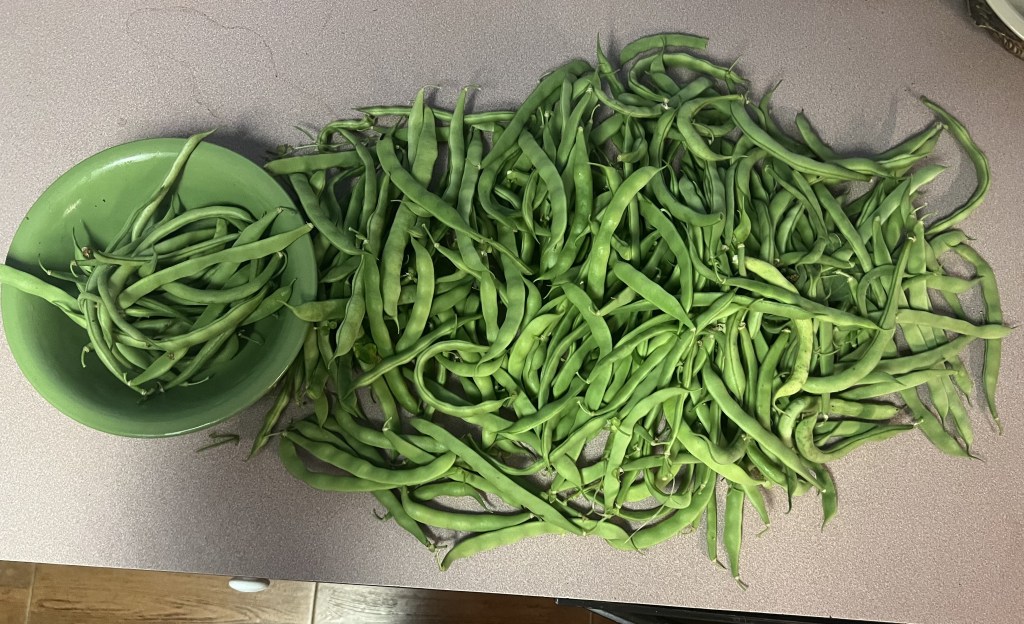
While I had (inadvertently) planted bush beans in my raised beds, I planted pole beans as my 2nd sister.  I have mentioned how bush beans are preferable for commercial cultivars as the fruit tends to ripen at the same time (yes, beans are another fruit that is eaten as a vegetable).  I harvested the bush beans last week and got a small return (the bowl in picture).  Unlike the bush beans I planted in the raised bed, the pole beans are expected to provide a continuous harvest throughout the growing cycle.  I look forward to several more weeks of harvest from my 2nd sister.    

THOUGHTS:  I was pleased with the harvest from the 2nd sister.  The first pick of pole beans yielded over 6 quarts of processed green beans.  I flash froze 4 quarts and plan for the other 2 quarts to be mixed with onions, bacon, and the Yukon Gold potatoes (Solanum tuberosum) I harvested earlier this month, for a meal later this week.  This Thanksgiving, I plan on providing a green bean casserole for the family using my home grown beans.  This is one of the joys I find in (trying) to provide subsistence agriculture.  While there are trials (i.e., the other sisters) in growing your own food, they make the successes sweeter.  This also forces me to explore a variety of preservation techniques.  Life-long learning is a good thing.  Act for all.  Change is coming and it starts with you.