2nd Crop

August 27, 2025

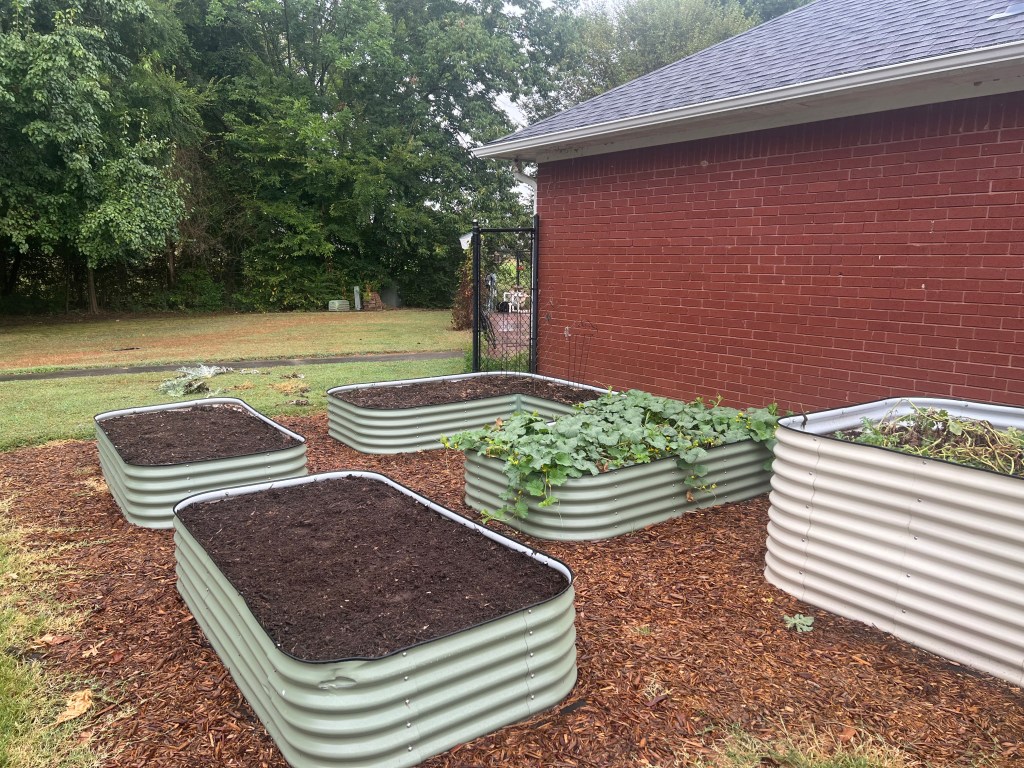
While I considered replanting my raised beds last year, I never got around to doing it.  When I planted my vegetables in April I noted when (and if) I could replant another round of the same vegetables.  After the initial harvest I also considered which vegetables I wanted more of.  I already had way too many pickles (Cucumis sativus) with 12 pints (5.7 liters) than I could use over the next year, and the same was true for the six pints (2.8 liters) of canned carrots (Daucus carota).  I had eaten through the radishes (Raphanus sativus) and only had 2 pints of beets (Beta vulgaris) left, so these were a good choice.  I also decided to replant cauliflower (Brassica oleracea) and cabbage (Brassica oleracea).  We enjoyed the two quarts (1.9 liters) of sauerkraut last year and I had not planted a new crop this year.  I rounded out the raised beds with a few vegetables that had not grown well along the patio; lettuce (Lactuca sativa), spinach (Spinacia oleracea), and peas (Pisum sativum).  Now that my 2nd crop is planted, I just need to wait and see what will produce.

When I went online, I found a second crop is either the second growth of a crop that regrows after an initial harvest, or, more commonly, a different crop planted on the same land within the same year after a previous crop has been harvested.  This is known as double cropping and allows farmers to maximize land use and harvest two yields from the same acreage in a single growing season.  This requires sufficient time for the crop to mature and resources like water to support the second planting.  There are two main types of second crop.  The first is a regrowth after the initial harvest where the stump/roots of a crop resprouts after it has been cut for its first harvest (example, broomcorn).  The second is to plant a follow-on crop of a new and different crop on the same piece of land within the same year after the first has been harvested.  This utilizes land that might otherwise lay idle or unproductive.  Double cropping requires adequate time for the second crop to mature and sufficient moisture from rainfall or irrigation to support both plantings.  This process can boost the overall farm revenue and potentially improve ecological services.

There are several benefits to succession planting or planting a 2nd crop in your vegetable garden.  First is that it allows you to enjoy the vegetables you love for a longer period.  This also allows for more yield in the same amount of space.  This is especially so for smaller gardens with limited space.  If you plant a 2nd crop from a different plant family, it can improve the soil structure and replenish nutrients depleted by the 1st crop.  Finally, rotating different types of plants helps disrupt the life cycles of pests that had fed on the 1st crop and reduce the spread of diseases.  Critical considerations for a 2nd crop are the first frost date in your growing area (mine is 7b).  That means planting fast maturing varieties and vegetables that thrive in cool weather.  You will also need to amend your soil with new compost or fertilizer to ensure a good result.  I did not fertilize when I planted yesterday.  This just gives me something to do today (ha ha).

THOUGHTS: Planting a 2nd crop is the next step toward my goal of sustainability.  Admittedly, I should have allowed several plants to go to seed and then replanted those.  Instead, I used what was left in the heirloom seed packages I had left.  Maybe next year.  As the weather cools, I am looking forward to finally getting some production from the tomatoes (Solanum lycopersicum) and bell (Capsicum annuum) and jalapeno (Capsicum annuum) peppers I planted last April along with the new produce from my 2nd crop.  While the time and expense of growing my garden may not cover the costs, the crispness of the produce makes it worthwhile.  Sustainability is a process that is its own reward.  Act for all.  Change is coming and it starts with you.
Pressure

August 03, 2025

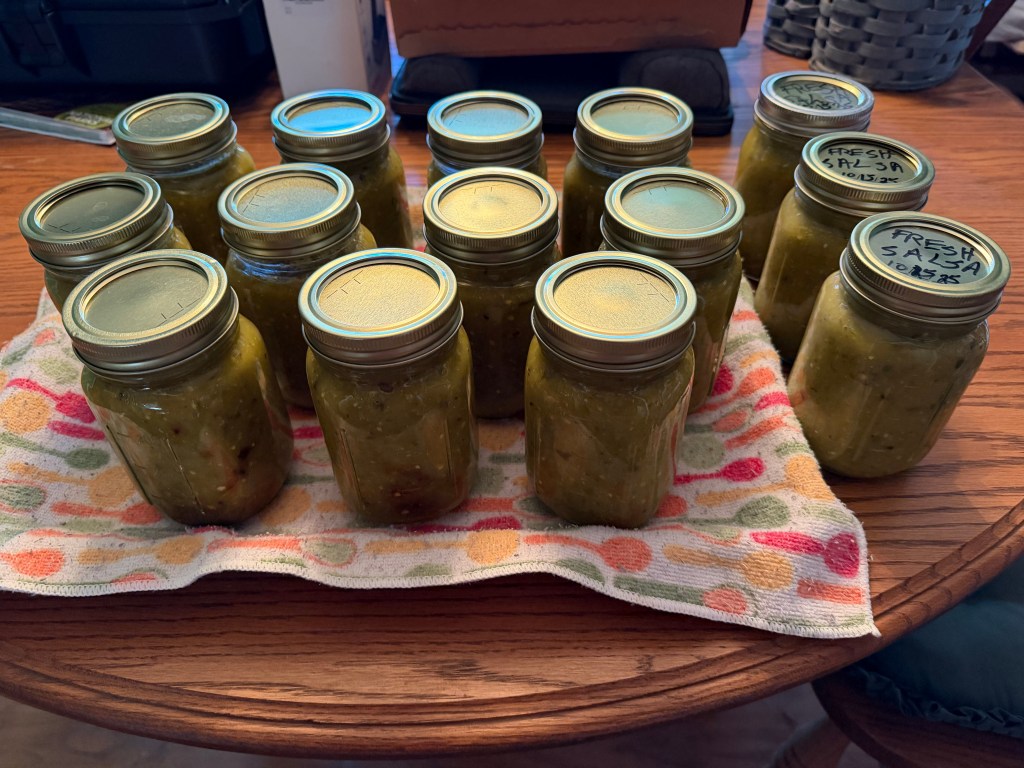
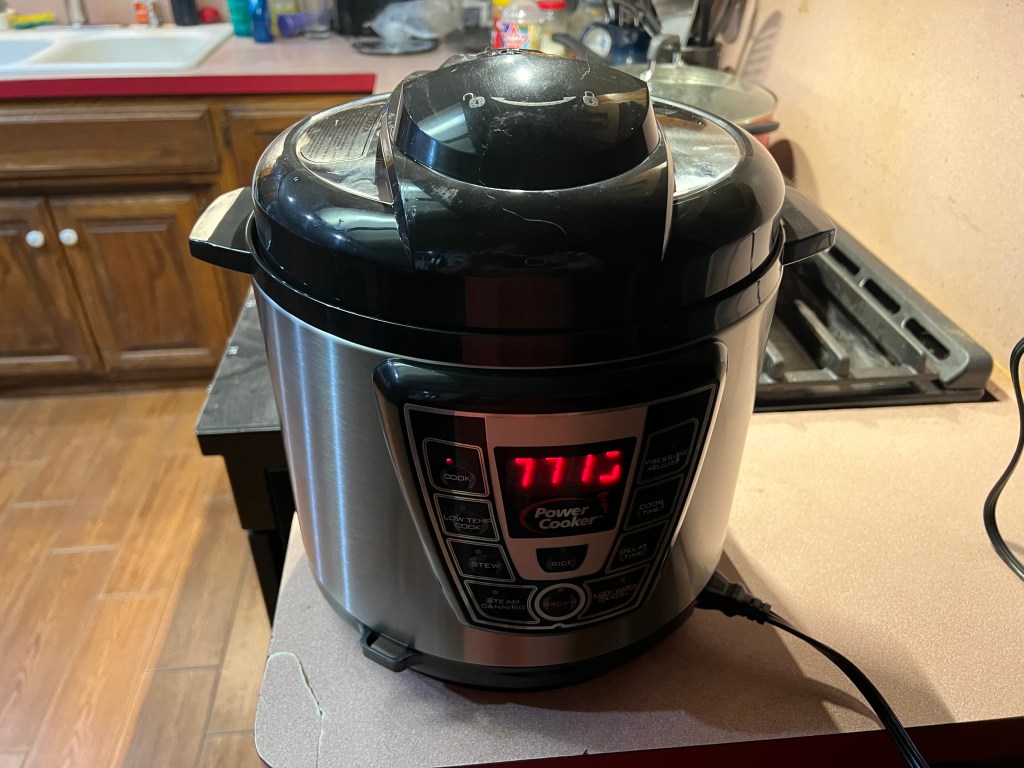
I decided I had enough tomatoes (Solanum lycopersicum) to make another batch of pasta sauce.  We used the last 2024 jar during January and have been using “store-bought” sauce.  I like the store brand, but it never seems as good as my home canned sauce.  The recipe calls for 25 pounds (11.3 kg) of tomatoes and makes around 10 quarts (9.5 liters) of sauce.  I never have that many tomatoes at one time, but I had prepped and frozen a gallon (3.8 liters) from a previous harvest and the cool(er) spell last week produced another burst of fruit.  This would give me 4 or 5 jars of sauce, so I adjusted the recipe accordingly.  I have been able to make my sauce using a water bath (boiling water) due to the higher acidity of the tomatoes.  Last week I had also prepared the carrots from my garden and the slices were sitting in the refrigerator.  I had been reluctant to can them because of their low acidity.  To can the carrots, I would need to do something I had never done before, use a pressure cooker.

When I went online, I found a pressure cooker is a sealed vessel for cooking food (pressure cooking) with the use of high-pressure steam and water or a water-based liquid.  The high-pressure limits the water from boiling and creates higher temperatures not possible at lower pressures.  This allows the food to be cooked faster than at normal pressure.  The prototype of the modern pressure cooker was the steam digester invented in the 17th century by the physicist Denis Papin.  The cooker worked by expelling air from the vessel and trapping steam produced from the boiling liquid.  The steam is used to raise the internal pressure up to one atmosphere above normal (ambient) and gives higher cooking temperatures between 212 F to 250F (100C to 121C).  Together with high thermal heat transfer from steam it permits cooking in between a half and a quarter of the time of conventional boiling while saving a considerable amount of energy.  Almost any food that can be cooked in steam or water-based liquids can be cooked in a pressure cooker. 

Modern pressure cookers have many safety features to prevent the pressure cooker from reaching a pressure that could cause an explosion.  After cooking, the steam pressure is lowered back to ambient atmospheric pressure so the vessel can be opened.  All modern devices also have a safety lock to prevent opening while the cooker is still under pressure.  According to the NY Times Magazine, 37% of US households owned at least one pressure cooker in 1950, but by 2011 that dropped to 20%.  This decline was attributed to a fear of explosion (rare with modern pressure cookers) and from competition by other fast cooking devices such as the microwave oven.  Today’s third-generation pressure cookers have many more safety features and digital temperature control, do not vent steam during cooking, and are quieter and more efficient.  These conveniences have helped make pressure cooking more popular.  I bought Melissa a third-generation electric pressure cooker (an odd gift?) before we were married.  I later found out she never used it. 

THOUGHTS: As I was making the carrots Melissa told me of her experience with an early pressure cooker.  She loved to watch her granny canning in the kitchen when she was a small girl.  Then one afternoon when she was three, the old-style first-generation pressure cooker exploded, sending hot water and glass everywhere.  Both her granny and mom wore glasses, but she did not, and glass got in her eyes.  A quick trip to the doctor removed all the glass, but neither she nor her mom ever watched granny using the pressure cooker again.  Even with the modern versions, her dad was the only one in the house who used one.  It took me a week to build up the nerve to use the pressure cooker.  I had never used one and had “heard the stories”.  I went online to learn how to operate it and found it easy to use.  I now have a new cooking method to add to my resume.  New things are generally only daunting if never tried.  Act for all.  Change is coming and it starts with you.
Tomato Pie

July 21, 2025

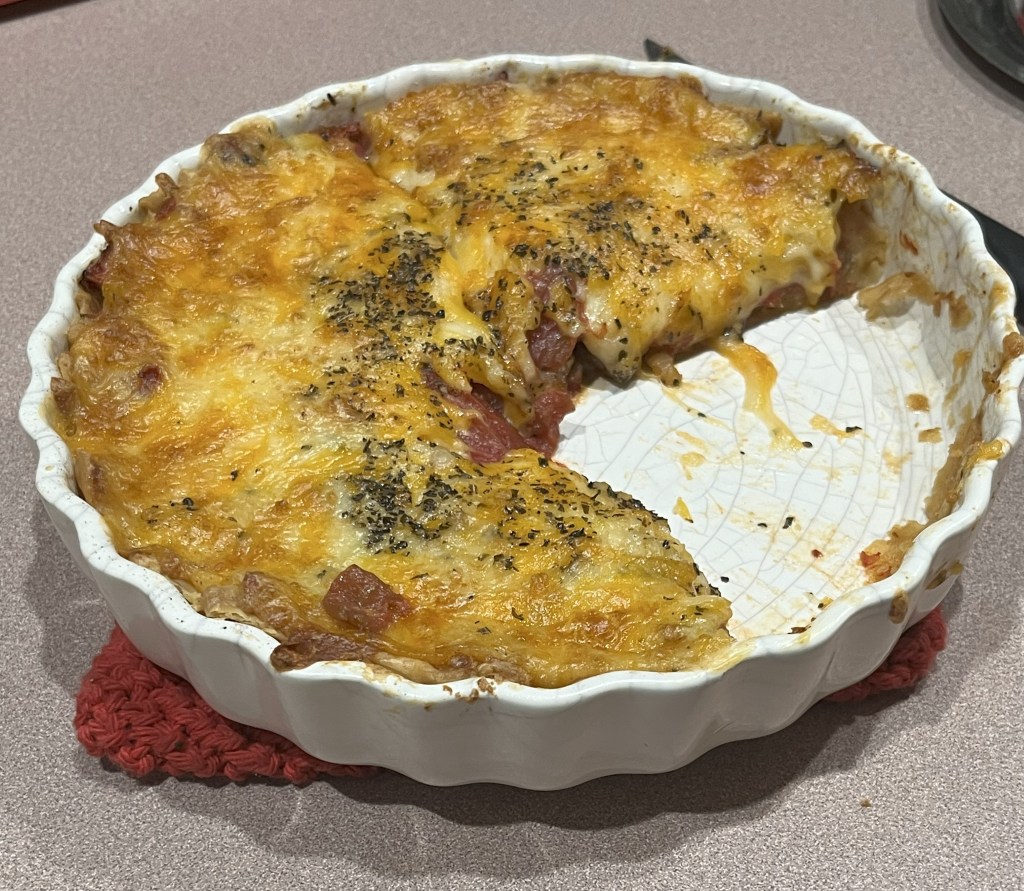
One of the advantages of having a garden is being able to step outside and pick fresh vegetables for the night’s dinner.  One of the disadvantages is trying to figure out what to do when large quantities of a particular vegetable ripen at the same time.  I have mentioned how I have plied family and friends with the bounty of my crops, along with taking several loads to the local food bank.  I have also learned to prepare, freeze, can, and preserve several different vegetables and even fruits.  Whether it is fresh or preserved, the real question becomes how is it going to be served?  There are always “go to” dishes that are the reason for a particular vegetable was grown, but having an abundance provides an opportunity to get creative.  That means when a new harvest happens, I pour over recipes on the internet searching for ideas.  Melissa has begun to cook meals more frequently.  While I tend to focus on the Midwestern meat n’ potato dishes I grew up with, Melissa falls back on her Southern heritage.  Several nights ago, she decided to make a Southern tomato pie.

When I went online, I found Southern tomato pie is a tomato dish popular in the Southern US (hence, the name).  The dish consists of a pie shell with a filling of tomatoes (Solanum lycopersicum), that are sometimes with basil or other herb), then covered with a topping of grated cheese mixed with either mayonnaise or a white sauce.  Tomato pie is considered a summer dish that is to be made when tomatoes are in season.  While tomato pie has its roots in Italian American cuisine, and particularly Philadelphia, it has become a popular and classic dish in the South during the summer months when tomatoes are at their peak.  Southern tomato pie is enjoyed both as a main course and a side dish, and is a staple at potlucks, picnics, and casual gatherings.  A sweet version called green tomato pie uses buttered and sugared green tomatoes, with a recipe dating at least as far back as 1877.  The taste of green tomato pie is comparable to green apple pie.  The sweet version is less common than the savory Southern tomato pie.  In the US, tomato pie may also refer to some types of pizza, like Sicilian pizza (originated in Sicily), Italian tomato pie (thick dough with tomato sauce on top).  In its simplest form, a Philly tomato pie is pizza with no cheese.

When Melissa told me she was going to make tomato pie for dinner, I had my doubts.  Not being from the South, I had never tried tomato pie and wondered about the taste of eating a bunch of baked tomatoes.  Being a meat n’ potato person, I also recognized there was no meat.  Still, this was a way to sample one of Melissa’s family dishes, and to take on the growing number of tomatoes sitting on our kitchen counter.  The pie starts with a baked pastry shell.  Several large beefsteak tomatoes (we used Cherokee Purple) are peeled, cut into thin slices, and layered in the shell.  Salt and pepper, basil, and chopped chives are sprinkled on the tomatoes to taste.  Mayonnaise (always Duke’s if truly Southern) and grated cheese are mixed and spread over the top.  The pie is popped into a pre-heated 400F (200.4C) oven and baked for 30 to 35 minutes.  The pie did look good and tasted better.

THOUGHTS: My trepidation around eating my first Southern tomato pie was mitigated when Melissa chose to make it a side dish, with the entrée being fried chicken strips, mashed potatoes, and gravy.  Knowing my protein was secure, I admitted the pie was good.  My Midwestern bent and Melissa’s Southern come from the comfort food we each grew up with.  The term comfort food can be traced back to 1615 (at least) where in the beginning of the second part of Don Quixote his niece and her nurse/governess are told “to give him things to eat which are comforting and appropriate for the heart and the brain.”  Comfort food provides a nostalgic or sentimental value to a person or a specific culture.  Sampling another’s comfort may also provide insight into their soul.  Act for all.  Change is coming and it starts with you.
Carrot Cake

July 15, 2025

I have mentioned the great number of cucumbers and carrots I harvested from this year’s garden.  After taking a load of cucumbers to the food Bank I thought I would try and share the wealth by bringing a basket filled with both to a potluck on Sunday.  Although this could provide fresh vegetables, it would not do much for the meal itself.  Having lived in different parts of the country I have noticed regional variations in potluck customs.  Since this was going to be my first Arkansas potluck, I did not know what to expect.  The potlucks I attended people have mostly brought side dishes, with fewer entrees and desserts.  The organizations hosting the potluck often provide a main meat dish to make sure there is at least some protein.  Since I had a lot of carrots, I decided to make something to feature them.  Cooked or even glazed carrots did not sound like the zing I wanted to bring.  What I decided was to make carrot cake.

When I went online, I found carrot cake (also known as pastel de zanahoria) is a cake that contains carrots mixed into the batter.  While the origin of carrot cake is disputed there is an English recipe published in 1591 for “pudding in a Carret [sic] root”.  This is essentially a carrot stuffed with meat, but it includes elements common to the modern dessert.  That includes shortening, cream, eggs, raisins, sweetener (dates and sugar), spices (clove and mace), scraped carrot, and breadcrumbs (in place of flour).  Many food historians believe that carrot cake originated in the carrot puddings eaten by Europeans in the Middle Ages when sugar and sweeteners were expensive and many people used carrots as a substitute for sugar.  In volume two of L’art du cuisinier (1814), Antoine Beauvilliers, former chef to King Louis XVI, included a recipe for a “Gâteau de Carottes” which was popular enough to be copied verbatim in competitors’ cookbooks.  Beauvilliers published an English version of his cookbook in London (1824) which includes a recipe for “Carrot Cakes” in a literal translation of his earlier recipe.  The popularity of carrot cake was revived in the UK because of sugar rationing during WWII along with government promotion of carrot consumption.

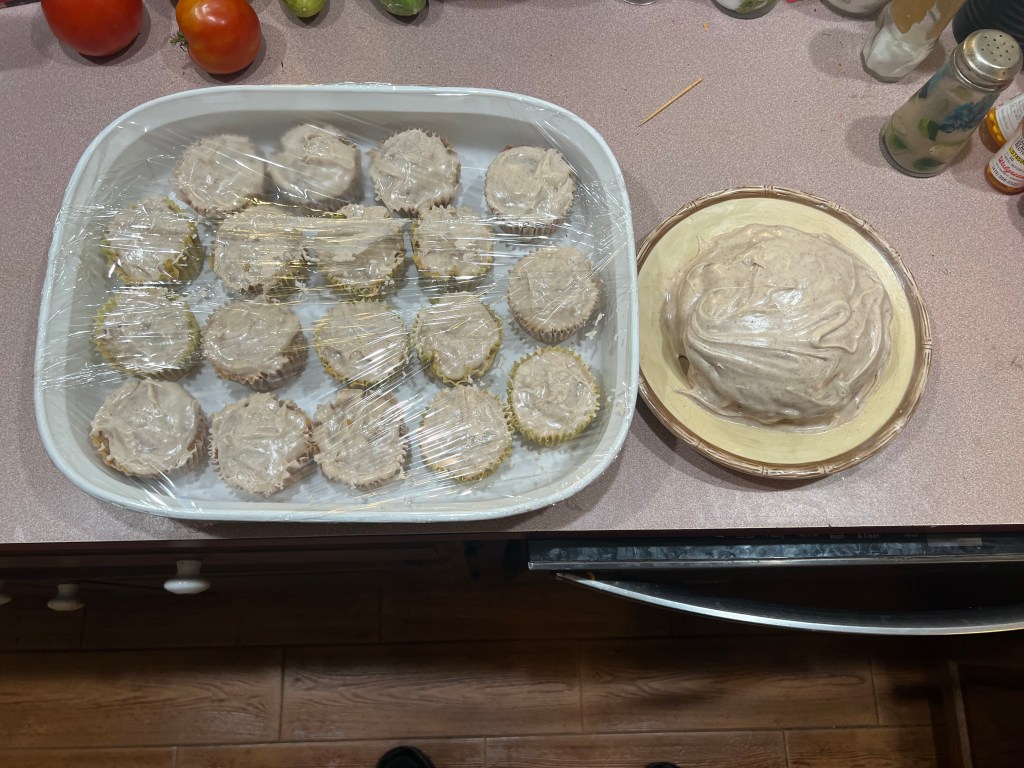
My carrot cake mix became a conglomerate dessert.  I bought a white cake mike and tub of cream cheese frosting several weeks ago when I had a craving for a cupcake.  It seems almost impossible to find one cupcake in a store (my sister later reminded me I could have gone to a bakery).  I ended up not making the cupcakes for the same reason, I did not want 24, just one.  The potluck was different.  I could bring the dish, eat my one cupcake, and share the rest.  I took the boxed cake mix and added cinnamon, nutmeg, egg whites, candied pecans (it is The South, everyone keeps a batch in the fridge), and a cup of grated carrots.  I also added cinnamon and nutmeg to the frosting mix to give it an extra umph.  I only had 18 cupcake tins, so I turned the rest of the batter into a small carrot cake for Melissa and myself.  I arranged the 18 cupcakes in a large corning ware roaster dish and brought them to the party.  Walking in from the car the platter slipped and shattered in the street.  That was the end of my carrot cake cupcakes.

THOUGHTS: Without my carrot cake cupcakes, I felt bad about going to the potluck without a dish.  I told myself, “At least I have the vegetables to give away.”  I labeled them as giveaway and provided paper bags to take the vegetables home.  At the end of the meal not one was gone and I took them all home.  The first potluck I attended when I lived in Utah had another twist.  A friend and I both arrived “fashionably late” and ended up walking in together.  As we came through the door the host exclaimed, “They are here, now we can eat!”  Apparently, the custom was to arrive early and start the event “on time”.  Getting to know customs can be a matter of trial and error.  It could be more efficient to ask.  Act for all.  Change is coming and it starts with you.
Food

July 09, 2025

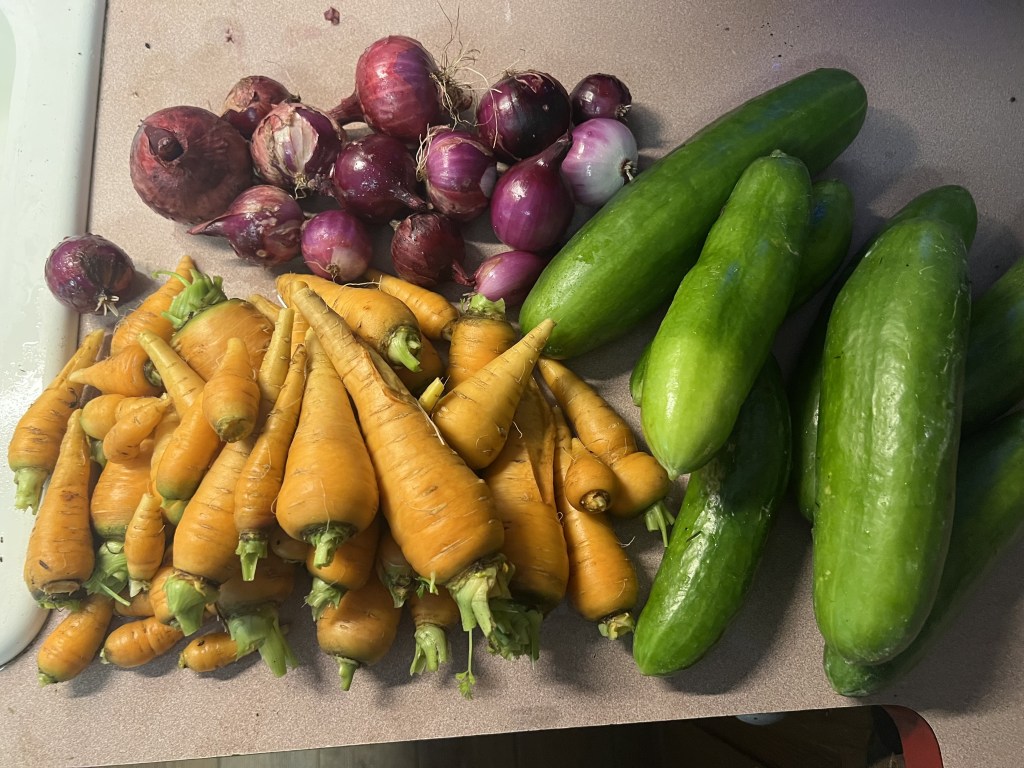
I made some final harvests from my garden today.  That included all my carrots (Daucus carota) and red onions (Allium cepa), along with a continuation of my cucumbers (Cucumis sativus).  I grow enough vegetables to keep our family stocked with fresh produce during the season and have begun to can and freeze my produce for later.  Still, there is a surplus which gives me the opportunity to share with friends and family.  There always seems to be an overabundance of some vegetables.  I have tried to compensate this year by growing a greater variety of produce and even staggering when I plant.  I also planted this year’s crop with the intent of sharing a portion of the produce with our local food bank.

When I went online, I found a food bank or food pantry is a non-profit, charitable organization that distributes food to those who have difficulty purchasing enough to avoid hunger.  This is usually done through food pantries and soup kitchens, but some food banks distribute food directly with their food pantries.  St. Mary’s Food Bank was the world’s first food bank, established in the US in 1967.  Now thousands of food banks have been set up all over the world.  Their numbers grew rapidly in Europe after the global increase in food prices which began in late 2006, and as the 2008 financial crisis began to worsen economic conditions.  The inflation and economic crisis of the 2020’s has exponentially driven low and middle-income consumers to get at least part of their food from a food bank.

Some US cities have organizations that provide dog and cat food for pets whose owners qualify for food assistance.  Daffy’s Pet Soup Kitchen in Lawrenceville, Georgia is considered the largest pet food aid agency in Georgia, distributing over 800,000 pounds (362874 kg) of dog and cat food in 2012.  Daffy’s was started in 1997 by Tom Wargo, a repairman who was working in an elderly woman’s home when he noticed her sharing her Meals On Wheels lunch with her pet cat because she could not afford cat food.  Daffy’s was one of seven non-profit organizations recognized by Barefoot Wine in 2013 through a US$10,000 donation and by being featured on labels of the vintner’s Impression Red Blend wines.  Pet Buddies Food Pantry in Atlanta, Georgia is another establishment that provides food aid for pets.  The St. Augustine Humane Society in St. Augustine, Florida, distributes over 1,600 pounds (726 kg) of pet food each month to families who are experiencing economic hardship and cannot afford to feed their pets.

THOUGHTS: While food banks are a vital resource for those who are food insecure, they have also led to a rise in obesity and diabetes.  Many foods offered to clients in food banks are high in processed sugars and salts and low in vitamin and mineral content.  The low nutritional quality of foods available to clientele at food banks has led to further health effects. A study showed 33% of American households visiting food pantries had diabetes.  When you grow and share locally grown fruits and vegetables you can help alter this trend.  Community gardens are another way to help.  Act for all.  Change is coming and it starts with you.
Marrow

July 08, 2025

My MSN browser scroll reported on a new study that shows evidence of Neanderthal “fat factories” dating back as far as 125,000 years ago.  The inhabitants of the settlement strategically selected the lakeside location for the factory and harvested bone marrow by breaking open the bones as well as through a process of crushing and heating.  The fat factory suggests Neanderthals were able to understand their environment and plan for hunting and resource-gathering.  The recent research from Leiden University and published in the journal Science Advances adds to decades of previous research at the Neumark-Nord archaeological site near Leipzig, Germany.  According to a press release from Leiden University, there is also evidence of plant use in the area, though it’s rarely preserved.  Additionally, previous studies found proof that inhabitants used fire to manage vegetation.  Needless to say, Neanderthals have long been underestimated, and the new study does nothing to dissuade that notion.  This fat factory was created to extract marrow from bones.

When I went online, I found bone marrow is a semi-solid tissue found within the spongy (cancellous) portions of bones.  In birds and mammals, bone marrow is the primary site of new blood cell production (haematopoiesis).  Marrow is composed of hematopoietic cells, marrow adipose tissue, and supportive stromal cells.  In adult humans, bone marrow is primarily located in the ribs, vertebrae, sternum, and bones of the pelvis.  Bone marrow comprises approximately 5% of total body mass in healthy adult humans.  A person weighing 161 pounds (73 kg) will have around 8 pounds (3.7 kg) of bone marrow.  Human marrow produces approximately 500 billion blood cells per day, which join the systemic circulation via permeable vasculature sinusoids within the medullary cavity.  All types of hematopoietic cells, including both myeloid and lymphoid lineages, are created in bone marrow.  However, lymphoid cells must migrate to other lymphoid organs (like the thymus) to complete maturation.

Archeologists found the Neanderthals intentionally selected the lakeside location to process the bones of at least 172 mammals including deer (genus, Cervus), horses (Equus ferus caballus), and aurochs (Bos primigenius), an extinct species of bovine.  Inhabitants at the site broke open large mammal bones to extract the marrow and ground the bones into fragments and heated them in water to extract calorie-rich bone grease.  This indicates estimates of advanced resource collection began thousands of years earlier than previously thought.  Lutz Kindler, the study’s first author, said, “Neanderthals were clearly managing resources with precision.  They understood both the nutritional value of fat and how to access it efficiently.”  Experts believe Neanderthals understood there was a “fat quota” they had to meet to make the process worthwhile.  The authors emphasized the number of herbivores that Neanderthals at Neumark-Nord must have been hunting and were likely able to plan and use their environment effectively.  Research into marrow extraction at the Neumark-Nord site complex was possible because this was not a single site but an entire landscape and provided the opportunity to investigate how Neanderthals influenced their environment. 

THOUGHTS: The Neanderthals who created the marrow extraction factory at Neumark-Nord present a far different picture than the often-depicted primitive, club-wielding, nonsocial individual driven solely by animal instinct.  Modern humans tend to seek ways to differentiate ourselves from our homo sapiens ancestors as well as extant animals.  The more research done indicates we are often more alike than different.  All creation should be respected for both its similarity and difference.  Act for all.  Change is coming and it starts with you.
Cucumber

June 27, 2025

Earlier this month I commented on the pickling I was doing.  That post mentioned the sliced cucumbers I use in a variety of salads.  This year I decided to grow “pickling” cucumbers.  I enjoy dill pickles, so I ended up canning 11 jars of dill pickle spears and three jars of dill pickle slices.  The slices are the result of having to cut more off the ends of the spears to get them into the pint jars I used for canning.  The cucumbers have excellent taste, and I am looking forward to trying my first jar of dill pickles.  While some vegetables produce a single crop at around the same time, cucumbers do not.  I waited for the cucumber to grow and discovered when a pickling cucumber gets large (over about 8 in/20 cm) the seed becomes a prominent feature of the eating experience.  I now harvest daily to ensure the fruits do not grow too large.   I bring in a bag of cucumber every morning. 

When I went online, I found cucumber (Cucumis sativus) is a widely cultivated creeping vine plant in the family Cucurbitaceae that bears cylindrical to spherical fruits elongated with tapered ends.  The fruit may grow as large as 24 inches (62 cm) long and 4 inches (10 cm) in diameter.  Cucumber is considered an annual plant whose fruits consist of 95% water.  There are three main types of cucumber (slicing, pickling, and seedless) within which several cultivars have been created.  The cucumber originates in Asia, extending from India, Nepal, Bangladesh, China (Yunnan, Guizhou, Guangxi), and Northern Thailand.  The plants are now grown on most continents and many different types of cucumber are grown commercially and traded on the global market.  In botanical terms, the cucumber is classified as a type of botanical berry (pepo) with a hard outer rind and no internal divisions.  Much like tomatoes (Solanum lycopersicum) and squashes (genus Cucurbita), cucumber is often perceived, prepared, and eaten as a vegetable. 

After pickling my two batches of cucumber I decided that was enough.  Even there I gave a jar away to our gardening friend and to my sister-in-law.  They have also been the recipients of cucumber and squash bags, as has my next-door neighbor.  Melissa wants to use some of the fruit to make a sweet refrigerator pickle.  I took 20 pounds (9 kg) of cucumber and 10 pounds (4.5 kg) of squash to the local food bank (and will no doubt take more).  Still, the cucumber keeps coming which has gotten me to be more innovative with the cucumber.  Last night I made a cucumber salad which we enjoyed along with fresh corn (local farmer) and squash I roasted on the grill.  Melissa commented the salad did not look much different than the Greek salad we were served when we were there earlier this year.  I took some of the salad, added tomato, feta cheese, and Kalamata olives and turned it into a passable version of a Greek salad.  Since the larger cucumber gets seedy, I am going to remove the seeds and use the larger fruit to make one of our favorites, Tzatziki Sauce (it goes on everything!).  I am looking forward to a long and fruitful summer.

THOUGHTS: Harvesting and eating fresh vegetables, like cucumber and tomato, is one of the reasons we grow our garden.  I also like to share the harvest with others who do not have access or the ability to grow their own vegetables.  Picking fresh vegetables off the vine or out of the soil to make dinner is its own reward.  The produce is crisper, and you know exactly what went into the soil without the expensive “organic” label.  Growing your own vegetables can be inexpensive, but if you want to grow a larger crop it does take up an investment (annually).  Harvesting, processing, canning, and freezing the produce is another step toward reducing our carbon footprint.  Act for all.  Change is coming and it starts with you.
Pickling

June 18

I got excited last year when my cucumbers started coming up.  We like to make cucumbers (Cucumis sativus) as an appetizer.  I peel and slice the cucumbers and arraign them on a plate.  Then I drizzle olive oil over them and sprinkle them with either Italian seasoning or a spice mixture called Slap Your Mama.  I also like eating cucumbers on my salad.  We often make a side salad for whatever happens to be the entrée.  This is what I call a “full-blown salad” of lettuce (Lactuca sativa), carrots (Daucus carota), and bell pepper (Capsicum annuum).  Melissa will add tomatoes (Solanum lycopersicum) to hers as well.  My “easy salad” is just romaine lettuce with slicked cucumber.  When the cucumbers began producing, I bought canning jars, vinegar, pickling salt, and a bag of dill pickle seasoning so I would be ready.  Then I checked to see how to begin pickling my cucumbers.  I found I had grown slicing cucumbers, not the pickling variety.

When I went online, I found pickling is a way to preserving or extending the shelf life of food by either anaerobic fermentation in brine or immersion in vinegar.  The procedure typically affects the food’s texture and flavor.  The resulting foods are called pickles.  If the food is named, the name is prefaced with the word “pickled”.  Foods that are pickled include vegetables, fruits, mushrooms, meats, fish, dairy, and eggs.  Pickling solutions are typically highly acidic, with a pH of 4.6 or lower, and high in salt, preventing enzymes from working and micro-organisms from multiplying.  Pickling can preserve perishable foods for months or even years.  Antimicrobial herbs and spices, such as mustard seed, garlic, cinnamon, or cloves are often added.  If the food contains sufficient moisture, a pickling brine may be produced by simply adding salt.  Sauerkraut and kimchi are produced by salting the vegetables to draw out excess water.  Natural fermentation at room temperature, by lactic acid bacteria, produces the required acidity.  Other pickles are made by placing vegetables in vinegar.  Unlike the canning process, pickling does not require that the food be completely sterile. The acidity or salinity of the solution, the temperature of fermentation, and the exclusion of oxygen determine which microorganisms dominate, and determine the flavor of the pickled product.

This year I grew pickling cucumbers.  As usual I did not know how many cucumbers a single plant would produce.  I bought a small six pack of plants and looked forward to completing the job I tried to do last year.  Neither did I know when I should pick my pickling cucumbers.  I knew for slicing cucumbers they were often 8 to 10 inches (20 to 25 cm) long.  If I picked them too soon, they would not be ripe, but if I waited too long, they could be tough.  I ended up picking fruits that were getting too large as well as what I thought were the ripe ones.  When I prepared them for pickling, I realized the “right size” was determined by what would fit in the pint jars I was using.  I cut the ends off the cucumbers.  The blossom end has enzymes that soften the pickles, and I do not like it when the stems are left on my pickles.  I was making spears, but since some were too long to fit in the jar I also ended up with pickle slices.  I found that 6 cumber plants produce way more fruit than I wanted to can.  I ended up pickling 8 jars today and will have more by the time I am ready to pickle my beets.  Now I just need to figure out what to do with all my pickling.

THOUGHTS: It is often claimed that pickling cucumbers was developed for workers building the Great Wall of China, although another hypothesis is that they were first made as early as 2030 BC in the Tigris Valley of Mesopotamia.  Ancient sources documented awareness around the nutritional benefits of pickling and the perceived beauty benefits of pickles.  Cleopatra credited pickles with contributing to her health and legendary beauty.  Perhaps it is a good thing to have 15 jars of pickles.  The best part is sharing produce with others.  Act for all.  Change is coming and it starts with you.
Buffet

February 11, 2025

When I booked our Greek cruise, I did not figure in that we would be at sea during the Super Bowl.  That would have been bad enough but being one-third of the way around the world there was an 8-hour time difference.  That meant the game was scheduled for 1:30 am Monday (our time), and the predicted length of the game was over 4 hours.  The game was being broadcast live on a special on-board sports channel and would be over in time for an 8:00 am departure for our shore excursion.  We weighed our options.  We could stay up and be too exhausted to make the excursion, but this was a trip to the Palace of Knossos, a bucket list tour.  We could miss the game, but that would mean I was a fair-weather fan, and I had already packed my Chiefs shirt to wear the night before the game.  The bigger disappointment was I always put out a spread for 8 to 10 people as part of the game (even if it was just Melissa and me).  How was I going to watch the game without my buffet?

When I looked online, I found the Super Bowl buffet was not just my obsession.  In fact, football is merely the main course on a menu designed to bring fans together.  There are commercials with their own buildup, the halftime show, parties held in houses and bars, and the rare sense most of the country is watching the same thing together.  More than anything, the event is built around food for everyone (but the players in the game).  Everyone else watches football for more than three hours and will eventually get hungry.  USA Today decided to rank the 10 best super Bowl snacks, and mentioned the “closest thing to a vegetable on this list is a jalapeno”.  This begins with soft pretzels and sliders, a tray with a variety of meats and cheeses (charcutier board), nachos, chili, potato skins, pigs in a blanket (or hot dogs) chips and dip, pizza, and wings.  Many of these favorites have been on my buffet over the years.

Our only choice was to go to bed early and wake up in time for the start of the game at 1:30 am.  This worked, and we woke up in time to see the coin toss.  I made it through the first half (24-0) but refused to watch 45 minutes of half-time extravaganza and went to sleep.  The score was exasperated by the fact we were not getting any of the commercials (soccer and MMA previews only) on the special sports channel.  Melissa lasted through the third quarter then also gave up.  Her sister did inform her of the outcome at the end of the game.  The ship planned their own Super Bowl party for later that evening.  The game was broadcast in the theater on the movie screen.  Most had not stayed up late and were not aware of the score.  For them it was great, for me knowing the score was another form of torture.  There was a bright spot.  The cruise made hundreds of bags of popcorn and there were two lines of tables placed in the hall.  One was held basic football food (nachos, wings, chips and dip) while the other was filled with a wide assortment of finger desserts.  I did not partake of the food and only lasted a quarter rewatching the game, but I complemented them on their buffet.

THOUGHTS: The all-you-can-eat buffet has become an integral part of dining culture worldwide, offering a lot of different foods at a fixed price.  This dining experience dates to ancient times and has evolved through different cultures until it is now a staple across the world.  That said, it stands in opposition to the 733 million people and women and children who are the most vulnerable around the world.  Clean air, water, and sufficient nutrition should be a right, not a privilege.  Act for all.  Change is coming and it starts with you.

Crab

January 31, 2025

One of my NY Times feeds suggested a unique approach to stemming the advance of an invasive species which has taken over New England.  The invasion is aided by the species being omnivores, scavengers, and cannibals, meaning they sustain themselves on almost any organic food.  They have a high fecundity, with females releasing as many as 185,000 eggs a year.  They survive in water temperatures from freezing (32F/0C) to 86F (30C) and tolerate sweet water zones where salt meets fresh.  An adult can live more than 10 days out of water.  Taken together, these characteristics explain why they were first documented along the United States coast in 1817 and continue their tour of the temperate world.  The suggested remedy to control the European green crab was to eat them.

When I looked online, I found the European green crab (Carcinus maenas) is a common near shore (littoral) crab known by different names around the world.  In North America and South Africa, it is called the European green crab, while in the British Isles it is referred to as the shore crab, or green shore crab.  The crab is a widespread invasive species and is listed among the 100 of the World’s Worst Invasive Alien Species.  The green crab is native to the north-east Atlantic Ocean and Baltic Sea, but has colonized similar habitats in Australia, South Africa, South America, and both Atlantic and Pacific coasts of North America.  The adult crab grows to a carapace (back shell) up to 2.4 inches (60 mm) long and 3.5 inches (90 mm) wide.  It can grow larger outside its native range, reaching 3.9 inches (100 mm) wide in British Columbia.  The color of the green crab varies greatly, from green to brown, grey, or red.  While this variation has a genetic component, it is largely due to local environmental factors.  The crab feeds on a variety of mollusks, worms, and small crustaceans, and has affected the fisheries where it spread.  The crab has been dispersed in a variety of ways, including on ships’ hulls, sea planes, packing materials, and bivalves moved for aquaculture.

In its native range, European green crab is mostly used as an ingredient in soups and sauces.  Italian fisher people cultivate soft-shell green crabs (moeche in Venetian, moleche in Italian) and sell hard-shell crabs for their roe (masinette).  Several groups in New England have successfully adapted these methods to produce soft-shell green crabs from the invasive species.  Various groups have looked at using green crabs in cuisine.  The Green Crab Cookbook (2019) was released and included recipes for soft-shell green crab, green crab roe, green crab stock, and green crab meat.  Researchers at the University of Maine have actively been developing green crab products with the goals of driving business interest, stimulating a commercial green crab fishery, and alleviating predation effects.  The same researchers developed a patty product made from minced green crab meat using restructuring additives (transglutaminase, dried egg white, isolated soy protein).  Americans consume enormous amounts of seafood, and several favorites (like scallops, lobster, and salmon) can be too expensive for many households.  The low-cost crabs are abundant, easy to catch, and are delicious, especially as a full-bodied stock that becomes the basis for ramen.

Thoughts: Some invasive species do not lend themselves to eating, but the European green crab is an exception.  The one obstacle comes with the small size of the carapace. The tiny claws, legs and segmented body chambers people typically eat are difficult to pick.  The small size is the one that has protected this crab from human consumption.  The smaller make an excellent stock and seasoned and dried can be a crunchy hand food eaten whole, much like a potato chip.  In the US, invasive species like the Asian carp (Family, Cyprinidae) and green crab are often seen as fertilizer, while they are eaten as a delicacy elsewhere.  Climate change and invasive species might force a reassessment.  The trick calling them something else and learning how to fix them.  Act for all.  Change is coming and it starts with you.