Sauerkraut

July 11, 2026

This is the second year I have tried raising cabbage (Brassica oleracea) in my raised beds.  Last year the weather was not conducive and the heads never formed.  I tried to use the individual leaves, but nothing I made worked.  This year I planted it earlier and put in more seeds.  Ten plants came up, but one was eaten (by something) almost immediately.  The other nine plants produced large leaves that were attacked by some sort of insect (never saw it).  Three of the plants were overstressed by the attacks and I ended thinning them out to give more space to the others.  That left two plants that had formed decent heads and the other four still in the process of folding (hopefully).  Sunday Melissa made a pork loin in the crockpot by combining the meat with baby potatoes (Solanum tuberosum), carrots (Daucus carota subsp. sativus), and the smaller head of my cabbage.  Melissa thought the cabbage was picked too late and had a bitter taste.  I did not want that to happen to the one good head of cabbage left, so today I used it to make sauerkraut.    

When I went online, I found Sauerkraut (lit. ’sour cabbage’) is finely cut raw white cabbage that has been fermented by various lactic acid bacteria.  The dish has a long shelf life and a distinctive sour flavor, both the result of the lactic acid formed when the bacteria ferment the sugars in the cabbage leaves.  The English name is borrowed from German, but the dish did not originate in Germany.  Some claim fermented cabbage (Suan cai) came from China during the time of the building of the Great Wall.  The Romans also pickled forms of cabbage and are the likely source of European sauerkraut.  The dish became popular in Central and Eastern European cuisines, and countries including the Netherlands (zuurkool) and France (choucroute).  Glenn Randall Mack and Asele Surina published “Food Culture in Russia and Central Asia” in 2005 and credit the Slavic peoples of Europe with likely discovering fermented cabbage.  Before frozen foods and refrigeration, sauerkraut was readily available in Northern, Central, and Eastern Europe, and provided a source of vitamin C during the winter.  Captain James Cook took sauerkraut on his sea voyages to prevent scurvy.

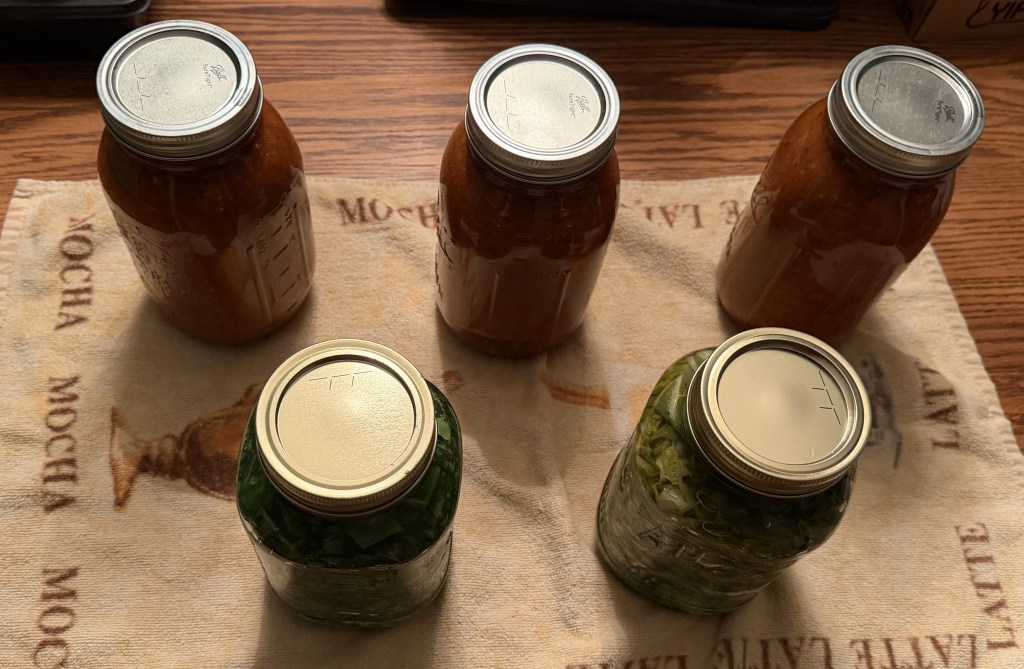
Sauerkraut is one of the easiest ways to preserve cabbage.  Wash the head, remove the outer leaves (setting one aside), cut out the core.  I used my large carving knife to cut thin slices off the head making a large pile of sliced cabbage.  I sprinkled on four tablespoons (60ml) of sea salt and gently mixed it into the cabbage, then let it stand for 15 minutes.  The important step is to knead the mixture for 5 minutes.  I was surprised by how much water came out of the cabbage and by how much it reduced.  I stuffed the entire head into the quart jar and poured the cabbage water over the mixture.  There was not quite enough water, so I made a salt brine of two tablespoons (30ml) salt to one cup (0.26L) distilled water and covered the mixture.  The last step was topping it off with the leaf I had set aside and adding one of Melissa’s decorative rocks to keep it weighted down.  I did not add the weight last year and the sauerkraut got moldy.  I need to wait 1 to 4 weeks for fermentation and then put it in the refrigerator.  It should last up to a year, but I think it will be eaten long before then.

THOUGHTS: One of my fond memories growing up was mom making sauerkraut in a ten gallon (38L) stoneware crock.  Mom would fill it with fresh cabbage and salt and place it in the basement to ferment where my brother and I would sneak “taste tests” out of the crock.  Sauerkraut, kielbasa, and baked potatoes are still one of my favorite meals.  Sauerkraut represents the two ways ideas, beliefs, and technologies spread.  There appear to be two simultaneous independent inventions (Slavic and China) which then spread by expansion (from one people to the next).  Technologies and ideas seem to have a life of their own and few things can be claimed as “mine” for long.  Act for all.  Change will come and it starts with you.

Condiment

July 04, 2026

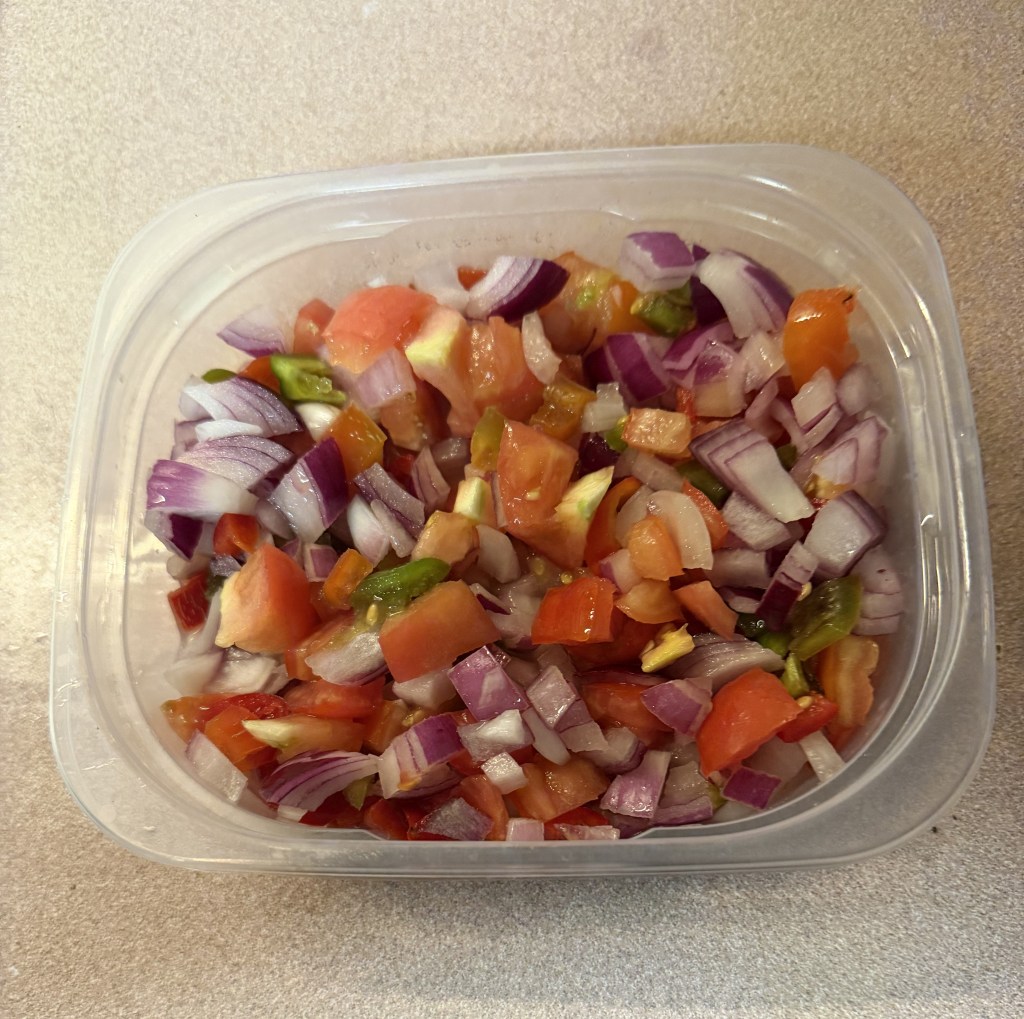
Like most people in the US, I spent part of the day harvesting the bounty of my garden (really?).  I began early this morning (for me) taking the kids for a walk.  By 10 am it was already 89F (31.6C) with a “feels like” of 99F (37.2C).   I got home in time to water my garden and to oversee what would be ripe enough to take to our feeding program tomorrow night.  I mentioned earlier I harvested around 20 pounds (9kg) of Roma tomatoes (Solanum lycopersicum var.) that I turned into 7 quarts (6.6L) of pasta sauce.  The vines have kept producing and I was able to garnish another 10 pounds (4.5kg) today, along with another 12 Arkansas Travelers (Solanum lycopersicum var.).  My red onions (Allium cepa) have stopped growing but there are 38 onions still in the ground.  My jalapeno peppers (Capsicum annuum) are now producing as the weather has turned hotter (not warmer).  I am also growing cilantro (Coriandrum sativum) in the herb garden.  While I have made several batches of pickle de Gallo, I now have the ingredients for my favorite condiment, Pico de Gallo.

When I went online, I found a condiment can be defined as a supplemental food (such as a sauce or powder) that is added to some foods to impart a particular flavor, enhance flavor, or complement a dish.  These foods are not considered enough to serve as a standalone dish.  The term condiment originally described pickled or preserved foods but now includes a great variety of flavorings.  Many diverse condiments exist in various countries, regions and cultures.  Pico de Gallo can be used in much the same way as Mexican liquid salsas, and because it contains less liquid, it can also be used as a main ingredient in dishes such as tacos and fajitas.  The tomato-based variety is widely known as salsa picada (‘minced/chopped sauce’) and in Mexico is normally called salsa mexicana (‘Mexican sauce’).  The colors of the red tomato, white onion, and green chili and cilantro are reminiscent of the colors of the Mexican flag, and it is also called salsa bandera (‘flag sauce’).  The Pickle de Gallo lacks the red of the tomato but is still a great way to use the 14 pints (6.6L) of pickles I canned last week.

Since today is the celebration of Independence Day in the US, there are two other important condiments associated with this day.  Ketchup typically refers to tomato ketchup, although early recipes for different varieties contained mushrooms, oysters, mussels, egg whites, grapes, or walnuts.  Tomato ketchup is made from tomatoes, sugar and vinegar, along with seasonings and spices.  Mustard is a condiment made from the seeds of a mustard plant, which may be the white/yellow mustard (Sinapis alba), brown mustard (Brassica juncea), or black mustard (Rhamphospermum nigrum).  The (whole, ground, cracked, or bruised) seeds are mixed with water, vinegar, lemon juice, wine, or other liquids, salt, and other flavorings and spices to create a paste or sauce.  The sauce can range in color from bright yellow to dark brown.  These are important condiments on Independence Day as they are often paired with hotdogs and hamburgers grilled on bar-b-q’s across America.

THOUGHTS: While a condiment is officially defined as a supplemental food, I often use both Pickle and Pico as a main course pared with tortilla chips.  While the USDA Food Buying Guide explicitly lists tomato catsup and chili sauce as condiments that do not contribute toward the daily vegetable component, there is a famous historical debate surrounding school lunches in the 1980’s.  Proposed USDA rules suggested counting various tomato condiments and pastes as vegetables, but this was never officially adopted for dietary health.  It seems we are willing to do anything to get children to eat their vegetables, even if the condiments do not contain the necessary nutritional value to count as a vegetable.  Act for all.  Change will come and it starts with you.

Lasagna

June 24, 2026

Monday I was once again scrolling through my phone looking for something different for dinner.  Melissa and I have several go-to meals that are simple that we make often.  While these are good, there are times when I get bored eating the same meals and then working through the leftovers.  I knew I had hamburger in the freezer, so I began my search with “quick hamburger meals”.  Not finding what I wanted I shifted the search to “quick easy meals”.   This opened the offerings to meals based around chicken, seafood, and salads, as well as more hamburger meals.  By this time, I had been scrolling for over 30 minutes (sound familiar?) and the local news was coming to an end.  The half hour between the 6 o’clock news and regular programing at 7 is when we usually prepare our meals, so I was beginning to get desperate.  Then I remembered we had a half pound (.23 kg) of sausage left over from one of our regular sausage and potatoes skillets Melissa had made on Sunday.  I switched the search to sausage and immediately found a skillet sausage and lasagna bake.

When I went online, I found lasagna, also known by the plural form lasagne, is a type of pasta made in wide, flat sheets.  This dish originated in Italian cuisine where it is served in a number of ways, but is best known for its use in a baked dish made by stacking layers of pasta, alternating with fillings such as ground meats and tomato sauce (ragu), béchamel sauce, vegetables, cheeses (including ricotta, mozzarella, and Parmesan), seasonings, and spices.  Typically, cooked pasta is assembled with the other ingredients, topped with grated cheese, and then baked in an oven (al forno).  Lasagna originated in Italy during the Middle Ages and the oldest known written reference appears in a ballad in 1282 CE.  There are many regional variations of the dish in Italy.  These dishes were traditionally served during religious celebrations, which were some of the few times many people would eat meat.

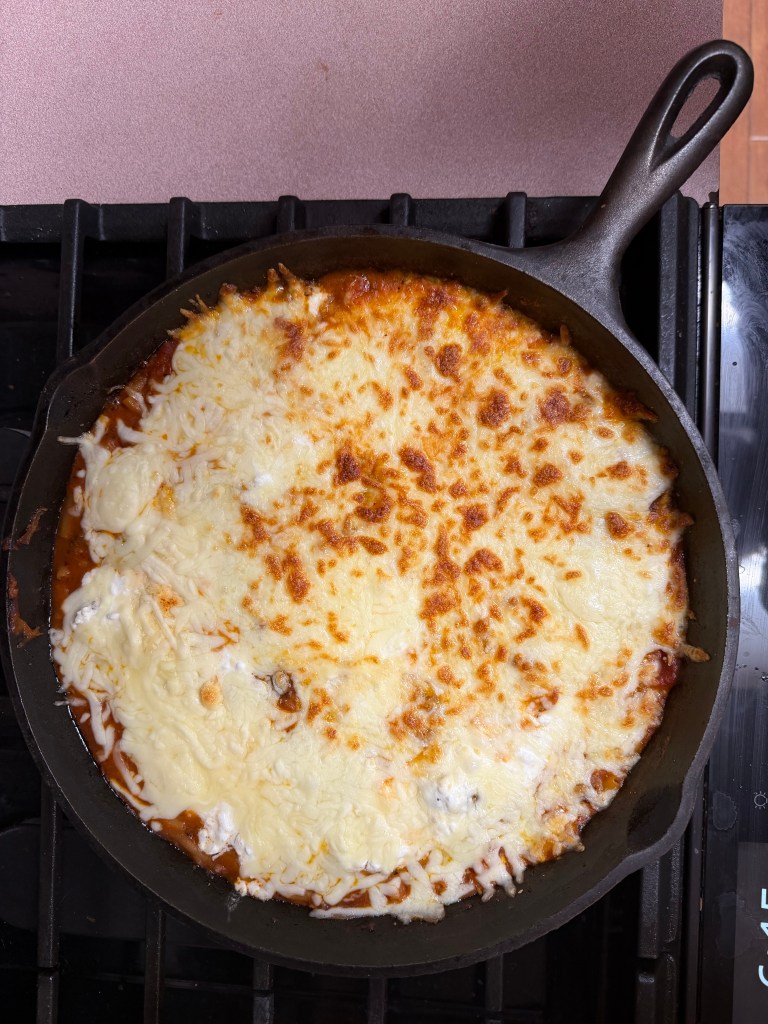
I frequently make lasagna and prefer my homemade to frozen store brands.  This recipe was a “quick one pan dish” ready in 40 minutes.  I pulled up the recipe and realized I did not have the ingredients.  No worry.  I often substitute and add or subtract ingredients depending on what is on hand.  The recipe suggested a cast iron skillet, and I pulled the largest one from under the cabinet.  I browned the sausage and added minced garlic.  Then came 2 cups (0.45 kg) of pasta sauce (my homemade) and 2 cups (0.45 kg) of chicken broth.  I realized I used a 10-inch (25 cm) pan rather than a 12-inch (30.5 cm) pan (did not fit), but I had a 12-inch cast iron skillet in my camping gear.  I brought the mixture to a boil and went to add the noodles.  I like to keep flat lasagna noodles in the pantry but was out.  None of the other noodles seemed right for the dish I was trying to imitate.  I finally opted for a package of mac-n-cheese to get the elbows.  I simmered the mixture for 15 minutes to blend the flavors and added cheese on top.  I mixed the mac-n-cheese packet into the sauce, substituted cottage cheese for ricotta, and finished with parmesan and mozzarella.  The whole pan went into the oven on broil for 5 minutes.  It turned out delicious.

THOUGHTS: One problem with searching online recipes is they are often subscription services, as was my sausage and cheese lasagna.  The recipe pulled up fine and the site asked if I wanted to subscribe.  I declined and preceded to make the dish.  I scrolled back and forth making sure I had the right amounts of each ingredient and the proper steps.  About halfway through preparation the screen flashed, “This is members-only content”, and blurred the screen.  I could join or sign in, but until I did it would not provide further information.  I knew enough of the ingredients and steps to proceed and I did neither.  I realize the site may need profit but am incensed when “free” information is belatedly tied to a subscription that at very least tracks and sells my information to others.  I prefer an upfront choice.  Act for all.  Change will come and it starts with you.

False Parasol

June 15, 2026

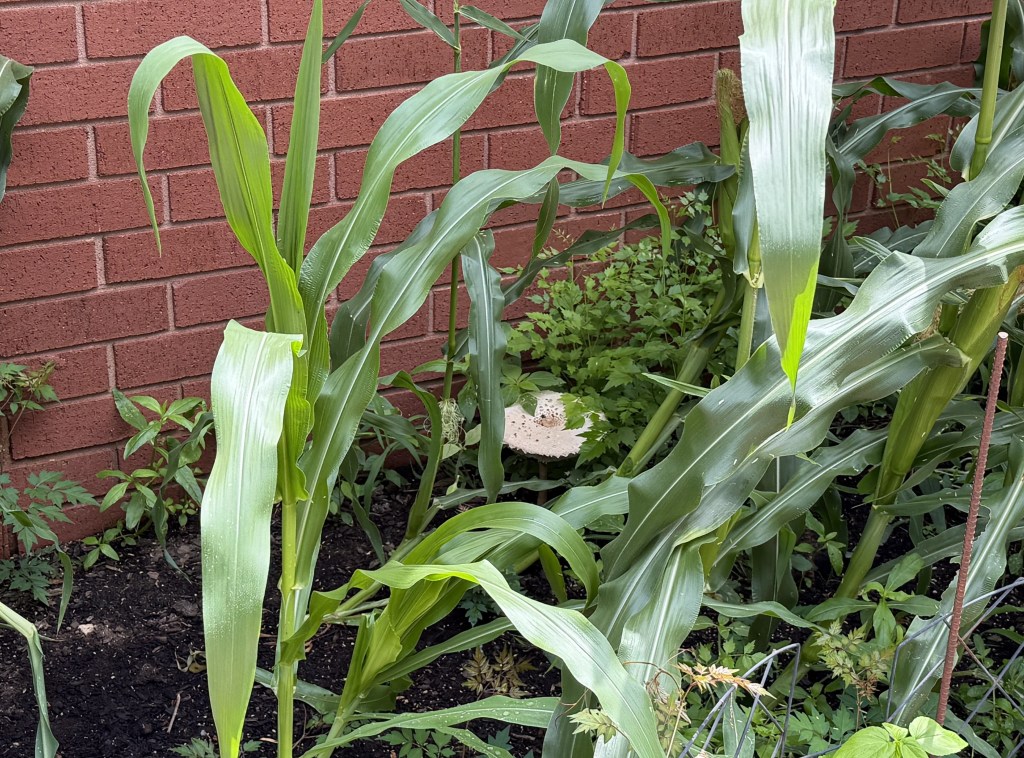
I have grown corn (Zea mays) in the bed along the back of my house for the last three years.  The first year I grew corn as part of the “three sisters”, an indigenous method that allows the corn stalks to support the climbing pole beans (Phaseolus vulgaris) with winter squash (genus, Cucurbita) providing ground cover to keep down the weeds.  While the corn grew, the cobs had spotty kernels that hardened before I harvested (oops!).  The entire crop also suffered “laydown” (common for corn in wind) just after I returned from vacation and I had to stake the stalks to get them to stand.  This year I learned about seed expiration (many did not sprout).  If you read the packets, it tells the planting year and how long it should remain viable.  I bought new seeds to plant this year.  The three rows were going well until the kids were “play fighting” and to my horror Loki jumped the fence and landed on top of the small stalks.  I added to the height of my fence, reset the plants I could, and replanted the ones that had been snapped, as well as several that had not sprouted.  The corn was growing well and began producing tassels (male) and silks (female ears).  Then two weekends ago a tornado cell passed over town and the winds caused another “laydown”.  I again staked what I could and hoped for the best.  When I checked the corn last week there was a large mushroom (false parasol) growing among the stalks.

When I went online, I found the false parasol (Chlorophyllum molybdites), commonly known as the green-spored or green-gill parasol, and vomiter, is a common species of mushroom found in temperate and subtropical meadows and lawns.  The species is poisonous and causes serious vomiting and diarrhea.  The cap (pileus) ranges from 3.1 to 12 inches (8 to 30 cm) in diameter and is hemispherical with a flattened top.  The cap is whitish in color with coarse brownish scales, with white gills that turn dark and green with maturity.  The stem (stipe) ranges from 2.0 to 12 inches (5 to 30 cm) tall and bears a double-edged ring and lacks the snakeskin pattern generally present on the edible parasol mushroom (Macrolepiota procera).  The flesh is thick and initially firm, although it softens with age.  The false parasol is the most consumed poisonous mushroom in North America as it is often misidentified as an edible species like the shaggy parasol (Chlorophyllum rhacodes) and parasol mushroom.  Fruiting bodies generally appear after summer and autumn rain.

The summer rains did bring out the large mushroom among my corn, as well as another in my next-door neighbor’s yard.  When I used Google identification it said the mushroom was a giant puffball (Calvatia gigantea) which is said to be very tasty.  I love mushrooms and I had visions of sauteing the firm flesh in butter and garlic.  As the round cap matured it flattened and the edible giant puffball morphed into a poisonous false parasol.  The large white puffball mushrooms are edible when young, as are all true puffballs, but even they can cause digestive issues if the spores have begun to form, as indicated when the pure white flesh begins to turn yellowish or greenish-brown.  An overripe puffball will fall apart and release spores when touched or if cut open and should be discarded.  I was glad I waited or I may have been another victim of mistaken identity. 

THOUGHTS: False parasol mushrooms are sometimes called fairy ring mushrooms as they often form fairy rings, a naturally occurring ring or arc of mushrooms.  Fairy rings are the subject of much folklore and myth worldwide, particularly in Western Europe, and are alternately seen as hazardous or dangerous places linked with witches or the Devil, or as a sign of good fortune.  Mine was a single mushroom so I will have neither good nor bad luck.  I am two days out from the maturation date on the package suggested for my corn.  Since I already had the laydown (bad luck), I am hoping for a good harvest (good luck).  Farming is not easy.  Act for all.  Change will come and it starts with you.

Distribute

May 16, 2026

After filling my bird feeders, I was sitting on the patio waiting to see what species would arrive.  What I noticed instead was how my tomato (Solanum lycopersicum) plants had begun to grow this last week.  I mentioned I planted fourteen tomato plants this year, using four different types of containers.  My two sweet 100s (cherry) are in 5-gallon (19-l) buckets.  Three of the Arkansas Travelers (slicing) are in 5-gallon grow bags and the other three are in 10-gallon (38-l) terra cotta pots.  The six Romas (sauce) are in the plastic self-watering containers I purchased last year.  All 14 plants were over 2-1/2 feet (0.76m) and are starting to produce (green) fruit.  While I have known since our family garden as a child that tomatoes need trellises or cages for support, it was not until three years ago that I learned you should also prune your plants.  The small, secondary shoots that grow in the “V” joint where a leaf branch meets the main stem (suckers) should be removed as these produce less desirable fruit.  The bottom branches should also be removed to guard against pests and disease.  Pruning encourages the plant to focus on growing fruit rather than tall, bushy vines.  With the number of plants in the ground, it got me thinking of how to distribute the expected tomatoes.

When I went online, I found one way to distribute excess produce was called Fresh Food Connect.  This group was formed in 2016 with the goal of connecting local gardeners with the hunger relief efforts in their community to grow a more local and resilient food system.  Fresh Food Connect has a free mobile app that connects gardeners with their communities.  By 2024, Fresh Food Connect had grown to over 4,300 gardeners with over 65 hunger relief nonprofits in 28 states and has shared over 300,000 pounds (136077.7 kg) of homegrown produce with 166,000 community people experiencing food insecurity.  During 2025, 5,210 registered gardeners in 18 states connected with 54 local community partners to provide over 91,490 pounds (41,499 kg) of homegrown produce to over 51,870 individuals facing food insecurity.  This distribution amounted to grocery savings of US$457,460, or over 76,240 meals and over 91 tons (82.5 mt) of CO2EQ saved.   

I got excited when I learned of this effort to efficiently distribute home grown food to those with food insecurity.  I immediately downloaded the app and typed in my zip code to find a distribution center near me.  While there was (currently) no distribution near me, the Ozark Church Food Pantry was listed as only 52 miles (83.5 km) away.  I used the app to suggest they partner with the Crawford Sebastian Community Development Council in Fort Smith (15 miles/24 km away).  The app does allow me to register my donations outside of their network so I will probably continue to give locally and register my donation with Fresh Food.  Last year I also shared with my neighbors and several friends, and I will probably do that again this year.  Today I used my last jar of dill pickles making pickle de Gallo, so I am also looking forward to restocking my garden favorites.

THOUGHTS: Cassey Anderson, Colorado State University Horticulture Agent, provided the three Golden Rules when planning to distribute your harvest to a local food bank.   These are: Keep it cool, Keep it wet (when appropriate), Handle with care.  Harvesting is best done in the cooler parts of the day (morning/evening) and many crops can be harvested and placed directly into a container of cool water.  If you continue to harvest, make sure they are placed out of the sun.  Using a sharp knife or scissors is a better choice for harvesting rather than tearing the crop off the main plant.  This reduces stress on the plant, reduces chances of damage, and makes for a cleaner product.  Food insecurity is limited or uncertain access to adequate, nutritious food due to limited funds or resources.  Arkansas has the highest rate of food insecurity in the nation, with 19.4% of households struggling to access consistent, nutritious meals.  Act for all.  Change is coming and it starts with you.

Gumbo

February 04, 2026

Melissa and I seem to be in constant search to find what to eat for dinner.  The task is made more difficult as I rarely go to the store to buy specific items for the evening’s meal and instead try and find innovative ways to cook what we already have on hand.  This approach is made more so as I try and use up leftovers or clear out the produce that I canned or frozen over last year’s growing season.  Several days ago, I had scrounged a packet of chicken pieces (breasts and thighs) I had frozen to make chicken and rice casserole.  I have a set recipe in my mind for how to make this dish, but I am still toying with how to get the rice to come out perfectly.  I have followed on-line recipes, and it will often come out either crunchy (too little liquid) or mushy (too much liquid).  The other issue is it is made in a 9-inch (23 cm) by 13-inch (33 cm) glass dish.  This makes a ton of casserole!  While I seem to have no problem eating all the rice, the leftover chicken is a harder sell (especially breasts). While scrolling on-line this afternoon I came across a sausage and chicken gumbo recipe.

When I went online, I found gumbo (Louisiana Creole: Gum-bo) is a stew that is popular among the US Gulf Coast community.  The dish combines ingredients and culinary practices of several cultures, including Central and West African, French, German, Spanish, and Native American Choctaw.  A gumbo consists primarily of a strongly flavored stock, meat or shellfish (or both), a thickener, and the Creole “holy trinity” (celery, bell peppers, and onions).  The preferred method in the historical New Orleans variation has a French-inspired dark, even chocolate-like, roux (flour and fat mixture) that is the official state cuisine of Louisiana.  Creole gumbo generally contains shellfish and a dark roux.  Cajun gumbo is generally based on a dark roux and is made with shellfish or fowl.  Sausage or ham is often added to gumbos of either variety.  After the base is prepared, vegetables are cooked down, and then meat is added.  The dish simmers for a minimum of three hours, with shellfish and some spices added near the end, and traditionally served with rice. A third, lesser-known variety, the meatless gumbo (z’herbes) is essentially a gumbo of slow-cooked greens.  Gumbo was first described in 1802 and was listed in various cookbooks in the latter half of the 19th century.

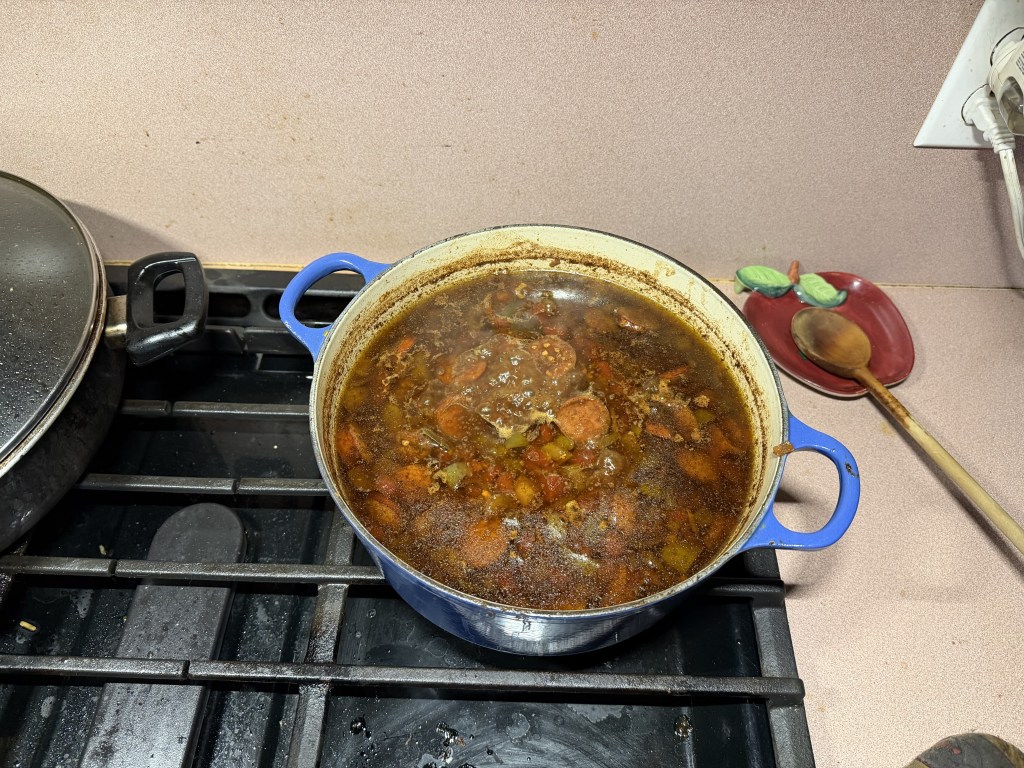
My decision to make gumbo was a mix of trying something new and my desire to use the leftover chicken in the refrigerator and the half-pack of kielbasa in the freezer.  I have made variations of this dish before, but this is the first time I started from a roux.  Being a creature of habit, I only partially followed the recipe.  I started by baking the flour in the oven at 350F (177.6C) for 45 minutes for the darkened color and to add a toasty flavor to the roux.  While the flour was baking, I got restless and went ahead and sautéed the cut-up chicken and sausage as well as the trinity (different pans).  The roux itself was a mix of vegetable oil (olive) and toasted flour that was cooked down on low heat for 35 minutes.  Since the vegetables had already softened, I placed them in the pot along with a can of Rotel tomatoes and chilies, Cajun spices, cayenne pepper, and six cups of chicken broth.  Next came the chicken and sausage and a Bay leaf for flavor.  The on-line recipe suggested letting the gumbo simmer for “1 to 2 hours” rather than the noted minimum of three.  I put the finished ingredients on around 4 pm and we will not eat until after 7.  That should give the flavors enough time to meld.

THOUGHTS: When I made my Gumbo, I used the eyeball measuring approach.  Between that and my hand slipping when I was “measuring” the cayenne the dish came out spicy hot.  I have learned (from Melissa) that one way to cut the heat is to add sugar.  I tasted the mixture again to be sure, then added two tablespoons of sugar.  I am looking forward to having Gumbo over white rice tonight.  We can all stand to learn new ways from each other.  Between Zydeco dancing and Cajun dishes, who can go wrong?  Act for all.  Change is coming and it starts with you.

Last Fruits

December 27, 2025

Back in August I blogged about my first attempt to grow a second yield in my raised beds (2nd Crop).  I replanted several of the vegetables that had done well in the spring (and that I liked).  For some reason, few of the vegetables sprouted.  What sprouted were the cabbages, cauliflower (both Brassica oleracea), and about half of the peas (Pisum sativum).  When it looked like we were going to get our first freeze in November I had covered the plants with bed sheets held above the plants with garden hoops.  I had done this in previous years and found it to be effective (and reusable).  The peas were harvested and eaten in salads prior to our trip, but I just let the brassica go to see if they would ever mature.  The cabbage never did head and the cauliflower never balled.  I thought about tearing them out, but the plants still had robust leaves.  Last week I finally gave up and pulled the plants.  I did not know what I would do with them, but cabbage leaves were the garden’s last fruits.

When I went online, I found cabbage leaves are completely edible, including the outer ones.  The texture and flavor will vary from the inner leaves.  Both types of leaves can be used raw in salads, cooked in soups, sautéed, or even used as wraps for other fillings.  The outer leaves are tougher but also more nutritious due to their exposure to the sun and can be blanched or used as wraps or stuffed as rolls.   The inner leaves are more tender and sweeter and are good for raw applications.  All the leaves should be washed to remove dirt and checked for insects and bad spots before preparation.  I ended with a large pile of outer leaves and a smaller pile of inner (sorta) leaves that I decided to make into sauerkraut anyway.  I washed the leaves, cut out the woody stems, and sliced the outer leaves for over an hour before the amount of work made me rethink processing the entire pile.  Instead, I went with what I had and then processed the smaller pile of inner leaves in the same way.  Sauerkraut was still a long way off, so I put the bowls of last fruits in the refrigerator

Two days later (today) I decided to finish processing my last fruits.  I added salt to the bowls of leaves and kneaded it for 5 minutes to break the leaves down and then packed them into quart jars, one for the outer leaves and another for the inner.  Working with my last fruits got me motivated to work the tomatoes frozen tomatoes (Solanum lycopersicum) and sweet peppers (Capsicum annuum) from August into more canned pasta sauce.  I added two red onions (Allium cepa) and three cans of diced tomatoes from the pantry along with spices and simmered it for four hours to render it down and meld the flavors.  While the sauce was finishing up, I brought the water bath to boil to sterilize four 1-quart jars and lids.  While I only used three, I have found it is easier to not use a jar than try and prepare another jar while everything else is ready.   I transferred the sauce into the jars, added lemon juice (for acidity), and let them boil for 45 minutes.  My last fruits were finished.

THOUGHTS: When we went to dinner with our gardening friends just before Christmas, I told her I had harvested my last fruits and planned to make sauerkraut.  That was when she asked if I had started planning what to grow in my beds and containers next year.  While I have begun to think about next year, there is hardly a plan.  That is the thing about gardening (or farming), you can never stop planning, or you will quickly get behind.  The same can be said for reaching out to those who need help.  If you do not plan and then act to make a difference, you will be overcome by apathy.  Act for all.  Change is coming and it starts with you.
Citrus

November 19, 2025

I have been winterizing my garden for the last several weeks.  That means taking down the trellises for storage and removing what is left of the plants.  I mentioned how I tore out the tomato (Solanum lycopersicum) vines in mid-October, resulting in 14 jars of salsa verde.   I did keep three vines on the off chance the fruit would ripen but gave up on them last week.  While I did have several fruits that had begun to ripen, most were solid green.  I was surprised as several more of the green tomatoes have ripened on the counter.  I harvested one head lettuce (Lactuca sativa) that grew, and we ate it as a salad last night.  The one spinach (Spinacia oleracea) that grew will become a wilted spinach salad for tonight along with fried green tomatoes.  I blanched the ripe/partially ripe tomatoes and froze them to make pasta sauce later.  I still have six cabbage (Brassica oleracea) I am holding out for sauerkraut.  They have yet to form a head so they will probably not make it before the frost.  Only about a third of the second crop peas (Pisum sativum) grew and are now producing pods.  We will finish them this week.  This year I am also trying another tact to preserve my citrus trees.

When I went online, I found Citrus is a genus of flowering trees and shrubs in the family Rutaceae that produce fruits.  Citrus is native to South Asia, East Asia, Southeast Asia, Melanesia, and Australia where indigenous people have used and domesticated various species since ancient times.  Citrus cultivation first spread into Micronesia and Polynesia through the Austronesian expansion (3000 to 1500 BCE), later spread to the Middle East and the Mediterranean (1200 BCE) via the incense trade route, and then from Europe to the Americas.  Citrus fruits are renowned for their fragrant aromas and complex flavor and are among the most popular fruits in cultivation.  The plants tend to hybridize between species making their taxonomy complicated.  The numerous varieties cover a wide range of appearance and fruit flavors.  Many important citrus crops have been developed through extensive hybridization, including oranges (Citrus macroptera), lemons (Citrus limon), grapefruits (Citrus paradisi), and limes (Citrus aurantiifolia) which all have many cultivars.

Two years ago, I purchased two citrus trees (limon and lime) hoping to grow my own fruit.  These were 4 feet (1.3 m) tall, and the seller suggested I might even get a few fruits that first year.  While the lime never fruited, the limon did have one fruit that I used for zest.  I had placed them in pots seated on rolling carriers to move them inside as I did not think they would survive the winter.  It proved impractical to move them indoors, so I bought protective covers to keep out the frost.  Citrus trees are evergreen and keep their foliage year-round, but stress from sudden temperature drops, low light (especially indoors), or lack of humidity can cause them to shed leaves.  When I removed the covers in late winter the leaves and most of the branches were dead.  I thought they had completely died, but they both began to sprout new stems by the spring.  This year I am putting them in the garage to protect them from the bitter cold.  Now to get them some light (grow lamps?).

THOUGHTS: It made more sense why my citrus trees died when I found out they were evergreen.  While some leaves may fall, they still need sunlight, water, and moderate temperatures.  Covering them deprived them of sunlight and never watering them dried them out.  Melissa told me when we return from our trip, she will make room on the sunporch so they can winter with the succulents.  I am hopeful they will continue to thrive under these conditions.  Much like my citrus trees, humans also need the right conditions to survive.  That includes adequate food, safe water, and protection from the elements (clothing and shelter).  A study focusing on low- and middle-income countries suggests 4.4 billion people lack safe drinking water and the WHO found 1 in 4 lack safe access to water.  We need to find another tact.  Act for all.  Change is coming and it starts with you.
Squash

November 12, 2025

Following a second night of hard freeze (28F/-2C or lower for several hours) temps are forecast to be in the 60’sF (15.5+C) and 70’sF (21+C) for the next week or two.  I had removed the sheets covering the last vegetables during the day between the freezes but permanently removed them yesterday as the daytime temps will remain well above freezing until we leave for a trip later in November.  By that time any 2nd crop vegetables that are going to produce fruit will have done so.   I already have a few peas (Pisum sativum), and the cabbage (Brassica oleracea) is beginning to curl into heads.  My garden activity got me motivated to make something with the butternut squash (Cucurbita moschata) I harvested several weeks ago.  The two ways I prefer to eat squash are roasted or in a cream soup.  I had a variety of vegetables in the refrigerator to go along with the squash, so I decided to make both.  

When I went online, I found squash, or Cucurbita (Latin ‘gourd’) is a genus of herbaceous fruits in the gourd family, Cucurbitaceae (also known as cucurbits or cucurbi), native to the Mesoamerica and the Andes.  The five edible species are variously known as squash, pumpkin, or gourd, depending on species, variety, and local jargon.  Other kinds of gourd, called bottle-gourds, are native to Africa and belong to the genus Lagenaria.  These are in the same family and subfamily as Cucurbita but in a different tribe.  The young fruits of bottle gourds are eaten like those of the Cucurbita species while the dried gourds are used as kitchen utensils.  There is debate about the taxonomy of the genus and the number of accepted species varies from 13 to 30.  The five domesticated species are Cucurbita argyrosperma, C. ficifolia, C. maxima, C. moschata, and C. pepo, all of which are called winter squash because the full-grown fruits can be stored for months.  Most squash species are herbaceous vines that grow several meters in length and have tendrils.  The yellow or orange flowers are either female (fruit) or male (pollen).  While botanical fruits, squash are cooked and eaten as vegetables.

I make my squash soup differently than most recipes (surprising, right?).  They suggest roasting squash and onion (Allium cepa) and adding it to a base of chicken broth and cream.  Nutmeg (Myristica fragrans) and sage (Salvia officinalis) then give the soup a sweeter taste.  I begin with roasting but add other vegetables and forego the spices.  Yesterday I roasted a sheet of baby carrots (Daucus carota), green bell peppers (Capsicum annuum), cauliflower (Brassica oleracea), potatoes (Solanum tuberosum), and red onions at 425F (218C) for 20 minutes to let them caramelize.  Next, I placed four small squashes, cut in half and seeded, on a sheet with salt, pepper (Piper nigrum), and olive (Olea europaea) oil.  I added a half cup of water (steam) and roasted them for 45 minutes.  During the last 20 minutes I added the same vegetables (minus the potatoes) to another sheet to roast.  I added the vegetables to the cream and broth base and used a hand mixer to puree the vegetables.  Melissa likes chunkier soup, so I did not make smooth puree.  I tasted the soup, and it seemed bland.  Melissa suggested more salt (tried to be low sodium) and black pepper (Piper nigrum) along with red pepper (Capsicum annuum) flakes.  That made it.

THOUGHTS: Melissa and I enjoyed the squash soup yesterday.  I kept some of the extra in a bowl for later this week and the rest went into a freezer bag, along with the two freezer bags of first batch roasted vegetables.  These went into the freezer for later meals.  Canning and freezing have become my go-to for excess produce and even leftovers.  While I enjoy the dishes I make, they are often too much for the two of us.  I also share as much as I am able with neighbors or the local food bank (produce).  Residential and community gardens can make a difference for those who face food insecurity.  Act for all.  Change is coming and it starts with you.
Pickle de Gallo

November 04, 2025

I was surprised when I walked through my local grocery store last week to see how many shelves were either light or empty.  We have had several runs on food over the last several years between covid, supply chain shortages, and tariffs.  The government shutdown is the latest (presumed) cause of the shortage.  Food subsidies like the US Department of Agriculture’s Supplemental Nutrition Assistance Program (SNAP) and the Women’s, Infants, Children (WIC) program were slated to lose funding on November 1.  Apparently, some were using the last of their monthly paychecks to purchase food while it was still available (affordable?).  You can imagine my surprise when I walked by the cheese and deli meat cold case to find new stocked items.  The cold case displayed Pickle de Gallo in mild, medium, and hot.

When I went online, I found the Pickle de Gallo, also known as pickle salsa, is packaged by Grillo’s Pickles who is owned by King’s Hawaiian (as of April 2021).  The company was founded by Travis Grillo in 2008 and developed the idea from a pickle cart on the Boston Common using a 100-year-old family recipe.  The biggest difference between fresh and non-refrigerated shelf pickles (Cucumis sativus) is pasteurization.  Grillo’s are made through a “fresh pickling” process using vinegar as the main active agent and are neither fermented nor pasteurized.  This means they need to be kept at refrigerated temperatures to ensure both quality and freshness are maintained.  Eddie Andre, director of brand experience at Grillo’s Pickles says, “If you see the top of the lid domed up or bubbled, this typically means the product has fermented and gone bad.”  Jarred pickles can remain unopened in the fridge for years.  Even after they are opened, they are still good for up to two years in the refrigerator.  Since fresh pickles aren’t pasteurized, they should be eaten within 75 days.

The Pickle de Gallo recipes I found were almost identical to the Pico de Gallo I have made every year since I started my garden five years ago.  This is usually made from early tomatoes (Solanum lycopersicum) and jalapeño peppers (Capsicum annuum).  This year I did not get an early crop, with almost no peppers and only enough tomatoes to make my pasta sauce (along with the green tomato Salsa Verde).  The difference between Pico and Pickle de Gallo is substituting pickles for tomatoes.  Chop the pickles jalapenos and onion (Allium cepa) into small pieces and mix in cilantro paste (Coriandrum sativum) and lime (Citrus aurantiifolia) juice.  I did not use spices as my canned dill pickles already had spices and garlic (Allium sativum).  The directions said to refrigerate the Gallo for at least 30 minutes to let the flavors mix.  I tried some with a chip and it was good (but different). 

THOUGHTS: Melissa is not a pickle fan and was not thrilled with the Pickle de Gallo.  I used an entire pint jar from my canning pantry (11 jars left).  The dills are good, but the storebought spice mixture is too salty for me and I wash the pickles before I eat them.  The advantage of making your own pickling mixture is you know what is in the brine.  I will probably make at least one more jar of the Pickle this year.  Even canned, pickles do not last forever once they are opened.  I enjoy trying new dishes made from the produce from my garden and the Pickle de Gallo is another way to use my crop.  Some of the dishes were excellent, and all were edible.  Approximately 40% of the food produced in the US is wasted, occurring at every stage of the food supply chain (from farm to home).  A large portion ends up in landfills and generates powerful greenhouse gas (methane).  The waste is compounded by the fact that 41 million Americans face food insecurity.  It reminds me of the sign at a buffet, “Take all you want, but eat all you take”.  We need to find ways to avoid wasting food and getting it to those in need.  Act for all.  Change is coming and it starts with you.