
October 15, 2026
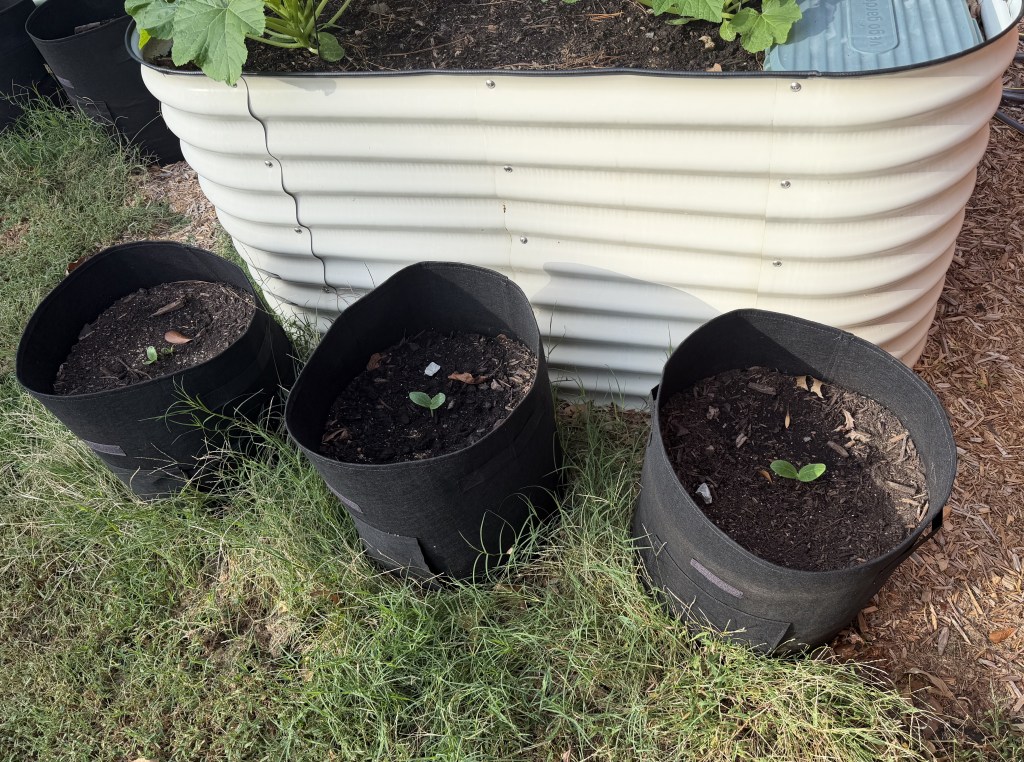
I have mentioned how the excessive heat destroyed my initial Fall planting in my raised beds. I watered daily but the 100+F straight days meant only three or four seeds ever germinated. That included 80 onion (Allium cepa) sets and six seed potatoes (Solanum tuberosum). After a month I gave up and decided to plant a second fall garden concentrating on root vegetables like beets (Beta vulgaris), turnips (Brassica rapa), and radishes (Raphanus sativus). About a week later I decided to plant outdated bean seeds in the potato grow bags. I figured nothing was lost if they did not germinate and a bonus if they did. The germination for the seeds is 7 to 10 days and after three weeks I gave up on them. Melissa has been watering my raised beds this week as she has been tending to her front flower beds. While I like to check on the beds, I have not been paying as much attention as I do when I stand there and water the beds myself. Then early this week Melissa called me outside to “come see”. All six of my grow bags had a tiny golden wax bean shoot poking out of the soil.
When I went online, I found the golden wax bean (Phaseolus vulgaris) is a type of snap bean that is identical to green beans in taste and nutrition. The main difference comes from natural genetic variation which prevents chlorophyll production in the pods. The lack of green pigment leaves them with a pale-yellow color and a smooth, glossy surface. Golden wax beans are a bush variety which forms erect bushes 8 to 20 inches (20 to 60 cm) tall. The green leaves are divided into three oval, smooth-edged leaflets, each 2 to 6 inches (6 to 15 cm) long and 1 to 4 inches (3 to 11 cm) wide. The self-pollenating white flowers are about 0.2 inches (1 cm) long and have 10 stamens each. The pods are 3 to 8 inches (8 to20 cm) long and a half inch (1 to1.5 cm) wide. The beans maintain their germination capacity for up to five years.
Golden wax beans are a variety of the genus Phaseolus which originated in the Americas, as are most kinds of beans commonly eaten today. The first European to encounter them was Christopher Columbus, while exploring what may have been the Bahamas, and saw them growing in fields. Five kinds of Phaseolus beans were domesticated by pre-Columbian peoples, selecting pods that did not open and scatter their seeds when ripe. These were the common beans (Phaseolus vulgaris) grown from Chile to the northern part of the US, lima and sieva beans (Phaseolus lunatus), and the less widely distributed teparies (Phaseolus acutifolius), scarlet runner beans (Phaseolus coccineus), and polyanthus beans. Pre-Columbian peoples as far north as the Atlantic seaboard grew beans in the “Three Sisters” method of companion planting. The beans were interplanted with maize (Zea mays) and squash (Cucurbita moschata). In 1528, Pope Clemente VII received some white beans, which thrived. Five years later, he gave a bag of beans as a present to his niece, Catherine, on her wedding to Prince Henri of France (along with the county of the Lauragais).
Thoughts: Raw golden wax beans, like other varieties of Phaseolus, contain phytohaemagglutinin, which can cause digestive discomfort, nausea, or upset stomach. Phytohaemagglutinin is destroyed by heat (heat-labile) and proper cooking or boiling neutralizes the carbohydrate-binding proteins (lectin) and makes the beans safe to eat. I have always marveled at the number of plants and animals that need to be processed in specific ways to remove their toxicity. I wonder how many got sick or even died before the process was perfected. Hungry humans seem willing to eat almost anything, but that does not mean they should need to do so. Act for all. Change is coming and it starts with you.

