
November 04, 2026
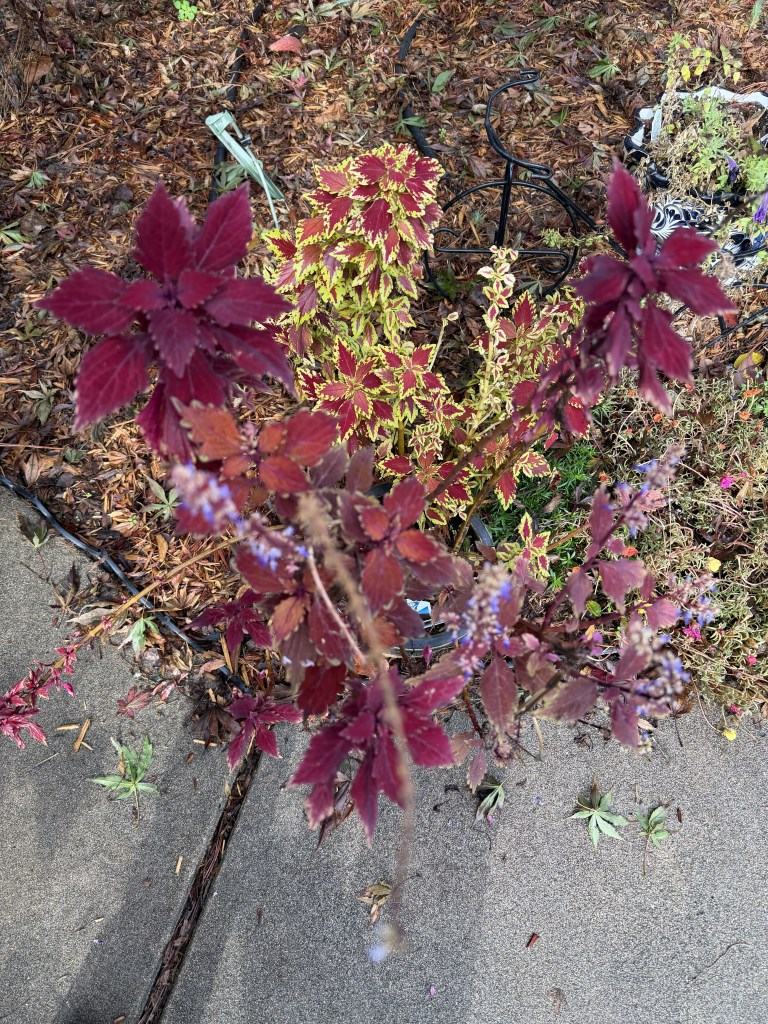
One of the things I find fascinating about gardening is plant resiliency. I commented in an earlier blog about the three volunteer vegetables that decided to grow in my containers, two squash (Cucurbitaceae) and a tomato (Solanum lycopersicum). The Super Sweet 100 cherry tomato failed early last year in the front bed under the Japanese Elm (Ulmus davidiana) but came up on its own this year. I replanted it in one of the containers on the pool deck and it struggled through the stretch of 100+F (38+C) temps during August and into September. It is now producing (small) fruits and is loaded with blossoms. The flowers Melissa planted in containers at the front of the house also struggled with the heat. I thought most of them were dead, but Melissa kept watering and pampering them. Here again the care proved beneficial. The cooler weather has revived the coleus plant and in the last week it has begun to bloom.
When I went online, I found coleus (Coleus scutellarioides) is a species of flowering plant in the family Lamiaceae (the mint or deadnettle family), native to southeast Asia and Australia. The species was first introduced into Europe from Java in 1851 by the Dutch horticulturalist Karl Ludwig Blume. The bushy evergreen perennial grows to 24 to 30 inches (60 to 75 cm) tall and wide and is widely grown for the highly decorative variegated leaves of cultivated varieties. Coleus scutellarioides is an upright annual or short-lived perennial plant which can live for about three or four years. With modern cultivation and hybridization, the species has become extremely variable with regards to its leaf color, patterning and shape. They have somewhat fleshy, semi-succulent, but tender leaves, varying in size from 0.6 to 3.9 inches (1.5 to 10 cm) long by 0.4 to 2.4 inches (1 to 6 cm) wide. Under the name Coleus blumei, the plant is reported to have very mild relaxing and/or hallucinogenic effects when consumed and was used by the Mazatec people of southern Mexico as a medicine.
While the coleus plant is thriving as we approach average Fall temperatures in Arkansas, it is a race to the finish to see which of my vegetables will produce. I decided the wax beans (Phaseolus vulgaris) will not bear a crop before the first freeze. They are in grow bags, and I am planning to move them inside the back porch under grow lights to see if they will produce. I already harvested the radishes (Raphanus sativus) and half of the beets (Beta vulgaris) that have matured. I set two pints of beets in the refrigerator as there were not enough to can them. The turnips (Brassica rapa) do not appear to be producing the root bulbs I like, but I found a friend who wants as many of the tops as I can spare for greens. The straight necked squash (Cucurbita pepo) will produce a crop as ten fruits are maturing and the zucchini (Cucurbita pepo var. cylindrica) has another four. That just leaves the ten broccolis (Brassica oleracea var. italica) that started late and do not appear to have time to produce. You never know what will survive to produce a crop.
Thoughts: Melissa’s coleus and other pots in the front can be brought indoors, as can my beans. This will let them (hopefully) survive the winter and produce. My fall garden was a test that I plan to repeat next year. Most of the seeds were expired and I believed I had nothing to lose. In that respect, it has done well and I have already given 15 pounds (6.8 kg) of produce to local food banks. I have mentioned my desire to become self-sustained. For a fall planting the key is circumnavigating the high heat and the hard freeze. Overall, the key is finding the right mix of plants to provide food throughout the summer months and then preservation methods to allow these to last through the winter. As my brother reminded me, if you are relying on your garden as your only source of vegetables it changes both what is edible and the effort to maintain what you have. Much of the world cannot supplement by the supermarket. Act for all. Change is coming and it starts with you.

