
November 02, 2026
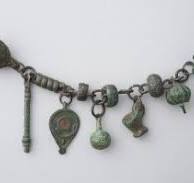
Towards the back of the HOMES section of Sunday’s local newspaper was a Reuters article on items recently found in an ancient cupboard. Archaeologists had pieced together bits of the wooden cabinet from traces uncovered in a house on Via dell’Abbondanza, one of the busiest streets of the ancient city of Pompeii. Site director Gabriel Zuchtriegel said, “We cannot reconstruct with certainty the identity of whoever lived in the house, but these fragments bring us closer to their daily life.” Along with other objects stored inside the cabinet was a necklace containing at least 24 tiny objects made of bone, glass paste, earthenware, and rock crystal. The objects included images of miniature hands, feet, pinecones, and bunches of grapes, along with the gods Bes and Mercury. Traditionally, these necklaces were given to Roman children as protective amulets but also served as rattles whose sounds helped adults keep track of them. These crepundia were sometimes kept into adulthood as mementos of childhood and offer a personal connection to the inhabitants of the house.
When I went online, I found crepundia are groups of amulets, often strung onto chains, from the 8th century BCE to the 5th century CE (Classical antiquity). The chains are like charm bracelets and are archaeologically associated with children. The singular form of the word (crepundium) derives from the Latin word crepare, meaning “to rattle or make a noise”. Crepundia is referred to in Act 4 of Rudens, a classic Roman comedy written by the playwright Plautus dated to c.211 BCE, where the character Palaestra describes the contents of a trinket box owned since childhood. The box contains a miniature gold sword inscribed with her father’s name, a miniature gold axe inscribed with her mother’s name, a silver knife, a little pig, and a gold amulet (bulla). Crepundia are variable objects, but Swiss archaeologist Stefanie Martin-Kilcher defined five main sorts of objects they contain: noise-producing objects; meaningful shapes; those with ‘exterior qualities’; remarkable objects and curiosities; and materials valued for their special properties. The noise-making components of crepundia may have been used to calm distressed infants or children or used as a toy.
The crepundia was found in a cupboard sealed for almost 2,000 years and yielded an intimate snapshot of one resident’s life before Mount Vesuvius destroyed the ancient Roman city and covered it in yards/meters of ash in 79 CE. There were tweezers, a small glass perfume or ointment bottle, and an incense burner, as well as bronze, glass and ceramic vessels and cooking pots. Lead weights in a wooden box suggest someone in the house was involved in trade and a small woven container held 38 bronze coins. “Pompeii is not just a place of great works of art. It is also a place where the most ordinary objects restore the human dimension of the past,” Zuchtriegel said. The house is tentatively associated with a man named Cornelius Maximus because of inscriptions discovered there. Its facade was first excavated in 1912, but archaeologists have only now investigated the rooms as part of a wider restoration project.
Thoughts: The fact that money and sentimental objects like the crepundia were left behind suggests the owners had no time to retrieve them after Vesuvius erupted. The PNC Financial Services ad currently running on TV shows a financial advisor who approaches a relaxed homeowner in Pompeii as Mount Vesuvius begins to show clear signs of an impending eruption. The advisor says, “So, I ran some numbers. You guys might want to consider moving.” The homeowner casually dismisses the warning and ignores the danger. While we can look back and find humor this dismissal, it is not far different than the attitude taken by politicians. All the signs point toward an imminent climate failure and casually say, “I’ve seen worse.” The geological record shows periodic mass extinction events where the dominant species is lost. Act for all. Change is coming and it starts with you.

