
November 05, 2026
GREGG PACHKOWSKI/USA TODAY NETWORK
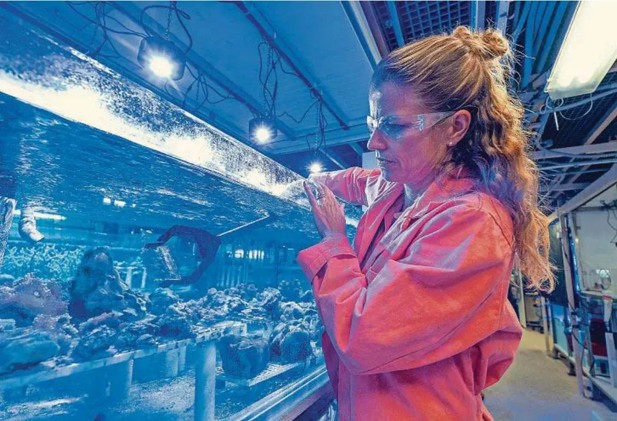
In yesterday’s local newspaper I found a USA Today article about work being done to save the world’s coral reefs. Coral reefs all over the world are in deep trouble and they serve as crucial nurseries for small fish and harbor a vast spectrum of ocean life, serving as an indispensable part of the offshore underwater ecosystem. Warming waters, sediments, fertilizers, microplastics, UV filters, and chemicals introduced into the water all pose threats. Some of the most significant work to protect the world’s coral is being conducted on a 17-acre (6.9 ha) island off Pensacola Beach, Florida. This facility serves as the only Environmental Protection Agency (EPA) site dedicated to protecting, remediating and restoring healthy coastal environments for invertebrate species (sea urchins and coral) since 1970. Much of the research is conducted in a 14,000 foot2 (1300 m2) “wet” lab where a flat aquarium houses coral brought from South Florida and Hawaii. The urchins get separate housing. This project is called the CRP.
When I went online, I found the Coral Reef Conservation Program (CRP) is part of the National Oceanic and Atmospheric Administration (NOOA). The project was established on the concept that by conserving coral reefs, we also save coastal economies, people’s livelihoods, and ensure the prosperity of coastal waters into the future. The CRP works with a variety of partners, from all sectors, to deliver the products, services, and programs most needed by coastal communities in states and territories with coral reefs. The CRP is working to increase the resilience of coral reef ecosystems throughout the US and to take the actions needed to protect, conserve, and restore these valuable resources. There are CRP staff located in seven coral reef jurisdictions (Florida, Hawai’i, Puerto Rico, Guam, US Virgin Islands, American Samoa, and the Commonwealth of the Northern Mariana Islands), to work directly with state and territorial partners to address the most pressing challenges, such as coral bleaching and habitat loss.
Coral is both animal and plant. It is a filter feeder, like oysters, but also relies on filtered sunlight for photosynthesis as a plant does. It needs nutrient-poor, clean water to survive, according to researcher Cheryl Hankins. The scientists at the research facility introduce stressors to coral samples collected by NOAA at different concentrations or durations and look at how the stressors impact growth and mortality. Teresa Booeshaghi, OASES’ associate administrator and agency science advisor, said environmental DNA research is being conducted to collect and process DNA from fish and other species by pulling it from the water column, putting an end to the yearslong practice of using nets or trawling to capture fish for study. It is hoped the eDNA inroads can be applied to coral reef research, Smith said. Hankins acknowledged the future for the world’s coral reefs appear bleak, saying “It’s grim, but there’s always hope.”
Thoughts: While the CRP is doing research, Booeshaghi said as a federal agency, the EPA cannot advocate against human activity that can destroy vast swaths of already endangered coral, like docking huge cruise ships off the Florida Keys. However, the studies being conducted off Pensacola Beach might provide the evidence needed to encourage humans to think twice before inflicting harm upon the world’s reef systems. The International Union for Conservation of Nature predicts 96% of the world’s warm-water coral reefs face a high risk of collapse by 2075 due to climate-driven heat stress and bleaching. The loss of reefs would not instantly wipe out every food chain across the entire global ocean, but it would severely damage and destabilize all marine food chains. This issue needs to be addressed now rather than later. Act for all. Change is coming and it starts with you.

