Lady Beetle

November 20, 2025

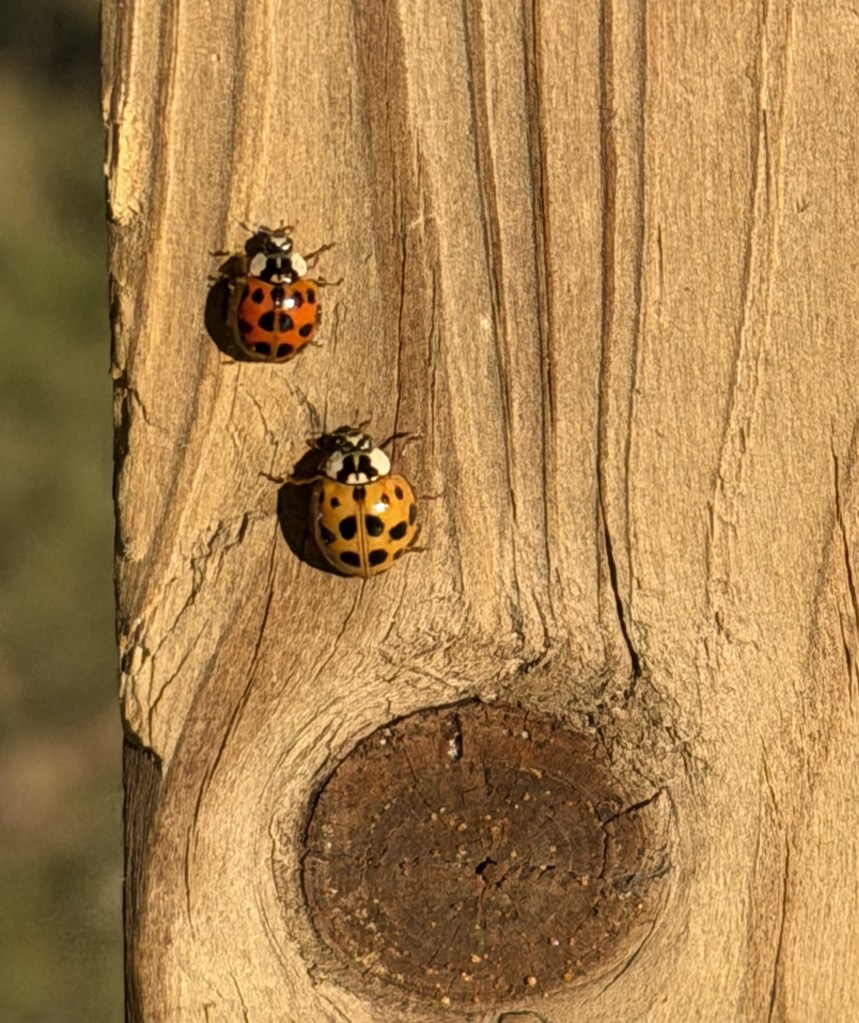
Last week Melissa and I were in a wooded area along the Arkansas River when we were inundated by flying insects.  Many species overwinter as adults sheltering in culverts, under bridges, or cavities in trees.  In the spring they will wake up and get along with starting the next generation.  Other than the short cold snap last week, we have been having nice weather this fall so these fliers may not have even begun the process.  Hibernating adults are also known to come out on unseasonably warm days.  The temperature was uncommonly warm (high 70’sF/25+C) so it would not have surprised me to find some insects buzzing around, these were literally everywhere.  I do not believe I have ever seen so many Asian lady beetle in one place.

When I went online, I found a lady beetle or ladybird (Harmonia axyridis) is a species commonly known as the harlequin, Asian, or multicolored Asian lady beetle.  This is one of the most variable lady beetle species in the world with a wide range of color forms.  The species is native to eastern Asia and has been artificially introduced to North America and Europe to control aphids (family Aphididae) and scale insects (Superfamily, Coccoidea).  It is now common and spreading in those regions and has also been established in Africa and across South America.  Individuals are beetles in shape and structure, being domed and having a “smooth” transition between their wing coverings (elytra), thorax (pronotum), and head.  It ranges from 0.22 to 0.34 inches (5.5 to 8.5 mm) in size.  The common color form is orange or red with 0 to 22 black spots of variable size.  The bright color makes the species conspicuous in North America and may be known locally as the Halloween beetle as they often invade homes during October to overwinter.

The Asian lady beetle is considered one of the world’s most invasive insects, due in part to their tendency to overwinter indoors.  They have an unpleasant odor and stain left by their bodily fluids when frightened or crushed, along with a tendency to bite humans.  In Europe they are increasing to the detriment of indigenous species as its voracious appetite enables it to outcompete (and consume) other ladybugs.  The Asian is highly resistant to diseases and carries a microsporidian parasite (it is immune) that can kill other lady beetle species.  Native ladybug species often experience dramatic declines from the invaders.  They were declared the fastest-invading species in the UK in 2015, spreading throughout the country after the first confirmed sighting in 2004.  The Asian lady beetle has been reported to be a minor agricultural pest that has been inadvertently harvested with crops in Iowa, Ohio, New York State, and Ontario.  This causes a detectable and distinctly unpleasant taste known as “lady beetle taint”.  The contamination of grapes by the beetle has also been found to alter the taste of wine.

THOUGHTS: Various methods of control have been tried where the Asian lady beetle has been introduced, causing a threat to native species, biodiversity, and to the grape industry.  These include insecticides, trapping, removal of beetles, and mechanically preventing entry to buildings.  The best methods for dealing with the Asian lady beetle in private homes involve sealing openings they enter and sweeping or vacuuming if they are inside.  Placing a nylon stocking inside the vacuum cleaner’s hose and securing it with a rubber band keeps the beetles from collecting (and being crushed) inside the machine.  Despite the dozens of beetles that landed on Melissa and me we were not bitten.  I have been bitten before and it was a sharp (but not lasting) pain.  Once again importing a species to get rid of another caused more problems than it solved.  Act for all.  Change is coming and it starts with you.
Citrus

November 19, 2025

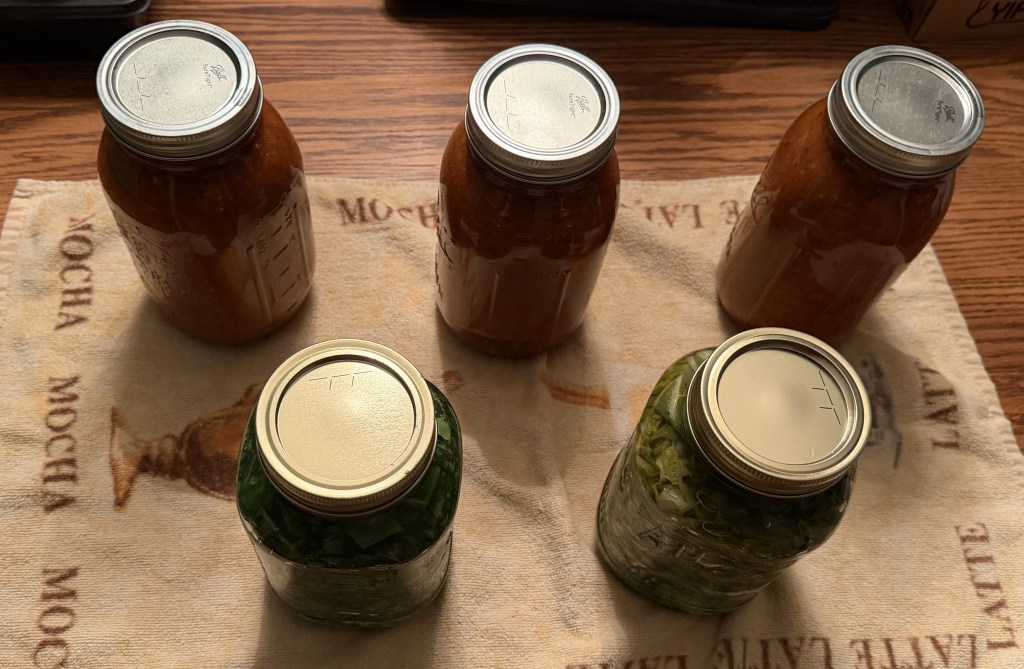
I have been winterizing my garden for the last several weeks.  That means taking down the trellises for storage and removing what is left of the plants.  I mentioned how I tore out the tomato (Solanum lycopersicum) vines in mid-October, resulting in 14 jars of salsa verde.   I did keep three vines on the off chance the fruit would ripen but gave up on them last week.  While I did have several fruits that had begun to ripen, most were solid green.  I was surprised as several more of the green tomatoes have ripened on the counter.  I harvested one head lettuce (Lactuca sativa) that grew, and we ate it as a salad last night.  The one spinach (Spinacia oleracea) that grew will become a wilted spinach salad for tonight along with fried green tomatoes.  I blanched the ripe/partially ripe tomatoes and froze them to make pasta sauce later.  I still have six cabbage (Brassica oleracea) I am holding out for sauerkraut.  They have yet to form a head so they will probably not make it before the frost.  Only about a third of the second crop peas (Pisum sativum) grew and are now producing pods.  We will finish them this week.  This year I am also trying another tact to preserve my citrus trees.

When I went online, I found Citrus is a genus of flowering trees and shrubs in the family Rutaceae that produce fruits.  Citrus is native to South Asia, East Asia, Southeast Asia, Melanesia, and Australia where indigenous people have used and domesticated various species since ancient times.  Citrus cultivation first spread into Micronesia and Polynesia through the Austronesian expansion (3000 to 1500 BCE), later spread to the Middle East and the Mediterranean (1200 BCE) via the incense trade route, and then from Europe to the Americas.  Citrus fruits are renowned for their fragrant aromas and complex flavor and are among the most popular fruits in cultivation.  The plants tend to hybridize between species making their taxonomy complicated.  The numerous varieties cover a wide range of appearance and fruit flavors.  Many important citrus crops have been developed through extensive hybridization, including oranges (Citrus macroptera), lemons (Citrus limon), grapefruits (Citrus paradisi), and limes (Citrus aurantiifolia) which all have many cultivars.

Two years ago, I purchased two citrus trees (limon and lime) hoping to grow my own fruit.  These were 4 feet (1.3 m) tall, and the seller suggested I might even get a few fruits that first year.  While the lime never fruited, the limon did have one fruit that I used for zest.  I had placed them in pots seated on rolling carriers to move them inside as I did not think they would survive the winter.  It proved impractical to move them indoors, so I bought protective covers to keep out the frost.  Citrus trees are evergreen and keep their foliage year-round, but stress from sudden temperature drops, low light (especially indoors), or lack of humidity can cause them to shed leaves.  When I removed the covers in late winter the leaves and most of the branches were dead.  I thought they had completely died, but they both began to sprout new stems by the spring.  This year I am putting them in the garage to protect them from the bitter cold.  Now to get them some light (grow lamps?).

THOUGHTS: It made more sense why my citrus trees died when I found out they were evergreen.  While some leaves may fall, they still need sunlight, water, and moderate temperatures.  Covering them deprived them of sunlight and never watering them dried them out.  Melissa told me when we return from our trip, she will make room on the sunporch so they can winter with the succulents.  I am hopeful they will continue to thrive under these conditions.  Much like my citrus trees, humans also need the right conditions to survive.  That includes adequate food, safe water, and protection from the elements (clothing and shelter).  A study focusing on low- and middle-income countries suggests 4.4 billion people lack safe drinking water and the WHO found 1 in 4 lack safe access to water.  We need to find another tact.  Act for all.  Change is coming and it starts with you.
Screwworm

November 10, 2025

The Sunday before Halloween, the Homes section of my local newspaper ran a Reutters article detailing a new sterile fly plant added in Mexico.  In Metapa, Mexico, engineers, veterinarians, and entomologists are racing to repurpose a plant that will play a pivotal role in trying to eradicate the flesh-eating fly threatening the country’s cattle industry and raising tensions with the US.  The facility used to help control Mediterranean fruit flies, but workers are dismantling old infrastructure and rebuilding specialized laboratories designed to mimic the conditions of an animal wound.  The plant aims to be ready by July 2026 and would double the number of sterile flies Mexico can release into the wild.  The US has kept its border mostly closed to Mexican cattle imports since May 2025 and has invested US$21 million towards the US$51 million facility in Chiapas state in an effort to keep the screwworm fly out of America.

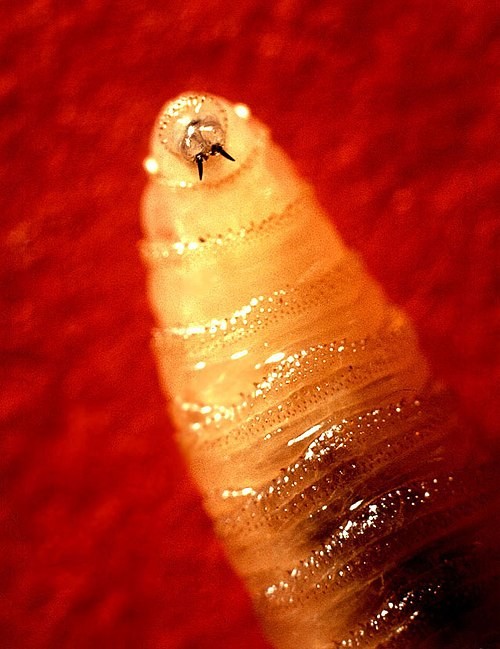
When I went online, I found the New World screwworm fly (Cochliomyia hominivorax), or simply screwworm, is a species of parasitic blowfly which is present in the New-World tropics.  The screwworm larvae (maggots) eat the living tissue of warm-blooded animals.  Of the four species of Cochliomyia, only the species hominivorax is parasitic, but a single parasitic species of Old-World screwworm fly is placed in a different genus (Chrysomya bezziana).  The maggots of many fly species eat dead flesh and may occasionally infest an old and putrid wound.  Infestation of a live vertebrate animal by the screwworm maggot (myiasis) is unusual because they attack healthy tissue, increasing the chances of infection, which then attracts more flies.  Screwworm females lay 250 to 500 eggs in the exposed flesh which hatch and burrow into the surrounding tissue as they feed.  If the wound is disturbed during this time, the larvae burrow or “screw” deeper into the flesh, giving the larva its common name.  The maggots can cause severe tissue damage or even death to the host.  About three to seven days after hatching, the larvae fall to the ground to pupate, reaching the adult stage about seven days later.  The female will mate four to five days after hatching and can lay up to 3,000 eggs and fly up to 120 miles (200 km) during her life.  Males mate up to ten times, but females mate only once and retain the male’s sperm for life, leading to the sterile eradication technique.

The screwworm was the first species to be tested with the sterile insect technique and resulted in control and systematic eradication of the species from the US, Central America, and parts of the Caribbean beginning in the 1950’s.  The US and Mexico bred and released more than 94 billion sterile flies from 1962 to 1975.  By the early 2000’s, it was considered eradicated from North America, but was detected in Mexico in 2024 and 2025, prompting renewed efforts to prevent its re-emergence.  The fly is still widespread in tropical and subtropical parts of the Caribbean and South America and animals imported from these areas must be inspected or treated to prevent the pest’s reintroduction.  Eradication efforts continued and in 1998 the first sterile flies were released in Panama with the goal of creating a barrier zone at the Darién Gap against a screwworm invasion.  This is achieved through weekly sterile screwworm releases of up to 50 million insects bred in factories and sterilized by ionizing radiation.  The bred insects must not suffer any impairment to compete with wild, fertile insects.  In September 2025, a case of New World screwworm was found in Sabinas Hidalgo, Mexico, less than 70 miles (110 km) from the US-Mexico border.

THOUGHTS: When sterile screwworm males’ mate with wild females no offspring are produced, and the population collapses over time.  Coordinator Jose Luis Quintero said, “The screwworm was eradicated once before in Mexico — it took 19 years.  We hope to do it in far less time.”  Let’s hope that is the case.  Act for all.  Change is coming and it starts with you.

Freeze

November 08, 2025

The front page of yesterday’s local newspaper ran a USA Today article telling gardeners how to prepare for the impending cold snap.  The first frost in Arkansas’ River Valley usually takes place around November 5.  Scot Covert, chief meteorologist at KFSM-TV, said we will be a little late this year, “we’re looking at Monday the 10th.”  Even before temperatures dip to 32 F (0C), frost can form in low lying areas like gardens (raised beds?) as plants cool faster than the surrounding air.  Randy Forst, extension educator with the University of Arkansas Division of Agriculture, said, “All indoor tropical plants and house plants should be moved into an area that does not go below 35 degrees.”   If you do not take this precaution, it is likely they will freeze.

When I went online, I found that a freeze will damage vegetables by causing ice crystals to form and expand inside the plant which ruptures the cell walls.  A freeze can cause visible damage like wilting, blackening, or water-soaked areas in the leaves.  While most vegetables are negatively affected by freezing (while in the ground), root vegetables and cabbages (brassicas) can become sweeter after a light frost as the cold converts their starches to sugars.  After they thaw, freeze-damaged vegetables are often softer and mushier than their fresh counterparts.  A hard freeze (28F/-2C for several hours) can kill plants outright.  That is particularly true for warm season crops like tomatoes (Solanum lycopersicum) and peppers (Capsicum annuum).  Freezing halts the growth of microorganisms but does not stop all enzymatic activity, which can lead to a loss of quality over time.  That is one reason to blanche your fresh vegetables before placing them in the freezer.

Forst went on the say cool-season vegetables that can tolerate a freeze should be covered to prevent leaf-tip burn.  A bigger concern during this time of year is drought.  Arkansas does not tend to get the moisture needed to keep outdoor plants hydrated.  You need to water outside plants if it does not rain at least once a week.  Outdoor perennials can also use extra care.  Once a frost happens you should clip back the dead foliage and then cover the crown with a biodegradable mulch.  Annuals that bloom during the cool season should continue to receive a water-soluble fertilizer once a month.  Four types of action should be taken to aid your garden and outdoor plants.   Once the temps fall below 40F (4.4C) houseplants should be moved inside.  On clear, calm nights vegetables should be covered if the temps will get into the mid-30’sF (1.6C), then be sure to uncover them when temps rise back into the 40’s+F (4.4+C).  Outdoor plants should be watered weekly if there is low rainfall.  Finally, mulch any perennials after the frost kills the top growth.  These actions will aid your plants’ regrowth the following spring.  I had better cover my plants tomorrow.

THOUGHTS: My vegetables are not the only thing I need to protect against a freeze.  We purchased a used C class RV and it is now approaching our first winter.  Everything I have read extolls the virtue of winterizing the unit if you are going to store it during the cold months.  Part of the process involves draining and pouring food grade antifreeze into the lines and tanks.  Once I do this, I cannot use the RV until I again drain and flush the lines.  While I should just bite the bullet and shut the unit down, I have wavered to the point where it is almost too late.  Our repair person told me the lines are enclosed within the vehicle so I should be fine turning on the water tank heaters and the furnace set low to keep everything warm.  The freeze is set to only last two nights and then it will warm up to the 70’sF again.  I hope I do not regret this decision.  We often delay action until it is too late.  We must address our environmental and communal issues/disagreements now rather than later.  Act for all.  Change is coming and it starts with you.
Variegated

November 05, 2025

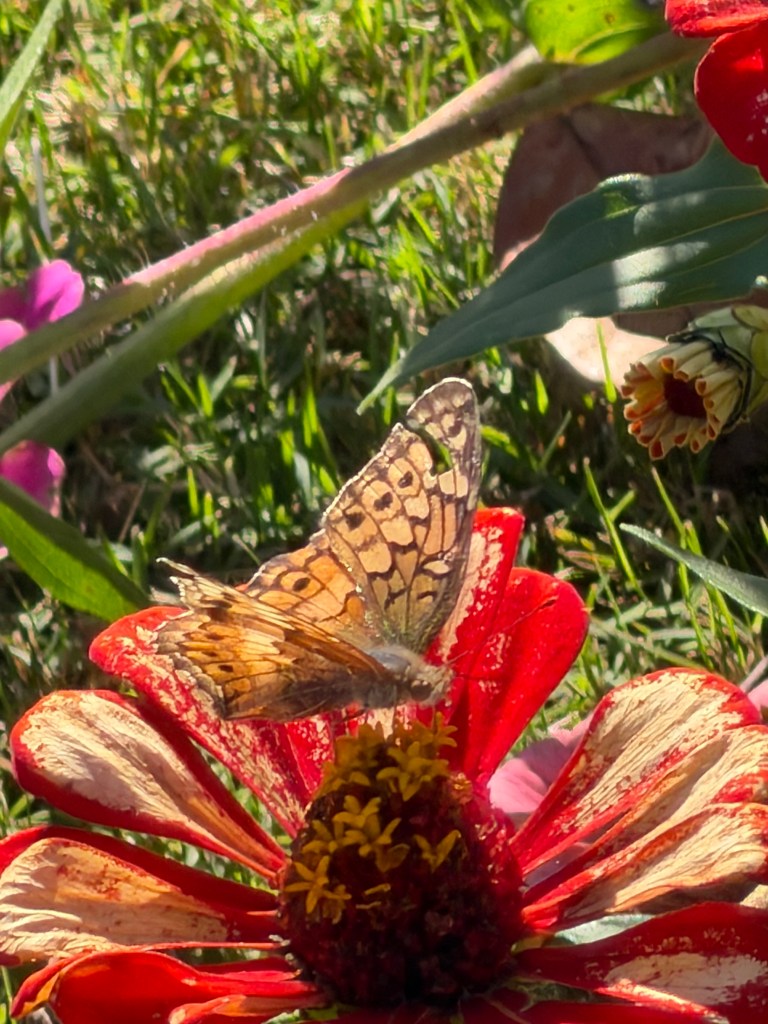
As Fall stretched into late October, I was amazed by the dozens of pollinators which still flocked to the wildflower bed in front of our house.  My guess is they are still stocking up for a flight south or survival during the long winter.  We have several coneflowers (family, Asteraceae) along with a proliferation of orange sulfur cosmos (Cosmos sulphureus).  Yesterday afternoon was bright, sunny, and in the mid-70 F’s (24 C’s) and they were still out in full force.  There were several late traveling monarch butterflies (Danaus plexippus) along with dozens of bumblebees (Genus, Bombus) flitting from flower to flower.  There was also a new arrival (at least I had not noticed) with several smaller brightly colored butterflies.  Two characteristics struck me about these Lepidoptera.  First was the speed they were traveling as they drew nectar from around the bed, the second was variegated wings.

When I went online, I found the variegated fritillary (Euptoieta claudia) is a North and South American butterfly in the family Nymphalidae.  The variegated flight is low and swift and even when collecting nectar, the species is extremely difficult to approach.  This has earned the genus name which taken from the Greek “euptoietos” meaning “easily scared”.  The wingspan of the adult variegated measures 1.75 to 2.25 inches (44 to 57 mm).  The upper side of the wings is checkered with orange and black, and both the fore and hind wings have a row of submarginal black spots and black median lines running across them.  The underside of the forewing is orange with a pale orange spot rimmed in black in the forewing cell.  The underside of the hindwing is mottled with browns and grays with a pale postmedian band.  The variegated fritillary has three very different characteristics that distinguish them from the genus of greater fritillaries (Speyeria fritillaries), but it is still closely related to them.  Variegated fritillaries have two or three broods per year (Speyeria one), are nomadic (Speyeria sedentary), and use a wide variety of host plants (Speyeria only violets). 

While the variegated fritillary is nomadic, it is not (officially) migratory like the monarch.  Instead, it overwinters in its caterpillar stage in the leaf litter, seeking shelter and entering a dormant state (diapause).  In warmer climates, adult butterflies may also overwinter.  In Arkansas the adults need to either migrate south or they will die (freeze).  Caterpillars can survive Arkansas’ winter temperatures and will emerge from their hibernation to form cocoons (pupate) in the spring.  The survival of the caterpillars (or adults farther South) depends on factors like predation, temperature, and the amount of insulation provided by leaf litter.  When weather conditions improve in the Spring the caterpillars emerge from their winter hibernation to continue their life cycle.  While I was planning on clearing the bed and scattering the seed, perhaps I should wait until new life emerges in Spring.

THOUGHTS: I can attest to the “euptoietos” nature of the variegated fritillary.  It took me 10 minutes for one to wait long enough on a flower to get a picture.  The butterflies would fly up to 30 feet (10 m) away and then dart back to seek out another flower or two before repeating the maneuver.  I find it interesting how different species have adapted to survival during the cold months of winter.  This also explains how a warm day can bring out a swam of flying insects as they emerge from their sheltered refuge.  Humans do not naturally go dormant (hibernate) because our bodies lack the necessary biological adaptations to enter a state of deep sleep with a significantly lower body temperature and metabolic rate.  The earliest evidence of controlled use of fire dates back at least 1.8 million years ago, but evidence for habitual or widespread use of fire does not become clear until around 400,000 years ago.  We rely on protective structure, clothes, or sources of heat to achieve what nature has given other species.  Act for all.  Change is coming and it starts with you.

Pickle de Gallo

November 04, 2025

I was surprised when I walked through my local grocery store last week to see how many shelves were either light or empty.  We have had several runs on food over the last several years between covid, supply chain shortages, and tariffs.  The government shutdown is the latest (presumed) cause of the shortage.  Food subsidies like the US Department of Agriculture’s Supplemental Nutrition Assistance Program (SNAP) and the Women’s, Infants, Children (WIC) program were slated to lose funding on November 1.  Apparently, some were using the last of their monthly paychecks to purchase food while it was still available (affordable?).  You can imagine my surprise when I walked by the cheese and deli meat cold case to find new stocked items.  The cold case displayed Pickle de Gallo in mild, medium, and hot.

When I went online, I found the Pickle de Gallo, also known as pickle salsa, is packaged by Grillo’s Pickles who is owned by King’s Hawaiian (as of April 2021).  The company was founded by Travis Grillo in 2008 and developed the idea from a pickle cart on the Boston Common using a 100-year-old family recipe.  The biggest difference between fresh and non-refrigerated shelf pickles (Cucumis sativus) is pasteurization.  Grillo’s are made through a “fresh pickling” process using vinegar as the main active agent and are neither fermented nor pasteurized.  This means they need to be kept at refrigerated temperatures to ensure both quality and freshness are maintained.  Eddie Andre, director of brand experience at Grillo’s Pickles says, “If you see the top of the lid domed up or bubbled, this typically means the product has fermented and gone bad.”  Jarred pickles can remain unopened in the fridge for years.  Even after they are opened, they are still good for up to two years in the refrigerator.  Since fresh pickles aren’t pasteurized, they should be eaten within 75 days.

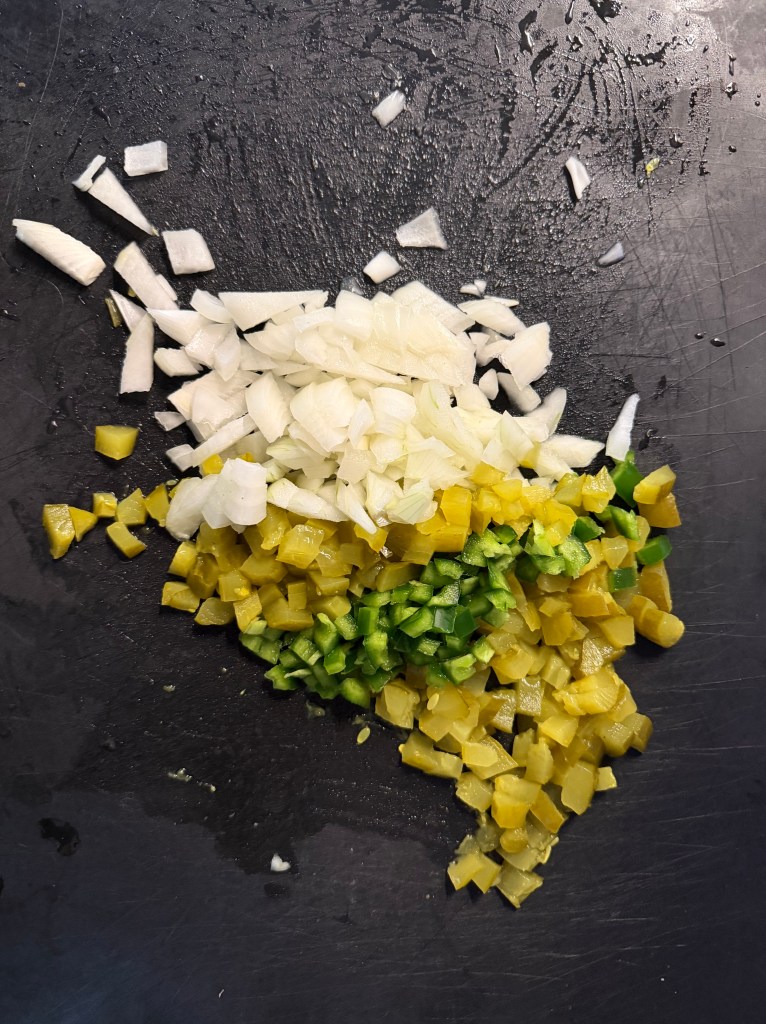
The Pickle de Gallo recipes I found were almost identical to the Pico de Gallo I have made every year since I started my garden five years ago.  This is usually made from early tomatoes (Solanum lycopersicum) and jalapeño peppers (Capsicum annuum).  This year I did not get an early crop, with almost no peppers and only enough tomatoes to make my pasta sauce (along with the green tomato Salsa Verde).  The difference between Pico and Pickle de Gallo is substituting pickles for tomatoes.  Chop the pickles jalapenos and onion (Allium cepa) into small pieces and mix in cilantro paste (Coriandrum sativum) and lime (Citrus aurantiifolia) juice.  I did not use spices as my canned dill pickles already had spices and garlic (Allium sativum).  The directions said to refrigerate the Gallo for at least 30 minutes to let the flavors mix.  I tried some with a chip and it was good (but different). 

THOUGHTS: Melissa is not a pickle fan and was not thrilled with the Pickle de Gallo.  I used an entire pint jar from my canning pantry (11 jars left).  The dills are good, but the storebought spice mixture is too salty for me and I wash the pickles before I eat them.  The advantage of making your own pickling mixture is you know what is in the brine.  I will probably make at least one more jar of the Pickle this year.  Even canned, pickles do not last forever once they are opened.  I enjoy trying new dishes made from the produce from my garden and the Pickle de Gallo is another way to use my crop.  Some of the dishes were excellent, and all were edible.  Approximately 40% of the food produced in the US is wasted, occurring at every stage of the food supply chain (from farm to home).  A large portion ends up in landfills and generates powerful greenhouse gas (methane).  The waste is compounded by the fact that 41 million Americans face food insecurity.  It reminds me of the sign at a buffet, “Take all you want, but eat all you take”.  We need to find ways to avoid wasting food and getting it to those in need.  Act for all.  Change is coming and it starts with you.
Holes

October 28, 2025

Yesterday Melissa and I were ripped awake at 4:30 am by the sound of Loki’s frantic barking.  Something outside had obviously set him off and he was sounding the alarm.  Melissa was able to quiet him down and I was able to immediately fall asleep.  Melissa was not so lucky.  Even though he was no longer sounding his alarm, both Loki and Zena continued to grumble and give little chirp barks.  Zena got up in my living room chair (her comfort zone in thunderstorms), but Loki kept running back and forth between the dining room window and the front hall for the next hour.  When I got up in the morning, I was wondering what set Loki off.  I went outside to check on my vegetables and make sure nothing had gotten into the few remaining plants in the raised beds.  I had removed the cantaloupe (Cucumis melo) vines after they had stopped producing but there are still one mature and two small watermelons (Citrullus lanatus) in the tall bed.  The tall bed is 30 inches (76 cm) and has not been targeted (yet), but raccoons (Procyon lotor) have eaten several cantaloupes in the shorter 18-inch (45.7 cm) bed in the past.  My watermelons were intact but as I walked back to the house, I noticed several dozen small holes in the lawn between the rose bush (genus, Rosa hybrid) and the wildflower (family, Primulaceae) beds.  

When I went online, I found that raccoons are one of the main animals that dig holes in your yard.  The holes are usually cone-shaped and three to four inches (7.5 to 10 cm) wide, but larger areas up to ten inches (25 cm) may occur.  The holes are created when raccoons are foraging for grubs and other insects. According to Clemson University, raccoons will peel back newly laid sod while searching for food.  Raccoons are omnivorous and eat a variety of plants and animals.  In cities and suburban areas, they dig for grubs and larval insects, eat vegetables and fruit grown in backyards, root through compost piles, steal picnic and pet food that has been left outdoors, and turn over garbage cans in search of food.  According to the University of California, these night creatures can live unnoticed for quite some time as they make their homes in hollow trees, outbuildings, brush piles, rock crevices, a raccoon burrow, crawl spaces, culverts, storm drains, attics, chimneys, or under decks.  Raccoons dig holes in lawns in search of grubs (uperfamily, Scarabaeoidea), earthworms (Lumbricus terrestris), and other insects.

Raccoons have a keen sense of smell which allows them to dig holes to find insect larvae under the grass.  The best way to keep raccoons from digging holes in your yard is to address the grub problem or using deterrents.  Treat your lawn for grubs, especially in late summer and fall, and use methods like motion-activated sprinklers or lights to scare them away.  You can also cover the lawn with netting or chicken wire to create a physical barrier and prevent digging.  You need to maintain proper lawn care, as poor watering practices can make your lawn more attractive to grubs.  If your lawn is damaged, repair it promptly.  If sod has been flipped, reposition it, water it, and consider using a root-building fertilizer to help it re-establish.  I guess it is time for my fall bug-be-gone dusting.

THOUGHTS: I was able to flip the sod on the larger holes that had been made in our yard, but I did not get the bug-be-gone down.  I told myself this would give me something to do today.  Most adult beetles in Arkansas are active in the summer and lay their eggs in the grassy areas.  The eggs hatch and the larva begin to feed on the surface of the soil for several weeks before moving deeper as the fall temps cool.  Arkansas winters are relatively mild, and summers are hot and humid, so the two treatment windows are late summer to early fall (preventive and biological control) and late spring to early summer (curative for spring-feeding pests).  Otherwise, I have holes in my yard.  Act for all.  Change is coming and it starts with you.
Wavy-lined

October 14, 20254

Melissa tends to keep the back door to the porch open to help provide a breeze and keep down the humidity for the succulents.  If the air conditioner is not running, she will often keep the house door open as well.  This provides a breeze for us and allows the kids to roam freely in and out of the house without having to get up every time they hear a noise or want to go outside.  While this is convenient, it allows house flies (Musca domestica), moths (order, Lepidoptera), and other flying insects (and occasional birds) to fly enter both the porch and the main house.  I have tried to combat this by placing a bug-zapper next to the doorway.  The blue light is not visible during the day but does attract moths at night.  When it is time for a final constitutional, Loki will wait at the door for Melissa or I to go first to “protect” him from the sounds of the moths hitting the zapper.  When I got up yesterday, I noticed one of the moths had avoided the zapper and was attached to the wall above the kitchen sink.  When I looked closer the moth’s coloration was “wavy-lined”.

When I went online, I found the wavy-lined emerald moth (Synchlora aerate), or camouflaged looper, is a species of moth of the family Geometridae.  The species is found in the US and Canada and was described by Johan Christian Fabricius in 1798.  There are dozens of species in the subfamily of emeralds in North America.  Most look incredibly similar, being green (sometimes tan) and typically resting with their wide wings spread out to the sides.  The key identifying features for the species are the mildly wavy white lines that run across the wings, a pale green fringe on the wings, and a long, thin white stripe running the whole length of the abdomen.  The adult wingspan is about 0.67 inches (17 mm).  The caterpillar of this species is an inchworm (looper) that camouflages itself from predators with small clippings from flower petals they are feeding on.  The wavy-lined is a common moth that has two or three broods a year and overwinters as a partially grown larva. 

The wavy-lined emerald moth is an important food for birds and other predators.  While some insects use camouflage or mimicry to outwit predators, the wavy-lined caterpillar blends these two defenses.  Insect camouflage often refers to creatures like stick bugs (order, Phasmatodea) that have evolved to look like their surroundings.  Mimicry means looking like a completely different creature, like the less toxic Viceroy Butterfly (Limenitis archippus) which looks like the toxic Monarch (Danaus plexippus).  The wavy-lined larva will attach bits of the plant material on which it is feeding to its back with bits of silk to blend into its host plant and avoid detection.  When it feeds on a different plant it will “wear” the appropriate foliage.  These fragments start off colorful (to blend in with the flower) and then dry out to look like a chunk of debris.  It also seems to detach and replace the parts as they wilt, keeping the larvae covered in fresh adornments that match its meal.  While it is essentially using camouflage, the insect is an active participant in the process, mimicking whatever flower it feeds on. 

THOUGHTS: While I have no problem swatting the flies and mosquitoes (family, Culicidae) that invade my house, I did not feel threatened or bothered by the wavy-lined emerald moth.  It spent the entire day resting on the wall as Melissa and I came and went around the sink, allowing me to admire its delicate lines many times.  When I got up this morning the moth was gone.  Hopefully it made it past the bug zapper on its way outside.  Most insects tend to go about their business and do not seek out humans.  Flies and mosquitoes are an exception and use humans as a source of food (dead skin, blood), water (sweat), and salt.  The fact that the moths are aesthetically pleasing is another plus.  Sometimes I need to remind myself that every creature has a role to play in the larger biome.  Act for all.  Change is coming and it starts with you.

Jumper

October 01, 2025

When I opened my mailbox this morning to retrieve my newspaper, I was surprised by something jumping out of the mail.  The mail itself was covered by a fine gauze-like webbing.  I figured this was some sort of spider that had decided to take up residence in the dark confines of my closed mailbox.  This did not strike me as unusual as many spiders are on the move at this time of year seeking a place to overwinter.  I was surprised by the distance the spider had jumped.  It had shot off my paper and onto the ground several feet away.  When I Goggled a picture of the spider, I found it was aptly named a Bold jumper.

When I went online, I found the bold jumper (Phidippus audax), also known as the daring jumping spider, is a common species of spider belonging to the genus Phidippus.  This group of jumping spiders easily identified by their large eyes and their iridescent mouth parts (chelicerae).  They are typically black with a distinct white triangle on their abdomen.  Like all jumping spiders, they have excellent stereoscopic vision that aids them in stalking prey and facilitates visual communication with potential mates during courting.  The species are native to North America and have been introduced to Hawaii, Nicobar Islands, Azores, and the Netherlands.  The Bold jumper is a solitary carnivore that uses their highly specialized eyesight to actively hunt and stalk a variety of insects and non-insect terrestrial arthropods such as caterpillars (order Lepidoptera), dragonflies (infraorder Anisoptera), grasshoppers (suborder Caelifera), and other spiders (order Araneae).  They are one of the most common spiders found in agricultural areas and have been studied to determine their impact on crop pest populations.  New Hampshire Governor Chris Sununu signed the HB 318 bill on June 11, 2021, designating the bold jumper as the state spider following a campaign by a class in Hollis, New Hampshire.

The bold jumper is often found living near humans.  Bites are rare but may occur if they feel threatened or are mishandled.  Bites are often described as mildly painful and are not considered dangerous.  Symptoms often include localized redness, itching, and swelling for one to two days, if at all.  Medical attention is only advised if symptoms worsen or abnormal symptoms arise.  If bitten, you should wash the area with water and a mild soap.  A cold compress may be used to treat swelling and aspirin, and acetaminophen may be used for pain.  As a major predator of crop pests, they have been studied to determine their impact on pest insect populations.  However, in addition to eating pests, they also eat beneficial insects such as pollinators.  My jumper went to the ground and then calmly stayed in place as I maneuvered my camera to take a photo.  It obviously did not consider me a threat and having been around them frequently I did not consider it a threat either.  Unlike most spiders, the bold jumper does not build webs to catch prey.

THOUGHTS: I found it curious that the bold jumper does not build a web to catch prey, yet there was an obvious webbing on my newspaper.  This was the start of the thin sheet of silk that would become the nest for an egg-sac.  This is usually built in hidden areas under rocks, bark, or leaves, but the inside of my mailbox seemed to serve.  The jumper was preparing to create a secluded nest to provide for the next generation in the spring, but my mailbox was not the secluded location she sought.  Humans find similar radical shifts in environment.  A site along the ocean seems perfect, until the storm surge from a hurricane washes out the foundation and sweeps the house into the sea.  Building needs to take potential environmental shifts into account.  Both for weather impact and the impact of encroaching on fragile ecosystems.  Act for all.  Change is coming and it starts with you.

Indeterminant

September 26, 2025

I toyed with the idea of tearing out my tomato (Solanum lycopersicum) plants since the beginning of August.  They quit producing and while I was getting scattered flowers, they did not result in fruit.  The exception was my super sweet 100’s which were doggedly producing, but the size of the cherry tomatoes had dropped from over a nickel (US) to less than a centavo (Mexico).  My gardener friend went on an extended trip during this time and when she returned many of the plants had died and she tore them out.  What stopped me was the weather began to cool, and we had a period of rain, so I did not feel the need to water.  Since all I was doing was monitoring the plants, I decided to leave them.  I still needed another gallon (3.8 liters) of tomatoes to augment the gallon I had frozen in June in hopes of more pasta sauce.  I had only given a quick scan to the plants along the back of the house for several days.  These Arkansas travelers are an indeterminant (keep growing) variety that had spent the summer producing vines without any fruit.  You can imagine my surprise when I gave them a more thorough inspection and found dozens of healthy green tomatoes up to a US half dollar size.

When I went online, I found in biology and botany, indeterminate growth refers to growth that is not limited (terminated) but continues to grow.  In contrast, determinate growth stops once a genetically predetermined structure has completely formed.  That means any plant that grows and produces flowers and fruit until killed by frost or some other external factor is called indeterminate.  Many tomato varieties (especially heirloom) tend to grow in a rangy fashion and produce fruit throughout the growing season.  A determinate tomato plant grows in more of a bushy shape and is most productive for a single, larger harvest.  It then either tapers off with minimal new growth or fruit or dies.  The Arkansas Traveler is an open-pollinated heirloom variety bred by the University of Arkansas in 1968.  The plant is indeterminate and produces round red fruits weighing approximately 6 ounces (170 grams).

When I told Melissa about the green tomatoes flourishing on these indeterminant plants she suggested if they did not ripen (for my pasta sauce or salsa), we could use them for green tomato relish.  Coming from the North I have never eaten this relish, although I have heard of it, but this is a popular and traditional staple in Southern cuisine.  This sweet and tangy relish is often referred to as “chow-chow” and is especially common towards the end of the summer harvest season to use up unripe tomatoes.  Green tomato relish is traditionally made when the season’s last tomatoes fail to ripen on the vine and as a way of preserving the harvest to enjoy throughout the winter.  The unripe tomatoes are mixed with peppers, onions, and pickling spices.  The relish can be preserved through water bath canning for long-term storage.  Another (Southern) use of green tomatoes is to cut them into 1/4-inch (0.6 cm) slices, season with salt and pepper, coated with plain, coarse cornmeal, and shallow-fry slices in bacon fat.  We had tried this (and green tomato pie) earlier in the year.

THOUGHTS: I am interested in trying the unripe fruit of my indeterminant tomatoes as both relish and again fried.  The relish is a traditional topper or side dish that provides a savory accent to meats, fish, or potatoes (Solanum tuberosum).  It is suggested to use bacon fat when frying, which is called “liquid gold” in traditional Southern cooking, as it adds a smokey, salty, and savory depth of flavor that is difficult to replicate with other fats.  While we did not fry tomatoes, my mom always had a can of bacon dripping beside the stove to supplement the can of lard in the cupboard and I still save bacon fat the same way today.  The practice is rooted in the practicality and “no waste” philosophy of southern cuisine as well as my rural Midwestern roots.  “You can take the boy out of . . .” Act for all.  Change is coming and it starts with you.