Hornet

September 22, 2025

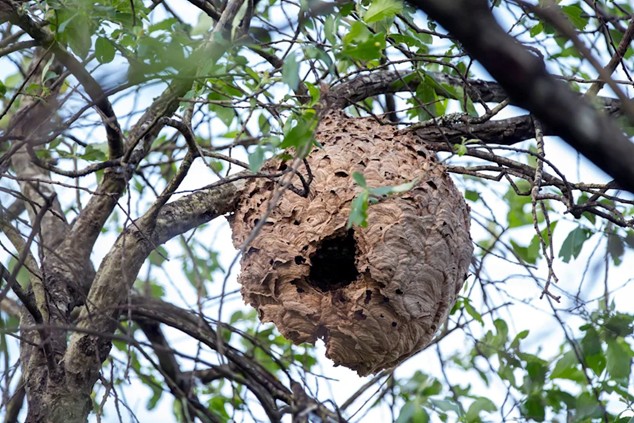
I found an article on yahoo!news about an innovative approach toward eradicating an invasive species in England.  British scientists are attaching miniature tracking devices to the invasive insects which allow teams to locate and destroy their hidden nests within an hour instead of several days.  Time is critical as the nest can reproduce within seven days.  Inspectors capture individuals near bait stations, secure hair-thin transmitters around their bodies, and follow them straight to their colonies.  According to The Guardian, Britain’s Animal and Plant Health Agency found 64 nests through August 2025, setting a seasonal record.  Public participation drives much of the success for the eradication program.  Citizens use the Asian Hornet Watch app to submit thousands of sightings and enabling rapid response teams to investigate reports near ports where the species often arrive hidden in shipments of wine, produce, or building materials.  The invasion started when a single Asian Hornet female likely arrived in France aboard a pottery shipment from China back in 2004.

When I went online, I found the Asian hornet (Vespa velutina), also known as the yellow-legged hornet, Asian predatory wasp, or murder hornet, is a species indigenous to Southeast Asia.  This is significantly smaller than the European hornet, with queens 1.2 inches (30 mm), males about 0.94 inches (24 mm), and workers about 0.79 inches (20 mm) in length.  The species has distinctive yellow legs (tarsi), a velvety brown or black mid-section (thorax), and a brown abdomen.  Each abdominal segment has a narrow posterior yellow border, except for an orange fourth segment.  The hornet has a black head and a yellow face.  The coloration of the species can vary regionally which causes difficulty in classification and resulted in several subspecies to have been identified and later rejected.  The most recent taxonomic revision of the genus treats all subspecific names in the genus Vespa as synonyms, effectively relegating them to no more than informal names for regional color forms.  The Asian hornet is an invasive species of concern in most of Europe.

The Guardian reported the Asian hornet feasts on honeybees (genus, Apis) and other pollinators that enable the production of approximately one-third of the crop humans consume.  A single colony of hornets consumes about 24 pounds (10.9 kg) of insects during one season, putting pressure on the bee populations already struggling with habitat loss.  Testing shows Britain has prevented permanent colonies from establishing, with only three of 24 nests last year originating from females that survived winter in England.  While government teams fight Asian hornets with high-tech solutions, homeowners can help in their own yards with intelligent landscaping choices.  Replacing portions of traditional lawns with native plants can create a refuge for local pollinators.  Native plants also demand less water and maintenance than non-native species, which cuts both utility bills and maintenance.  These plants support local bee populations naturally by providing the nectar and pollen sources these insects evolved to use.

THOUGHTS: The Asian hornet was declared eradicated by the US Department of Agriculture in December of 2024.  Eradicated means there has not been a sighting in three years.  Even without the threat of this hornet, we have taken two steps to assist pollinators in our yard.  The wildflower bed in the front draws both bees and butterflies while also providing cover from any predators.  The side yard has a bird bath that I fill every time I water the vegetables.  This has a half brick in the middle to allow bees to cling to the brick and take a drink.  It took little effort for either of these features and the result has provided food and water for countless pollinators.  Act for all.  Change is coming and it starts with you.
2nd Crop

August 27, 2025

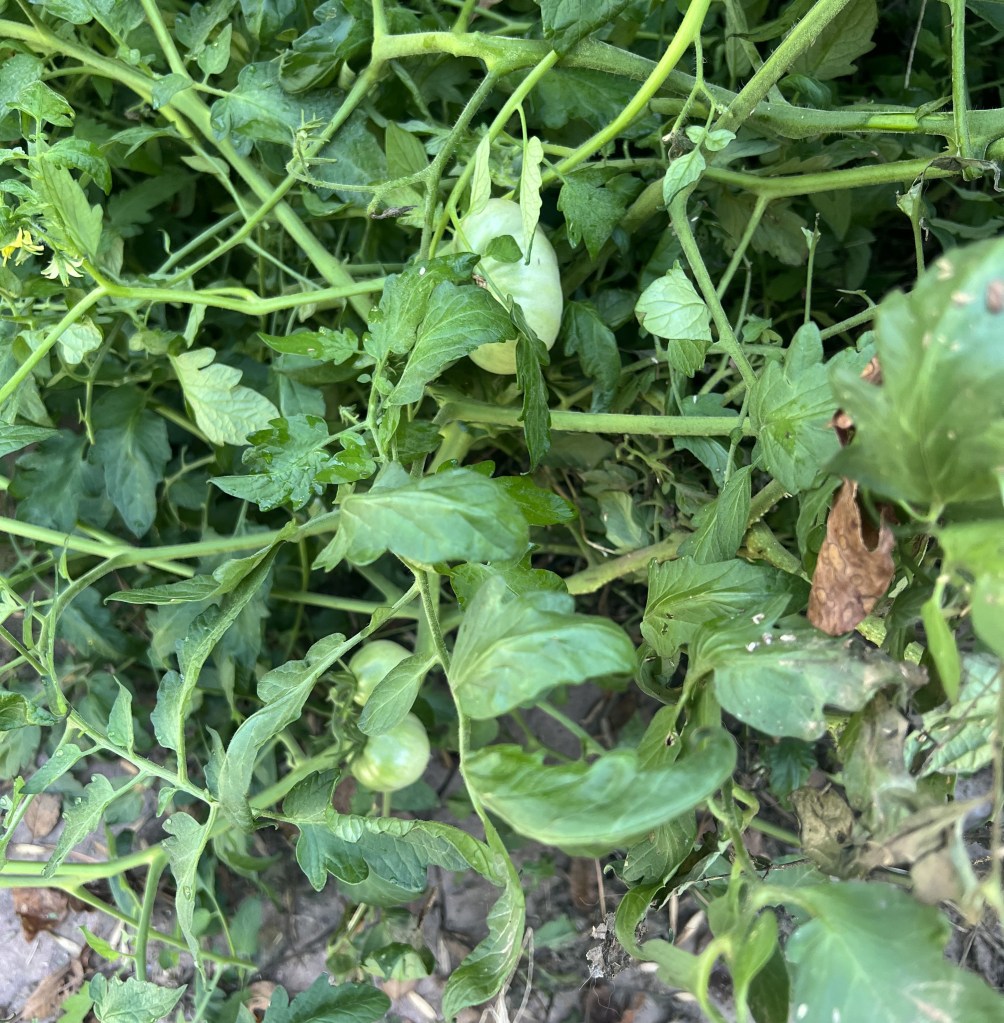
While I considered replanting my raised beds last year, I never got around to doing it.  When I planted my vegetables in April I noted when (and if) I could replant another round of the same vegetables.  After the initial harvest I also considered which vegetables I wanted more of.  I already had way too many pickles (Cucumis sativus) with 12 pints (5.7 liters) than I could use over the next year, and the same was true for the six pints (2.8 liters) of canned carrots (Daucus carota).  I had eaten through the radishes (Raphanus sativus) and only had 2 pints of beets (Beta vulgaris) left, so these were a good choice.  I also decided to replant cauliflower (Brassica oleracea) and cabbage (Brassica oleracea).  We enjoyed the two quarts (1.9 liters) of sauerkraut last year and I had not planted a new crop this year.  I rounded out the raised beds with a few vegetables that had not grown well along the patio; lettuce (Lactuca sativa), spinach (Spinacia oleracea), and peas (Pisum sativum).  Now that my 2nd crop is planted, I just need to wait and see what will produce.

When I went online, I found a second crop is either the second growth of a crop that regrows after an initial harvest, or, more commonly, a different crop planted on the same land within the same year after a previous crop has been harvested.  This is known as double cropping and allows farmers to maximize land use and harvest two yields from the same acreage in a single growing season.  This requires sufficient time for the crop to mature and resources like water to support the second planting.  There are two main types of second crop.  The first is a regrowth after the initial harvest where the stump/roots of a crop resprouts after it has been cut for its first harvest (example, broomcorn).  The second is to plant a follow-on crop of a new and different crop on the same piece of land within the same year after the first has been harvested.  This utilizes land that might otherwise lay idle or unproductive.  Double cropping requires adequate time for the second crop to mature and sufficient moisture from rainfall or irrigation to support both plantings.  This process can boost the overall farm revenue and potentially improve ecological services.

There are several benefits to succession planting or planting a 2nd crop in your vegetable garden.  First is that it allows you to enjoy the vegetables you love for a longer period.  This also allows for more yield in the same amount of space.  This is especially so for smaller gardens with limited space.  If you plant a 2nd crop from a different plant family, it can improve the soil structure and replenish nutrients depleted by the 1st crop.  Finally, rotating different types of plants helps disrupt the life cycles of pests that had fed on the 1st crop and reduce the spread of diseases.  Critical considerations for a 2nd crop are the first frost date in your growing area (mine is 7b).  That means planting fast maturing varieties and vegetables that thrive in cool weather.  You will also need to amend your soil with new compost or fertilizer to ensure a good result.  I did not fertilize when I planted yesterday.  This just gives me something to do today (ha ha).

THOUGHTS: Planting a 2nd crop is the next step toward my goal of sustainability.  Admittedly, I should have allowed several plants to go to seed and then replanted those.  Instead, I used what was left in the heirloom seed packages I had left.  Maybe next year.  As the weather cools, I am looking forward to finally getting some production from the tomatoes (Solanum lycopersicum) and bell (Capsicum annuum) and jalapeno (Capsicum annuum) peppers I planted last April along with the new produce from my 2nd crop.  While the time and expense of growing my garden may not cover the costs, the crispness of the produce makes it worthwhile.  Sustainability is a process that is its own reward.  Act for all.  Change is coming and it starts with you.
Arborist

August 12, 2025

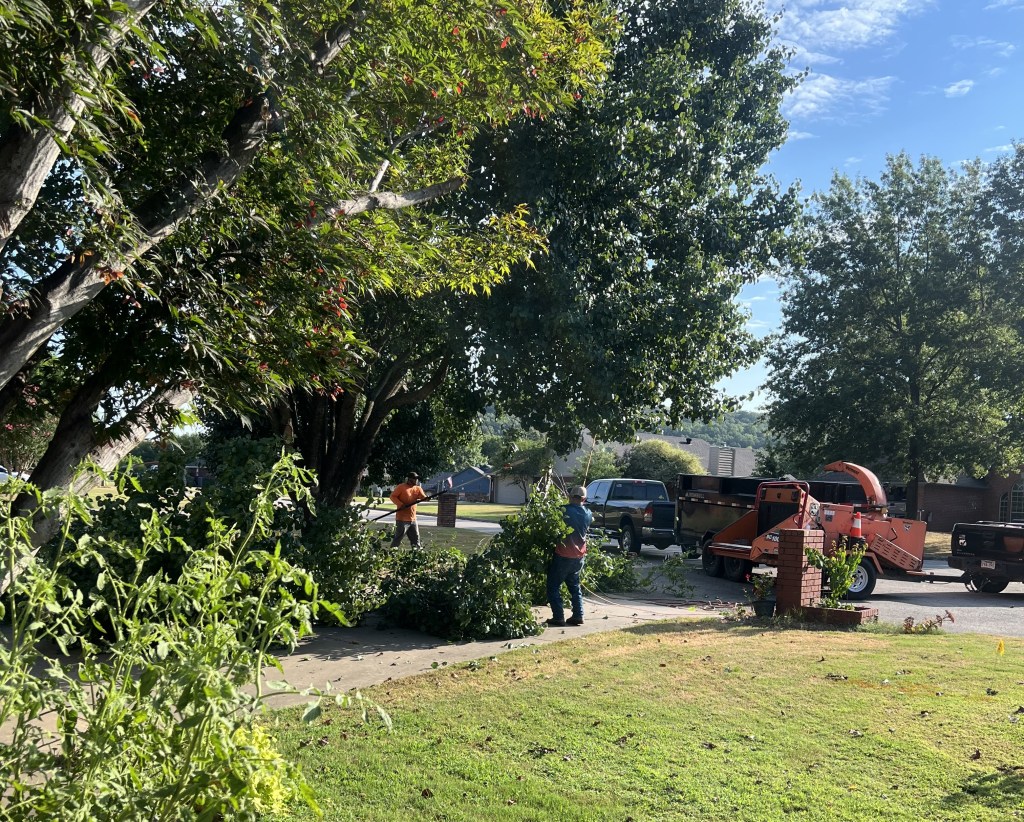
I came across another example of how one decision leads to the necessity of making others this week.  We have been checking out buying a motorhome for the last eight years.  We began when we still lived in Kansas, but after the move to Arkansas the concept fell off our radar.  This last year my sister and brother-in-law purchased a small teardrop trailer with their son and then a larger trailer for their use.  They camped most of their married life, so this was not a surprise.  She told us that while it was cheaper to stay in a hotel than buy and maintain a trailer, they enjoyed the outdoor freedom.  One reason I (and now Melissa) retired was to travel.  Now that we have the kids, this has become problematic (for me).  It is more difficult to find a hotel that allows pets (not impossible) and even more so now that we have 175 pounds (75 kg) of dogs.  Boarding is a possibility but adds another US$1,000 to the vacation.  That moved us to buy a Class C motor home.  These vehicles are smaller than the Class A motorhomes and have slide-outs for maximum square footage.  The purchase meant we also needed to decide where to keep the vehicle.  The fenced side yard was an obvious choice, but that meant we needed to enlarge the gate and cut down a tree for access.  While I could have taken days to cut the tree and haul it to the dump, we decided to call an arborist. 

When I went online, I found arboriculture is the cultivation, management, and study of individual trees, and other perennial woody plants, and a person who practices or studies arboriculture is called an arborist.  The science of arboriculture studies how these plants grow and respond to their environment.  The practice of arboriculture includes techniques for selection, planting, training, fertilization, pest and pathogen control, pruning, shaping, and removal.  A tree surgeon is more typically someone who is trained in the physical maintenance and manipulation of trees and more a part of the arboriculture process rather than an arborist.  Risk management, legal issues, and aesthetic considerations have come to play prominent roles in the practice of arboriculture.  Businesses often hire arboriculturists to complete “tree hazard surveys” and generally manage the trees on-site to fulfill occupational safety and health obligations.  Arboricultural matters are also considered to be within the practice of urban forestry, yet the clear and separate divisions are not distinct or discreet.

Both the arborist and the fence man showed up at the same time today.  While they were working in the same area of the yard, they did not seem to interfere with each other.  The tree came down in a matter of hours (not my days) and the limbs were either ground or stacked in 15-inch (38cm) lengths to be used as firewood when we go camping.  The fence took a little longer.  It needed two posts removed and another set.  This shortened the total area but allows for a 12.5-foot (3.8 m) entrance.  That is enough to safely drive my 10 foot (3 m) wide motor home through the gate and park it in an enclosed area.  As I said, one decision often leads to several others. 

THOUGHTS: One of the reasons people call an arborist is the perceived risk of death by falling trees.  This is influenced by media and often hyped, and the risk has been reported to be close to 1:10,000,000, or almost as low as death by lightning.  Trees in urban green spaces and their careful conservation are sometimes in conflict with aggressive urban development, despite how urban trees contribute to livability of suburbs and cities objectively (reduction of urban heat island effect, etc.) and subjectively.  Tree planting programs implemented by a growing number of organizations and cities are mitigating the losses and often increasing the number of trees in suburbia.  This includes planting 2 trees for every 1 tree removed or paying landowners to keep trees instead of removing them.  Each tree absorbs about 55 pounds (25 kg) of C02 annually.  My two fruit trees help replace the one Bradford pear (Pyrus calleryana).  Act for all.  Change is coming and it starts with you.
Wildflower Bed

July 07, 2025

Five years ago, I blogged about my stint as director of a conference center in Kansas.  The camp was located on 63 acres (25.5 ha) of mixed trees and (originally) prairie grass that was now mostly seeded with Bermuda grass (Cynodon dactylon) for lawns.  During the summer we spent 5 to 6 days a week on the mower cutting grass.  Part of our mission was to provide opportunities for education, so I decided to let the prairie grass return.  The first year we let most of the camp return to natural grass to evaluate where the prairie grass was still abundant.  The second year we selected about 12 acres (4.5 ha) to return to native prairie.  We also reseeded those acres with the Big Five grasses prominent in the Tall Grass Prairie that used to dominate Kansas.  This provided lawn for camp activities and nature trails with identification signage for eco-visitors.  To complete the prairie’s restoration, we seeded a variety of prairie wildflowers in prominent locations along the roads.  Being on the flyway of the Monarch butterfly, I transplanted 20 milkweeds (Asclepias syriacaplants) from the lawns into a wildflower bed near the entrance of the camp.

When I went online, I found a wildflower is a flower that grows in the wild, rather than being intentionally seeded or planted.  The term implies that the plant is neither a hybrid nor a selected cultivar that is any different from the native plant, even if it is growing where it would not naturally be found.  This can refer to the whole plant, even when not in bloom, and not just the flower.  The term “Wildflower” is imprecise, and more exact terms refer to specific types of flowers including native species naturally occurring in the area, exotic or introduced species not native to the area, invasive species that outcompete other plants (introduced deliberately or accidentally), and plants that have become naturalized (imported but considered native by the public).  Wildflowers can be annual (germinates from seed, live one year), perennial (live multiple years, return each growing season), or biennial (two-year life cycle, blooming in the second year).  In recent years, wildflower gardening has gained popularity.  A planted wildflower bed not only looks attractive but has the advantage of supporting pollinators, reducing maintenance, and conserving water. 

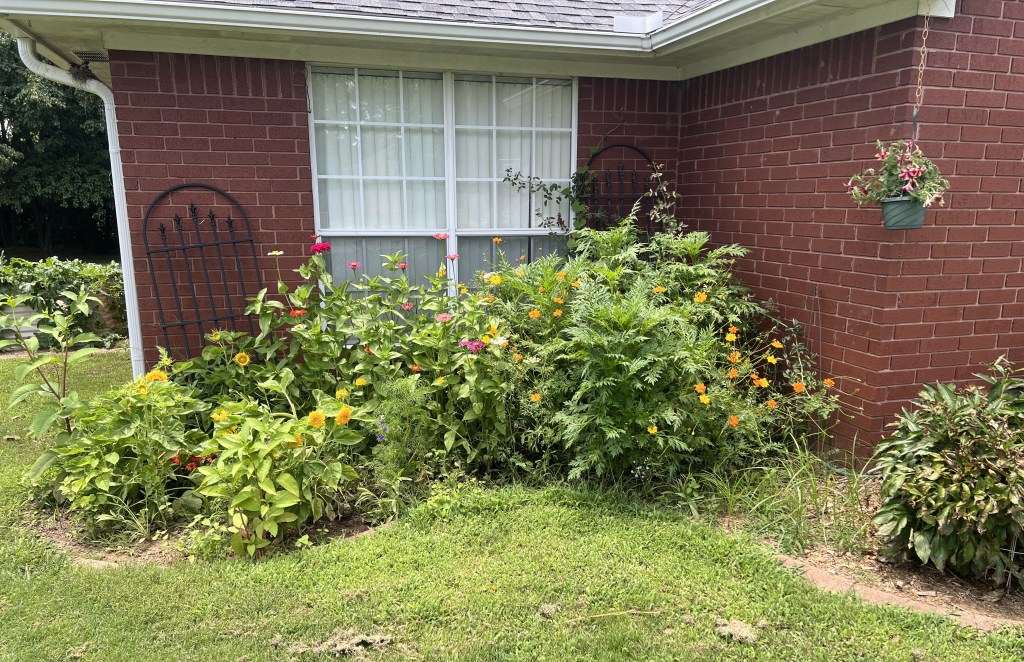
I wanted to duplicate my conference center experience when we moved to Arkansas, but I could never decide where to plant the wildflowers.  Melissa’s mom established several flower beds that I thought Melissa wanted me to maintain.  Melissa likes the look of a green lawn and symmetrical flower beds more than the asymmetrical look of a wildflower bed.  I was also interested in expanding my garden into the front beds to replace the roses neither of us liked.  Indecision meant we did nothing for five years.  Last year we did decide to place wildflowers in one of the beds in front of the house but never got around to doing so.  When Melissa retired this year, she decided she would plant a wildflower bed.  We sprayed to kill all the grass that had taken over the beds, spaded the soil and weeded the bed to prepare it, Melissa sowed the seed, and then we waited.  The first thing that grew was more grass and weeds, so I weeded the bed again.  The wildflowers finally began to grow.  Now we have a wildflower bed in the front of the house.

THOUGHTS: One of the problems with weeding the wildflower bed was knowing what to pull and what to leave.  Removing the grass was obvious, but how do you tell the difference between the wildflowers Melissa planted and the weeds that grew naturally?  In essence, all wildflowers are weeds if they are intruding in the vegetables or “planted” flowers.  I decided to leave any plants I could not identify.  If it grew a flower it was supposed to be there, whether Melissa sowed the seed or not.  The same could be said for people.  If they flourish in a new location they are meant to be there, no matter how they arrive.  Act for all.  Change is coming and it starts with you.
Leafcutter

June 29, 2025

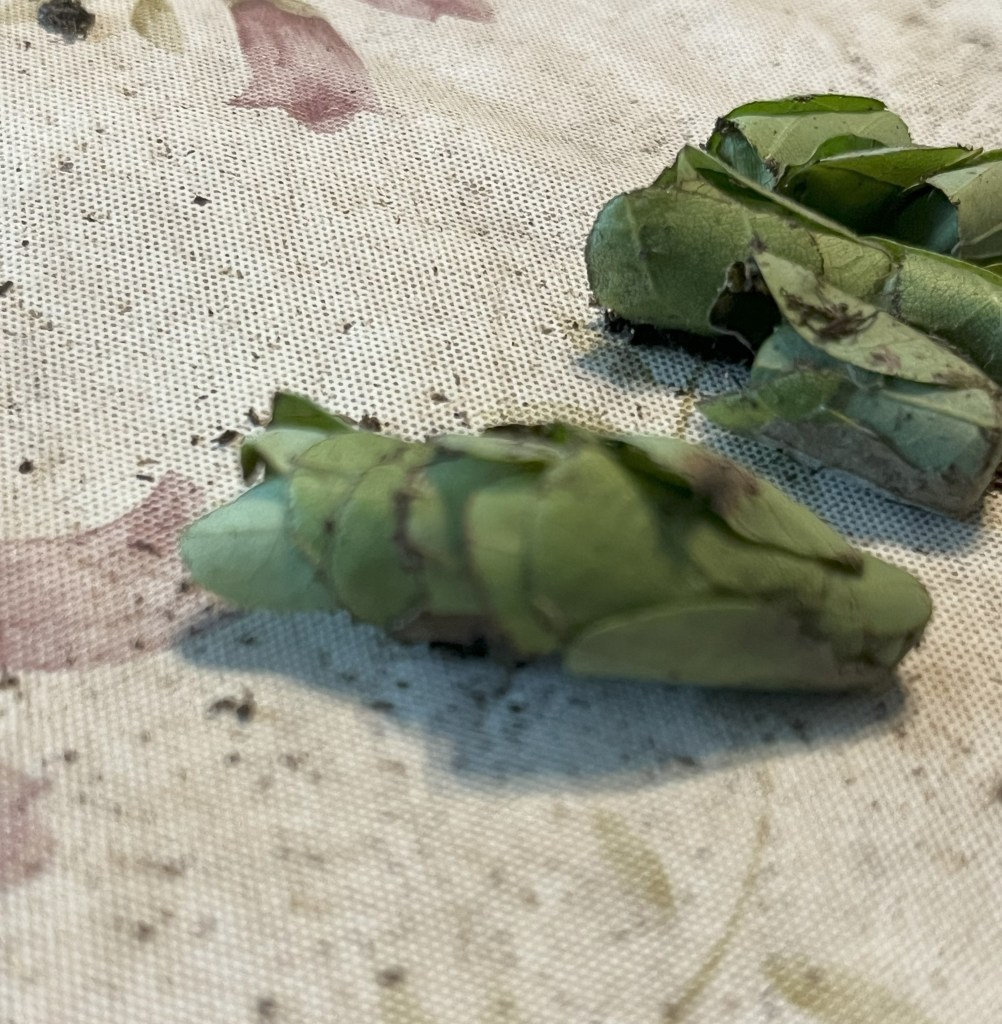
Melissa went shopping with me yesterday to get out of the house.  I needed to get some roasted peanut chips for the birds and Melissa wanted to look at the succulents.  She was surprised by the large number of inexpensive arraignments, and by their state of disrepair.  They were all soaked in water (causes root rot) and the leaves were starting to fall off.  Melissa bought a large arraignment to divide into separate plants and try and save them.  As we were checking out, I mentioned to the attendant that the plants were getting too much water.  She agreed and said she had also bought several to save them from dying.  When we got home Melissa began dividing the arraignment and repotting them into a cactus medium.  The plants were in potting soil (retains water) rather than cactus medium and the bright containers were made of plastic (retains heat).  Each of the plants were root-bound from their previous pots and the soil had not been broken up.  As Melissa dug through the potting soil she came across what looked like a leaf tube buried deep in the soil.  When she googled the odd structure, she found it was the egg nest of a leafcutter.

When I went online, I found leafcutter bees (Megachilidae), are part of a widespread (cosmopolitan) family of mostly solitary bees.  Characteristic traits of this family are the restriction of their pollen-carrying structure (scopa) to the ventral surface of the abdomen, rather than on the hind legs as in other bee families, and their typically elongated flap-like structure immediately in front of the mouth (labrum).  The scientific name Megachilidae refers to the genus Megachile, translating roughly as large lipped (Ancient Greek mégas – “big” and kheîlos – “lip”).  Their “large lips” and strong jaws are well-suited for collection of building materials for the nest.  These bees get their names from the materials they use to build their nest cells.  Leafcutter bees use leaves while mason bees use soil.  A few species collect plant or animal hairs and fibers (carder bees) while others use plant resins in nest construction (resin bees).  All species feed on nectar and pollen, but a few are kleptoparasites, which feed on the pollen collected by other megachilid bees.  The parasitic species do not possess scopae.  North America has an estimated 630 different megachilid species.  Most are native but a few are introduced, accidentally and intentionally.  Globally the number of species identified exceeds 4,000 and represents 15% to 20% of named species of bees.

The Nonparasitic Megachilidae divide their nests into cells with each cell receiving a supply of food and an egg.  The larva hatches from the egg and consumes the food supply.  After molting a few times, it spins a cocoon and pupates, then emerges from the nest as an adult.  Males die shortly after mating, but females survive for another few weeks, during which they build new nests.  Nest cavities are often linear, like the one found by Melissa, but not always.  Above ground megachilid bees are more commonly cultivated than ground nesting bees.  They accept nesting materials made from hollow stems, tubes, and blocks with preformed holes (“nest blocks”), and several megachilids have become important species for agricultural or horticultural pollination.  In North America these cultivated bees include the introduced alfalfa leafcutter bees (Megachile rotundata), used extensively in alfalfa pollination, and the orchard mason bee or blue orchard bee (Osmia lignaria), used in orchard pollination.  Other species are also in commercial use in North America, Europe and Asia.

THOUGHTS: Arkansas is home to at least 40 species of bees and the genus Megachile, has an estimated 15 to 20 species, including many leafcutter species.  Finding the nest tube of a leafcutter bee shows how easy it is to transport a species to another area.  While the leafcutter is beneficial, not all invaders are.  People criticize states like California which have tight controls on agricultural products.  Perhaps we should all be vigilant.  Act for all.  Change is coming and it starts with you.
Cucumber

June 27, 2025

Earlier this month I commented on the pickling I was doing.  That post mentioned the sliced cucumbers I use in a variety of salads.  This year I decided to grow “pickling” cucumbers.  I enjoy dill pickles, so I ended up canning 11 jars of dill pickle spears and three jars of dill pickle slices.  The slices are the result of having to cut more off the ends of the spears to get them into the pint jars I used for canning.  The cucumbers have excellent taste, and I am looking forward to trying my first jar of dill pickles.  While some vegetables produce a single crop at around the same time, cucumbers do not.  I waited for the cucumber to grow and discovered when a pickling cucumber gets large (over about 8 in/20 cm) the seed becomes a prominent feature of the eating experience.  I now harvest daily to ensure the fruits do not grow too large.   I bring in a bag of cucumber every morning. 

When I went online, I found cucumber (Cucumis sativus) is a widely cultivated creeping vine plant in the family Cucurbitaceae that bears cylindrical to spherical fruits elongated with tapered ends.  The fruit may grow as large as 24 inches (62 cm) long and 4 inches (10 cm) in diameter.  Cucumber is considered an annual plant whose fruits consist of 95% water.  There are three main types of cucumber (slicing, pickling, and seedless) within which several cultivars have been created.  The cucumber originates in Asia, extending from India, Nepal, Bangladesh, China (Yunnan, Guizhou, Guangxi), and Northern Thailand.  The plants are now grown on most continents and many different types of cucumber are grown commercially and traded on the global market.  In botanical terms, the cucumber is classified as a type of botanical berry (pepo) with a hard outer rind and no internal divisions.  Much like tomatoes (Solanum lycopersicum) and squashes (genus Cucurbita), cucumber is often perceived, prepared, and eaten as a vegetable. 

After pickling my two batches of cucumber I decided that was enough.  Even there I gave a jar away to our gardening friend and to my sister-in-law.  They have also been the recipients of cucumber and squash bags, as has my next-door neighbor.  Melissa wants to use some of the fruit to make a sweet refrigerator pickle.  I took 20 pounds (9 kg) of cucumber and 10 pounds (4.5 kg) of squash to the local food bank (and will no doubt take more).  Still, the cucumber keeps coming which has gotten me to be more innovative with the cucumber.  Last night I made a cucumber salad which we enjoyed along with fresh corn (local farmer) and squash I roasted on the grill.  Melissa commented the salad did not look much different than the Greek salad we were served when we were there earlier this year.  I took some of the salad, added tomato, feta cheese, and Kalamata olives and turned it into a passable version of a Greek salad.  Since the larger cucumber gets seedy, I am going to remove the seeds and use the larger fruit to make one of our favorites, Tzatziki Sauce (it goes on everything!).  I am looking forward to a long and fruitful summer.

THOUGHTS: Harvesting and eating fresh vegetables, like cucumber and tomato, is one of the reasons we grow our garden.  I also like to share the harvest with others who do not have access or the ability to grow their own vegetables.  Picking fresh vegetables off the vine or out of the soil to make dinner is its own reward.  The produce is crisper, and you know exactly what went into the soil without the expensive “organic” label.  Growing your own vegetables can be inexpensive, but if you want to grow a larger crop it does take up an investment (annually).  Harvesting, processing, canning, and freezing the produce is another step toward reducing our carbon footprint.  Act for all.  Change is coming and it starts with you.
Cactus Barrel

June 24, 2025

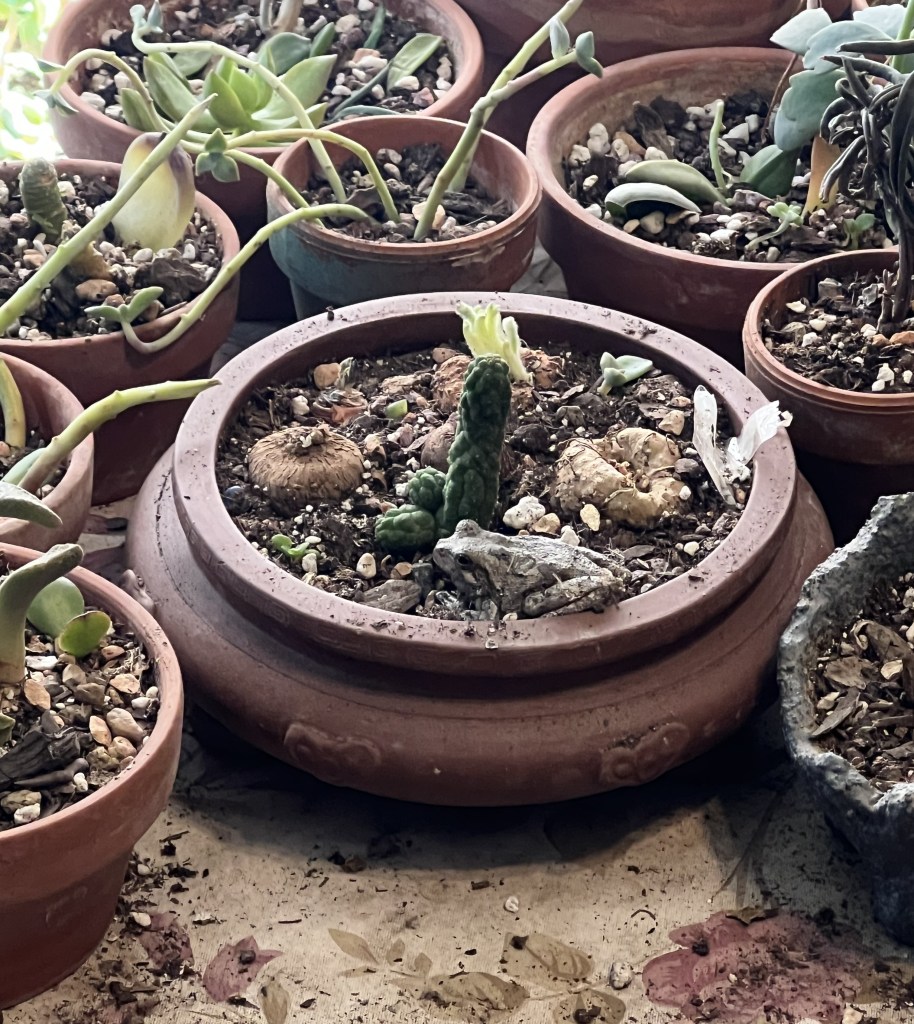
Earlier this week Melissa called me into the kitchen to take care of a “problem” she had found while working on her succulents.  Our pool/pond on the back patio has been teeming with grey tree frogs (Dryophytes versicolor) caught in the height of mating season.  This has resulted in successive scores of tadpoles that grow up to be adults.  I often see one of the small frogs hopping across the straw mulch that covers the potato plants as I am watering.  The frogs also like to hide behind the cushions on the Adirondack chairs on the patio.   It appeared one of the larger adult frogs was not content hiding on the patio or in the American elm (Ulmus americana) trees that line the back property line and had decided to take up residence in the “jungle” of succulents Melissa was working with on the kitchen table.  Melissa does not like hoppy things and called on me to remove it.  I thought it was interesting and snapped a photo before grabbing the frog and releasing it over our back fence (away from the kids).  It was not until I later looked at the photo that I realized the frog had been hiding next to a cactus barrel that appeared to have a bloom on its top.

When I went online, I found Cactus Barrel Milkweed (Larryleachia cactiformis), is a small perennial stem succulent with a globular body displaying a pattern of repeated shapes or polygons (tessellate) with either five pointed (pentangular), flat, or depressed projections (tubercles) on the surface.  The species can vary greatly, particularly in the color of flowers, which open in the summer.  The cactus barrel is native to South Africa and Namibia and grows at an altitude of a half to one mile (800 to 1600 m) above sea level.  It is found amongst a belt of natural shrubland (Fynbos) and desert (Succulent Karoo) vegetation on the quartz hills of the Kamiesberge mountain range.  The species is highly succulent (juicy) and adapted to the very harsh and bright habitats of the desert.  The plant is an excellent example of convergent evolution and is easily mistaken for a cactus.  It is widespread and the Red List of Threatened Species from the International Union for Conservation of Nature says it is common and not threatened.

One of my apps first misidentified my photo of the cactus barrel as a candelabra cactus (Euphorbia lactea).  This made sense as when I looked at the photo there appeared to be a yellow flame coming out of the top of the succulent.  When I mentioned this to Melissa, she pointed out the yellow bloom was on a low-lying elephant’s foot (Dioscorea elephantipes) succulent behind the cactus barrel.  Melissa had placed four different types of elephant’s foot in the bowl, and said the only way to tell the difference (even for most botanists) was by the color and shape of the bloom.  My flaming candelabra was an optical illusion formed by the angle from which I took the photo.  I obviously have a long way to go when it comes to succulent identification.

THOUGHTS: The cactus barrel milkweed succulent is like other members of the Apocynaceae genus in its difficulty for cultivation.  Propagation is a problem as the plant does not offset or seed readily and grows difficultly and slowly from seedling.  Melissa has had this small specimen for two years and it has yet to flower (despite my declaration).  Humans can also find it hard to propagate (spread) and are easy to be misidentified.  When we say other newcomers “all look alike” we lump individuals into categories that may not define their true nature.  We need to wait and take time to see what flowers (fruits) they produce to understand and accept them.  Act for all.  Change is coming and it starts with you.

Domino

June 05, 2025

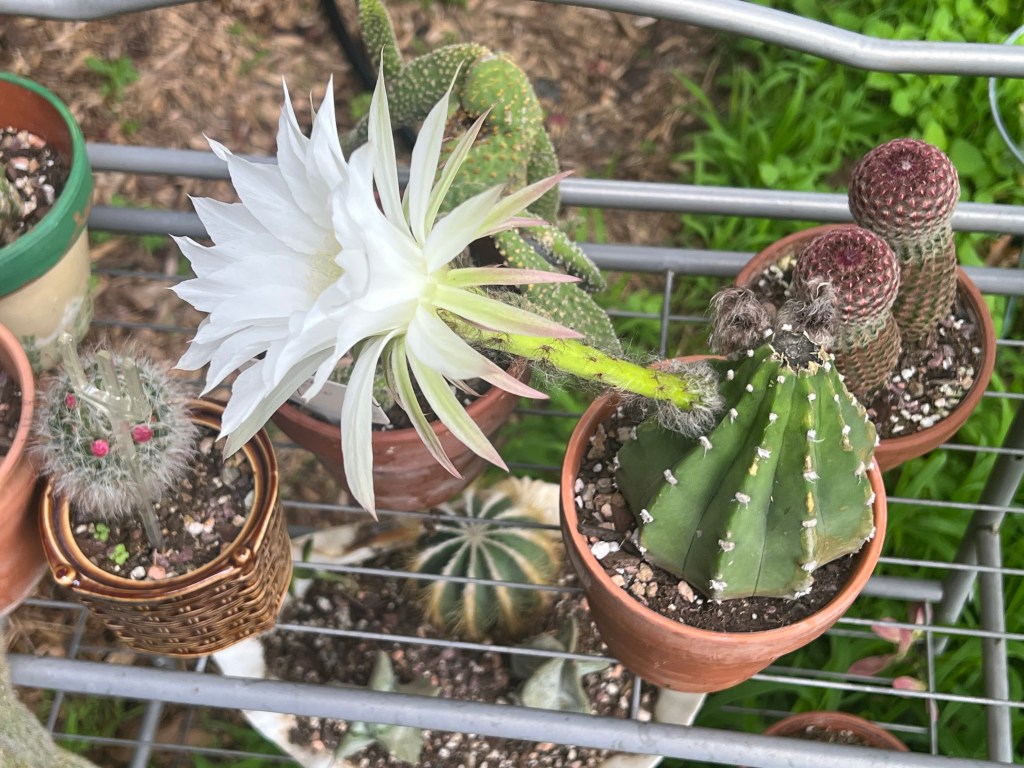
Yesterday morning Melissa asked me to come to the front porch and look at the beautiful flower that had sprung up overnight on one of her cacti.  With warmer weather she has placed many of her summer growing cacti on shelves along the front entryway.  This allows them to catch the early rays of sun and protects them from the rain we have been getting.  I have mentioned how Melissa says one of the worst things you can do for a cactus is to water it.  While they need moisture, if you over water it will cause root rot and kill the plant.  This is one of melissa’s newer cactus and the first time it has bloomed.  The domino cactus flower dwarfed the small globe of cactus it sprouted from.

When I went online, I found the domino cactus (Lobivia ancistrophora) has a globular shape, few spines, with large, white flowers attached to long, green tubes.  The domiono is endemic (native) to Bolivia at altitudes of 1,968.5 to 5,905.5 feet (600 to 1800 m).  It has gained the Royal Horticultural Society’s Award of Garden Merit under the synonym Echinopsis ancistrophora.  The domino has a single spherical shaped grey-green body, slightly depressed at the top.  The plant grows to heights of 2 to 3 inches (5 to 8 cm) with diameters of 2.7 to 4.7 inches (7 to 12 cm).  It has 10 to 12 straight, sharp ribs with small, cream-colored, elongated-elliptical bumps (areoles) that are 1/2 inch (1.5 cm) apart.  The small thorns are grayish brown and often hidden in the areole wool.  The upright central spine is again small (2 mm) with 3 to 7 tiny 1.5 mm) thorns at the base.  The narrow funnel shaped flowers are white to light pink and slightly curved above the ovary, are 6.5 to 7.8 inches (17 to 20 cm) long.  They appear on the side near the top of the shoot and open at night. The pale green flower tube is up to 5 inches (15 cm) long.  Its purple scales are pointed with long white and black hairs.  The flower blooms at night and then closes during the day.

The domino cactus is one of the many cacti that are night bloomers.  The night bloom is primarily to facilitate pollination by nocturnal creatures and to conserve water.  These cacti have evolved to attract pollinators which are active at night, like bats and moths.  Since the habitat where they thrive is cooler and more humid at night, a night bloom reduces water loss through evaporation from the plant’s leaves and flowers (transpiration).  The timing of cactus blooms is also part of a broader adaptation known as a pollination syndrome, where plants co-evolve with their primary pollinators to maximize pollination efficiency.  Melissa’s domino cactus is continuing its genetic predisposition.  While we do not have a lot of bats swooshing through our front porch, there are a lot of moths which could facilitate pollination.

THOUGHTS: The domino cactus is not native to the desert of Southeast Utah, but pollinating bats are plentiful.  My son and I used to camp by rolling our bedrolls out on the slickrock above the wadi beds.  Although the sand may have been softer, the rock got you above any possible flash flood from a rain 20 miles upstream.  One of my memories was listening to the swishing sound as the bats zipped through the air in search of insects.  I never saw a bat in the dark, but the sound of their wings was unmistakable.  Many desert plants have adapted to produce bright showy flowers, and a number of those produce a strong aroma, to attract pollinators.  Different environments have created selective ecosystems that have adapted to their conditions.  When humans interject new species or radically change the environment it can have devastating effects.  Some species will survive by adapting to the new environmental conditions, but many will either lose out to competition from the invasive species or die from lack of suitable habitat.  While change itself is inevitable, forcing change from artificially created human conditions is rarely good for an existing ecosystem.  Eventually however, mother nature wins, and often in surprising ways.  Act for all.  Change is coming and it starts with you.
Wheel Bug

May 14, 2025

Last weekend I decided to weed the succulent bed beside the drive.  Melissa planted the bed with white stonecrops (Sedum album) mats placed around the 4-foot by 3-foot (1.2 m by .9 m) bed.  The bed sits under the Bradford pear (Pyrus calleryana) tree I had trimmed for the limbs and branches that made up the base layer of my hügelkultur raised beds made last year.  The problem was the bed was filled with dead leaves and the invasive Bermuda grass (Cynodon dactylon) from the surrounding yard.  After an hour of concentrated effort, I amassed a large pile of grass, leaves, and weeds on the driveway.  I raked the debris into a pile and scooped it up to place in the trash bin (I do not have a large compost pile, yet).  When I came back to blow the remaining debris onto the yard, I noticed a small insect with a red back scurrying across the drive.  At first, I thought it was a Black widow (Latrodectus hesperus) spider dislodged from the debris.  A closer look showed the creature had 6 legs, meaning it was an insect rather than a spider.  I took a picture and googled the bug, and it was identified as an assassin bug, or more specifically a North American wheel bug.

When I went online, I found the North American wheel bug (Arilus cristatus), or simply wheel bug, is a species of large assassin bug in the family Reduviidae and the only species of wheel bug found in the US.  It was described in 1763 by Carl Linnaeus.  It is one of the largest terrestrial true bugs in North America and reaches up to 1.5 inches (38 mm) in length in its adult stage.  It is sexually dimorphic with males slightly smaller than females.  The characteristic feature of the species is the wheel-shaped armor on the first segment of the thorax which also bears the first set of legs.  Adults are gray to brownish gray in color and black shortly after molting, but the nymphs (which have not developed the wheel-shaped structure) have bright red or orange abdomens.  Wheel bugs prey on caterpillars and beetles by piercing them with their beak to inject salivary fluids that dissolve soft tissue.  Wheel bugs are the most active in daylight but may feed at night in areas illuminated by lights.  A wheel bug uses camouflage and hides in leafy areas (like my overgrown bed) whenever possible.  Despite the prevalence of the wheel bug in many habitats, the information on the species is haphazard and incomplete.  Most of its prey are pests, so the wheel bug is considered beneficial.

The wheel bug I found scurried off and I did not think any more about it until I noticed another one on my rake 20 minutes later.  My app initially identified the insect as an assassin bug, but this refers to over 7,000 species of Reduviidae, a large wide-ranging (cosmopolitan) family of the suborder Heteroptera of the order Hemiptera (true bugs).  Scanning pictures of the 5 different types of assassin bug, I determined it was a wheel bug, which also had 5 species.  I narrowed this to the North American wheel bug because it was the only one native to North America.  North American wheel bugs are highly regarded by organic gardeners because they consume a variety of insects, and their presence indicates a healthy, pesticide-free ecosystem.  “They are the lion or the eagle of your food web,” according to Michael J. Raupp, an entomologist at the University of Maryland.  I was glad I had left it alone.

THOUGHTS: The pictures of wheel bugs all showed a large black or gray adult, unlike the tiny (.25 inch/6 mm) insect I found.  This was a nymph version of the wheel bug that hatches at the beginning of May and matures (after 5 molts) in July.  That explains the second individual on my rake.  I had disturbed a group of hatchlings hidden in the leaves.  When I saw the wheel bug my first reaction was to squash it because it was unknown.  Taking time to know, I found it was beneficial.  Taking time to know (things or people) can often change our understanding.  We just need to be willing to spend the time.  Act for all.  Change is coming and it starts with you.
It’s In

April 14, 2025

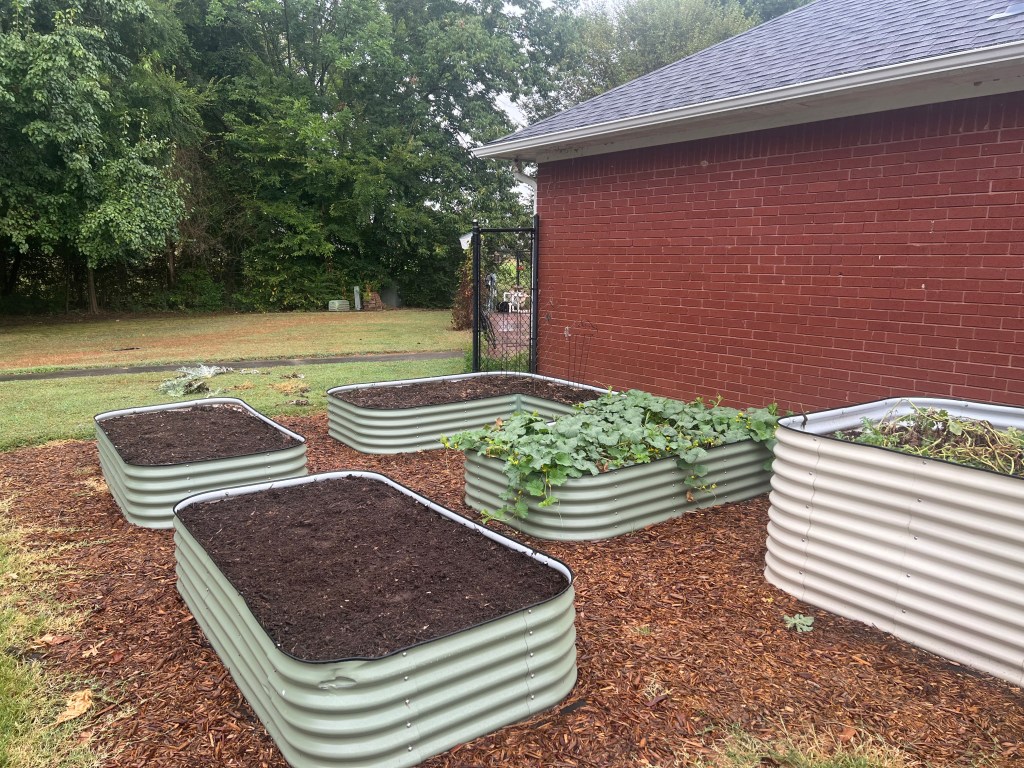
It has been an odd planting season (month) this year, to say the least.  It started four weeks ago when I went to the soil and mulch supply I had used for the Hügelkultur raised beds last year.  I had read that the limbs and wood on the bottom layer would decay over several years and as it does, the soil will sink.  At least I did not get the dreaded sink holes that can result when you do not compact the soil into the limbs well enough.  I ordered two skid scoops of topsoil but could only get one in my 8×5 foot (2.4×1.5 m) trailer.  I realized too late I wanted raised bed soil (a topsoil/compost mix) rather than topsoil.  I put the entire scoop into the four raised beds and when I went back for the second load, I changed my order to raised bed soil.  I used this to top off the raised beds and put a layer over two additional beds.  Melissa is going to scatter a wildflower mix in the bed in front of the house and I was going to put squash and lettuce in the back bed I had used for last year’s three sisters (corn, beans, squash).  I misjudged the amount of work this was going to take.  After two long afternoons the soil was finally laid down.  I breathed a sigh of relief and said, “It’s In”.

When I looked online, I found the Old Farmer’s Almanac says the average last frost date for USDA hardiness zone 7a is between March 22 and April 3.  It is Generally safe to plant most garden vegetables after this period, but you need to check local weather forecasts for potential late frosts.  We got excited and went to the plant nursery during the last weekend of March and got some great deals on six packs of peppers (Capsicum annuum), tomatoes (Solanum lycopersicum), and squash (Cucurbita pepo).  I was prepared to put them in the following Monday, but the weather person said there was a “possibility” of one of two frost days (they were right).  We put the plants on the porch with Melissa’s succulents where they could get sun and be out of the cold.  Melissa was countering the humidity for her succulents, so the fan was running 24/7.  The veggies did not like the fan and dried out quickly.  We brought them into the house and Melissa babied them.  Finally last week I was ready to take the risk and put them all in the ground along with the radish (Raphanus sativus), carrot (Daucus carota), beet (Beta vulgaris) seeds, and a hill each of cantaloupe (Cucumis melo) and watermelon (Citrullus lanatus).  I breathed a sigh of relief and said, “It’s In”.

I had worried as I planted the veggies last Monday as several were looking poorly.  I mulched and watered them for several days before I bought replacements and replanted five.  As the week went on several more withered and died.  I removed the store plants and planted seed for several straight necked squash and cucumbers (Cucumis sativus).  As I watered this morning, I faced the dilemma of what to do with three tomatoes and two bell peppers that were struggling.  It was iffy whether they would survive and if I waited to act it would probably be too late for seed before the summer heat.  I went back to the co-op and found a six pack of Cherokee purple tomatoes and two single peppers.  That meant I had more plants than planters, but the six pack was the same price as one single (I needed two).  I ended up placing two of the tomatoes in the back bed with the squash and found another container for the third.  I breathed a sigh of relief and said, “It’s In”.        

THOUGHTS: Each time I said, “It’s In, I thought the job was over.  While I could have left the empty containers and garden spaces I was unwilling to do so.  I had already invested too much time and energy to quit when I was so close to completing my planting.   I did tell Melissa after finishing today that I was not going to buy any more plants.  If any fail now their spaces will be reserved for my summer/fall planting.  In gardening and life, you need to be willing to overcome initial setbacks.  You also need to know when it is time to change strategies and tactics.  Doing the same thing and expecting different results rarely works.  Act for all.  Change is coming and it starts with you.