Volunteer

June 03, 2026

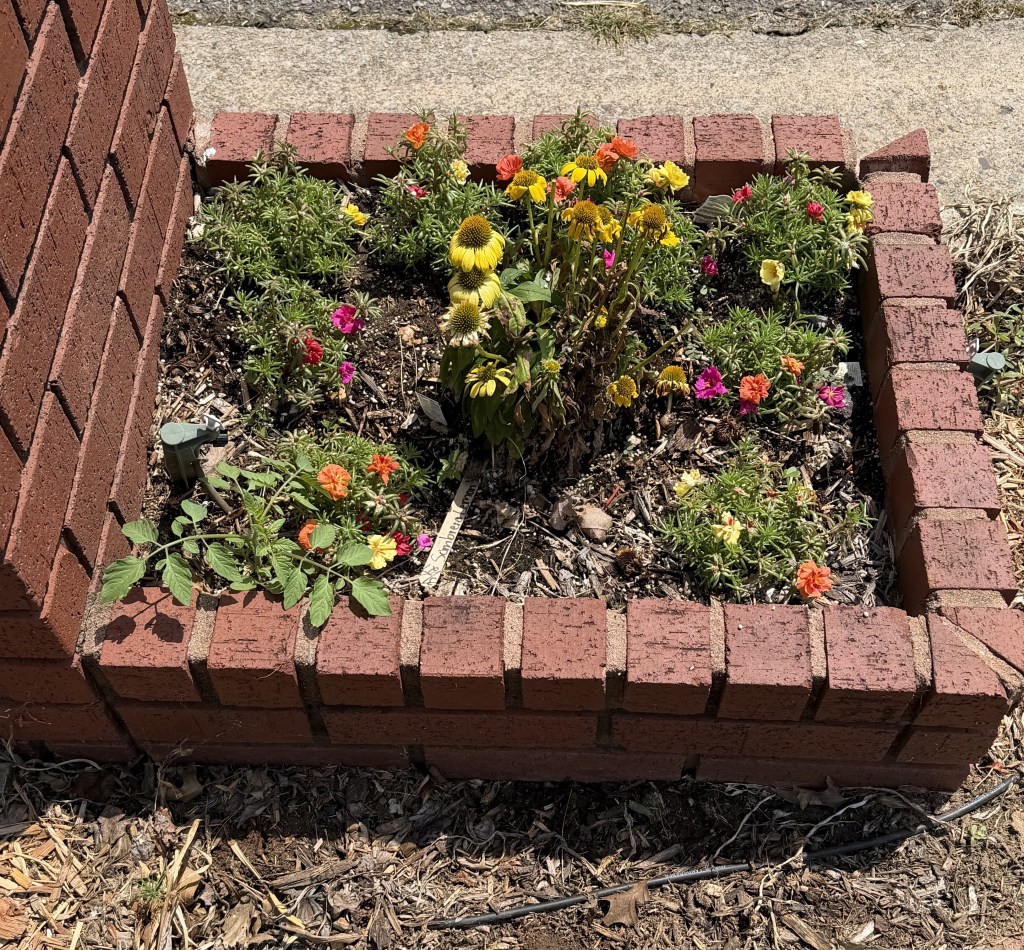
I went to the eye doctor for my annual checkup today and when I returned Melissa wanted to show me something that had sprouted in the mailbox planter.  Melissa has tried to grow several different flowers in this brick planter.  The grape hyacinth (Muscari armeniacum) has done well and explode in early spring, but they dwindle and die leaving the box empty during the summer and fall.  We have tried a variety of different perennials, but none have lasted through the season, yet alone come back the following year.  This year Melissa tried something different by planting a central coneflower (Echinacea) hybrid (sombrero lemon yellow) surrounded by rose moss (Portulaca grandiflora) starts to act as an annual bedding and keep down the weeds.  While the rose moss plants are doing well, the coneflower is again struggling.  What Melissa wanted to show me, however, was an intrusive weed that was beginning to take over the lower left side of the planter.  It was obvious this volunteer was a tomato (Solanum lycopersicum) plant.

When I went online, I found “volunteer” plants in gardening are those that sprout and grow on their own without being intentionally planted.  They emerge from seeds dropped in the previous season, spread by wildlife, or distributed through homemade compost.  While some volunteers are thought of as nuisances, they can be surprisingly vigorous, cost-free additions to your garden.  On the plus side, a volunteer is free and takes no effort from you.  They can be exciting to find and can add fun and unpredictability to a well-planned garden.  On the minus side, the volunteer can grow in unwanted places, and you can never be sure what you are getting.  Seeds from open pollinated plants always produce a vegetable identical to its parent.  Seeds from hybrid plants are not true to form and it is more likely the volunteer will resemble one of the plants that produced the hybrid seed, and some hybrid plants will not produce any fruit.  The intruder can mess with the crop rotation you planned for your garden and can also carry soil borne disease.

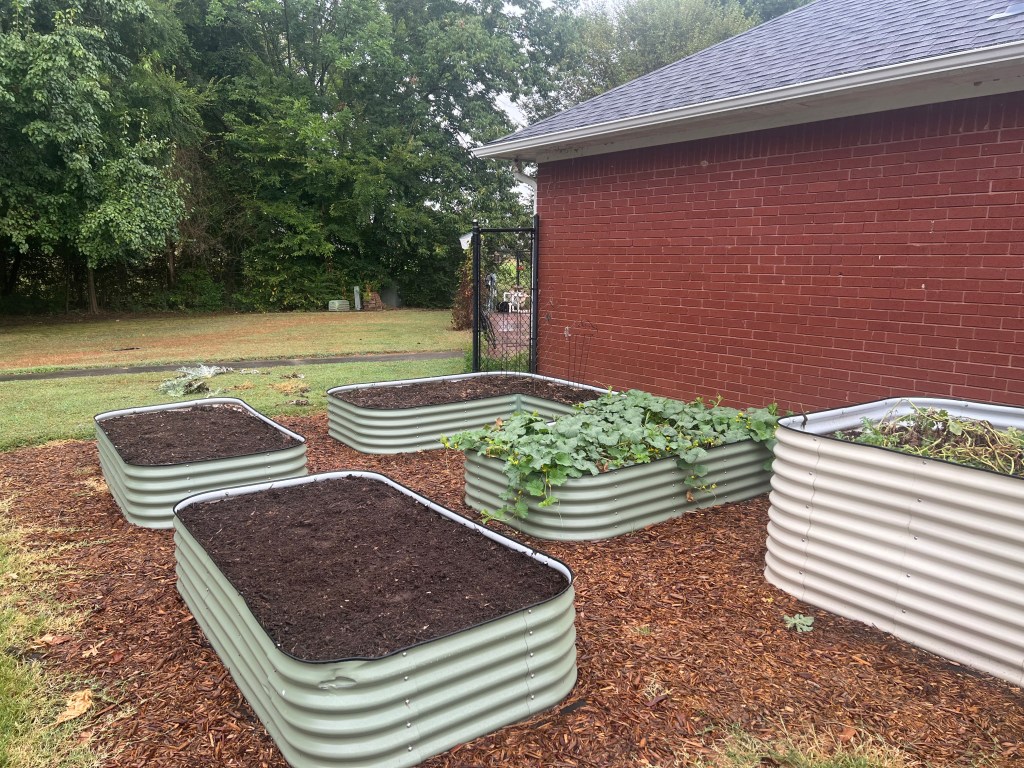
When I saw the volunteer plant I wanted to dig it up and transplant it in the container where some animal had sat on one of my Roma tomatoes.  Melissa wanted to let it grow in place and see what it will produce.  All the seeds grown in my garden are from older cultivars (heirlooms) but most of the tomatoes are nursery purchases (heirloom and/or hybrid).  Since we have never planted tomatoes in the mailbox bed it must have gotten there from an animal or in the compost I used to enhance the soil.  This year I also noticed several volunteer plants in my raised beds.  These are some sort of unknown squash (genus, Cucurbita) that have sprouted in the rows of beets (Beta vulgaris) and a leafy lettuce (Lactuca sativa) that sprouted after I replanted the spinach with a cucumber (Cucumis sativus).  Here again, we must wait and see what is produced.   

THOUGHTS: While this is the first time to have a volunteer tomato in the flower bed, I have had a volunteer in my raised beds both years.  Last year my sown seed in one of the beds was overcome by large ground cherry (Physalis angulata) plants.  These grow wild in Arkansas and some harvest them from the open woods where they thrive.  I let them grow after finding out what they were and even tried harvesting them.  I did not like the taste and since they were blocking light to what I had planted I tore them out (again, one person’s weed is another’s harvest).  When you get a volunteer, you can leave them, relocate them, or remove them.  Humans seem to take a similar approach when other people move into their neighborhood.  Some are welcomed, some are asked to move to another area, and some are physically removed.  Currently in the US, the difference seems linked with ethnicity and culture.  Act for all.  Change will come and it starts with you.
Distribute

May 16, 2026

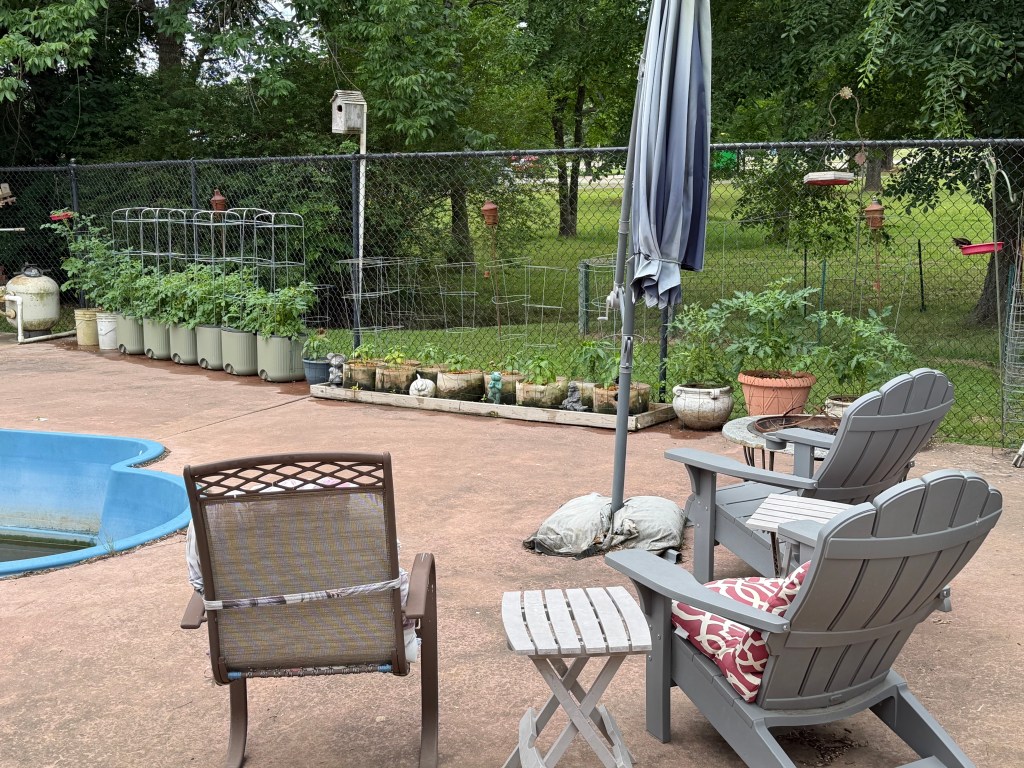
After filling my bird feeders, I was sitting on the patio waiting to see what species would arrive.  What I noticed instead was how my tomato (Solanum lycopersicum) plants had begun to grow this last week.  I mentioned I planted fourteen tomato plants this year, using four different types of containers.  My two sweet 100s (cherry) are in 5-gallon (19-l) buckets.  Three of the Arkansas Travelers (slicing) are in 5-gallon grow bags and the other three are in 10-gallon (38-l) terra cotta pots.  The six Romas (sauce) are in the plastic self-watering containers I purchased last year.  All 14 plants were over 2-1/2 feet (0.76m) and are starting to produce (green) fruit.  While I have known since our family garden as a child that tomatoes need trellises or cages for support, it was not until three years ago that I learned you should also prune your plants.  The small, secondary shoots that grow in the “V” joint where a leaf branch meets the main stem (suckers) should be removed as these produce less desirable fruit.  The bottom branches should also be removed to guard against pests and disease.  Pruning encourages the plant to focus on growing fruit rather than tall, bushy vines.  With the number of plants in the ground, it got me thinking of how to distribute the expected tomatoes.

When I went online, I found one way to distribute excess produce was called Fresh Food Connect.  This group was formed in 2016 with the goal of connecting local gardeners with the hunger relief efforts in their community to grow a more local and resilient food system.  Fresh Food Connect has a free mobile app that connects gardeners with their communities.  By 2024, Fresh Food Connect had grown to over 4,300 gardeners with over 65 hunger relief nonprofits in 28 states and has shared over 300,000 pounds (136077.7 kg) of homegrown produce with 166,000 community people experiencing food insecurity.  During 2025, 5,210 registered gardeners in 18 states connected with 54 local community partners to provide over 91,490 pounds (41,499 kg) of homegrown produce to over 51,870 individuals facing food insecurity.  This distribution amounted to grocery savings of US$457,460, or over 76,240 meals and over 91 tons (82.5 mt) of CO2EQ saved.   

I got excited when I learned of this effort to efficiently distribute home grown food to those with food insecurity.  I immediately downloaded the app and typed in my zip code to find a distribution center near me.  While there was (currently) no distribution near me, the Ozark Church Food Pantry was listed as only 52 miles (83.5 km) away.  I used the app to suggest they partner with the Crawford Sebastian Community Development Council in Fort Smith (15 miles/24 km away).  The app does allow me to register my donations outside of their network so I will probably continue to give locally and register my donation with Fresh Food.  Last year I also shared with my neighbors and several friends, and I will probably do that again this year.  Today I used my last jar of dill pickles making pickle de Gallo, so I am also looking forward to restocking my garden favorites.

THOUGHTS: Cassey Anderson, Colorado State University Horticulture Agent, provided the three Golden Rules when planning to distribute your harvest to a local food bank.   These are: Keep it cool, Keep it wet (when appropriate), Handle with care.  Harvesting is best done in the cooler parts of the day (morning/evening) and many crops can be harvested and placed directly into a container of cool water.  If you continue to harvest, make sure they are placed out of the sun.  Using a sharp knife or scissors is a better choice for harvesting rather than tearing the crop off the main plant.  This reduces stress on the plant, reduces chances of damage, and makes for a cleaner product.  Food insecurity is limited or uncertain access to adequate, nutritious food due to limited funds or resources.  Arkansas has the highest rate of food insecurity in the nation, with 19.4% of households struggling to access consistent, nutritious meals.  Act for all.  Change is coming and it starts with you.

Slime Mold

April 14, 2026

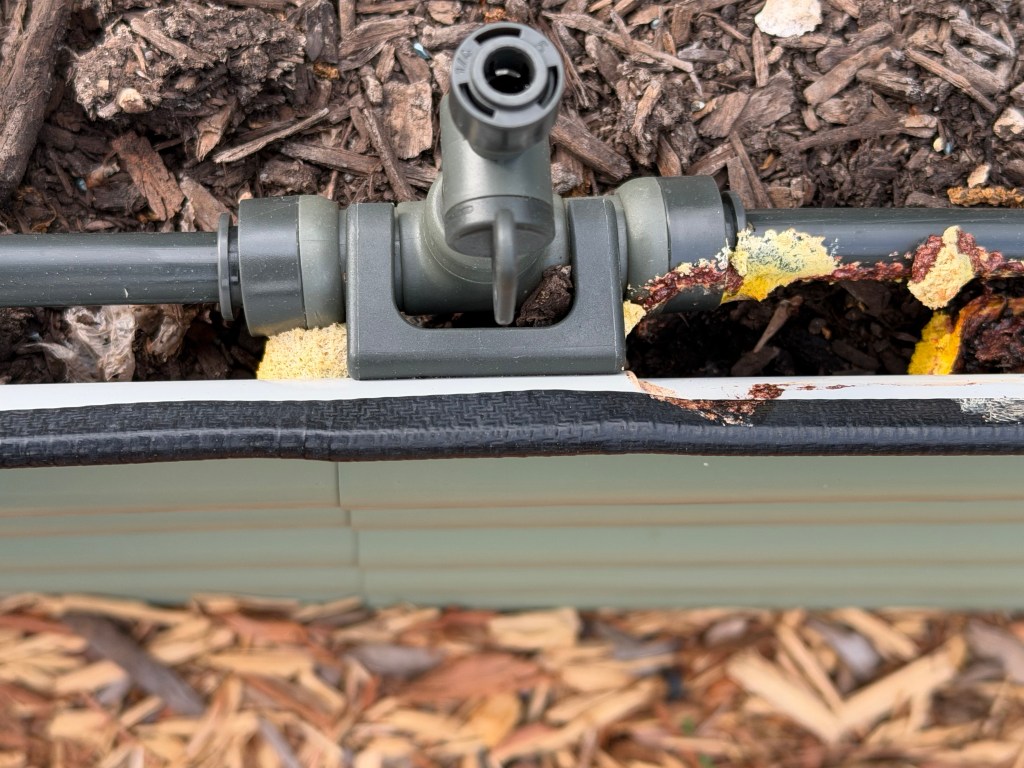
Today was time for a second planting of several vegetables in the raised beds.  The seed package suggested I plant my peas (Pisum sativum) with a second planting two weeks later to ensure I had a continued harvest later during the season.  I thought this was a good idea for my cabbage (Brassica oleracea) and cauliflower (Brassica oleracea var. botrytis) as well.  It was also time to plant the artichoke (Cynara cardunculus var. scolymus) seeds I had placed in the refrigerator (scored) two weeks ago to prepare them for planting.  Scoring is done to “trick” the seeds into thinking they are coming out of Winter and into Spring.  While I was placing the new seeds in the ground I found most of the seeds I had planted had yet to sprout, except for my radishes (Raphanus sativus).  Something should have sprouted in all these seeds.  After planting the new seeds, I watered the raised beds to keep all the unsprouted seed moist.  Then I noticed several spots of bright yellow blobs clinging to the watering hoses in one of the beds.  This appeared to be a form of slime mold.   

When I went online, I found the yellow slime mold (Fuligo septica) in my garden is in the class Myxomycetes.  It is commonly known as scrambled egg slime or flowers of tan because of its peculiar yellowish appearance, or even “dog vomit slime mold”.  This slime mold is relatively common with worldwide distribution and is often found on bark, mulch, lawns, as well as other rotting organic matter in urban areas after heavy rain or excessive watering.  The slime spores are produced on or in aerial spore cases (sporangia) and are spread by wind.  Slime mold is a harmless, amoeba-like organism that is not a fungus, but a type of organism (protist) that feeds on bacteria and decomposes organic matter.  Protists are a diverse group of (mostly) single-celled microorganisms that are not classified as plants, animals, or fungi, with a membrane-bound nucleus and thrive in moist environments.  It is a plasmodial slime mold, meaning it can move (up to several feet in a day) across surfaces.  Slime mold is not harmful to pets, humans, or plants.

I did not know what the slime mold was when I first saw it, although I knew it was not there when I checked the day before.  Being inquisitive, I reached out and touched it (yes, this is how the Blob attached itself to humans before engulfing them).  The blob disintegrated on my touch and left a slimy covering on my finger.  Northern European folk lore attributed slime mold to witches and demons.  In Scandinavia it is identified as the vomit of troll cats.  In Finland, the mold was believed to be used by witches to spoil their neighbors’ milk and is called “paranvoi” (butter of the familiar spirit).  Swedish folklore labels another slime (Tremella mesenterica) as the vomit of a witch’s “carrier” (familiar).  Both are referred to in Dutch as “heksenboter” (witches’ butter), and in Latvian as “ragansviests” (witches’ butter) or “raganu spļāviens” (witches’ spit).  At least “dog vomit” removes the slime from the realm of the supernatural.  Finding the slime safe, I left the other intact.

THOUGHTS: The overcast skies and mild temperatures (70’sF/20’sC) have combined with my watering to grow more than just slime mold.  The mulch in the paths around the raised beds are also growing mushrooms.  This term is applied to two divisions of subkingdom Dikarya (Basidiomycota, Agaricomycetes).  I remove the volunteer mushrooms that appear in my raised beds as they compete for the soil’s nutrients.  I decided to leave the mulch plants as they were not hurting anything.  When I went back outside to determine the species, the sun had come out and they had withered.  Fungi are paradoxically both fragile and incredibly resilient, depending on their visible fruits (mushrooms) or their underlying microscopic network (mycelium).  Humans often have a reverse characteristic, with a rough persona hiding a fragile psyche brought on by our exposure to stress, trauma, and emotional overload.  This should be noted in interactions.  Act for all.  Change is coming and it starts with you.

Starts

April 08, 2026

After I posted my last blog (Hardiness) I was informed (by Melissa) that the Hardiness Zones had indeed changed and we were no longer in 7b.  The update that I had mentioned had reclassified the Arkansas River Valley as zone 8.  According to the updated 2023 US Department of Agriculture map, Greenwood is now in Zone 8a.  This indicates a moderate climate where average annual extreme minimum winter temperatures range from 10F to 15F (-12C to -9.5C) and the last spring frost typically occurs around March 25th to April 3rd.  There is still 10% chance of a later frost lasting until April.  That means my thinking I was testing the envelope by planting two weeks early was instead getting my seeds (and young plants) in the ground right on time.  That worked out well as when I went to the local hardware store for several bags of potting soil I saw they had a big sale on both flowers and a variety of vegetables.  Having already planted my seeds, I decided to go ahead and buy my plant starts as well.

When I went online, I found choosing between seeds and plants (starts) depends on your budget, time, and the plant type.  Seeds are often better for fast-growing crops (better value and more variety) like lettuce (Lactuca sativa) and spinach (Spinacia oleracea), beans, and herbs.  Starter plants are best for high-maintenance, slow-growing, or long-season crops like tomatoes (Solanum lycopersicum) and peppers (Capsicum annuum) to guarantee a harvest.  Seeds have the advantage of inexpensive, offer a variety of heirloom choices, and have healthier root systems.  They require more patience and specialized equipment (lights/trays) to start them indoors to have them ready for the growing season.  Starts can provide immediate gratification, save time, and have a higher success rate for beginners.  They are more expensive and have limited variety.  Small gardens benefit from buying plants to maximize production, while large gardens can save money using seeds.  A mix of both seems best.

Last year I bought starts early and did not get them in the ground for a week.  Even though I tried to keep them watered, they looked sickly by the time they were planted and several died forcing me to buy new starts to replace the ones I previously bought.  This year I ended up buying my starts early in the afternoon but knew I needed to get them in the ground.  I worked into the evening remixing potting soil, planting six jalapeño peppers, five bell peppers, and three varieties of tomatoes.  Melissa likes the Sweet 100’s for salads (2 starts), I like Roma (6 starts) for canning pasta sauce, and then Arkansas Travelers (3 starts) for slicing.  That left 3 Traveler starts (pack of 6) that I did not have pots for.  There was a major rain forecast for the evening, so I pushed on to plant three rows of sweet corn (Zea mays convar) in the bed I had used last year for my Three Sisters (corn, beans, squash).  Everything was done in time for the three inches (7.5 cm) of rain to set everything into the soil.           

THOUGHTS: Having planted my starts I was ready for the growing season, but still had several starts not in the ground.  Monday Melissa and I cleared last year’s potato beds for watermelon (Citrullus lanatus) and honeydew melon (Cucumis melo) starts.  I planted the zucchini and spaghetti squash (Cucurbita pepo) in large pots and found three grow bags for the leftover Travelers.  In total we have three soil beds, four raised beds, and 27 containers with a variety of seeds and starts.  I also believe a mix seems to work best.  That is true with my small garden, but also with our nation and world.  Every dystopian society depicted in sci-fi movies is the result of a controlled lack of diversity.  While that may just be perception, it is also borne out with historic civilization examples.  Diversity is our strength, not a weakness.  Act for all.  Change is coming and it starts with you.

Last Fruits

December 27, 2025

Back in August I blogged about my first attempt to grow a second yield in my raised beds (2nd Crop).  I replanted several of the vegetables that had done well in the spring (and that I liked).  For some reason, few of the vegetables sprouted.  What sprouted were the cabbages, cauliflower (both Brassica oleracea), and about half of the peas (Pisum sativum).  When it looked like we were going to get our first freeze in November I had covered the plants with bed sheets held above the plants with garden hoops.  I had done this in previous years and found it to be effective (and reusable).  The peas were harvested and eaten in salads prior to our trip, but I just let the brassica go to see if they would ever mature.  The cabbage never did head and the cauliflower never balled.  I thought about tearing them out, but the plants still had robust leaves.  Last week I finally gave up and pulled the plants.  I did not know what I would do with them, but cabbage leaves were the garden’s last fruits.

When I went online, I found cabbage leaves are completely edible, including the outer ones.  The texture and flavor will vary from the inner leaves.  Both types of leaves can be used raw in salads, cooked in soups, sautéed, or even used as wraps for other fillings.  The outer leaves are tougher but also more nutritious due to their exposure to the sun and can be blanched or used as wraps or stuffed as rolls.   The inner leaves are more tender and sweeter and are good for raw applications.  All the leaves should be washed to remove dirt and checked for insects and bad spots before preparation.  I ended with a large pile of outer leaves and a smaller pile of inner (sorta) leaves that I decided to make into sauerkraut anyway.  I washed the leaves, cut out the woody stems, and sliced the outer leaves for over an hour before the amount of work made me rethink processing the entire pile.  Instead, I went with what I had and then processed the smaller pile of inner leaves in the same way.  Sauerkraut was still a long way off, so I put the bowls of last fruits in the refrigerator

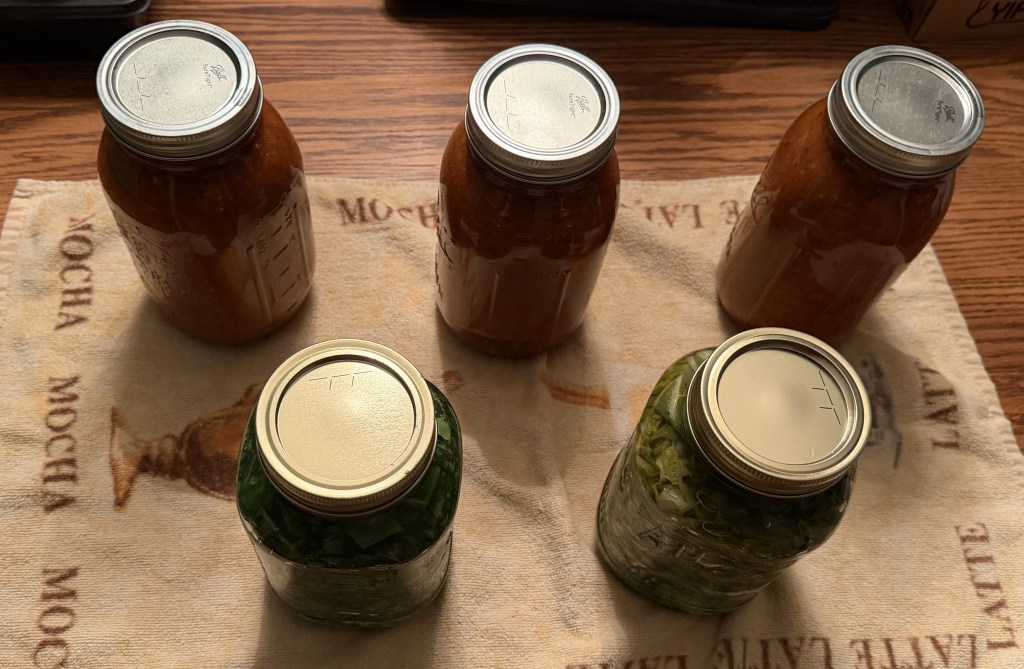
Two days later (today) I decided to finish processing my last fruits.  I added salt to the bowls of leaves and kneaded it for 5 minutes to break the leaves down and then packed them into quart jars, one for the outer leaves and another for the inner.  Working with my last fruits got me motivated to work the tomatoes frozen tomatoes (Solanum lycopersicum) and sweet peppers (Capsicum annuum) from August into more canned pasta sauce.  I added two red onions (Allium cepa) and three cans of diced tomatoes from the pantry along with spices and simmered it for four hours to render it down and meld the flavors.  While the sauce was finishing up, I brought the water bath to boil to sterilize four 1-quart jars and lids.  While I only used three, I have found it is easier to not use a jar than try and prepare another jar while everything else is ready.   I transferred the sauce into the jars, added lemon juice (for acidity), and let them boil for 45 minutes.  My last fruits were finished.

THOUGHTS: When we went to dinner with our gardening friends just before Christmas, I told her I had harvested my last fruits and planned to make sauerkraut.  That was when she asked if I had started planning what to grow in my beds and containers next year.  While I have begun to think about next year, there is hardly a plan.  That is the thing about gardening (or farming), you can never stop planning, or you will quickly get behind.  The same can be said for reaching out to those who need help.  If you do not plan and then act to make a difference, you will be overcome by apathy.  Act for all.  Change is coming and it starts with you.

2nd Crop

August 27, 2025

While I considered replanting my raised beds last year, I never got around to doing it.  When I planted my vegetables in April I noted when (and if) I could replant another round of the same vegetables.  After the initial harvest I also considered which vegetables I wanted more of.  I already had way too many pickles (Cucumis sativus) with 12 pints (5.7 liters) than I could use over the next year, and the same was true for the six pints (2.8 liters) of canned carrots (Daucus carota).  I had eaten through the radishes (Raphanus sativus) and only had 2 pints of beets (Beta vulgaris) left, so these were a good choice.  I also decided to replant cauliflower (Brassica oleracea) and cabbage (Brassica oleracea).  We enjoyed the two quarts (1.9 liters) of sauerkraut last year and I had not planted a new crop this year.  I rounded out the raised beds with a few vegetables that had not grown well along the patio; lettuce (Lactuca sativa), spinach (Spinacia oleracea), and peas (Pisum sativum).  Now that my 2nd crop is planted, I just need to wait and see what will produce.

When I went online, I found a second crop is either the second growth of a crop that regrows after an initial harvest, or, more commonly, a different crop planted on the same land within the same year after a previous crop has been harvested.  This is known as double cropping and allows farmers to maximize land use and harvest two yields from the same acreage in a single growing season.  This requires sufficient time for the crop to mature and resources like water to support the second planting.  There are two main types of second crop.  The first is a regrowth after the initial harvest where the stump/roots of a crop resprouts after it has been cut for its first harvest (example, broomcorn).  The second is to plant a follow-on crop of a new and different crop on the same piece of land within the same year after the first has been harvested.  This utilizes land that might otherwise lay idle or unproductive.  Double cropping requires adequate time for the second crop to mature and sufficient moisture from rainfall or irrigation to support both plantings.  This process can boost the overall farm revenue and potentially improve ecological services.

There are several benefits to succession planting or planting a 2nd crop in your vegetable garden.  First is that it allows you to enjoy the vegetables you love for a longer period.  This also allows for more yield in the same amount of space.  This is especially so for smaller gardens with limited space.  If you plant a 2nd crop from a different plant family, it can improve the soil structure and replenish nutrients depleted by the 1st crop.  Finally, rotating different types of plants helps disrupt the life cycles of pests that had fed on the 1st crop and reduce the spread of diseases.  Critical considerations for a 2nd crop are the first frost date in your growing area (mine is 7b).  That means planting fast maturing varieties and vegetables that thrive in cool weather.  You will also need to amend your soil with new compost or fertilizer to ensure a good result.  I did not fertilize when I planted yesterday.  This just gives me something to do today (ha ha).

THOUGHTS: Planting a 2nd crop is the next step toward my goal of sustainability.  Admittedly, I should have allowed several plants to go to seed and then replanted those.  Instead, I used what was left in the heirloom seed packages I had left.  Maybe next year.  As the weather cools, I am looking forward to finally getting some production from the tomatoes (Solanum lycopersicum) and bell (Capsicum annuum) and jalapeno (Capsicum annuum) peppers I planted last April along with the new produce from my 2nd crop.  While the time and expense of growing my garden may not cover the costs, the crispness of the produce makes it worthwhile.  Sustainability is a process that is its own reward.  Act for all.  Change is coming and it starts with you.

It’s In

April 14, 2025

It has been an odd planting season (month) this year, to say the least.  It started four weeks ago when I went to the soil and mulch supply I had used for the Hügelkultur raised beds last year.  I had read that the limbs and wood on the bottom layer would decay over several years and as it does, the soil will sink.  At least I did not get the dreaded sink holes that can result when you do not compact the soil into the limbs well enough.  I ordered two skid scoops of topsoil but could only get one in my 8×5 foot (2.4×1.5 m) trailer.  I realized too late I wanted raised bed soil (a topsoil/compost mix) rather than topsoil.  I put the entire scoop into the four raised beds and when I went back for the second load, I changed my order to raised bed soil.  I used this to top off the raised beds and put a layer over two additional beds.  Melissa is going to scatter a wildflower mix in the bed in front of the house and I was going to put squash and lettuce in the back bed I had used for last year’s three sisters (corn, beans, squash).  I misjudged the amount of work this was going to take.  After two long afternoons the soil was finally laid down.  I breathed a sigh of relief and said, “It’s In”.

When I looked online, I found the Old Farmer’s Almanac says the average last frost date for USDA hardiness zone 7a is between March 22 and April 3.  It is Generally safe to plant most garden vegetables after this period, but you need to check local weather forecasts for potential late frosts.  We got excited and went to the plant nursery during the last weekend of March and got some great deals on six packs of peppers (Capsicum annuum), tomatoes (Solanum lycopersicum), and squash (Cucurbita pepo).  I was prepared to put them in the following Monday, but the weather person said there was a “possibility” of one of two frost days (they were right).  We put the plants on the porch with Melissa’s succulents where they could get sun and be out of the cold.  Melissa was countering the humidity for her succulents, so the fan was running 24/7.  The veggies did not like the fan and dried out quickly.  We brought them into the house and Melissa babied them.  Finally last week I was ready to take the risk and put them all in the ground along with the radish (Raphanus sativus), carrot (Daucus carota), beet (Beta vulgaris) seeds, and a hill each of cantaloupe (Cucumis melo) and watermelon (Citrullus lanatus).  I breathed a sigh of relief and said, “It’s In”.

I had worried as I planted the veggies last Monday as several were looking poorly.  I mulched and watered them for several days before I bought replacements and replanted five.  As the week went on several more withered and died.  I removed the store plants and planted seed for several straight necked squash and cucumbers (Cucumis sativus).  As I watered this morning, I faced the dilemma of what to do with three tomatoes and two bell peppers that were struggling.  It was iffy whether they would survive and if I waited to act it would probably be too late for seed before the summer heat.  I went back to the co-op and found a six pack of Cherokee purple tomatoes and two single peppers.  That meant I had more plants than planters, but the six pack was the same price as one single (I needed two).  I ended up placing two of the tomatoes in the back bed with the squash and found another container for the third.  I breathed a sigh of relief and said, “It’s In”.        

THOUGHTS: Each time I said, “It’s In, I thought the job was over.  While I could have left the empty containers and garden spaces I was unwilling to do so.  I had already invested too much time and energy to quit when I was so close to completing my planting.   I did tell Melissa after finishing today that I was not going to buy any more plants.  If any fail now their spaces will be reserved for my summer/fall planting.  In gardening and life, you need to be willing to overcome initial setbacks.  You also need to know when it is time to change strategies and tactics.  Doing the same thing and expecting different results rarely works.  Act for all.  Change is coming and it starts with you.

Carrots

October 10, 2024

Only a few plants remain in my raised beds as we approach the end of the growing season.  I have two bell peppers (Capsicum annuum) that had been overshadowed by the cutleaf ground cherry (Physalis angulata) that had self-propagate and taken over three of my raised beds.  After I ripped the plants out of the bed these two scrawny plants were hidden underneath.  I had no idea what they were but decided to let them grow.  They are now producing fruit, while the peppers in my containers have stopped producing and the wilted stems have been removed.  The 2 red burgundy okra (Abelmoschus esculentus) are still going strong at over six feet (2 m) with new blossoms daily.  If only I liked okra.  I am thinking I might try and pickle some smaller fruits as it is the only way I can eat them.  The watermelons are still trying to produce, with five new melons on the vine.  Then there are the five cabbage plants (Brassica oleracea) struggling to survive.  I did not pay close enough attention and most of my leafy vegetables were eaten by insects.  I never saw them, but the holes in the leaves gave away their presence.  The only other crop is the carrots I had planted at the end of April.

When I looked online, I found the carrot (Daucus carota subsp. sativus) is a root vegetable, typically orange in color and is a biennial plant in the umbellifer family (Apiaceae).  Heirloom variations can be purple, black, red, white, and yellow.  All of the subspecies are domesticated forms of the wild carrot which is native to Europe and Southwestern Asia.  The plant probably originated in Iran and was originally cultivated for its leaves and seeds, but the most common part of the plant now eaten is the taproot.  The domestic carrot has been selectively bred to have a larger, more palatable, and less woody-textured taproot.  Carrots are commonly consumed raw or cooked in various dishes and are a rich source of the provitamin A compound (beta-carotene), which converts to vitamin A as it is digested.  Fast-growing cultivars mature within about 90 days of sowing the seed, while slower-maturing cultivars need 120 days.  World production of carrots (combined with turnips) for 2022 was 42 million tons, with China producing 44% of the total.

I do not know if I planted a fast growing or slow growing variety of carrots, but my carrots have been in the ground for over 160 days.  When I planted them, I made a single slit in the ground and shook the tiny seeds into the ground.  I had planted them too close together and when they sprouted none of the seedlings had enough room to flourish.  I tried thinning them several times but never seemed to get them far enough away from each other to give them room to grow.  Every time I checked or thinned them, they were still needle thin.  Several of the tops had become larger recently and today I decided it was time to quit messing with them and harvested the batch.  I did have one descent sized carrot, and a lot of smaller (but passable) ones.  I tried one and gave another small one to Melissa.  While they may not have grown large, they did taste good.           

THOUGHTS: The carrots suffered the same fate as all my root vegetables.  I did not space them enough and even thinning them did not give them enough room to grow.  I watched a YouTube video suggesting I plant them in squares to make sure there was proper spacing to grow.  More knowledge to save for the future.  I did not do a second planting of any of my vegetables (in August).  I had grown weary and was not paying enough attention to the plants I already had in the ground.  I guess sustainability is still a long way off.  Overcrowding has the same effect on humans as it does carrots.  Human overpopulation suggests we may become too large to be sustained by the environment or the Earth’s resources.  Estimates of the world’s carrying capacity predict a maximum of 7.7 billion.  We now stand at over 8 billion and rising.  Unless this is addressed, like my carrots the world will self-correct itself.  Act for all.  Change is coming and it starts with you.