
June 03, 2026
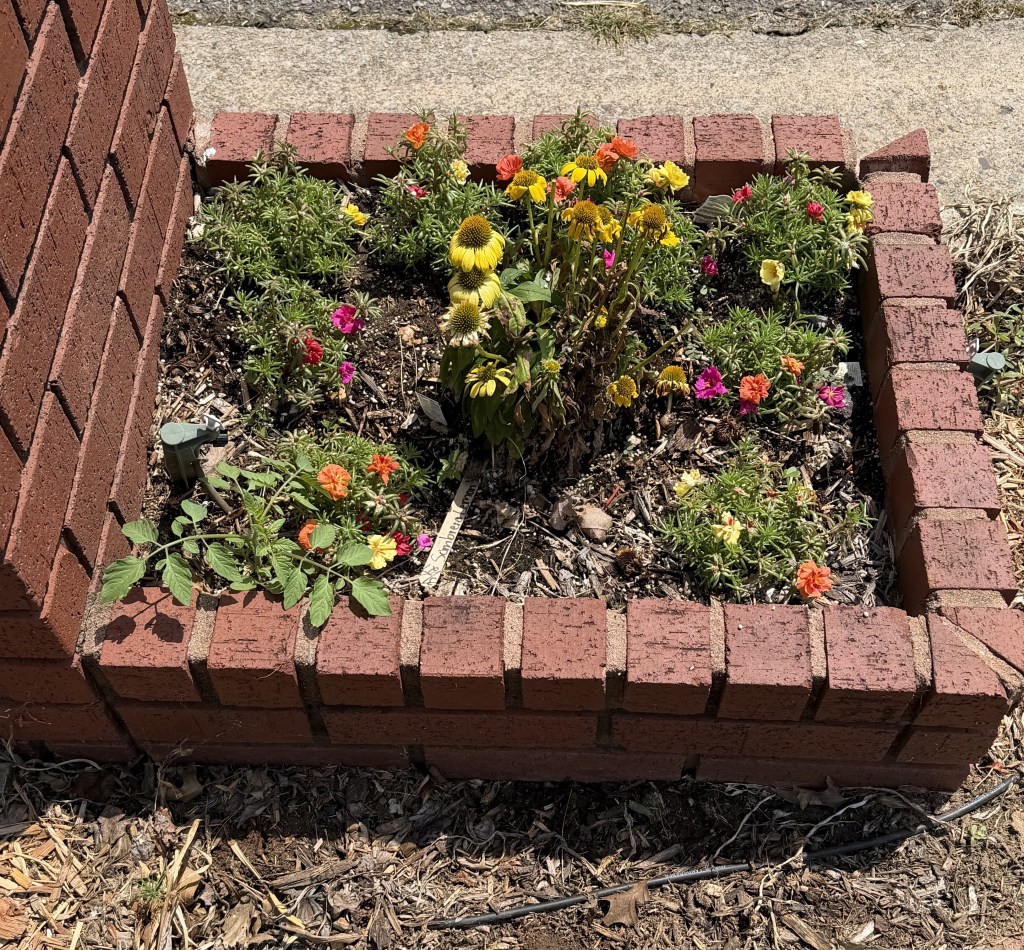
I went to the eye doctor for my annual checkup today and when I returned Melissa wanted to show me something that had sprouted in the mailbox planter. Melissa has tried to grow several different flowers in this brick planter. The grape hyacinth (Muscari armeniacum) has done well and explode in early spring, but they dwindle and die leaving the box empty during the summer and fall. We have tried a variety of different perennials, but none have lasted through the season, yet alone come back the following year. This year Melissa tried something different by planting a central coneflower (Echinacea) hybrid (sombrero lemon yellow) surrounded by rose moss (Portulaca grandiflora) starts to act as an annual bedding and keep down the weeds. While the rose moss plants are doing well, the coneflower is again struggling. What Melissa wanted to show me, however, was an intrusive weed that was beginning to take over the lower left side of the planter. It was obvious this volunteer was a tomato (Solanum lycopersicum) plant.
When I went online, I found “volunteer” plants in gardening are those that sprout and grow on their own without being intentionally planted. They emerge from seeds dropped in the previous season, spread by wildlife, or distributed through homemade compost. While some volunteers are thought of as nuisances, they can be surprisingly vigorous, cost-free additions to your garden. On the plus side, a volunteer is free and takes no effort from you. They can be exciting to find and can add fun and unpredictability to a well-planned garden. On the minus side, the volunteer can grow in unwanted places, and you can never be sure what you are getting. Seeds from open pollinated plants always produce a vegetable identical to its parent. Seeds from hybrid plants are not true to form and it is more likely the volunteer will resemble one of the plants that produced the hybrid seed, and some hybrid plants will not produce any fruit. The intruder can mess with the crop rotation you planned for your garden and can also carry soil borne disease.
When I saw the volunteer plant I wanted to dig it up and transplant it in the container where some animal had sat on one of my Roma tomatoes. Melissa wanted to let it grow in place and see what it will produce. All the seeds grown in my garden are from older cultivars (heirlooms) but most of the tomatoes are nursery purchases (heirloom and/or hybrid). Since we have never planted tomatoes in the mailbox bed it must have gotten there from an animal or in the compost I used to enhance the soil. This year I also noticed several volunteer plants in my raised beds. These are some sort of unknown squash (genus, Cucurbita) that have sprouted in the rows of beets (Beta vulgaris) and a leafy lettuce (Lactuca sativa) that sprouted after I replanted the spinach with a cucumber (Cucumis sativus). Here again, we must wait and see what is produced.
THOUGHTS: While this is the first time to have a volunteer tomato in the flower bed, I have had a volunteer in my raised beds both years. Last year my sown seed in one of the beds was overcome by large ground cherry (Physalis angulata) plants. These grow wild in Arkansas and some harvest them from the open woods where they thrive. I let them grow after finding out what they were and even tried harvesting them. I did not like the taste and since they were blocking light to what I had planted I tore them out (again, one person’s weed is another’s harvest). When you get a volunteer, you can leave them, relocate them, or remove them. Humans seem to take a similar approach when other people move into their neighborhood. Some are welcomed, some are asked to move to another area, and some are physically removed. Currently in the US, the difference seems linked with ethnicity and culture. Act for all. Change will come and it starts with you.
 A travelers odyssey