Lady Beetle

November 20, 2025

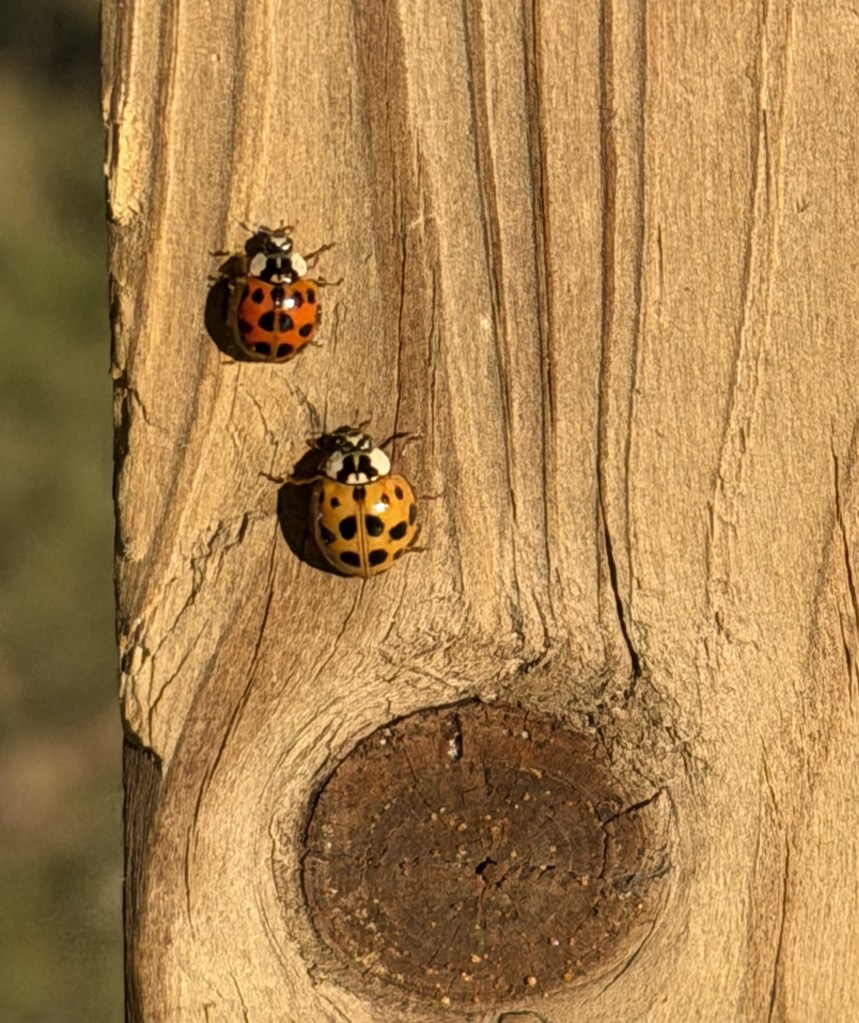
Last week Melissa and I were in a wooded area along the Arkansas River when we were inundated by flying insects.  Many species overwinter as adults sheltering in culverts, under bridges, or cavities in trees.  In the spring they will wake up and get along with starting the next generation.  Other than the short cold snap last week, we have been having nice weather this fall so these fliers may not have even begun the process.  Hibernating adults are also known to come out on unseasonably warm days.  The temperature was uncommonly warm (high 70’sF/25+C) so it would not have surprised me to find some insects buzzing around, these were literally everywhere.  I do not believe I have ever seen so many Asian lady beetle in one place.

When I went online, I found a lady beetle or ladybird (Harmonia axyridis) is a species commonly known as the harlequin, Asian, or multicolored Asian lady beetle.  This is one of the most variable lady beetle species in the world with a wide range of color forms.  The species is native to eastern Asia and has been artificially introduced to North America and Europe to control aphids (family Aphididae) and scale insects (Superfamily, Coccoidea).  It is now common and spreading in those regions and has also been established in Africa and across South America.  Individuals are beetles in shape and structure, being domed and having a “smooth” transition between their wing coverings (elytra), thorax (pronotum), and head.  It ranges from 0.22 to 0.34 inches (5.5 to 8.5 mm) in size.  The common color form is orange or red with 0 to 22 black spots of variable size.  The bright color makes the species conspicuous in North America and may be known locally as the Halloween beetle as they often invade homes during October to overwinter.

The Asian lady beetle is considered one of the world’s most invasive insects, due in part to their tendency to overwinter indoors.  They have an unpleasant odor and stain left by their bodily fluids when frightened or crushed, along with a tendency to bite humans.  In Europe they are increasing to the detriment of indigenous species as its voracious appetite enables it to outcompete (and consume) other ladybugs.  The Asian is highly resistant to diseases and carries a microsporidian parasite (it is immune) that can kill other lady beetle species.  Native ladybug species often experience dramatic declines from the invaders.  They were declared the fastest-invading species in the UK in 2015, spreading throughout the country after the first confirmed sighting in 2004.  The Asian lady beetle has been reported to be a minor agricultural pest that has been inadvertently harvested with crops in Iowa, Ohio, New York State, and Ontario.  This causes a detectable and distinctly unpleasant taste known as “lady beetle taint”.  The contamination of grapes by the beetle has also been found to alter the taste of wine.

THOUGHTS: Various methods of control have been tried where the Asian lady beetle has been introduced, causing a threat to native species, biodiversity, and to the grape industry.  These include insecticides, trapping, removal of beetles, and mechanically preventing entry to buildings.  The best methods for dealing with the Asian lady beetle in private homes involve sealing openings they enter and sweeping or vacuuming if they are inside.  Placing a nylon stocking inside the vacuum cleaner’s hose and securing it with a rubber band keeps the beetles from collecting (and being crushed) inside the machine.  Despite the dozens of beetles that landed on Melissa and me we were not bitten.  I have been bitten before and it was a sharp (but not lasting) pain.  Once again importing a species to get rid of another caused more problems than it solved.  Act for all.  Change is coming and it starts with you.
Screwworm

November 10, 2025

The Sunday before Halloween, the Homes section of my local newspaper ran a Reutters article detailing a new sterile fly plant added in Mexico.  In Metapa, Mexico, engineers, veterinarians, and entomologists are racing to repurpose a plant that will play a pivotal role in trying to eradicate the flesh-eating fly threatening the country’s cattle industry and raising tensions with the US.  The facility used to help control Mediterranean fruit flies, but workers are dismantling old infrastructure and rebuilding specialized laboratories designed to mimic the conditions of an animal wound.  The plant aims to be ready by July 2026 and would double the number of sterile flies Mexico can release into the wild.  The US has kept its border mostly closed to Mexican cattle imports since May 2025 and has invested US$21 million towards the US$51 million facility in Chiapas state in an effort to keep the screwworm fly out of America.

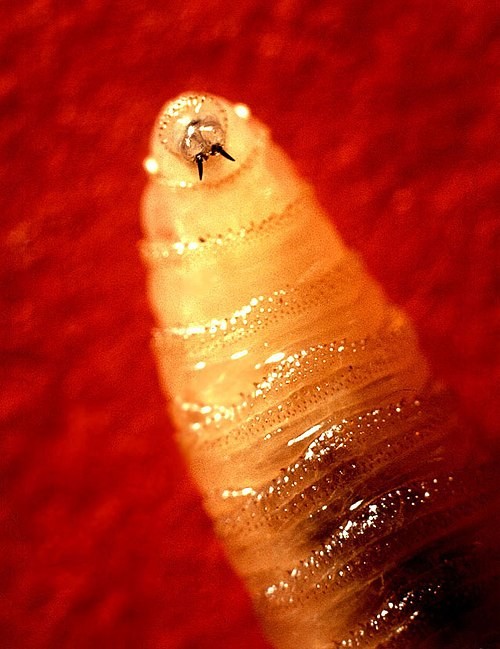
When I went online, I found the New World screwworm fly (Cochliomyia hominivorax), or simply screwworm, is a species of parasitic blowfly which is present in the New-World tropics.  The screwworm larvae (maggots) eat the living tissue of warm-blooded animals.  Of the four species of Cochliomyia, only the species hominivorax is parasitic, but a single parasitic species of Old-World screwworm fly is placed in a different genus (Chrysomya bezziana).  The maggots of many fly species eat dead flesh and may occasionally infest an old and putrid wound.  Infestation of a live vertebrate animal by the screwworm maggot (myiasis) is unusual because they attack healthy tissue, increasing the chances of infection, which then attracts more flies.  Screwworm females lay 250 to 500 eggs in the exposed flesh which hatch and burrow into the surrounding tissue as they feed.  If the wound is disturbed during this time, the larvae burrow or “screw” deeper into the flesh, giving the larva its common name.  The maggots can cause severe tissue damage or even death to the host.  About three to seven days after hatching, the larvae fall to the ground to pupate, reaching the adult stage about seven days later.  The female will mate four to five days after hatching and can lay up to 3,000 eggs and fly up to 120 miles (200 km) during her life.  Males mate up to ten times, but females mate only once and retain the male’s sperm for life, leading to the sterile eradication technique.

The screwworm was the first species to be tested with the sterile insect technique and resulted in control and systematic eradication of the species from the US, Central America, and parts of the Caribbean beginning in the 1950’s.  The US and Mexico bred and released more than 94 billion sterile flies from 1962 to 1975.  By the early 2000’s, it was considered eradicated from North America, but was detected in Mexico in 2024 and 2025, prompting renewed efforts to prevent its re-emergence.  The fly is still widespread in tropical and subtropical parts of the Caribbean and South America and animals imported from these areas must be inspected or treated to prevent the pest’s reintroduction.  Eradication efforts continued and in 1998 the first sterile flies were released in Panama with the goal of creating a barrier zone at the Darién Gap against a screwworm invasion.  This is achieved through weekly sterile screwworm releases of up to 50 million insects bred in factories and sterilized by ionizing radiation.  The bred insects must not suffer any impairment to compete with wild, fertile insects.  In September 2025, a case of New World screwworm was found in Sabinas Hidalgo, Mexico, less than 70 miles (110 km) from the US-Mexico border.

THOUGHTS: When sterile screwworm males’ mate with wild females no offspring are produced, and the population collapses over time.  Coordinator Jose Luis Quintero said, “The screwworm was eradicated once before in Mexico — it took 19 years.  We hope to do it in far less time.”  Let’s hope that is the case.  Act for all.  Change is coming and it starts with you.
Woolly Bear

October 22, 2025

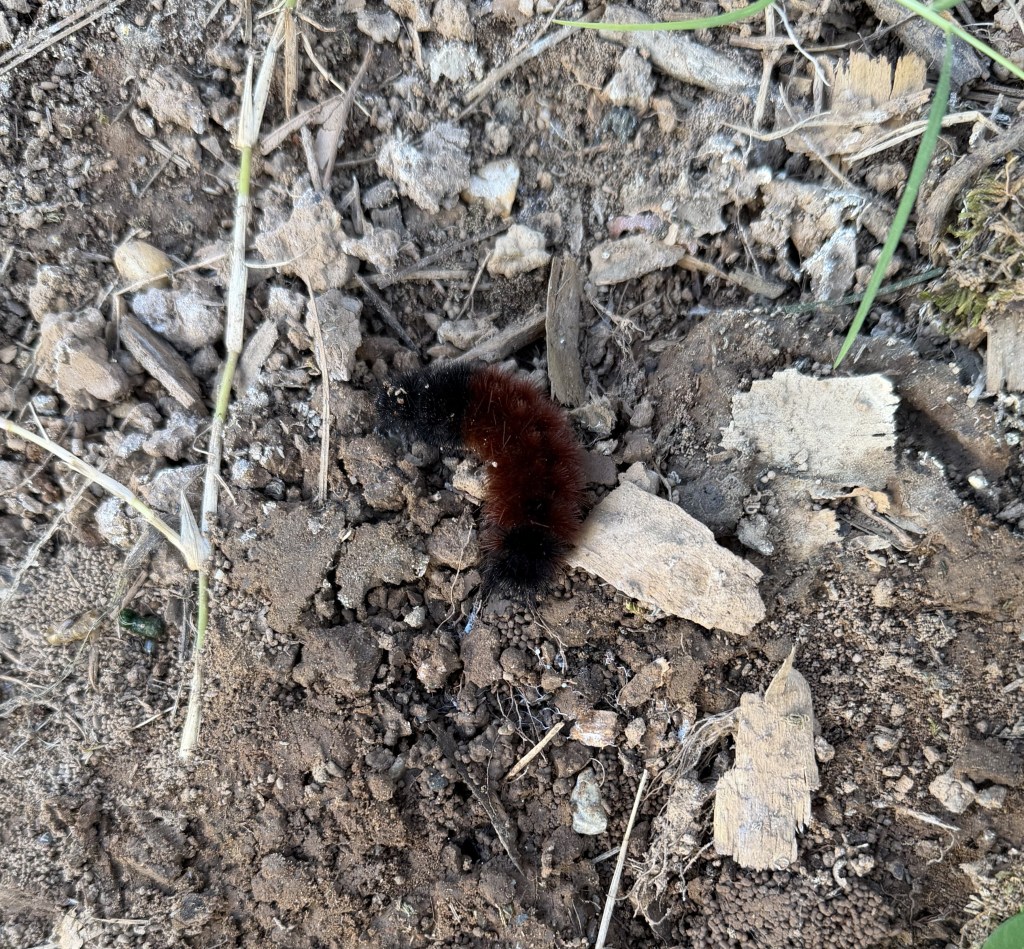
Even though the cooler temps have slowed the grass in my yards the weeds in the flower beds seem to be doing fine.  Yesterday I got out and performed (I hope) my last weeding before fall.  I usually just throw the weeds into the lawn and run my mower over them to mulch them into the sod. I had just mowed last week, and it really did not need to be mown again.   I just raked the weeds up and threw them away.  It seems I can never do just one part of yard work and doing one thing always seems to bring on other tasks.  Mowing, weed eating, weeding the beds, and blowing off the sidewalks have become interchangeable.  While I may put one or the other off for a day or two, once I start, I know I am committed to the long haul.  I also have the wood pile stacked at the edge of the drive from the tree I had cut down.  I had it stacked for firewood, but I know I still need to split and season the wood for a minimum of six months or preferably a year.  While cleaning up around the pile I moved several pieces of cardboard and we greated by two guests who had taken up residence, a 12-inch (30.5 cm) Texas brown snake (Storeria dekayi texana) and a banded woolly bear caterpillar.

When I went online, I found the Isabella tiger moth (Pyrrharctia Isabella), whose larval form is called the banded woolly bear, woolly bear, or woolly worm, occurs throughout the US and Canada.  It was first formally named by James Edward Smith in 1797.  The thirteen-segment larvae are usually covered with brown hair (setae) in their mid-regions and black hair in their front (anterior) and back (posterior) areas.  In direct sunlight, the brown hair looks bright reddish brown.  Adult moths are generally dull yellowish through orangish and have robust and scaly midsection (thoraces), small heads, bright reddish-orange forelegs, and sparse black spotting on the wings.  Each abdominal segment bears three black dots.  The Isabella larva emerges from the egg in the fall and overwinters in its caterpillar form by allowing most of its mass to freeze solid.  First its heart stops beating, then its gut freezes, then its blood, followed by the rest of the body.  The larva survives being frozen by producing a cryoprotectant in its tissues that keeps the inside of the cells from freezing.  In the spring, it thaws, and the cycle begins again.

Folklore in both Canada and the US holds that the relative amounts of brown and black hair on a woolly bear larva indicate the severity of the coming winter.  If the brown band is wide, winter weather will be mild.  If the brown band is narrow, the winter weather will be severe.  A variation of this story says the color of the stripes predicts winter weather, with darker stripes indicating a harsher winter.  Another version of this belief is that the direction the Isabella crawls indicates the winter weather, with the caterpillar crawling south to escape colder weather.  There is no scientific evidence for weather prediction and hatchlings from the same clutch of eggs can display considerable variation in their color banding.  The larva’s brown band tends to widen with age as it molts.  Since the 1970’s, several locations in the US hold woolly bear festivals in the fall.

THOUGHTS: The wooly bear Caterpillar is not the only creature that can withstand being frozen.  Amphibians like the wood frog (Lithobates sylvaticus) and American toad (Anaxyrus americanus), reptiles like the alligator (Alligator mississippiensis) and green iguana (Iguana iguana), certain types of carp (family Cyprinidae), and microscopic animals like the tardigrades (Phylum, Tardigrada) and rotifers (Phylum, Rotifera) all survive freezing.  While the technology for freezing a human and bringing them back to life does not yet exist, cryonics involve preserving legally deceased bodies at extremely low temperatures with the hope of future revival.  If an alligator can do it . . . Act for all.  Change is coming and it starts with you.

Wavy-lined

October 14, 20254

Melissa tends to keep the back door to the porch open to help provide a breeze and keep down the humidity for the succulents.  If the air conditioner is not running, she will often keep the house door open as well.  This provides a breeze for us and allows the kids to roam freely in and out of the house without having to get up every time they hear a noise or want to go outside.  While this is convenient, it allows house flies (Musca domestica), moths (order, Lepidoptera), and other flying insects (and occasional birds) to fly enter both the porch and the main house.  I have tried to combat this by placing a bug-zapper next to the doorway.  The blue light is not visible during the day but does attract moths at night.  When it is time for a final constitutional, Loki will wait at the door for Melissa or I to go first to “protect” him from the sounds of the moths hitting the zapper.  When I got up yesterday, I noticed one of the moths had avoided the zapper and was attached to the wall above the kitchen sink.  When I looked closer the moth’s coloration was “wavy-lined”.

When I went online, I found the wavy-lined emerald moth (Synchlora aerate), or camouflaged looper, is a species of moth of the family Geometridae.  The species is found in the US and Canada and was described by Johan Christian Fabricius in 1798.  There are dozens of species in the subfamily of emeralds in North America.  Most look incredibly similar, being green (sometimes tan) and typically resting with their wide wings spread out to the sides.  The key identifying features for the species are the mildly wavy white lines that run across the wings, a pale green fringe on the wings, and a long, thin white stripe running the whole length of the abdomen.  The adult wingspan is about 0.67 inches (17 mm).  The caterpillar of this species is an inchworm (looper) that camouflages itself from predators with small clippings from flower petals they are feeding on.  The wavy-lined is a common moth that has two or three broods a year and overwinters as a partially grown larva. 

The wavy-lined emerald moth is an important food for birds and other predators.  While some insects use camouflage or mimicry to outwit predators, the wavy-lined caterpillar blends these two defenses.  Insect camouflage often refers to creatures like stick bugs (order, Phasmatodea) that have evolved to look like their surroundings.  Mimicry means looking like a completely different creature, like the less toxic Viceroy Butterfly (Limenitis archippus) which looks like the toxic Monarch (Danaus plexippus).  The wavy-lined larva will attach bits of the plant material on which it is feeding to its back with bits of silk to blend into its host plant and avoid detection.  When it feeds on a different plant it will “wear” the appropriate foliage.  These fragments start off colorful (to blend in with the flower) and then dry out to look like a chunk of debris.  It also seems to detach and replace the parts as they wilt, keeping the larvae covered in fresh adornments that match its meal.  While it is essentially using camouflage, the insect is an active participant in the process, mimicking whatever flower it feeds on. 

THOUGHTS: While I have no problem swatting the flies and mosquitoes (family, Culicidae) that invade my house, I did not feel threatened or bothered by the wavy-lined emerald moth.  It spent the entire day resting on the wall as Melissa and I came and went around the sink, allowing me to admire its delicate lines many times.  When I got up this morning the moth was gone.  Hopefully it made it past the bug zapper on its way outside.  Most insects tend to go about their business and do not seek out humans.  Flies and mosquitoes are an exception and use humans as a source of food (dead skin, blood), water (sweat), and salt.  The fact that the moths are aesthetically pleasing is another plus.  Sometimes I need to remind myself that every creature has a role to play in the larger biome.  Act for all.  Change is coming and it starts with you.
Jumper

October 01, 2025

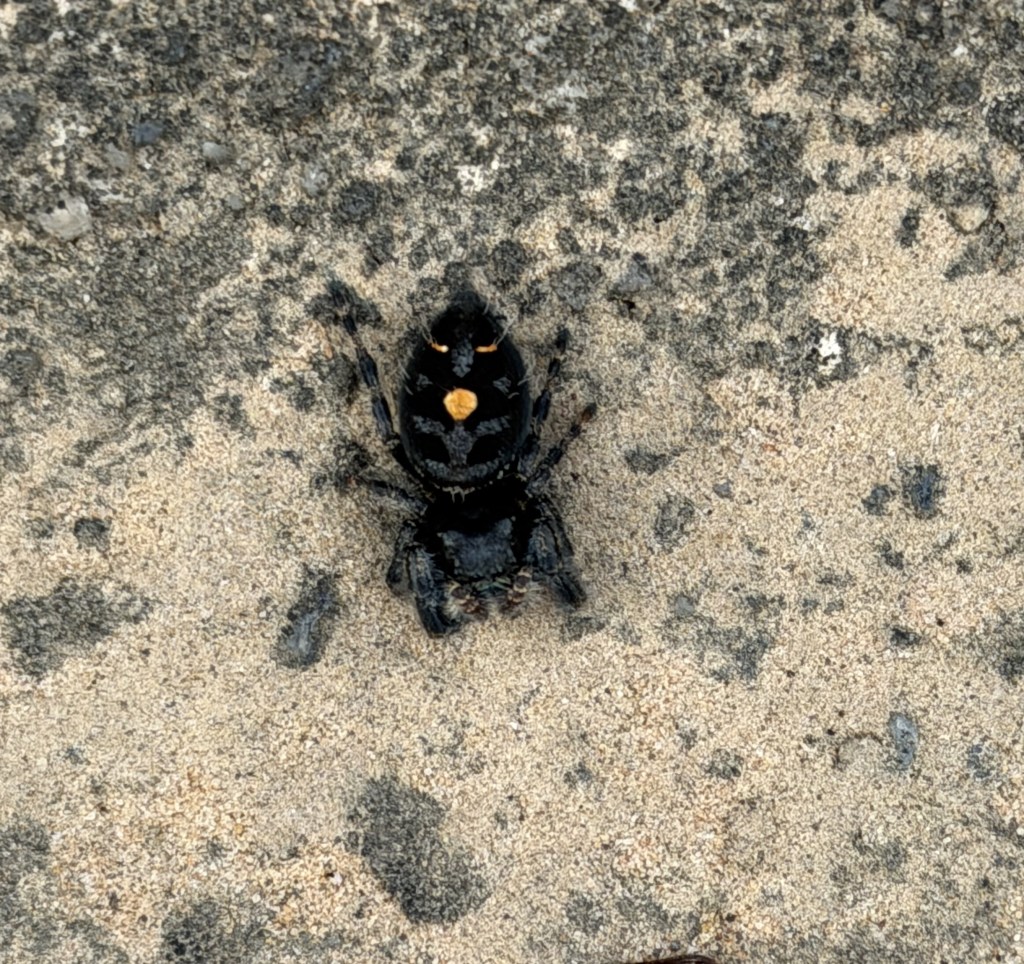
When I opened my mailbox this morning to retrieve my newspaper, I was surprised by something jumping out of the mail.  The mail itself was covered by a fine gauze-like webbing.  I figured this was some sort of spider that had decided to take up residence in the dark confines of my closed mailbox.  This did not strike me as unusual as many spiders are on the move at this time of year seeking a place to overwinter.  I was surprised by the distance the spider had jumped.  It had shot off my paper and onto the ground several feet away.  When I Goggled a picture of the spider, I found it was aptly named a Bold jumper.

When I went online, I found the bold jumper (Phidippus audax), also known as the daring jumping spider, is a common species of spider belonging to the genus Phidippus.  This group of jumping spiders easily identified by their large eyes and their iridescent mouth parts (chelicerae).  They are typically black with a distinct white triangle on their abdomen.  Like all jumping spiders, they have excellent stereoscopic vision that aids them in stalking prey and facilitates visual communication with potential mates during courting.  The species are native to North America and have been introduced to Hawaii, Nicobar Islands, Azores, and the Netherlands.  The Bold jumper is a solitary carnivore that uses their highly specialized eyesight to actively hunt and stalk a variety of insects and non-insect terrestrial arthropods such as caterpillars (order Lepidoptera), dragonflies (infraorder Anisoptera), grasshoppers (suborder Caelifera), and other spiders (order Araneae).  They are one of the most common spiders found in agricultural areas and have been studied to determine their impact on crop pest populations.  New Hampshire Governor Chris Sununu signed the HB 318 bill on June 11, 2021, designating the bold jumper as the state spider following a campaign by a class in Hollis, New Hampshire.

The bold jumper is often found living near humans.  Bites are rare but may occur if they feel threatened or are mishandled.  Bites are often described as mildly painful and are not considered dangerous.  Symptoms often include localized redness, itching, and swelling for one to two days, if at all.  Medical attention is only advised if symptoms worsen or abnormal symptoms arise.  If bitten, you should wash the area with water and a mild soap.  A cold compress may be used to treat swelling and aspirin, and acetaminophen may be used for pain.  As a major predator of crop pests, they have been studied to determine their impact on pest insect populations.  However, in addition to eating pests, they also eat beneficial insects such as pollinators.  My jumper went to the ground and then calmly stayed in place as I maneuvered my camera to take a photo.  It obviously did not consider me a threat and having been around them frequently I did not consider it a threat either.  Unlike most spiders, the bold jumper does not build webs to catch prey.

THOUGHTS: I found it curious that the bold jumper does not build a web to catch prey, yet there was an obvious webbing on my newspaper.  This was the start of the thin sheet of silk that would become the nest for an egg-sac.  This is usually built in hidden areas under rocks, bark, or leaves, but the inside of my mailbox seemed to serve.  The jumper was preparing to create a secluded nest to provide for the next generation in the spring, but my mailbox was not the secluded location she sought.  Humans find similar radical shifts in environment.  A site along the ocean seems perfect, until the storm surge from a hurricane washes out the foundation and sweeps the house into the sea.  Building needs to take potential environmental shifts into account.  Both for weather impact and the impact of encroaching on fragile ecosystems.  Act for all.  Change is coming and it starts with you.
Hornet

September 22, 2025

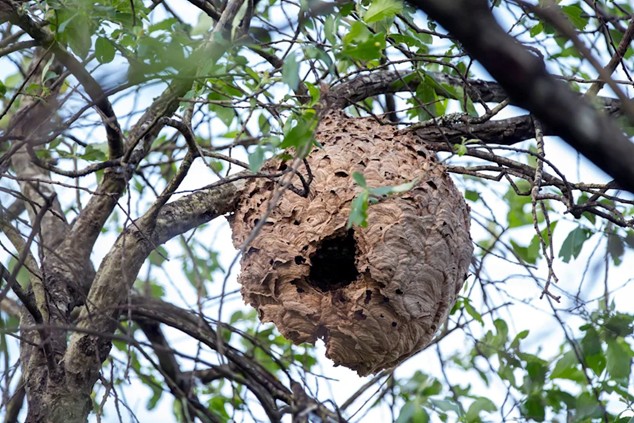
I found an article on yahoo!news about an innovative approach toward eradicating an invasive species in England.  British scientists are attaching miniature tracking devices to the invasive insects which allow teams to locate and destroy their hidden nests within an hour instead of several days.  Time is critical as the nest can reproduce within seven days.  Inspectors capture individuals near bait stations, secure hair-thin transmitters around their bodies, and follow them straight to their colonies.  According to The Guardian, Britain’s Animal and Plant Health Agency found 64 nests through August 2025, setting a seasonal record.  Public participation drives much of the success for the eradication program.  Citizens use the Asian Hornet Watch app to submit thousands of sightings and enabling rapid response teams to investigate reports near ports where the species often arrive hidden in shipments of wine, produce, or building materials.  The invasion started when a single Asian Hornet female likely arrived in France aboard a pottery shipment from China back in 2004.

When I went online, I found the Asian hornet (Vespa velutina), also known as the yellow-legged hornet, Asian predatory wasp, or murder hornet, is a species indigenous to Southeast Asia.  This is significantly smaller than the European hornet, with queens 1.2 inches (30 mm), males about 0.94 inches (24 mm), and workers about 0.79 inches (20 mm) in length.  The species has distinctive yellow legs (tarsi), a velvety brown or black mid-section (thorax), and a brown abdomen.  Each abdominal segment has a narrow posterior yellow border, except for an orange fourth segment.  The hornet has a black head and a yellow face.  The coloration of the species can vary regionally which causes difficulty in classification and resulted in several subspecies to have been identified and later rejected.  The most recent taxonomic revision of the genus treats all subspecific names in the genus Vespa as synonyms, effectively relegating them to no more than informal names for regional color forms.  The Asian hornet is an invasive species of concern in most of Europe.

The Guardian reported the Asian hornet feasts on honeybees (genus, Apis) and other pollinators that enable the production of approximately one-third of the crop humans consume.  A single colony of hornets consumes about 24 pounds (10.9 kg) of insects during one season, putting pressure on the bee populations already struggling with habitat loss.  Testing shows Britain has prevented permanent colonies from establishing, with only three of 24 nests last year originating from females that survived winter in England.  While government teams fight Asian hornets with high-tech solutions, homeowners can help in their own yards with intelligent landscaping choices.  Replacing portions of traditional lawns with native plants can create a refuge for local pollinators.  Native plants also demand less water and maintenance than non-native species, which cuts both utility bills and maintenance.  These plants support local bee populations naturally by providing the nectar and pollen sources these insects evolved to use.

THOUGHTS: The Asian hornet was declared eradicated by the US Department of Agriculture in December of 2024.  Eradicated means there has not been a sighting in three years.  Even without the threat of this hornet, we have taken two steps to assist pollinators in our yard.  The wildflower bed in the front draws both bees and butterflies while also providing cover from any predators.  The side yard has a bird bath that I fill every time I water the vegetables.  This has a half brick in the middle to allow bees to cling to the brick and take a drink.  It took little effort for either of these features and the result has provided food and water for countless pollinators.  Act for all.  Change is coming and it starts with you.

Cicada-killer

August 11, 2025

I have been seeing the scattered exoskeletons of the cicada (superfamily, Cicadoidea) brood hatch that is occurring in Arkansas this summer.  Brood XIX emerges every 13 years, and its last emergence was in 2011.  It is a large brood that encompasses 15 states.  Although they are not in Arkansas, Brood XIII is also emerging in other parts of the country.  Although the cicadas are large and a brood hatch can become messy when great numbers emerge at the same time, they are not agricultural pests or a threat to humans.  Trees may be overwhelmed by the sheer number of females laying their eggs in their shoots and small branches.  Yesterday while watering my garden, I noticed what looked like a large wasp trapped between the screen and window on the porch.  When I find wasps on our porch, I shoo them away or if they persist, I will spray them.  I have been stung too many times to allow these pests to establish close to our house.  The insect looked like a yellow jacket but was over twice the normal size.  What I found out was this was an eastern cicada-killer.

When I went online, I found the eastern cicada-killer wasp (Sphecius speciosus) is a large, solitary digger wasp species in the family Bembicidae.  They are also erroneously called sand hornets, although they are not true hornets, which belong to the family Vespidae.  Their name comes as they hunt cicadas and provision their nests with them.  The species is found in the Eastern and Midwest US and south into Mexico and Central America.  Adult eastern cicada wasps are 0.6 to 2.0 inches (1.5 to 5.0 cm) long.  They have hairy, reddish, and black areas on their middles (thoraces), and black to reddish brown rear (abdominal) segments that are marked with light yellow stripes.  The wings are brownish.  The females are slightly larger than the males, and both are among the largest wasps in the Eastern US.  European hornets (Vespa crabro) are often mistaken for eastern cicada killers, although they are smaller at 1.4 inches (3.5 cm) long.  The males are smaller than the females because they are not given as much larval food.  The females benefit from being larger as they must carry the cicadas they have killed to a burrow for nesting.  Cicada killers exert a measure of natural control on cicada populations which may directly benefit the deciduous trees the cicadas feed on.  

Despite their fearsome appearance, female cicada-killers are not aggressive and rarely sting unless they are mistreated.  Their sting is not much more than a “pinprick”.  Males aggressively defend their perching areas on nesting sites against rival males, but they have no stinger.  Although they appear to attack anything that moves near their territories, male cicada killers are just investigating anything that might be a female cicada killer ready to mate.  Their close inspection may appear to be an attack, but male and female cicada killers do not land on people with the intent to sting.  If handled roughly, females will sting, and males will jab with a sharp spine on the tip of their abdomen.  They are generally not aggressive towards humans and usually fly away rather than attacking.  I initially tried to swat the wasp but its size and being behind the screen protected it.  I finally gave up and decided if it could get out of the screen on its own it would go away.  Since it was not there this morning, I assume it had done so. 

THOUGHTS: The size of the cicada-killer and its resemblance to a yellow jacket made me fearful when I first encountered it.  It seemed docile rather than the aggression I have seen from other wasps.  Still, I wanted it to go.  After I found out what it was, I was glad I left it alone.  We do not have a cicadae problem, but this was nature’s way of providing control.  One benefit of my garden is taking time to observe the interaction between the flora and fauna (plants and animals) that thrive there.  Identifying the different species and their place in my sub-ecosystem has been enlightening.  We are all part of the same planet.  Act for all.  Change is coming and it starts with you.
Leafcutter

June 29, 2025

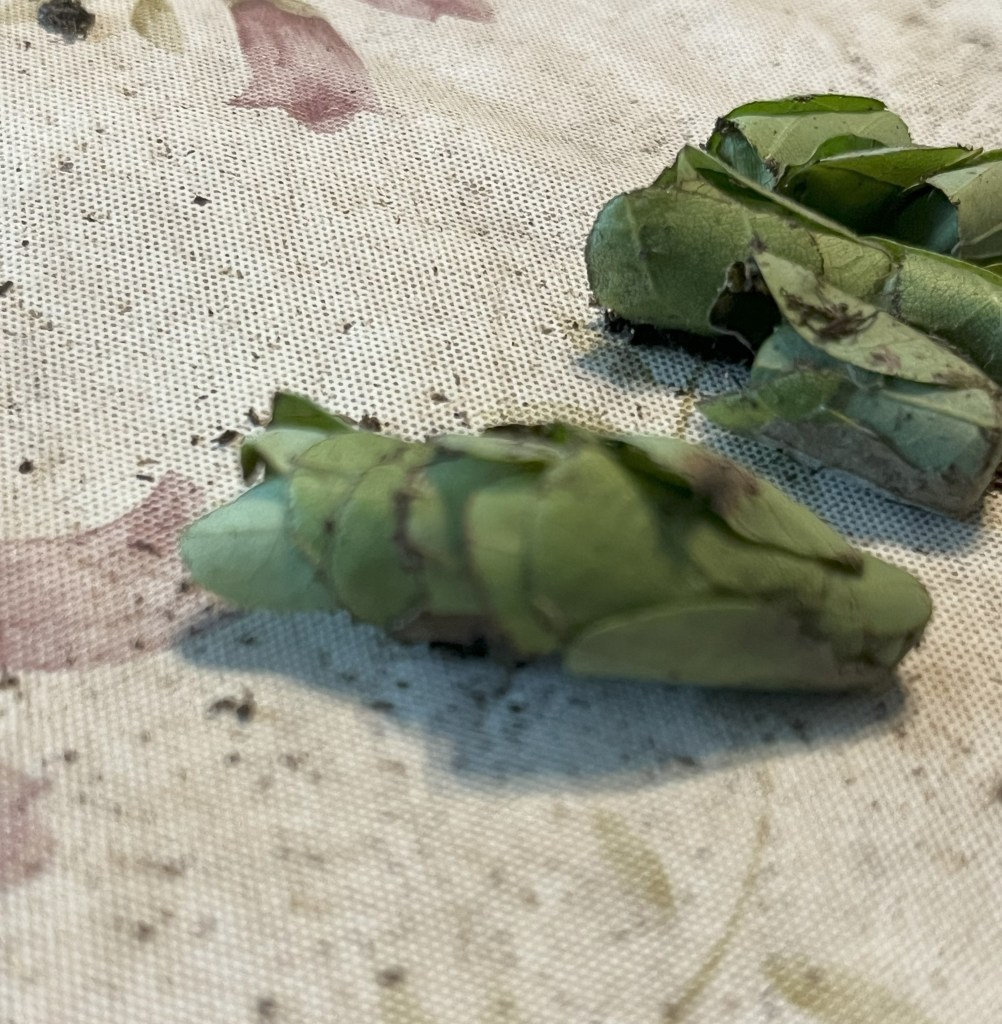
Melissa went shopping with me yesterday to get out of the house.  I needed to get some roasted peanut chips for the birds and Melissa wanted to look at the succulents.  She was surprised by the large number of inexpensive arraignments, and by their state of disrepair.  They were all soaked in water (causes root rot) and the leaves were starting to fall off.  Melissa bought a large arraignment to divide into separate plants and try and save them.  As we were checking out, I mentioned to the attendant that the plants were getting too much water.  She agreed and said she had also bought several to save them from dying.  When we got home Melissa began dividing the arraignment and repotting them into a cactus medium.  The plants were in potting soil (retains water) rather than cactus medium and the bright containers were made of plastic (retains heat).  Each of the plants were root-bound from their previous pots and the soil had not been broken up.  As Melissa dug through the potting soil she came across what looked like a leaf tube buried deep in the soil.  When she googled the odd structure, she found it was the egg nest of a leafcutter.

When I went online, I found leafcutter bees (Megachilidae), are part of a widespread (cosmopolitan) family of mostly solitary bees.  Characteristic traits of this family are the restriction of their pollen-carrying structure (scopa) to the ventral surface of the abdomen, rather than on the hind legs as in other bee families, and their typically elongated flap-like structure immediately in front of the mouth (labrum).  The scientific name Megachilidae refers to the genus Megachile, translating roughly as large lipped (Ancient Greek mégas – “big” and kheîlos – “lip”).  Their “large lips” and strong jaws are well-suited for collection of building materials for the nest.  These bees get their names from the materials they use to build their nest cells.  Leafcutter bees use leaves while mason bees use soil.  A few species collect plant or animal hairs and fibers (carder bees) while others use plant resins in nest construction (resin bees).  All species feed on nectar and pollen, but a few are kleptoparasites, which feed on the pollen collected by other megachilid bees.  The parasitic species do not possess scopae.  North America has an estimated 630 different megachilid species.  Most are native but a few are introduced, accidentally and intentionally.  Globally the number of species identified exceeds 4,000 and represents 15% to 20% of named species of bees.

The Nonparasitic Megachilidae divide their nests into cells with each cell receiving a supply of food and an egg.  The larva hatches from the egg and consumes the food supply.  After molting a few times, it spins a cocoon and pupates, then emerges from the nest as an adult.  Males die shortly after mating, but females survive for another few weeks, during which they build new nests.  Nest cavities are often linear, like the one found by Melissa, but not always.  Above ground megachilid bees are more commonly cultivated than ground nesting bees.  They accept nesting materials made from hollow stems, tubes, and blocks with preformed holes (“nest blocks”), and several megachilids have become important species for agricultural or horticultural pollination.  In North America these cultivated bees include the introduced alfalfa leafcutter bees (Megachile rotundata), used extensively in alfalfa pollination, and the orchard mason bee or blue orchard bee (Osmia lignaria), used in orchard pollination.  Other species are also in commercial use in North America, Europe and Asia.

THOUGHTS: Arkansas is home to at least 40 species of bees and the genus Megachile, has an estimated 15 to 20 species, including many leafcutter species.  Finding the nest tube of a leafcutter bee shows how easy it is to transport a species to another area.  While the leafcutter is beneficial, not all invaders are.  People criticize states like California which have tight controls on agricultural products.  Perhaps we should all be vigilant.  Act for all.  Change is coming and it starts with you.
Wheel Bug

May 14, 2025

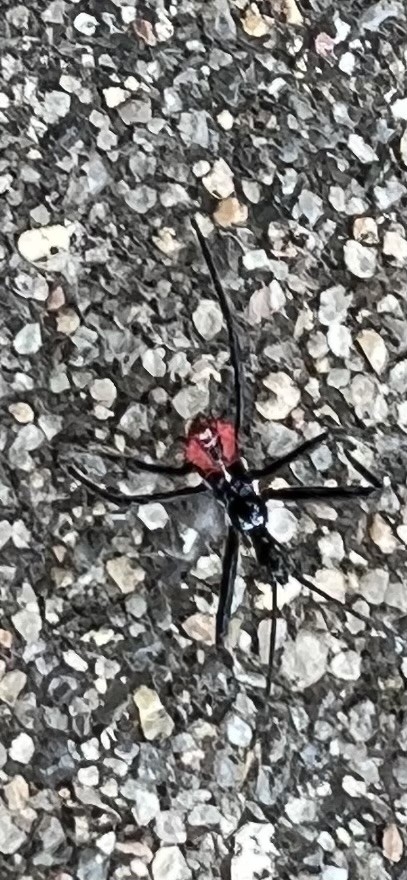
Last weekend I decided to weed the succulent bed beside the drive.  Melissa planted the bed with white stonecrops (Sedum album) mats placed around the 4-foot by 3-foot (1.2 m by .9 m) bed.  The bed sits under the Bradford pear (Pyrus calleryana) tree I had trimmed for the limbs and branches that made up the base layer of my hügelkultur raised beds made last year.  The problem was the bed was filled with dead leaves and the invasive Bermuda grass (Cynodon dactylon) from the surrounding yard.  After an hour of concentrated effort, I amassed a large pile of grass, leaves, and weeds on the driveway.  I raked the debris into a pile and scooped it up to place in the trash bin (I do not have a large compost pile, yet).  When I came back to blow the remaining debris onto the yard, I noticed a small insect with a red back scurrying across the drive.  At first, I thought it was a Black widow (Latrodectus hesperus) spider dislodged from the debris.  A closer look showed the creature had 6 legs, meaning it was an insect rather than a spider.  I took a picture and googled the bug, and it was identified as an assassin bug, or more specifically a North American wheel bug.

When I went online, I found the North American wheel bug (Arilus cristatus), or simply wheel bug, is a species of large assassin bug in the family Reduviidae and the only species of wheel bug found in the US.  It was described in 1763 by Carl Linnaeus.  It is one of the largest terrestrial true bugs in North America and reaches up to 1.5 inches (38 mm) in length in its adult stage.  It is sexually dimorphic with males slightly smaller than females.  The characteristic feature of the species is the wheel-shaped armor on the first segment of the thorax which also bears the first set of legs.  Adults are gray to brownish gray in color and black shortly after molting, but the nymphs (which have not developed the wheel-shaped structure) have bright red or orange abdomens.  Wheel bugs prey on caterpillars and beetles by piercing them with their beak to inject salivary fluids that dissolve soft tissue.  Wheel bugs are the most active in daylight but may feed at night in areas illuminated by lights.  A wheel bug uses camouflage and hides in leafy areas (like my overgrown bed) whenever possible.  Despite the prevalence of the wheel bug in many habitats, the information on the species is haphazard and incomplete.  Most of its prey are pests, so the wheel bug is considered beneficial.

The wheel bug I found scurried off and I did not think any more about it until I noticed another one on my rake 20 minutes later.  My app initially identified the insect as an assassin bug, but this refers to over 7,000 species of Reduviidae, a large wide-ranging (cosmopolitan) family of the suborder Heteroptera of the order Hemiptera (true bugs).  Scanning pictures of the 5 different types of assassin bug, I determined it was a wheel bug, which also had 5 species.  I narrowed this to the North American wheel bug because it was the only one native to North America.  North American wheel bugs are highly regarded by organic gardeners because they consume a variety of insects, and their presence indicates a healthy, pesticide-free ecosystem.  “They are the lion or the eagle of your food web,” according to Michael J. Raupp, an entomologist at the University of Maryland.  I was glad I had left it alone.

THOUGHTS: The pictures of wheel bugs all showed a large black or gray adult, unlike the tiny (.25 inch/6 mm) insect I found.  This was a nymph version of the wheel bug that hatches at the beginning of May and matures (after 5 molts) in July.  That explains the second individual on my rake.  I had disturbed a group of hatchlings hidden in the leaves.  When I saw the wheel bug my first reaction was to squash it because it was unknown.  Taking time to know, I found it was beneficial.  Taking time to know (things or people) can often change our understanding.  We just need to be willing to spend the time.  Act for all.  Change is coming and it starts with you.
Beetle

October 30, 2024

Hidden in the back of the front section in yesterday’s newspaper was a USA Today article about Hawaii’s attempts to stop an invasive insect.  According to the Hawaii Invasive Species Council, the invader “jeopardizes the economy, the entire ecosystem, agriculture and food security.”  This species feeds by biting and boring into emerging palm fronds, creating holes in the top of the tree.  While they prefer to feed on coconut, royal, date, and fan palms, they will also feed on hala, taro, banana, pineapple, and sugarcane if the palm trees are unavailable.  The insects are nocturnal and can fly up to two miles if they are looking for food.  The insect attacks a palm at the base of the fronds (leaves) where they are attached to the trunk, bore through the base of the fronds into the center of the crown (the palm heart), and feed on the undeveloped white fronds.  Attacks cause a reduction in leaf area on the damaged fronds and results in a reduction in the number of nuts produced.  Newly planted palms can have their growth point destroyed resulting in the palms death and even mature palms may die after extremely heavy attacks by the coconut rhinoceros beetle.

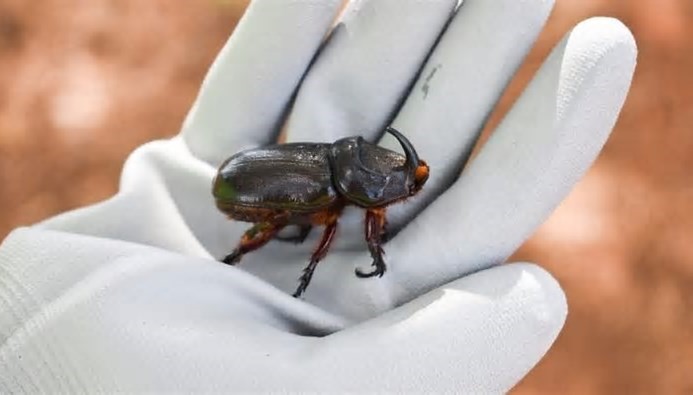
When I looked online, I found the coconut rhinoceros beetle (Oryctes rhinoceros), also known as Asiatic rhinoceros beetle, is a large species of beetle belonging to the subfamily Dynastinae.  This dynastid beetle has a length of 1.4 to 2 inches (3.5 to 5 cm) and is a dark brown to black color.  The head has a horn which is more prominently developed in males and in larger specimens. The first segment of the thorax (pronotum) has a large central depression with two humps at the hind margin and the tibia of the foreleg has three large teeth.  Male beetles can be reliably distinguished from females as the tip of the abdomen is rounded, shiny, and hairless.  In females the tip is more pointed and densely covered with hair.  The larvae are C-shaped white grubs typical of other scarab beetles.  The beetle breeds in decaying palm trunks or other organic matter (sawdust or compost heaps).  The native distribution of this beetle covers most parts of tropical Asia, but human activity accidentally introduced the beetle to a large number of tropical islands throughout the Pacific.   The beetle has most recently invaded Guam, Hawaii, the Solomon Islands, and Vanuatu.

A virus disease of coconut rhinoceros beetle (Oryctes rhinoceros nudivirus) has turned out to be the most effective natural control agent.  This virus was discovered by Alois Huger in Malaysia in 1963 and was later found to occur naturally in other countries within the native range of the beetle.  The introduced beetle populations in the Pacific and in the Maldives were found to be virus-free.  The virus was introduced into the virus-free populations and caused a significant decline in the beetle population.  The virus mainly effects the adult population and spreads easily, reducing their life span and the fertility of females.  During replanting of palms more breeding sites become available and transmission of the virus is often interrupted, and outbreaks still occur.  There is also evidence of resistance to the virus in some coconut rhinoceros beetle populations.  A fungus (Metarhizium majus) is also effective in controlling the beetles in breeding sites, but it does not spread well by itself.  The fungus does have the advantage that it survives for some time outside its host (as conidia).

THOUGHTS: Use of a virus to control the coconut rhinoceros beetle population is common, and natural biological controls include predators, parasitoids, pathogens, and competitors.  Biological control can have side-effects on biodiversity through attacks on non-target species by any of these mechanisms, especially when a new species is introduced without an understanding of the possible consequences.  Viruses being transmitted to other species (and humans) may cause greater harm than the original problem.  Alexander Pope’s proverbial phrase in 1711 was, “To err is human”.  Even without forgiveness, this is more than an adage.  Act for all.  Change is coming and it starts with you.