Sauerkraut

July 11, 2026

This is the second year I have tried raising cabbage (Brassica oleracea) in my raised beds.  Last year the weather was not conducive and the heads never formed.  I tried to use the individual leaves, but nothing I made worked.  This year I planted it earlier and put in more seeds.  Ten plants came up, but one was eaten (by something) almost immediately.  The other nine plants produced large leaves that were attacked by some sort of insect (never saw it).  Three of the plants were overstressed by the attacks and I ended thinning them out to give more space to the others.  That left two plants that had formed decent heads and the other four still in the process of folding (hopefully).  Sunday Melissa made a pork loin in the crockpot by combining the meat with baby potatoes (Solanum tuberosum), carrots (Daucus carota subsp. sativus), and the smaller head of my cabbage.  Melissa thought the cabbage was picked too late and had a bitter taste.  I did not want that to happen to the one good head of cabbage left, so today I used it to make sauerkraut.    

When I went online, I found Sauerkraut (lit. ’sour cabbage’) is finely cut raw white cabbage that has been fermented by various lactic acid bacteria.  The dish has a long shelf life and a distinctive sour flavor, both the result of the lactic acid formed when the bacteria ferment the sugars in the cabbage leaves.  The English name is borrowed from German, but the dish did not originate in Germany.  Some claim fermented cabbage (Suan cai) came from China during the time of the building of the Great Wall.  The Romans also pickled forms of cabbage and are the likely source of European sauerkraut.  The dish became popular in Central and Eastern European cuisines, and countries including the Netherlands (zuurkool) and France (choucroute).  Glenn Randall Mack and Asele Surina published “Food Culture in Russia and Central Asia” in 2005 and credit the Slavic peoples of Europe with likely discovering fermented cabbage.  Before frozen foods and refrigeration, sauerkraut was readily available in Northern, Central, and Eastern Europe, and provided a source of vitamin C during the winter.  Captain James Cook took sauerkraut on his sea voyages to prevent scurvy.

Sauerkraut is one of the easiest ways to preserve cabbage.  Wash the head, remove the outer leaves (setting one aside), cut out the core.  I used my large carving knife to cut thin slices off the head making a large pile of sliced cabbage.  I sprinkled on four tablespoons (60ml) of sea salt and gently mixed it into the cabbage, then let it stand for 15 minutes.  The important step is to knead the mixture for 5 minutes.  I was surprised by how much water came out of the cabbage and by how much it reduced.  I stuffed the entire head into the quart jar and poured the cabbage water over the mixture.  There was not quite enough water, so I made a salt brine of two tablespoons (30ml) salt to one cup (0.26L) distilled water and covered the mixture.  The last step was topping it off with the leaf I had set aside and adding one of Melissa’s decorative rocks to keep it weighted down.  I did not add the weight last year and the sauerkraut got moldy.  I need to wait 1 to 4 weeks for fermentation and then put it in the refrigerator.  It should last up to a year, but I think it will be eaten long before then.

THOUGHTS: One of my fond memories growing up was mom making sauerkraut in a ten gallon (38L) stoneware crock.  Mom would fill it with fresh cabbage and salt and place it in the basement to ferment where my brother and I would sneak “taste tests” out of the crock.  Sauerkraut, kielbasa, and baked potatoes are still one of my favorite meals.  Sauerkraut represents the two ways ideas, beliefs, and technologies spread.  There appear to be two simultaneous independent inventions (Slavic and China) which then spread by expansion (from one people to the next).  Technologies and ideas seem to have a life of their own and few things can be claimed as “mine” for long.  Act for all.  Change will come and it starts with you.

Condiment

July 04, 2026

Like most people in the US, I spent part of the day harvesting the bounty of my garden (really?).  I began early this morning (for me) taking the kids for a walk.  By 10 am it was already 89F (31.6C) with a “feels like” of 99F (37.2C).   I got home in time to water my garden and to oversee what would be ripe enough to take to our feeding program tomorrow night.  I mentioned earlier I harvested around 20 pounds (9kg) of Roma tomatoes (Solanum lycopersicum var.) that I turned into 7 quarts (6.6L) of pasta sauce.  The vines have kept producing and I was able to garnish another 10 pounds (4.5kg) today, along with another 12 Arkansas Travelers (Solanum lycopersicum var.).  My red onions (Allium cepa) have stopped growing but there are 38 onions still in the ground.  My jalapeno peppers (Capsicum annuum) are now producing as the weather has turned hotter (not warmer).  I am also growing cilantro (Coriandrum sativum) in the herb garden.  While I have made several batches of pickle de Gallo, I now have the ingredients for my favorite condiment, Pico de Gallo.

When I went online, I found a condiment can be defined as a supplemental food (such as a sauce or powder) that is added to some foods to impart a particular flavor, enhance flavor, or complement a dish.  These foods are not considered enough to serve as a standalone dish.  The term condiment originally described pickled or preserved foods but now includes a great variety of flavorings.  Many diverse condiments exist in various countries, regions and cultures.  Pico de Gallo can be used in much the same way as Mexican liquid salsas, and because it contains less liquid, it can also be used as a main ingredient in dishes such as tacos and fajitas.  The tomato-based variety is widely known as salsa picada (‘minced/chopped sauce’) and in Mexico is normally called salsa mexicana (‘Mexican sauce’).  The colors of the red tomato, white onion, and green chili and cilantro are reminiscent of the colors of the Mexican flag, and it is also called salsa bandera (‘flag sauce’).  The Pickle de Gallo lacks the red of the tomato but is still a great way to use the 14 pints (6.6L) of pickles I canned last week.

Since today is the celebration of Independence Day in the US, there are two other important condiments associated with this day.  Ketchup typically refers to tomato ketchup, although early recipes for different varieties contained mushrooms, oysters, mussels, egg whites, grapes, or walnuts.  Tomato ketchup is made from tomatoes, sugar and vinegar, along with seasonings and spices.  Mustard is a condiment made from the seeds of a mustard plant, which may be the white/yellow mustard (Sinapis alba), brown mustard (Brassica juncea), or black mustard (Rhamphospermum nigrum).  The (whole, ground, cracked, or bruised) seeds are mixed with water, vinegar, lemon juice, wine, or other liquids, salt, and other flavorings and spices to create a paste or sauce.  The sauce can range in color from bright yellow to dark brown.  These are important condiments on Independence Day as they are often paired with hotdogs and hamburgers grilled on bar-b-q’s across America.

THOUGHTS: While a condiment is officially defined as a supplemental food, I often use both Pickle and Pico as a main course pared with tortilla chips.  While the USDA Food Buying Guide explicitly lists tomato catsup and chili sauce as condiments that do not contribute toward the daily vegetable component, there is a famous historical debate surrounding school lunches in the 1980’s.  Proposed USDA rules suggested counting various tomato condiments and pastes as vegetables, but this was never officially adopted for dietary health.  It seems we are willing to do anything to get children to eat their vegetables, even if the condiments do not contain the necessary nutritional value to count as a vegetable.  Act for all.  Change will come and it starts with you.

Lasagna

June 24, 2026

Monday I was once again scrolling through my phone looking for something different for dinner.  Melissa and I have several go-to meals that are simple that we make often.  While these are good, there are times when I get bored eating the same meals and then working through the leftovers.  I knew I had hamburger in the freezer, so I began my search with “quick hamburger meals”.  Not finding what I wanted I shifted the search to “quick easy meals”.   This opened the offerings to meals based around chicken, seafood, and salads, as well as more hamburger meals.  By this time, I had been scrolling for over 30 minutes (sound familiar?) and the local news was coming to an end.  The half hour between the 6 o’clock news and regular programing at 7 is when we usually prepare our meals, so I was beginning to get desperate.  Then I remembered we had a half pound (.23 kg) of sausage left over from one of our regular sausage and potatoes skillets Melissa had made on Sunday.  I switched the search to sausage and immediately found a skillet sausage and lasagna bake.

When I went online, I found lasagna, also known by the plural form lasagne, is a type of pasta made in wide, flat sheets.  This dish originated in Italian cuisine where it is served in a number of ways, but is best known for its use in a baked dish made by stacking layers of pasta, alternating with fillings such as ground meats and tomato sauce (ragu), béchamel sauce, vegetables, cheeses (including ricotta, mozzarella, and Parmesan), seasonings, and spices.  Typically, cooked pasta is assembled with the other ingredients, topped with grated cheese, and then baked in an oven (al forno).  Lasagna originated in Italy during the Middle Ages and the oldest known written reference appears in a ballad in 1282 CE.  There are many regional variations of the dish in Italy.  These dishes were traditionally served during religious celebrations, which were some of the few times many people would eat meat.

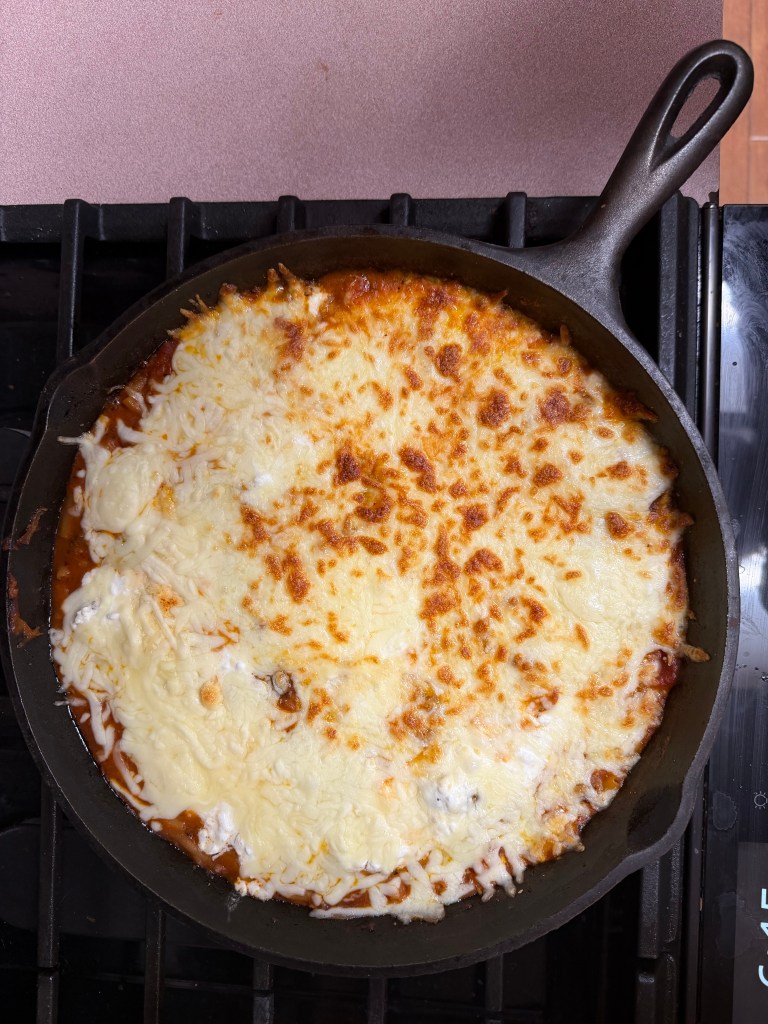
I frequently make lasagna and prefer my homemade to frozen store brands.  This recipe was a “quick one pan dish” ready in 40 minutes.  I pulled up the recipe and realized I did not have the ingredients.  No worry.  I often substitute and add or subtract ingredients depending on what is on hand.  The recipe suggested a cast iron skillet, and I pulled the largest one from under the cabinet.  I browned the sausage and added minced garlic.  Then came 2 cups (0.45 kg) of pasta sauce (my homemade) and 2 cups (0.45 kg) of chicken broth.  I realized I used a 10-inch (25 cm) pan rather than a 12-inch (30.5 cm) pan (did not fit), but I had a 12-inch cast iron skillet in my camping gear.  I brought the mixture to a boil and went to add the noodles.  I like to keep flat lasagna noodles in the pantry but was out.  None of the other noodles seemed right for the dish I was trying to imitate.  I finally opted for a package of mac-n-cheese to get the elbows.  I simmered the mixture for 15 minutes to blend the flavors and added cheese on top.  I mixed the mac-n-cheese packet into the sauce, substituted cottage cheese for ricotta, and finished with parmesan and mozzarella.  The whole pan went into the oven on broil for 5 minutes.  It turned out delicious.

THOUGHTS: One problem with searching online recipes is they are often subscription services, as was my sausage and cheese lasagna.  The recipe pulled up fine and the site asked if I wanted to subscribe.  I declined and preceded to make the dish.  I scrolled back and forth making sure I had the right amounts of each ingredient and the proper steps.  About halfway through preparation the screen flashed, “This is members-only content”, and blurred the screen.  I could join or sign in, but until I did it would not provide further information.  I knew enough of the ingredients and steps to proceed and I did neither.  I realize the site may need profit but am incensed when “free” information is belatedly tied to a subscription that at very least tracks and sells my information to others.  I prefer an upfront choice.  Act for all.  Change will come and it starts with you.

Gumbo

February 04, 2026

Melissa and I seem to be in constant search to find what to eat for dinner.  The task is made more difficult as I rarely go to the store to buy specific items for the evening’s meal and instead try and find innovative ways to cook what we already have on hand.  This approach is made more so as I try and use up leftovers or clear out the produce that I canned or frozen over last year’s growing season.  Several days ago, I had scrounged a packet of chicken pieces (breasts and thighs) I had frozen to make chicken and rice casserole.  I have a set recipe in my mind for how to make this dish, but I am still toying with how to get the rice to come out perfectly.  I have followed on-line recipes, and it will often come out either crunchy (too little liquid) or mushy (too much liquid).  The other issue is it is made in a 9-inch (23 cm) by 13-inch (33 cm) glass dish.  This makes a ton of casserole!  While I seem to have no problem eating all the rice, the leftover chicken is a harder sell (especially breasts). While scrolling on-line this afternoon I came across a sausage and chicken gumbo recipe.

When I went online, I found gumbo (Louisiana Creole: Gum-bo) is a stew that is popular among the US Gulf Coast community.  The dish combines ingredients and culinary practices of several cultures, including Central and West African, French, German, Spanish, and Native American Choctaw.  A gumbo consists primarily of a strongly flavored stock, meat or shellfish (or both), a thickener, and the Creole “holy trinity” (celery, bell peppers, and onions).  The preferred method in the historical New Orleans variation has a French-inspired dark, even chocolate-like, roux (flour and fat mixture) that is the official state cuisine of Louisiana.  Creole gumbo generally contains shellfish and a dark roux.  Cajun gumbo is generally based on a dark roux and is made with shellfish or fowl.  Sausage or ham is often added to gumbos of either variety.  After the base is prepared, vegetables are cooked down, and then meat is added.  The dish simmers for a minimum of three hours, with shellfish and some spices added near the end, and traditionally served with rice. A third, lesser-known variety, the meatless gumbo (z’herbes) is essentially a gumbo of slow-cooked greens.  Gumbo was first described in 1802 and was listed in various cookbooks in the latter half of the 19th century.

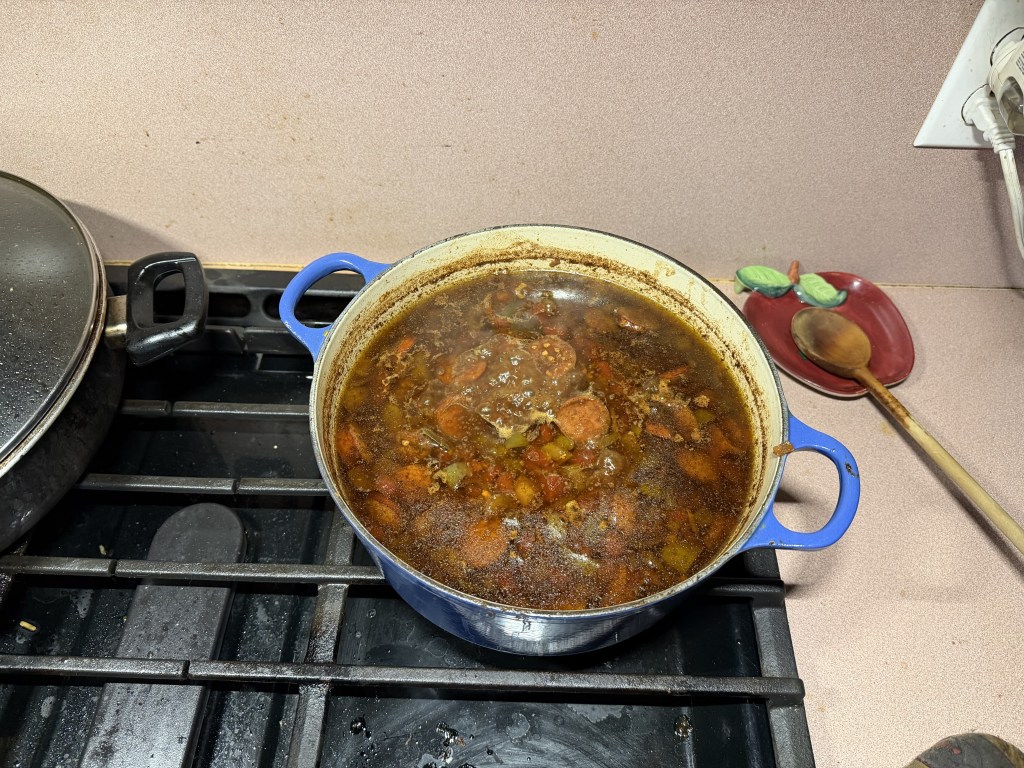
My decision to make gumbo was a mix of trying something new and my desire to use the leftover chicken in the refrigerator and the half-pack of kielbasa in the freezer.  I have made variations of this dish before, but this is the first time I started from a roux.  Being a creature of habit, I only partially followed the recipe.  I started by baking the flour in the oven at 350F (177.6C) for 45 minutes for the darkened color and to add a toasty flavor to the roux.  While the flour was baking, I got restless and went ahead and sautéed the cut-up chicken and sausage as well as the trinity (different pans).  The roux itself was a mix of vegetable oil (olive) and toasted flour that was cooked down on low heat for 35 minutes.  Since the vegetables had already softened, I placed them in the pot along with a can of Rotel tomatoes and chilies, Cajun spices, cayenne pepper, and six cups of chicken broth.  Next came the chicken and sausage and a Bay leaf for flavor.  The on-line recipe suggested letting the gumbo simmer for “1 to 2 hours” rather than the noted minimum of three.  I put the finished ingredients on around 4 pm and we will not eat until after 7.  That should give the flavors enough time to meld.

THOUGHTS: When I made my Gumbo, I used the eyeball measuring approach.  Between that and my hand slipping when I was “measuring” the cayenne the dish came out spicy hot.  I have learned (from Melissa) that one way to cut the heat is to add sugar.  I tasted the mixture again to be sure, then added two tablespoons of sugar.  I am looking forward to having Gumbo over white rice tonight.  We can all stand to learn new ways from each other.  Between Zydeco dancing and Cajun dishes, who can go wrong?  Act for all.  Change is coming and it starts with you.

Squash

November 12, 2025

Following a second night of hard freeze (28F/-2C or lower for several hours) temps are forecast to be in the 60’sF (15.5+C) and 70’sF (21+C) for the next week or two.  I had removed the sheets covering the last vegetables during the day between the freezes but permanently removed them yesterday as the daytime temps will remain well above freezing until we leave for a trip later in November.  By that time any 2nd crop vegetables that are going to produce fruit will have done so.   I already have a few peas (Pisum sativum), and the cabbage (Brassica oleracea) is beginning to curl into heads.  My garden activity got me motivated to make something with the butternut squash (Cucurbita moschata) I harvested several weeks ago.  The two ways I prefer to eat squash are roasted or in a cream soup.  I had a variety of vegetables in the refrigerator to go along with the squash, so I decided to make both.  

When I went online, I found squash, or Cucurbita (Latin ‘gourd’) is a genus of herbaceous fruits in the gourd family, Cucurbitaceae (also known as cucurbits or cucurbi), native to the Mesoamerica and the Andes.  The five edible species are variously known as squash, pumpkin, or gourd, depending on species, variety, and local jargon.  Other kinds of gourd, called bottle-gourds, are native to Africa and belong to the genus Lagenaria.  These are in the same family and subfamily as Cucurbita but in a different tribe.  The young fruits of bottle gourds are eaten like those of the Cucurbita species while the dried gourds are used as kitchen utensils.  There is debate about the taxonomy of the genus and the number of accepted species varies from 13 to 30.  The five domesticated species are Cucurbita argyrosperma, C. ficifolia, C. maxima, C. moschata, and C. pepo, all of which are called winter squash because the full-grown fruits can be stored for months.  Most squash species are herbaceous vines that grow several meters in length and have tendrils.  The yellow or orange flowers are either female (fruit) or male (pollen).  While botanical fruits, squash are cooked and eaten as vegetables.

I make my squash soup differently than most recipes (surprising, right?).  They suggest roasting squash and onion (Allium cepa) and adding it to a base of chicken broth and cream.  Nutmeg (Myristica fragrans) and sage (Salvia officinalis) then give the soup a sweeter taste.  I begin with roasting but add other vegetables and forego the spices.  Yesterday I roasted a sheet of baby carrots (Daucus carota), green bell peppers (Capsicum annuum), cauliflower (Brassica oleracea), potatoes (Solanum tuberosum), and red onions at 425F (218C) for 20 minutes to let them caramelize.  Next, I placed four small squashes, cut in half and seeded, on a sheet with salt, pepper (Piper nigrum), and olive (Olea europaea) oil.  I added a half cup of water (steam) and roasted them for 45 minutes.  During the last 20 minutes I added the same vegetables (minus the potatoes) to another sheet to roast.  I added the vegetables to the cream and broth base and used a hand mixer to puree the vegetables.  Melissa likes chunkier soup, so I did not make smooth puree.  I tasted the soup, and it seemed bland.  Melissa suggested more salt (tried to be low sodium) and black pepper (Piper nigrum) along with red pepper (Capsicum annuum) flakes.  That made it.

THOUGHTS: Melissa and I enjoyed the squash soup yesterday.  I kept some of the extra in a bowl for later this week and the rest went into a freezer bag, along with the two freezer bags of first batch roasted vegetables.  These went into the freezer for later meals.  Canning and freezing have become my go-to for excess produce and even leftovers.  While I enjoy the dishes I make, they are often too much for the two of us.  I also share as much as I am able with neighbors or the local food bank (produce).  Residential and community gardens can make a difference for those who face food insecurity.  Act for all.  Change is coming and it starts with you.
Pickle de Gallo

November 04, 2025

I was surprised when I walked through my local grocery store last week to see how many shelves were either light or empty.  We have had several runs on food over the last several years between covid, supply chain shortages, and tariffs.  The government shutdown is the latest (presumed) cause of the shortage.  Food subsidies like the US Department of Agriculture’s Supplemental Nutrition Assistance Program (SNAP) and the Women’s, Infants, Children (WIC) program were slated to lose funding on November 1.  Apparently, some were using the last of their monthly paychecks to purchase food while it was still available (affordable?).  You can imagine my surprise when I walked by the cheese and deli meat cold case to find new stocked items.  The cold case displayed Pickle de Gallo in mild, medium, and hot.

When I went online, I found the Pickle de Gallo, also known as pickle salsa, is packaged by Grillo’s Pickles who is owned by King’s Hawaiian (as of April 2021).  The company was founded by Travis Grillo in 2008 and developed the idea from a pickle cart on the Boston Common using a 100-year-old family recipe.  The biggest difference between fresh and non-refrigerated shelf pickles (Cucumis sativus) is pasteurization.  Grillo’s are made through a “fresh pickling” process using vinegar as the main active agent and are neither fermented nor pasteurized.  This means they need to be kept at refrigerated temperatures to ensure both quality and freshness are maintained.  Eddie Andre, director of brand experience at Grillo’s Pickles says, “If you see the top of the lid domed up or bubbled, this typically means the product has fermented and gone bad.”  Jarred pickles can remain unopened in the fridge for years.  Even after they are opened, they are still good for up to two years in the refrigerator.  Since fresh pickles aren’t pasteurized, they should be eaten within 75 days.

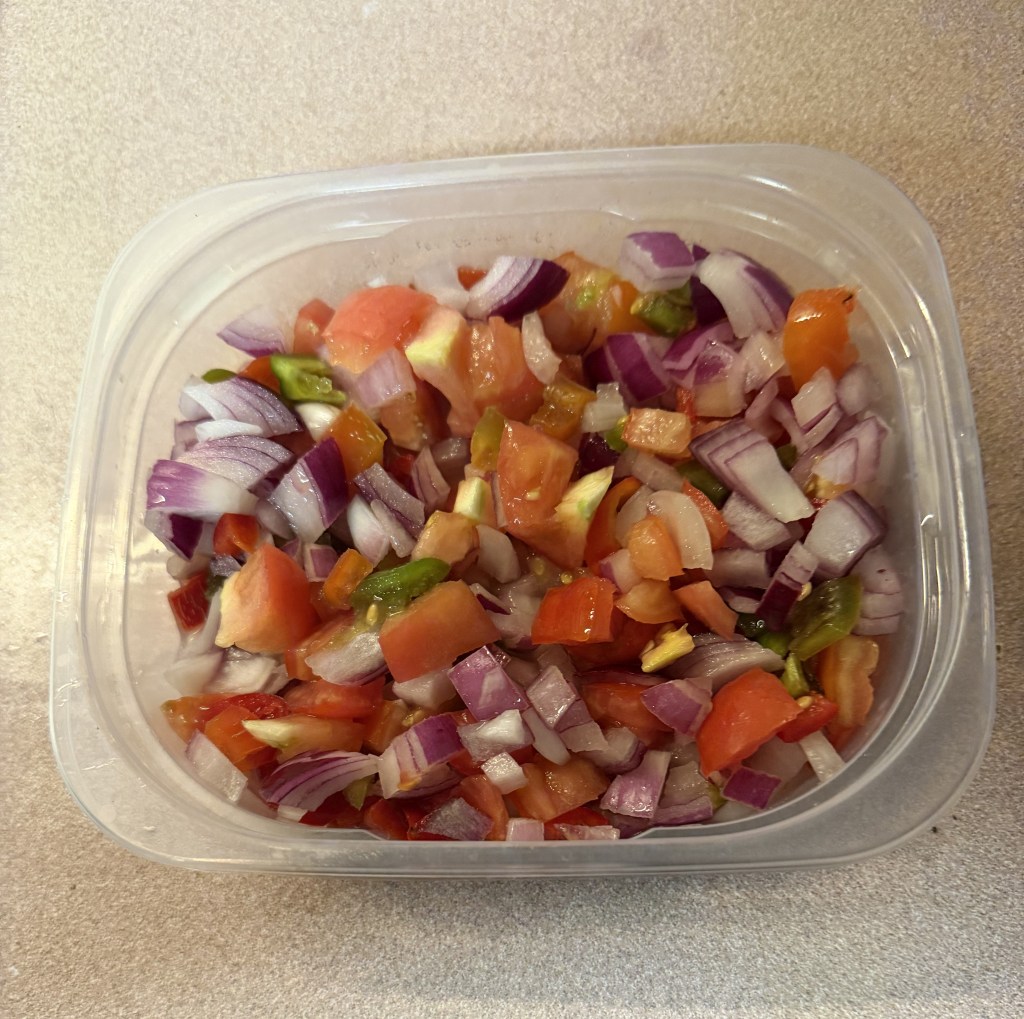
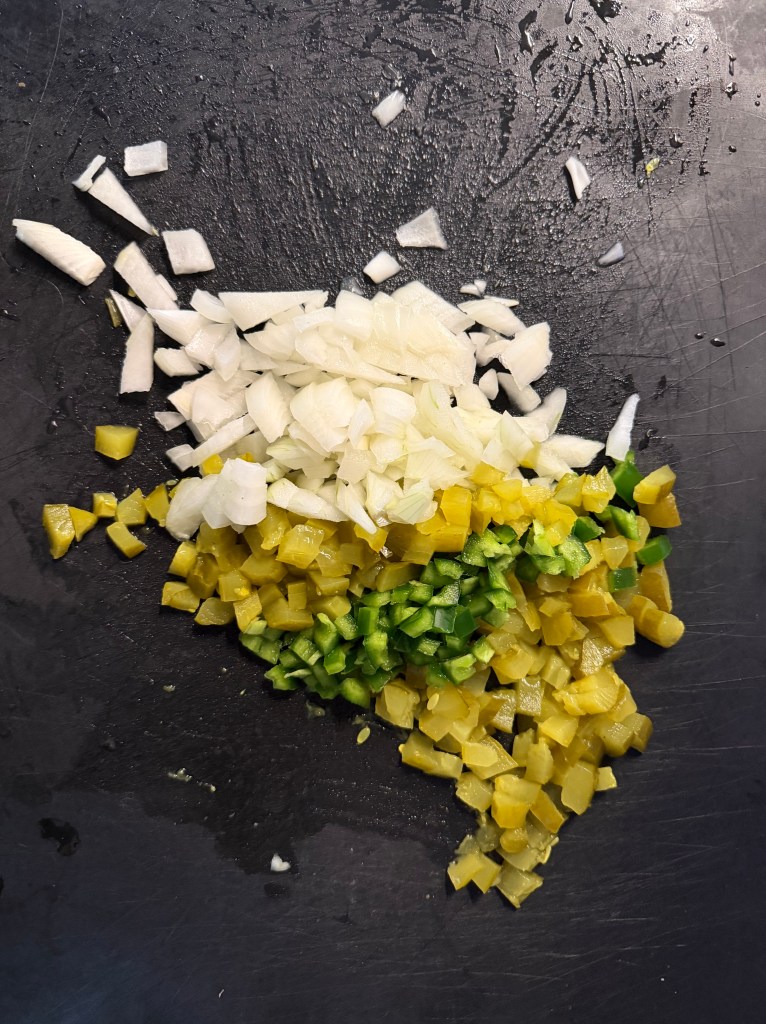
The Pickle de Gallo recipes I found were almost identical to the Pico de Gallo I have made every year since I started my garden five years ago.  This is usually made from early tomatoes (Solanum lycopersicum) and jalapeño peppers (Capsicum annuum).  This year I did not get an early crop, with almost no peppers and only enough tomatoes to make my pasta sauce (along with the green tomato Salsa Verde).  The difference between Pico and Pickle de Gallo is substituting pickles for tomatoes.  Chop the pickles jalapenos and onion (Allium cepa) into small pieces and mix in cilantro paste (Coriandrum sativum) and lime (Citrus aurantiifolia) juice.  I did not use spices as my canned dill pickles already had spices and garlic (Allium sativum).  The directions said to refrigerate the Gallo for at least 30 minutes to let the flavors mix.  I tried some with a chip and it was good (but different). 

THOUGHTS: Melissa is not a pickle fan and was not thrilled with the Pickle de Gallo.  I used an entire pint jar from my canning pantry (11 jars left).  The dills are good, but the storebought spice mixture is too salty for me and I wash the pickles before I eat them.  The advantage of making your own pickling mixture is you know what is in the brine.  I will probably make at least one more jar of the Pickle this year.  Even canned, pickles do not last forever once they are opened.  I enjoy trying new dishes made from the produce from my garden and the Pickle de Gallo is another way to use my crop.  Some of the dishes were excellent, and all were edible.  Approximately 40% of the food produced in the US is wasted, occurring at every stage of the food supply chain (from farm to home).  A large portion ends up in landfills and generates powerful greenhouse gas (methane).  The waste is compounded by the fact that 41 million Americans face food insecurity.  It reminds me of the sign at a buffet, “Take all you want, but eat all you take”.  We need to find ways to avoid wasting food and getting it to those in need.  Act for all.  Change is coming and it starts with you.
Salsa Verde

October 16, 2025

Last week I decided to harvest the last of my jalapeños (Capsicum annuum).  While they had been turning red (ripening) they were not getting over 2 inches (5 cm) long.  This gave me a dozen peppers that I stored in the refrigerator.  I have been waiting for the green tomatoes (Solanum lycopersicum) to ripen for the last several weeks.  I mentioned how the vines did not produce much fruit during the heat of summer.  Now that cooler weather is (intermittently) on us they have begun to make fruit.  The problem has been that most of it has stayed green.  Yesterday I resigned myself to the idea they will never ripen on the vine.  That left me wondering what to do with over 5 gallons (19 liters) of green tomatoes.  While making green tomato relish (“chow-chow”) or frying them was an option, I wanted something more ambitious (that I would eat).  One of the suggestions was to use green tomatoes as a substitute for the tomatillos (Physalis philadelphica and Physalis ixocarpa) found as the base for salsa verde.

When I went online, I found salsa verde (Spanish, “green sauce”) is a versatile green sauce with two main variations: Mexican and Italian. The type commonly found in Mexican and Tex-Mex cuisines is a spicy condiment made with tomatillos, while the classic Italian version is an uncooked, herbaceous sauce.  The Mexican version is a vibrantly green, tangy sauce featuring tomatillos and chili peppers that can be made by boiling or roasting the main ingredients.  For the boiled version, the tomatillos, chili peppers (Capsicum annuum), and sometimes onion (Allium cepa), and garlic (Allium sativum) are simmered in water until soft.  The softened ingredients are then blended with fresh cilantro (Coriandrum sativum), salt, and lime (Citrus aurantiifolia) juice to create a bright and fresh-tasting salsa.  The roasted version has a deeper, smoky flavor.  The tomatillos, chiles, onion, and garlic are roasted or broiled until they are blistered and charred and again blended with fresh cilantro, salt, and lime juice.  Italian salsa verde is a no-cook, chopped green sauce made from fresh herbs like parsley (Petroselinum crispum), basil (Ocimum basilicum), or mint (Mentha spicata).  This version is known for its fresh, savory, and tangy flavor and is typically served with meat or seafood.

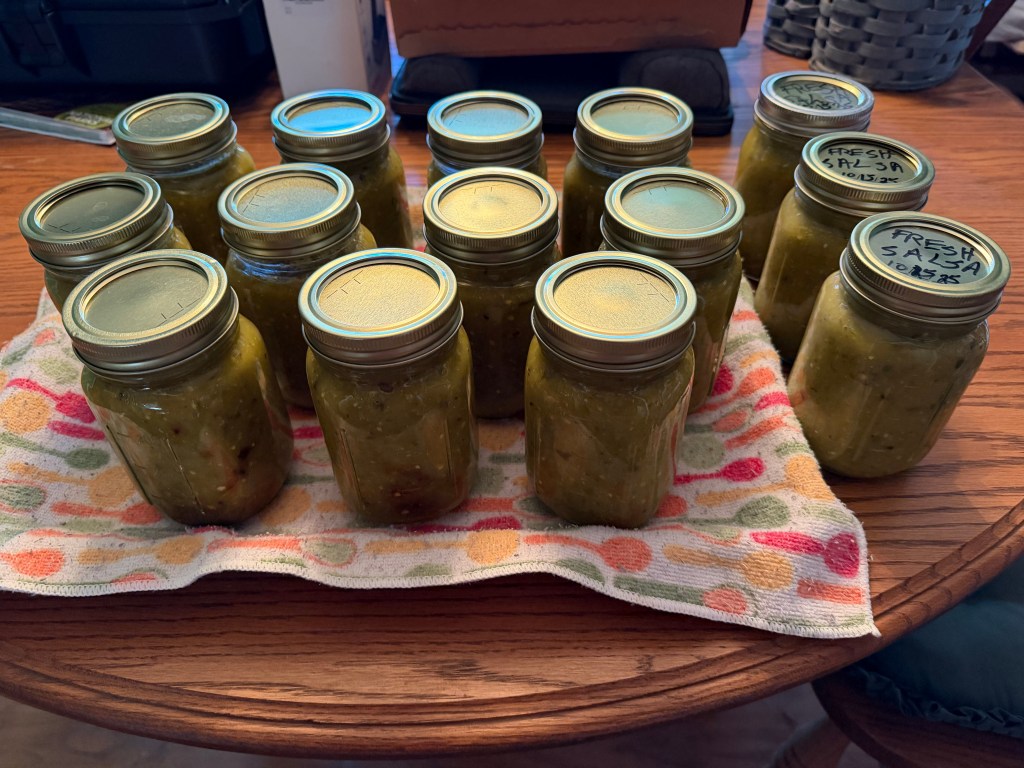
Melissa wanted to make a fresh salsa verde that is stored in the refrigerator.  The problem was it has a limited shelf life (2 to 3 weeks).  With the number of tomatoes we had there was no way to use all the verde before it would go bad.  I decided to make several pints of fresh verde and then can the rest.  We roasted the ingredients, and I used a hand blender to chop it, then blended in the lime juice, cilantro, and salt.  We filled 3 1-pint (0.47 liters) jars with the verde and set them aside.  Next, I prepared the verde for canning.  This required adding vinegar (for acidity) and cooking the mixture on the stove while the water bath was coming to a boil.  I can only get 6 or 7 pints in my water bath, which worked well as my largest pan could only hold about half of the verde mixture.  I processed the verde and set the jars on the dining room table to cool.  We produced 14 jars of salsa verde and an extra bowl of canning mixture (I ran out of pint jars).  I had some with a burrito and it was excellent.

THOUGHTS: Even though I harvested most of the green tomatoes to make salsa verde, I hedged and kept three vines in the ground.  The vines are filled with green tomatoes that I (still) hope will ripen.  If not, I can always make fried green tomatoes or chow-chow.  We plan on sharing some of the salsa verde with friends, but Melissa is looking forward to enjoying the verde as our main salsa until next season.  We now have half of a pantry shelf filled with the vegetables I have canned this year, taking us closer to being self-sustainable.  That is a good thing, as the second crop I planted in August has not faired well.  It may be the seed is pushing its limit (3 years old) and is no longer viable.  Always more to learn.  Act for all.  Change is coming and it starts with you.
Pressure

August 03, 2025

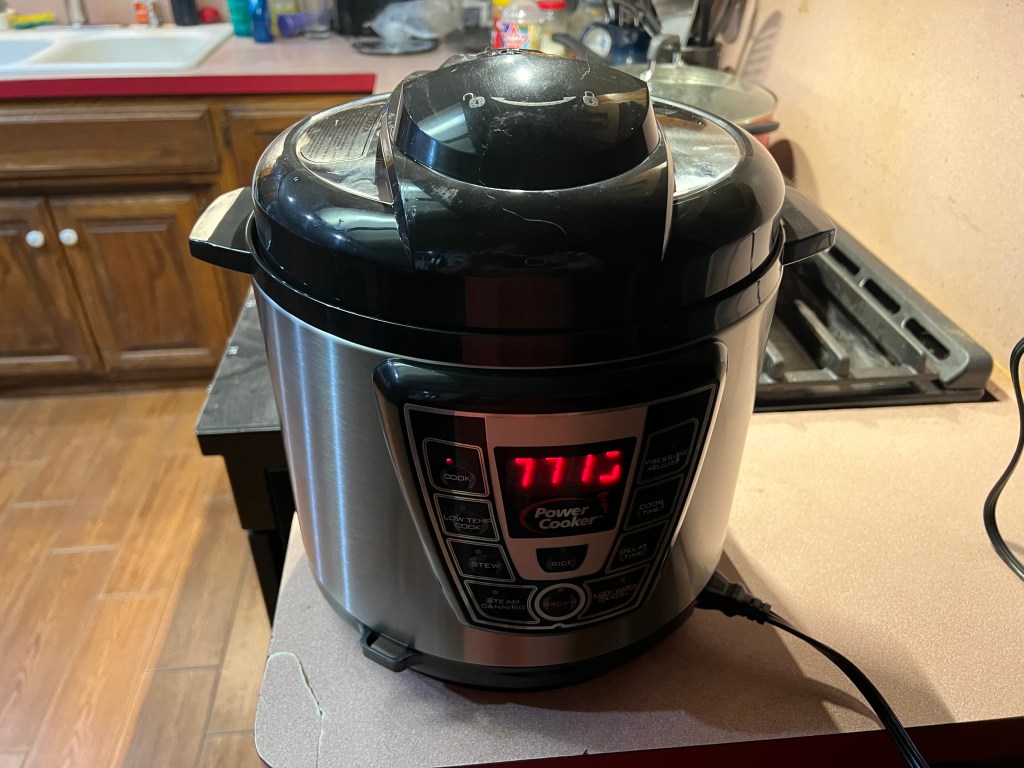
I decided I had enough tomatoes (Solanum lycopersicum) to make another batch of pasta sauce.  We used the last 2024 jar during January and have been using “store-bought” sauce.  I like the store brand, but it never seems as good as my home canned sauce.  The recipe calls for 25 pounds (11.3 kg) of tomatoes and makes around 10 quarts (9.5 liters) of sauce.  I never have that many tomatoes at one time, but I had prepped and frozen a gallon (3.8 liters) from a previous harvest and the cool(er) spell last week produced another burst of fruit.  This would give me 4 or 5 jars of sauce, so I adjusted the recipe accordingly.  I have been able to make my sauce using a water bath (boiling water) due to the higher acidity of the tomatoes.  Last week I had also prepared the carrots from my garden and the slices were sitting in the refrigerator.  I had been reluctant to can them because of their low acidity.  To can the carrots, I would need to do something I had never done before, use a pressure cooker.

When I went online, I found a pressure cooker is a sealed vessel for cooking food (pressure cooking) with the use of high-pressure steam and water or a water-based liquid.  The high-pressure limits the water from boiling and creates higher temperatures not possible at lower pressures.  This allows the food to be cooked faster than at normal pressure.  The prototype of the modern pressure cooker was the steam digester invented in the 17th century by the physicist Denis Papin.  The cooker worked by expelling air from the vessel and trapping steam produced from the boiling liquid.  The steam is used to raise the internal pressure up to one atmosphere above normal (ambient) and gives higher cooking temperatures between 212 F to 250F (100C to 121C).  Together with high thermal heat transfer from steam it permits cooking in between a half and a quarter of the time of conventional boiling while saving a considerable amount of energy.  Almost any food that can be cooked in steam or water-based liquids can be cooked in a pressure cooker. 

Modern pressure cookers have many safety features to prevent the pressure cooker from reaching a pressure that could cause an explosion.  After cooking, the steam pressure is lowered back to ambient atmospheric pressure so the vessel can be opened.  All modern devices also have a safety lock to prevent opening while the cooker is still under pressure.  According to the NY Times Magazine, 37% of US households owned at least one pressure cooker in 1950, but by 2011 that dropped to 20%.  This decline was attributed to a fear of explosion (rare with modern pressure cookers) and from competition by other fast cooking devices such as the microwave oven.  Today’s third-generation pressure cookers have many more safety features and digital temperature control, do not vent steam during cooking, and are quieter and more efficient.  These conveniences have helped make pressure cooking more popular.  I bought Melissa a third-generation electric pressure cooker (an odd gift?) before we were married.  I later found out she never used it. 

THOUGHTS: As I was making the carrots Melissa told me of her experience with an early pressure cooker.  She loved to watch her granny canning in the kitchen when she was a small girl.  Then one afternoon when she was three, the old-style first-generation pressure cooker exploded, sending hot water and glass everywhere.  Both her granny and mom wore glasses, but she did not, and glass got in her eyes.  A quick trip to the doctor removed all the glass, but neither she nor her mom ever watched granny using the pressure cooker again.  Even with the modern versions, her dad was the only one in the house who used one.  It took me a week to build up the nerve to use the pressure cooker.  I had never used one and had “heard the stories”.  I went online to learn how to operate it and found it easy to use.  I now have a new cooking method to add to my resume.  New things are generally only daunting if never tried.  Act for all.  Change is coming and it starts with you.

Tomato Pie

July 21, 2025

One of the advantages of having a garden is being able to step outside and pick fresh vegetables for the night’s dinner.  One of the disadvantages is trying to figure out what to do when large quantities of a particular vegetable ripen at the same time.  I have mentioned how I have plied family and friends with the bounty of my crops, along with taking several loads to the local food bank.  I have also learned to prepare, freeze, can, and preserve several different vegetables and even fruits.  Whether it is fresh or preserved, the real question becomes how is it going to be served?  There are always “go to” dishes that are the reason for a particular vegetable was grown, but having an abundance provides an opportunity to get creative.  That means when a new harvest happens, I pour over recipes on the internet searching for ideas.  Melissa has begun to cook meals more frequently.  While I tend to focus on the Midwestern meat n’ potato dishes I grew up with, Melissa falls back on her Southern heritage.  Several nights ago, she decided to make a Southern tomato pie.

When I went online, I found Southern tomato pie is a tomato dish popular in the Southern US (hence, the name).  The dish consists of a pie shell with a filling of tomatoes (Solanum lycopersicum), that are sometimes with basil or other herb), then covered with a topping of grated cheese mixed with either mayonnaise or a white sauce.  Tomato pie is considered a summer dish that is to be made when tomatoes are in season.  While tomato pie has its roots in Italian American cuisine, and particularly Philadelphia, it has become a popular and classic dish in the South during the summer months when tomatoes are at their peak.  Southern tomato pie is enjoyed both as a main course and a side dish, and is a staple at potlucks, picnics, and casual gatherings.  A sweet version called green tomato pie uses buttered and sugared green tomatoes, with a recipe dating at least as far back as 1877.  The taste of green tomato pie is comparable to green apple pie.  The sweet version is less common than the savory Southern tomato pie.  In the US, tomato pie may also refer to some types of pizza, like Sicilian pizza (originated in Sicily), Italian tomato pie (thick dough with tomato sauce on top).  In its simplest form, a Philly tomato pie is pizza with no cheese.

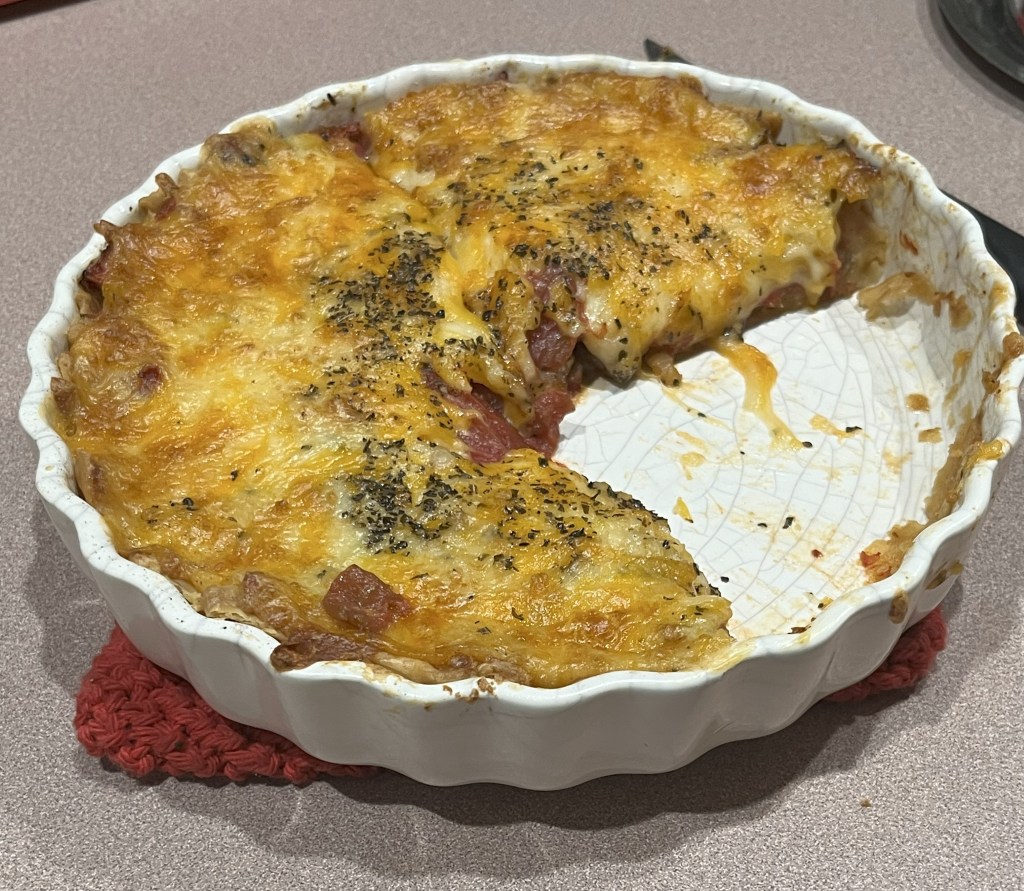
When Melissa told me she was going to make tomato pie for dinner, I had my doubts.  Not being from the South, I had never tried tomato pie and wondered about the taste of eating a bunch of baked tomatoes.  Being a meat n’ potato person, I also recognized there was no meat.  Still, this was a way to sample one of Melissa’s family dishes, and to take on the growing number of tomatoes sitting on our kitchen counter.  The pie starts with a baked pastry shell.  Several large beefsteak tomatoes (we used Cherokee Purple) are peeled, cut into thin slices, and layered in the shell.  Salt and pepper, basil, and chopped chives are sprinkled on the tomatoes to taste.  Mayonnaise (always Duke’s if truly Southern) and grated cheese are mixed and spread over the top.  The pie is popped into a pre-heated 400F (200.4C) oven and baked for 30 to 35 minutes.  The pie did look good and tasted better.

THOUGHTS: My trepidation around eating my first Southern tomato pie was mitigated when Melissa chose to make it a side dish, with the entrée being fried chicken strips, mashed potatoes, and gravy.  Knowing my protein was secure, I admitted the pie was good.  My Midwestern bent and Melissa’s Southern come from the comfort food we each grew up with.  The term comfort food can be traced back to 1615 (at least) where in the beginning of the second part of Don Quixote his niece and her nurse/governess are told “to give him things to eat which are comforting and appropriate for the heart and the brain.”  Comfort food provides a nostalgic or sentimental value to a person or a specific culture.  Sampling another’s comfort may also provide insight into their soul.  Act for all.  Change is coming and it starts with you.
Carrot Cake

July 15, 2025

I have mentioned the great number of cucumbers and carrots I harvested from this year’s garden.  After taking a load of cucumbers to the food Bank I thought I would try and share the wealth by bringing a basket filled with both to a potluck on Sunday.  Although this could provide fresh vegetables, it would not do much for the meal itself.  Having lived in different parts of the country I have noticed regional variations in potluck customs.  Since this was going to be my first Arkansas potluck, I did not know what to expect.  The potlucks I attended people have mostly brought side dishes, with fewer entrees and desserts.  The organizations hosting the potluck often provide a main meat dish to make sure there is at least some protein.  Since I had a lot of carrots, I decided to make something to feature them.  Cooked or even glazed carrots did not sound like the zing I wanted to bring.  What I decided was to make carrot cake.

When I went online, I found carrot cake (also known as pastel de zanahoria) is a cake that contains carrots mixed into the batter.  While the origin of carrot cake is disputed there is an English recipe published in 1591 for “pudding in a Carret [sic] root”.  This is essentially a carrot stuffed with meat, but it includes elements common to the modern dessert.  That includes shortening, cream, eggs, raisins, sweetener (dates and sugar), spices (clove and mace), scraped carrot, and breadcrumbs (in place of flour).  Many food historians believe that carrot cake originated in the carrot puddings eaten by Europeans in the Middle Ages when sugar and sweeteners were expensive and many people used carrots as a substitute for sugar.  In volume two of L’art du cuisinier (1814), Antoine Beauvilliers, former chef to King Louis XVI, included a recipe for a “Gâteau de Carottes” which was popular enough to be copied verbatim in competitors’ cookbooks.  Beauvilliers published an English version of his cookbook in London (1824) which includes a recipe for “Carrot Cakes” in a literal translation of his earlier recipe.  The popularity of carrot cake was revived in the UK because of sugar rationing during WWII along with government promotion of carrot consumption.

My carrot cake mix became a conglomerate dessert.  I bought a white cake mike and tub of cream cheese frosting several weeks ago when I had a craving for a cupcake.  It seems almost impossible to find one cupcake in a store (my sister later reminded me I could have gone to a bakery).  I ended up not making the cupcakes for the same reason, I did not want 24, just one.  The potluck was different.  I could bring the dish, eat my one cupcake, and share the rest.  I took the boxed cake mix and added cinnamon, nutmeg, egg whites, candied pecans (it is The South, everyone keeps a batch in the fridge), and a cup of grated carrots.  I also added cinnamon and nutmeg to the frosting mix to give it an extra umph.  I only had 18 cupcake tins, so I turned the rest of the batter into a small carrot cake for Melissa and myself.  I arranged the 18 cupcakes in a large corning ware roaster dish and brought them to the party.  Walking in from the car the platter slipped and shattered in the street.  That was the end of my carrot cake cupcakes.

THOUGHTS: Without my carrot cake cupcakes, I felt bad about going to the potluck without a dish.  I told myself, “At least I have the vegetables to give away.”  I labeled them as giveaway and provided paper bags to take the vegetables home.  At the end of the meal not one was gone and I took them all home.  The first potluck I attended when I lived in Utah had another twist.  A friend and I both arrived “fashionably late” and ended up walking in together.  As we came through the door the host exclaimed, “They are here, now we can eat!”  Apparently, the custom was to arrive early and start the event “on time”.  Getting to know customs can be a matter of trial and error.  It could be more efficient to ask.  Act for all.  Change is coming and it starts with you.