July 15, 2025
I have mentioned the great number of cucumbers and carrots I harvested from this year’s garden. After taking a load of cucumbers to the food Bank I thought I would try and share the wealth by bringing a basket filled with both to a potluck on Sunday. Although this could provide fresh vegetables, it would not do much for the meal itself. Having lived in different parts of the country I have noticed regional variations in potluck customs. Since this was going to be my first Arkansas potluck, I did not know what to expect. The potlucks I attended people have mostly brought side dishes, with fewer entrees and desserts. The organizations hosting the potluck often provide a main meat dish to make sure there is at least some protein. Since I had a lot of carrots, I decided to make something to feature them. Cooked or even glazed carrots did not sound like the zing I wanted to bring. What I decided was to make carrot cake.
When I went online, I found carrot cake (also known as pastel de zanahoria) is a cake that contains carrots mixed into the batter. While the origin of carrot cake is disputed there is an English recipe published in 1591 for “pudding in a Carret [sic] root”. This is essentially a carrot stuffed with meat, but it includes elements common to the modern dessert. That includes shortening, cream, eggs, raisins, sweetener (dates and sugar), spices (clove and mace), scraped carrot, and breadcrumbs (in place of flour). Many food historians believe that carrot cake originated in the carrot puddings eaten by Europeans in the Middle Ages when sugar and sweeteners were expensive and many people used carrots as a substitute for sugar. In volume two of L’art du cuisinier (1814), Antoine Beauvilliers, former chef to King Louis XVI, included a recipe for a “Gâteau de Carottes” which was popular enough to be copied verbatim in competitors’ cookbooks. Beauvilliers published an English version of his cookbook in London (1824) which includes a recipe for “Carrot Cakes” in a literal translation of his earlier recipe. The popularity of carrot cake was revived in the UK because of sugar rationing during WWII along with government promotion of carrot consumption.
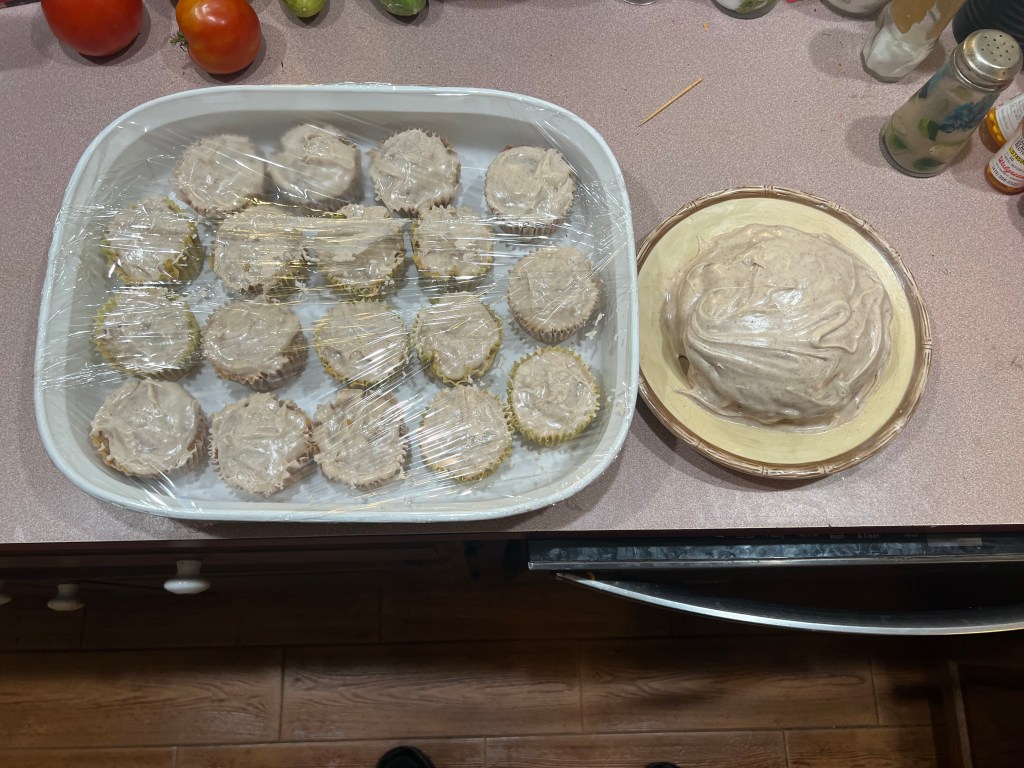
My carrot cake mix became a conglomerate dessert. I bought a white cake mike and tub of cream cheese frosting several weeks ago when I had a craving for a cupcake. It seems almost impossible to find one cupcake in a store (my sister later reminded me I could have gone to a bakery). I ended up not making the cupcakes for the same reason, I did not want 24, just one. The potluck was different. I could bring the dish, eat my one cupcake, and share the rest. I took the boxed cake mix and added cinnamon, nutmeg, egg whites, candied pecans (it is The South, everyone keeps a batch in the fridge), and a cup of grated carrots. I also added cinnamon and nutmeg to the frosting mix to give it an extra umph. I only had 18 cupcake tins, so I turned the rest of the batter into a small carrot cake for Melissa and myself. I arranged the 18 cupcakes in a large corning ware roaster dish and brought them to the party. Walking in from the car the platter slipped and shattered in the street. That was the end of my carrot cake cupcakes.
THOUGHTS: Without my carrot cake cupcakes, I felt bad about going to the potluck without a dish. I told myself, “At least I have the vegetables to give away.” I labeled them as giveaway and provided paper bags to take the vegetables home. At the end of the meal not one was gone and I took them all home. The first potluck I attended when I lived in Utah had another twist. A friend and I both arrived “fashionably late” and ended up walking in together. As we came through the door the host exclaimed, “They are here, now we can eat!” Apparently, the custom was to arrive early and start the event “on time”. Getting to know customs can be a matter of trial and error. It could be more efficient to ask. Act for all. Change is coming and it starts with you.