Anoka

November 03, 2025

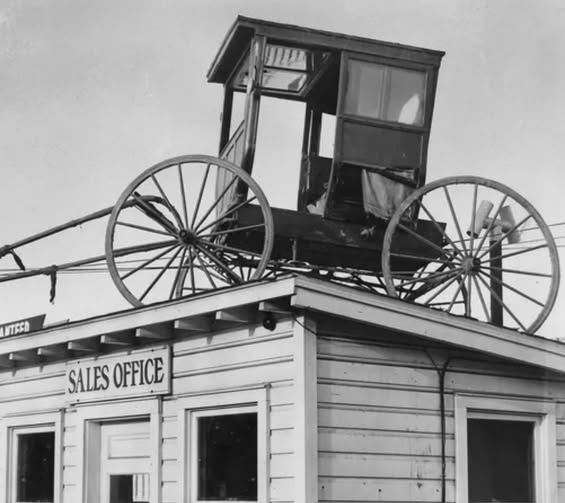
Last Friday my local newspaper printed a USA Today article on the pranks that sparked a Halloween tradition in Minnesota.  The tradition began in the aftermath of particularly bad pranks in 1919.  Residents would wake the next day to find windows soaped, cows roaming the streets, outhouses set afire or tipped over, and carriages taken apart and reassembled on the rooftops of buildings.  This was not new, and many cities and towns were considering banning Halloween celebrations because the pranks had turned to outright vandalism.  The city leaders took another approach and rather than forbidding celebration, they organized a night parade as part of civic celebrations to keep the young troublemakers busy.  More than a century later Anoka, Minnesota has dubbed itself the “Halloween Capital of the World”.

When I went online, I found Anoka is believed to be the first city in the US to put on a Halloween celebration to divert its youngsters from Halloween pranks.  In 1920, George Green and other Anoka civic leaders suggested the idea of a giant celebration.  The idea was adopted by the Anoka Kiwanis Club and Anoka Commercial Club, which both gave their full support and a Halloween committee was organized.  Teachers from the public and parochial schools partnered with the businessmen, parents, and students.  More than a thousand Anoka school children made plans and costumes for the big event.  The evening opened with a parade with bands, the police and fire departments, National Guard, and 500 costumed marchers.  That was followed by a give-away of hundreds of bags of popcorn, candy, peanuts, and other treats to the children who had marched in the parade.  The celebrations have been held every year since 1920, except for 1942 and 1943 when the festivities were canceled because of World War II.  The “Anoka Halloween Capital of the World” celebration has grown to include units from all over the Midwest.

Anoka was not the only city to be plagued by Halloween tricks.  The Celtic traditions of All Saints Day (Alholowmesse in Middle English) and All Hallow’s Eve the night before to become known as Halloween.  The night grew in popularity in the US during the 1840’s with the immigration of Scottish and Irish to America.  They also brought a love of prank playing and carving a gourd with a glowing face.  By the early 1900’s the pranks morphed into leaving manure on the front porch or making frightening noises with a spool-and-stick (tick tack) to make noises on neighbors’ windows.  As America urbanized the pranks became more destructive.  Nine boys were detained in Kansas City in 1919 for waxing the streetcar tracks and causing a crash.  Trick or Treat took on a new meaning. 

THOUGHTS: While it did not have the longevity of the Anoka celebration, my High School football team had a tradition of bringing our line coach’s car into the gym lobby.  The lobby had a mosaic of the team mascot which the seniors “polished” with the bodies of anyone who accidentally stepped on it (unsuspecting Sophomores).  The car was brought inside around Halloween by the large linemen under the tutelage of the coach.  The coach drove a VW beetle (which made it doable) which was literally picked up and carried through the gym to rest on the logo.  Both these traditions went away during my Senior year when the administration had enough and placed a short metal fence around mosaic.  In 1920, the Anoka celebration included the release of chickens into the crowd for revelers to capture and take home.  The Anoka County Union declared, “We don’t know if the chickens enjoyed the sport, but the crowd did.”  The chicken release of Anoka, the bodily polishing at my High School, and the Halloween pranks were seen as fun until someone stepped in to control the mayhem.  Anoka showed control does not have to mean exclusion of liberties.  We should revisit that revelation.  Act for all.  Change is coming and it starts with you.
Trails

October 10, 2025

We had decided to take our second trip out in our newly acquired RV just as the US government decided it was not in their (our?) best interest in keeping the government operational.  While many of the National Parks are at least partially open, we learned the Corp of Engineers location we planned to visit was shut down.  We have some neighbors who were also planning on the same trip and learned they had booked a private location about an hour away.  We already had two events scheduled for the week and thankfully these were both centrally located to the RV Park.  Melissa made reservations and we took off Tuesday morning.  The park described itself as “rustic”, and when our neighbors arrived, they called to make sure we were comfortable with what that meant.  Melissa and I both thought the unpaved location along the Mulberry River was going to be perfect.  There was even a trail/road that led back along the river that was perfect (and away from other campers) for walking the kids.  The trail provided a moderate walk that wound through the trees and wildflowers.

When I went online, I found a trail, also known as a path or track, is an unpaved lane or small paved road generally not intended for usage by motorized vehicles, and usually passing through a natural area.  However, it is sometimes applied to highways in North America.  In the UK and Ireland, a path or footpath is the preferred term for a pedestrian lane or hiking trail.  In the US historically, the term was used for a route into or through wild territory used by explorers and migrants (i.e., the Oregon Trail).  A “trace” is sometimes used as a synonym for trail (i.e., the Natchez Trace).  Some trails are restricted to only walkers, or cyclists, or horses (equestrians).  During the winter these same trails can be used for snowshoeing or cross-country skiing.  Others, like the bridleways in the UK, are shared and are jointly used by walkers, cyclists, and equestrians.  Although most trails ban motorized use, there are unpaved trails used by dirt bikes, quad bikes, and other off-road ehicles.  This is especially true for extreme sports and rally races.  In places like the mountainous Europe (Alps), trails are also used by alpine agrarian communities for moving cattle and other livestock.

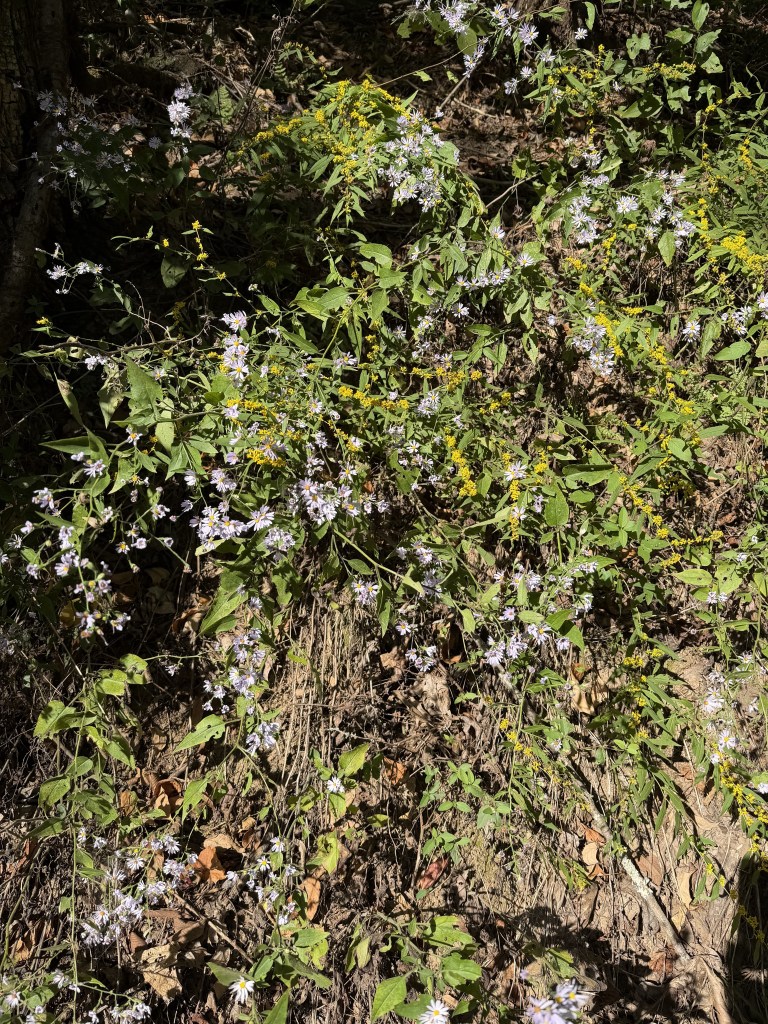
Over the last several days I have been walking the trail along the river marveling at the amazing views.  The track passes above the river and in places rises on the bluffs that overlook the water.  Being an avid fisherperson, this has given me pause to dream of climbing down the slope and fishing the fast water and pools that dot the river’s course.  Several days I did exactly that, although I did so by following the rocks at th e water’s edge.  My other pleasure has been seeing the patches of Tatarian Aster (Aster tararicus) and goldenrod (genus, Solidago) that line the trail.  This is the freedom and escape we had hoped to find when we decided to start RVing.

THOUGHTS: Following most modern-day trails is a far cry from the trails that cut through the thick forests and lush grassland that filled North America when the European explorers and settlers first arrived.  These trails possessed unseen dangers (animals and nature) along with the impressive beauty.  Still, I can get a glimpse of the wonder of days gone by.  We need to work hard, an together, to preserve those areas that still exist for future generations to enjoy.  Act for all.  Change is coming and it starts with you.

Paddle Tribal

September 19, 2025

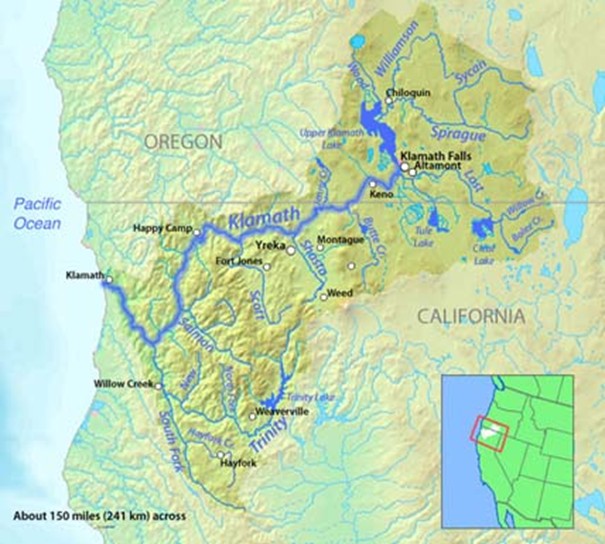
Inside the front section of my local newspaper was a USA Today article following up on a blog I posted a year ago on the dam removal along the Klamath River in California/Oregon.  The Klamath had been pushed to the point of extinction with construction of two hydroelectric and two reservoir dams.  A key tributary was channelized resulting in massive amounts of phosphorus flowing into the lake and lower river.  The dams deprived the Chinook (Oncorhynchus tshawytscha) and threatened coho (Oncorhynchus kisutch) salmon and other fish species from reaching the headwaters to spawn.  Dam removal began in 2024.  This initially released millions of tons of accumulated sediment but began a natural part of the river’s restoration.  The salmon many said would never return appeared upstream almost overnight.  This summer members of the Yurok Tribe were joined by other tribal participants to take a historic 310-mile kayak journey from Klamath Falls to the Pacific Ocean. Central to this trek were the teenage participants in the Paddle Tribal Waters program.   

When I went online, I found the Paddle Tribal Waters program was formed in July of 2022 as a collaboration of the groups Ríos to Rivers and Maqlaqs Paddle.  The program started with a two-and-a-half-week kayak and river advocacy training program for 15 Indigenous youth from the Klamath Basin and continued with weekend kayaking trips and kayak roll training sessions.  The program continued in the summer of 2023 with a second cohort of 15 Native students participating and a third cohort in in the summer of 2024 with 13 participants, for a total number of 43 indigenous youth completing the beginner program.  In January 2024, the first two cohorts combined to participate in a semester-long kayak training and high school program that Ríos to Rivers created in collaboration with World Class Kayak Academy.  The semester-long kayaking and high school program is key to setting these students on the path to truly having the skills needed to make the first descent of the Klamath.  The long-term vision of the Paddle Tribal Waters program is to support the youth who participated in the first descent of the Klamath to go on to create tribally led river programs in their communities.  The descent was completed in September 2025.

Another of the Paddle Tribal Waters programs’ goals is continued restoration and conservation of the entire Klamath Basin.  Wetlands need to be restored to impound the phosphorus and prevent the growth of deadly algae.  Much of this comes from the extinct volcanoes at the head of the Sprague River around Mount Mazuma.  The channeling needs to be replumbed to bring back the meandering stream and water plants to hold back the phosphorus.  Two other dams still bar salmon migration as the fish ladders constructed by the Bureau of Reclamation were not built to accommodate large fish.  Wetland removal from the Upper Klamath Lake and some of its tributaries allow the toxic algae to feast off the phosphorus and suffocate the fish.  Ashia Wilson, member of the Klamath Tribe at the rivers’ headwaters, said the Upper Klamath is still too toxic to touch, even as the kayakers paddled their way to the mouth.  The endemic c’waam (Deltistes luxatus) or lost river sucker, and the koptu (Chasmistes brevirostris) or short nosed sucker, used to feed the tribe but are now endangered. 

THOUGHTS: The arrival of the small Paddle Tribal Waters group of natives and their allies marked a milestone.  Removal of the four dams (all beyond their service life) will make restoration of the rest of the basin possible.  An ending ceremony at Requa and a celebration the next day in Klamath told of the 20-year struggle to restore the river and seemed to suggest anything is possible.  The wetlands of headwaters and river deltas are critical habitat and must be both preserved and restored.  Act for all.  Change is coming and it starts with you.
Invasion

August 22, 2025

@Elijah Nouvelage, Reuters

Inside the back section of my local newspaper was a USA Today article on and invasion taking place in the San Jaquin Valley, California.  This month’s newsletter by the Almond Board of California said the infestation has impacted more than 100,000 acres of almond trees and caused US$109 million to US$311 million in losses from damage to equipment and crops over a year.  The valley is one of the world’s top agricultural regions.  The invasion started last fall and took growers by surprise.  Now they are still scrambling to figure out how to repel the intruders, often turning to Roger Baldwin, a rodent expert with the University of California, Davis, where he is a cooperative extension professor.  Baldwin used to get fewer than one inquiry a year, but he said, “There are inquiries and questions about doing interviews on rat control and giving seminars on rat control, and can I write articles about this.”  His phone buzzes with requests from farmers, journalists, and others seeking expertise on how to control the rat invasion on the state’s US$4.7 billion almond industry.

When I went online, I found the brown rat (Rattus norvegicus), also known as the common rat, street rat, sewer rat, wharf rat, Hanover rat, Norway rat, and Norwegian rat, is a widespread species of common rat known to create periodic invasions in other parts of the world.  The island of Taukihepa (Maori) or Big South Cape Island (European) is an offshore island of New Zealand to the west of the southern tip of Rakiura or Stewart Island.  The island has no permanent inhabitants but is visited by Maori hunters (muttonbirders) in search of sooty shearwaters (Ardenna grisea), known in New Zealand as “muttonbirds”, that came to nest on the island in the spring.  The muttonbirders arrived in March 1964 to find the island devastated by rats.  Previously free of mammalian predators, the ecology of the island was overwhelmed in a matter of years.  Many endemic species of bird (some flightless) were driven to extinction and the surviving insect and bird life heavily reduced.  An eradication program was initiated to rid the island of rats, and the island was rat-free again in 2006.

The exact cause of the California rat invasion is unclear, but it may have been spurred by abandoned fields.  California accounts for more than 75% of the global almond production and exports 70% of its output to 100-plus countries, with India as the leading customer.  Rats have always been a bigger problem at citrus orchards but have now developed a taste for nut trees.  Baldwin and others say the shift comes from three contributing factors.  A protracted drought and diminishing water supplies in the early 2020’s left over half a million acres (202,343 ha) in California unplanted.  That also meant there was no pest control in those fields.  The drought ended in the winter of 2022-23 and began a three-year spell of at least average rainfall bringing vegetation growth and an abundance of food resources.  State restrictions on pesticides have also limited the means growers have for getting rid of rodents.  The rats are joined by five species of squirrels (family, Sciuridae), deer mice (genus, Peromyscus), and others, but rats have by far been the most destructive.  Some farmers say they have spent hundreds and even thousands of US dollars per acre on rat control over the last year.

THOUGHTS: Invasive plants and animals can quickly expand to the level of an invasion if left unchecked.  Humans have tried to control the invasion using biological and pesticide controls.  The biological fixes have a record of resulting in an invasion of their own.  Globalization has brought an influx of goods and services to every corner of the earth.  It has also resulted in the destruction of ecosystems in these same areas.  While we may never reverse these effects, we can be vigilant in choosing what to purposefully spread and curtailing any negative aspects that may result.  Act for all.  Change is coming and it starts with you.
Digger

August 21, 2025

Following my disappointment fishing while at the coast last week I decided to walk through the beach community and see if I could spot some birds that were not yet on my list.  I took the road through the community first to try and spot land birds.  I was able to see two species I already recorded, an American Crow (Corvus brachyrhynchos) and a flock of house sparrows (Passer domesticus).  It was not until I returned along the beach that I picked out several forms of gulls (California gull, Larus californicus; western gull, Larus occidentalis; short-billed gull, Larus brachyrhynchus) and a flock of white-winged scoter (Melanitta deglandi) ducks.  The beaches along the Puget Sound tend to be small well-worn rock rather than the sand I associat with other coasts.  This is harder to walk on, and it took me a while to get back to the house.  When I arrived, my daughter-in-law showed me a picture of the unusual wasp they had encountered on their beach walk (other direction).  It was a large golden digger sand wasp.

When I went online, I found the golden digger sand wasp (Sphex ichneumoneus), or great golden digger wasp or great golden sand digger, is a wasp in the family Sphecidae.  The wasp’s name comes from the Greek word for “tracker,” and is most well-known for its parasitic nesting behavior.  It is identified by the golden pubescence on its head and thorax (chest), its reddish orange legs, and partly reddish orange body.  Golden hairs cover the head and thorax (hence “golden”).  The digger has a long, slender waist (petiole).  Their hind region (metasoma) is black with the first couple of segments a brilliant orange-red that matches their legs.  Size varies from 1/2 to over 1 inch (1-1/4 to 2.5+ cm) long.  This wasp is native to the Western Hemisphere, from Canada to South America, and provisions its young with various types of paralyzed Orthoptera (grasshoppers and crickets). 

From May through August, great golden digger wasp females build their nests in sandy soils.  These consist of a descending shaft and side chambers for the young at right angles.  This makes it difficult to pull prey into a brood chamber without getting stuck and is one possible reason why the wasp always checks to ensure the path is clear before pulling its prey down by its antennae.  Female wasps commonly build their burrows nearby those of other females of their species and may even share a nest.  However, they will fight other wasps if they encounter them inside their burrow during prey retrieval.  By inspecting the unattended nest, the wasp avoids risking an encounter with another wasp while carrying its prey.  The digger will track and hunt their prey (i.e., tracker) and sting it with a paralyzing venom that keeps it alive, then flies (or drags) the prey to the nest.  At the nest the digger wasp lays down their paralyzed prey and enters her tunnel and checks to ensure that all is well.  Then she brings the prey down into a side chamber, lays an egg on the prey, and seals the chamber.  When the egg hatches it feeds on the prey through the winter, and the new wasp emerges from its side chamber in the spring and begins the cycle again. 

THOUGHTS: The golden digger sand wasp is like the cicada killer (Sphecius speciosus) I saw last week in Arkansas.  Both are large, solitary, build nests in the ground, are harmless to humans, and do not defend their nest or behave aggressively.  While they have stingers, they rarely sting humans unless they are stepped on.  The digger is a pollinator that preys on insects that are harmful and are helpful to have around your garden (or beach house!).  These are possibly the only wasps known to be attacked by birds.  House sparrows and American robins (Turdus migratorius) will attack to force the digger to drop its prey for the bird to eat.  I guess both the young and the birds are looking for an easy meal.  Act for all.  Change is coming and it starts with you.
Sea Lion

August 17, 2025

One of the joys of visiting family is being able to spend time on the ocean coast.  My sister lives in Maine and we always take time to visit the ocean for at least one day during the trip.  My son’s family lives near Seattle and has a beach house near the Tulalip Tribe’s reservation.  This weekend we were able to go to Seattle and spend two days on the coast.  The first day my young grandson took me fishing on the rock beach behind their house.  He made two casts and immediately caught a 6-inch (15 cm) sculpin (Hemilepidotus spinosus).  After two more casts, he offered the pole to me.  I took several casts and did not get a bite.  My grandson seemed to get bored and went back to play at the house.  I kept casting for another 10 minutes and did not get a bite the entire time.  I gave up and went to sit on the deck and watch the beautiful sunset.  After several minutes my daughter-in-law noticed a sea lion had ventured into our part of the bay and was bobbing up and down in the channel.

When I went online, I found the California sea lion (Zalophus californianus) is a coastal eared seal native to western North America.  It is one of six species of sea lions.  It has a natural habitat range from southeast Alaska to central Mexico, including the Gulf of California.  California sea lions are sexually dimorphic with the males being larger than females. Males have a thicker neck and a protruding ridge of bone lengthwise along the top of the skull (sagittal crest).  The animals will mainly haul out on sandy or rocky beaches, but they also frequent manmade environments such as marinas and wharves.  Sea lions feed on several species of fish and squid and are preyed on by orcas and great white sharks.  The sea lions have a polygynous (multiple partners) breeding pattern.  Males establish territories from May to August and try to attract females to mate.  Females are free to move between territories and are not coerced by males.  Mothers nurse their pups in between foraging trips.  California sea lions use many vocalizations, but most notably barks and mother-pup contact calls.  Outside breeding season, California sea lions spend much of their time at sea but come to shore to molt.  The International Union for Conservation of Nature (IUCN) lists the species as Least Concern due to its abundance.  Oregon and Washington states engage in annual kill quota to protect the fish.

When I woke up the following morning, I decided I would try my luck with fishing again.  When I fished yesterday it had been high tide (the best time to catch fish on this beach).  Now it was low tide.  Undeterred, I took the poll and strode to the water’s edge and began to cast once more.  I found out why it is best to fish at high tide almost immediately.  On nearly every cast I fouled my hook in the lush beds of eel grass (Zostera marina) that covered the bottom of the channel.  Besides providing excellent forage for the California sea lions, the sea grass meadows provide food and shelter for juvenile fish, Dungeness crabs (Metacarcinus magister), the Pink (Chlamys rubida) and Spiny Scallops (Chlamys hastata). and other marine life.  They serve as a food source for herbivores during the growing season and for things that feed on the decomposing grass (detritivores).  The seagrasses absorb carbon dioxide, filter polluted runoff, absorb excess nutrients (nitrogen and phosphorus), stabilize sediments, and improve water flow. 

THOUGHTS: One of the questions I was frequently asked after moving from California’s Bay Area to southcentral Kansas was if it was any different where I used to live.  I rented a house at a marina on the bay with a boat slip out my back door.  My stock answer was, “well, I have not been greeted by the sound of a sea lion when I wake up in the morning.”  While not getting any bites the second day, I spotted a sea lion pup and mother foraging nearby.  It was good to know I was in a healthy ecosystem.  We need to do what we can to keep them that way.  Act for all.  Change is coming and it starts with you.
Outburst

August 16, 2025

A USA Today article reported how water from a melting glacier has caused a river near Alaska’s capital city of Juneau to swell to historic levels.  As of August 13th, emergency barriers protecting Juneau appear are holding.  The risk from summer glacial flooding is on the rise as climate change increases temperatures, causing more ice to melt.  Lakes form behind the unsteady dams made of ice and when these dams fail, the water rushes out, often resulting in catastrophic downstream flooding.  The ice dam lake near Juneau ice is called Suicide Basin, which is part of the Mendenhall Glacier.  If it collapses from summer heat it will release the water in a short period of time.  Aaron Jacobs, a hydrologist at the National Weather Service office in Juneau, said as these events continue to unfold, scientists need to continue to improve their understanding of these glacial systems, especially as the climate continues to change and warm throughout Alaska.  Glacial lake outburst flooding is produced by the quick, unexpected release of water from a glacial lake.

When I went online, I found a glacial lake outburst flood (GLOF) is a type of outburst flood caused by the failure of a dam containing a glacial lake. A similar event where the ice melts and overflows the glacier is called a jökulhlaup.  The dam can consist of glacier ice or previous glacial deposits (moraine).  Failure can happen due to erosion, buildup of water pressure, an avalanche of rock or heavy snow, an earthquake, or by a sudden cracking action in frozen soil or rock saturated with water or ice (cryoseism), volcanic eruptions under the ice, or massive displacement of water in a glacial lake when a large portion of an adjacent glacier collapses into it.  Increasing glacial melting because of climate change along with melting of the permafrost means regions with glaciers are likely to see increased flooding risks from GLOFs.  This is especially true in the Himalayas where geologies are more active.  A 2023 study found 15 million people at risk from this hazard, mostly in China, India, Nepal, Pakistan, and Peru.

Glacial lake volumes vary but may hold millions (35,314,666+ cubic feet) to hundreds of millions of cubic meters (3,531,466,600+ cubic feet) of water.  Catastrophic failure of the ice or glacial sediment containing the water can be released over periods of minutes to days.  Peak flows as high as 529,720 cubic feet (15,000 cubic meters) per second have been recorded in such events.  This suggests the v-shaped canyon of a normally small mountain stream could suddenly develop an extremely turbulent and fast-moving torrent of water some 160 feet (50 m) deep.  Glacial Lake Outburst Floods are often compounded by a massive riverbed erosion in the steep moraine valleys resulting in flood peaks increasing as they flow downstream until the sediment deposits.  On a downstream floodplain, it suggests a somewhat slower inundation spreading as much as 10 kilometers (6.2 mi) wide.  Both scenarios are significant threats to life, property and infrastructure.

THOUGHTS: The glacial outburst in Alaska is not a new phenomenon and has occurred annually in Suicide Basin since 2011.  What is new in the last few years is the amount of water being released all at once during these events.  According to the National Centers for Environmental Information Alaska has warmed twice as fast over the last several decades Information compared to the rest of the US.  Its average annual temperature has risen 3.1F (-16.0C) in the past century.  Since 1990, humans have been the primary cause of melting glaciers worldwide due to rising temperatures from the burning of greenhouse gases and land-use changes.  Such an outburst can be prevented.  Act for all.  Change is coming and it starts with you.
Cramps

August 15, 2025

We decided it was time to visit my son and his wife (and especially the grandkids!) and arraigned for the flight to Seattle, Washington.  We previously took advantage of a direct flight when we lived in Wichita, Kansas.  The flight was set up to quickly fly air manufacturers and reps between their factories in both cities.  Even after moving to Arkansas, we took this flight since both mom and my brother lived in Wichita.  We would drive to see them and then fly direct to Seattle.  This time we decided to fly from the regional airport next to us rather than drive 5 hours prior to the 3-1/2 hour flight.  The difficulty with our local airport is they only fly to big hubs and then you still need the same amount of time to get to your location.  That meant we took a short flight to Dallas/Fortworth, had a quick layover, and still had the 3-1/2 hour flight to Seattle.  This was complicated further as our puddle jumper got in 20 minutes late and left us only 35 minutes to catch our next flight (no stress here).  Luckily, that flight had difficulty boarding passengers and we easily made the next leg.  We arrived just after my son flew into the same airport and had an exciting evening watching grandkid activities (football and cheer).  We went to bed early after the long day, but both Melissa and I both woke up in the middle of the night with leg cramps.

When I went online, I found that long flights can result in leg cramps.  Everyday leg cramps are often caused by muscle strain, exercise, or dehydration, but long flights can introduce extra complications that increase the risk of cramps.  The main cause is long periods of sitting still in cramped conditions. Even when sitting for long periods at work or at home, we have the freedom to move and stretch.  Sitting on a long flight has limited leg room that reduces the natural muscle contractions in your legs crucial for pumping blood back to your heart.  This causes sluggish circulation, allows blood to pool, and makes muscles far more vulnerable to cramping.  Long flights can also create dehydration from the dry cabin air (humidity is often 10 to 20% compared to 40 to 50% on land) and pressure changes during take-off and landing.  This makes your muscles more prone to painful cramps.  However, there are ways to help prevent painful cramps.

I found a site that listed five ways to prevent the painful cramps we both experienced.  The first is to start hydrating 1-2 days pre-flight, wear loose fitting clothing, and consider wearing compression socks to promote better blood flow.  Once on the flight, make it a priority to get up and move around the cabin at least once every hour and resist the urge to cross your legs (impedes blood flow).  There are simple exercises you can perform to maintain circulation.  These include ankle circles, foot pumps, knee lifts, calf raises, and leg extensions.  Next, find ways to stay hydrated while in the air by drinking at least 8.5 ounces (250 ml) of fluid every hour you are in the air.  Finally, avoid alcoholic beverages (a diuretic) as these encourage your body to lose more fluids and increase your risk of cramps.  Drinks with high sugar content (fruit juices and soda) can also pull water from your system as your body tries to process it.  While not glamorous, plain water is best for preventing leg cramps.

THOUGHTS: When Melissa and I woke up with cramps we both immediately thought of grabbing an electrolyte drink which provides minerals in your body fluids that carry an electric charge.  My son is a fitness aficionado, so I figured he would have something.  I looked through the drinks stored in the garage and checked the refrigerator, but to no avail.  Getting moving seemed to help.  When he got up, I asked, and he had several powdered remedies rather than a liquid version.  Between the electrolytes and moving the cramps went away.  Now that I know the secret to avoiding cramps, I am ready for our return flights.  Like most things, planning in advance and proper execution can make life easier.  Act for all.  Change is coming and it starts with you.
Miniature

July 16, 2025

The “big town” near us operates 29 parks and recreation areas scattered around the city.  These include everything from historic and nature trails, playgrounds and green space, aquatic and recreation centers, performing arts, and even two dog parks.  The parks include three stocked fishing lakes that I frequent as often as possible.  Another annual favorite is the light display located at Creekmore Park.  This is an expansive venture that provided inspiration for the light displays I put up when I was director of a camp and conference center in Kansas.  This summer, Creekmore has been undergoing needed improvements throughout the park.  The pool’s bathhouse (built 1948) was demolished, and a new facility and diving pool were finished in June, just in time to host the state swim meet.  The 18-hole mini-golf course (built 1959) was refurbished by volunteer labor from local businesses Graphic Packaging and IT Logistics and includes a little semi-trailer truck obstacle.  The city said it is also resurfacing and expanding the parking lot.  Sara Deuster, director of Fort Smith Parks and Recreation, said the upgrades are necessary to accommodate the growing number of families visiting the parks.  One project waiting for funding is the miniature train that circles the park in summer and tours the Christmas lights.

When I went online, I found A ridable miniature railway, or in the US a riding railroad or grand scale railroad, is a large scale, usually ground-level railway that hauls passengers using locomotives that are often models of full-sized railway locomotives powered by diesel or gas engines, live steam, or electric motors.  These miniature railways have a rail track gauge between 5 inches (127 mm) and under 15 inches (381 mm), though both larger and smaller gauges are used.  With gauges of 5 inches (127 mm) and less, the track is commonly raised above ground level.  Flat cars are arranged with foot boards so that a driver and passengers sit astride the track.  The smaller gauges of miniature railway track can be portable.  Portable track is used to carry passengers at temporary events such as festivals and summer fairs.  These miniature lines are frequently operated by nonprofit organizations, and often model engineering societies, though some are in private grounds and others run commercially. 

There are several national organizations representing and providing guidance on miniature railway operations including the Australian Association of Live Steamers, the Southern Federation of Model Engineering Societies (UK), and the National Model Railroad Association (NMRA).  The NMRA is a large, international organization focused on the hobby and business of model railroading.  It provides education, advocacy, standards, and social interaction for its members. The NMRA has a strong presence in the US and operates in Canada, Australia, the UK, and the Netherlands.  Deuster said the miniature railway at Creekmore is a favorite of park-goers of all ages.  There are three miniature trains housed at the park.  The #200 Electric Steam Engine was manufactured by Western Train Company out of Temecula, California.  There is also a standard diesel train named the Creekmore Express.  The steam engine is currently waiting for funding for its restoration.

THOUGHTS: I frequent a coffee shop across the street from Creekmore and last week saw the miniature train chugging by with a full load of passengers.  It reminded me of George Bailey’s comment from the movie, “It’s a Wonderful Life”.  George declares, “You know what the three most exciting sounds in the world are?  Anchor chains, plane motors, and train whistles.”  Travel blogs say many are like George and share a love for travel and adventure, associating these sounds with freedom and the allure of the unknown.  That is also the original impetus for this blog.  While content has expanded, the blog still tries to express the joy (and irony) of life.  Act for all.  Change is coming and it starts with you.
Cherries

July 11, 2025

Our gardener friend is always on the lookout for fresh fruit and vegetables sourced from local farms and orchards.  She often buys in bulk and then splits the cost (and produce) with Melissa.  Several weeks ago, we got a baker’s dozen ears of corn (Zea mays), but we missed out on a bushel of fresh peaches (Prunus persica).  She texted Melissa several days ago and said she had found another farm selling peaches nearby and she was going to get them.  These were the free-stone variety that I really like, and I began to think of ways to use a half bushel of sweet Georgia peaches.  After she bought them, she called Melissa and said she also had 10 pounds (4.5 kg) of cherries.  When Melissa told me she was going to pick up the fruit, the only thought on my mind was, “What are we going to do with 10 pounds of cherries?”

When I went online, I found a cherry is the fruit of many plants of the genus Prunus and is a fleshy stone fruit (drupe).  Commercial cherries are obtained from cultivars of several species, such as the sweet Prunus avium and the sour Prunus cerasus.  The English word cherry derives from Old Northern French or Norman “cherise” from the Latin “cerasum”.  These are a reference to the ancient Greek region of Kerasous near Giresun, Turkey, where cherries were first thought to be exported to Europe.  The name ‘cherry’ also refers to the cherry tree and its wood and is sometimes applied to almonds and visually similar flowering trees in the genus Prunus, as in “ornamental cherry” (Prunus serrulate) or “cherry blossom”.  The word “cherry” is also used for some species that bear fruits with similar size and shape even though they are not in the same Prunus genus.  These include species like the “Jamaican cherry” (Muntingia calabura) and the “Spanish cherry” (Mimusops elengi).  Cherries, along with many other fruiting trees and plants, probably first arrived in North America around 1606 in the New France colony of Port Royal, which is modern-day Annapolis Royal, Nova Scotia.  

While Melissa was picking up the cherries, I googled to find out what to do with 10 pounds (4.5 kg) of cherries.  I was surprised to find several sites attempting to address the exact issue.  It seems unless you buy a controlled amount in the grocery store, they come in bulk.  The obvious choice (other than eating them fresh) was to turn them into jellies, jams, or preserves.  Melissa occasionally eats jam, but I rarely do, so 10 pounds of cherry jam seemed a bit much.  Then there was cherry cheesecake and other cherry desserts.  Again, we rarely eat dessert, let alone 10 pounds of such.  That is when I came across a recipe for brandied cherries (brandy, water, sugar).  This was said to be like maraschino cherries but with a wonderful flavor.  The suggestion was to replace the maraschino in your favorite cocktail, but they could be used in a variety of ways.  When the cherries arrived, it turned out to only be five pounds (2.25 kg), or 5 each.  Our friend also lent us her cherry pitter.  This quickly popped out the seed rather than cutting the pits out of a bulk of cherries with a knife.  Five pounds (2.25 kg) of cherries is still a lot.

THOUGHTS: As we were pitting the cherries Melissa came up with several ways to use them.  We made four cups into two pints brandied cherries, one of which was destined to become cheesecake.  Another four cups were reserved to become cherry crisp.  The last batch we left unpitted for Melissa to snack on.  The first cherry pitter dates to the 1880’s as home cooks sought to simplify the task of cutting the stones out of the cherries for canning, baking, or other food uses.  A straw or chopstick can also be used to push out the pit.  The pitter I used reminded me of the cotton gin invented by Eli Whitney in 1793.  Both were designed to speed up the process and reduce the tedious task of seed extraction.  Mechanical ingenuity saves time.  These savings could/should be put back into building your family or community.  Act for all.  Change is coming and it starts with you.