
October 28, 2024
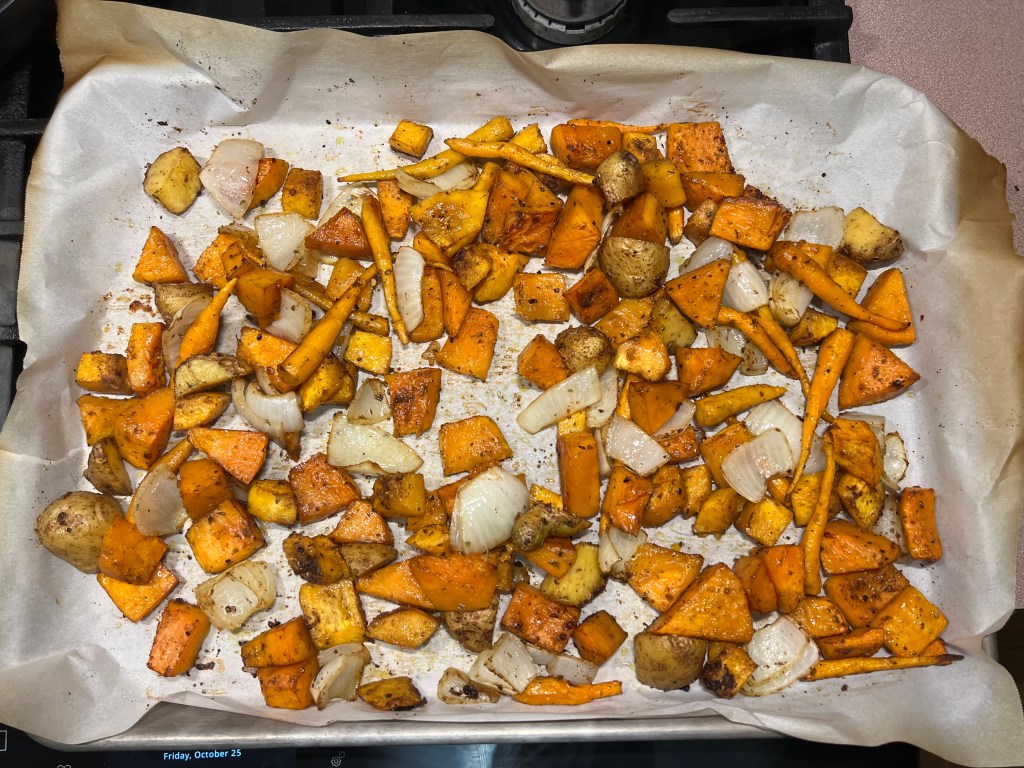
I have continued to be amazed how productive our Kentucky pole beans (Phaseolus vulgaris, var.) have been this year. They got a late start as the second sister and tarried through most of the summer, but the cooler temps have brought them on. I gave my niece a bag of prepared beans on Thursday and picked another 3 cups of prepared beans on Sunday. While I decided to flash freeze most of the quart bags of green beans for later use, I like the ability to go directly from garden to table. We had decided to put a mini-split HVAC unit on the porch to protect the succulents this year and while moving the racks on Saturday to allow the technician access I noticed several of the Butternut squash (Cucurbita moschata) I had stored on the racks on the porch had started to rot on the stem ends (obviously too warm). I ended up throwing two away but the other two were still good. It seemed this might be a good time to make some roasted vegetables.
When I looked online, I found there are many benefits to making roasted vegetables. This is not only a fairly hands-off method to prepare them, but you do not even need a recipe, just some good cooking oil and some salt. Roasting adds a savory depth of flavor only achieved once the amino acids and reducing sugars creates melanoidins (Maillard reaction), the compounds that give browned food its distinctive flavor. The bit of caramelization and crispy edges also add a textural delight. Boiled vegetables tend to be mushy somewhat bland, while roasted ones are slightly charred and sweet. Even salad greens like romaine can be roasted and transformed into more complex and intensely flavored versions of their fresh selves. The easiest way to roast vegetables is to cut them into similar sized pieces (for uniform cooking), toss them in enough oil to completely coat them. Lay them out on a baking sheet and sprinkle them with salt and pepper and cook them on the middle shelf in your oven at 400F to 450F (204C to 232C), until they are fork tender and have crisped up at the edges. The timing varies depending on the hardiness of the vegetables and can range from 10 to 20 minutes for soft yellow squash to up to 60 minutes for carrots and winter squash. The real length of time varies on how small you dice them.
I diced the squash into 1 inch (2.5 cm) pieces, cut up the last of my Yukon Gold potatoes (Solanum tuberosum, var.), peeled the smallest of my carrots (Daucus carota), and added a medium onion (Allium cepa) to round out the roasted vegetables. We purchased several seasoning packets from a spice store in Wichita and I added a packet of Tuscan seasoning to three tablespoons of oil to coat the vegetables. An online recipe suggested it only took 10 to 20 minutes to roast the mixture, but I was skeptical (see above). I put them in for 15 minutes at 425F (218C) and then checked. They were not done. I raised the temperature to 450F (232C) and put them back for another 15 minutes. They were perfect. Prior to making the roasted vegetables I made a pot of green beans. This was another simple recipe, with the beans mixed with two russet potatoes (store-bought and diced), another medium onion, crumbled bacon, and a Southwest seasoning mix. Melissa made a small corn bread to accent the roasted vegetables. The whole meal turned out delicious, and most of it was grown by me.
THOUGHTS: The roasted vegetables and pot of green beans were simple to make, but what made the meal truly satisfying was knowing it came (mostly) from my garden. It was nice to have some wins out of the time and expense put into raising the crops. Since I waffled on planting a fall crop, this is the time to start thinking about what will go into my garden next year. Like most of life, this is a process. Life seems to have times of frustration and times of satisfaction. The key is to focus on the latter and let the former slide away. Act for all. Change is coming and it starts with you.
 A travelers odyssey