
December 30, 2024
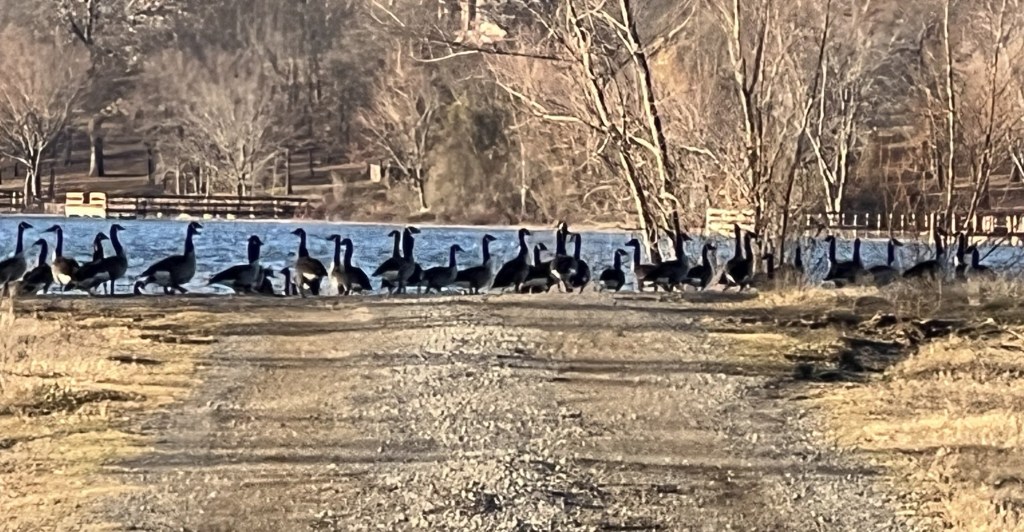
The kids were overwhelmed as we took our walk at the lake last week. They had been intrigued in the past by the occasional greater egret (Ardea alba) or great blue heron (Ardea herodias) that spend time in the shallows at the end of the two spits we walk. The kids will stop and even strain on their leash trying to get a better look at these large solitary birds. They were not prepared for the mass of birds we encountered on this occasion. The herons had flown away as the kids approached, but the Canada geese (Branta canadensis) stood their ground. Both Zena and Loki hesitated in the face of this loud and raucous group of birds. It was not until the kids composed themselves and began to move forward that the group decided they wanted no part of these two large dogs (Canis familiaris). This gaggle of geese took flight and moved to the safety of the water.
When I looked online, I found a gaggle of geese occurred in English print in Julia Berners book, “The Book of Hawking, Hunting and Blasing of Arms” in 1486. Geese are called a “gaggle” because together they are noisy and rowdy. Little is known of Berners, and much of what is known cannot be verified with certainty, but she is thought to be the earliest female author writing in the English language. Based on her last name, scholars suggest that she was either the daughter of the courtier Sir James Berners or wife to the lord of the manor of Julians Barnes, and she was high-born and well-educated. Since she was most likely brought up at court, she would have hunted and fished with the other fashionable court ladies. It is generally believed that she entered the monastic life and became the prioress of Sopwell Nunnery near St Albans. Berners seemed to retain her love of hawking, hunting and fishing, and her passion for field sports, leading her to write her treatise on hunting and others. These treatises are some of the earliest extant writings of their kind and include remarks on the virtues of environmental conservation and on etiquette for field sports. These concepts would not become commonly accepted for hundreds of years after the publication of these treatises. She is also remembered as one of the first authors (of either sex) to write on angling.
A gaggle is just one of the 165 collective nouns (a “naming word for groups of things) for groups Berners defines in her publication. A group of owls (Order: Strigiformes) is called a parliament, possibly attributed to the idea that owls are considered intelligent and wise. A group of wildebeests (Genus: Connochaetes) is called a confusion. This could be due to the huge numbers of animals that in the annual Great Migration and the resulting confusion and noise that happens when the animals migrate. A group of lemurs (Superfamily: Lemuroidea) is called a conspiracy. Lemurs are social animals and live in communities of around 10 to 25 members who often work together (conspire) to outwit predators using a technique called “mobbing”. A group of hippopotamuses is called a bloat. Hippos live in groups of 10 to 20 females and one male, and bloat may refer to their large, bloated bellies. Finally, a group of wild cats is called a destruction. Feral cats can be territorial and fight to protect their territory, and when a group of feral cats get together, they can become destructive.
THOUGHTS: Canada geese thrived around the golf courses I played in Salt Lake City and would form into a large gaggle around the water hazards. The geese were generally docile as they sat on the lawn or swam in the ponds. The problem came when you hit your ball in their midst, when they cackled and blustered a warning. One even decided my ball was her egg and made an aggressive defense. Animals form groups for protection and defend their territory against predators. Humans use the same tactic and form resistance movements against tyrants or marauders. Like a gaggle of geese, we are stronger together. Act for all. Change is coming and it starts with you.
 A travelers odyssey