
January 27, 2025
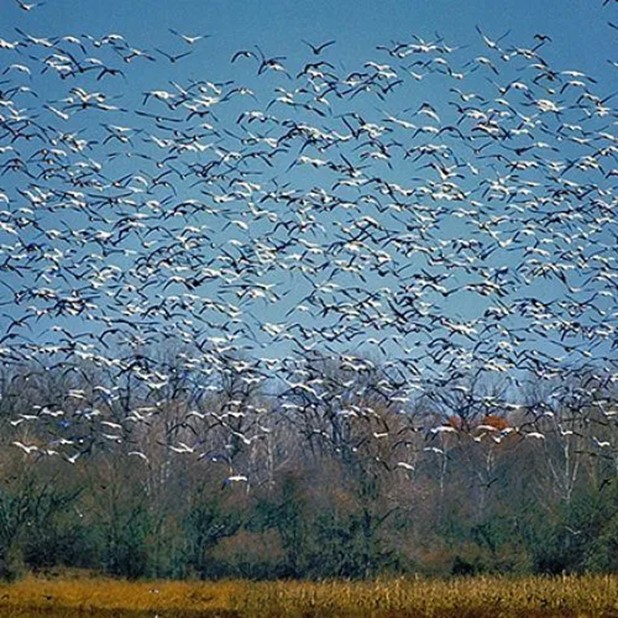
The intense cold (highs below freezing) that has stricken most of the south began to lessen over the weekend and Melissa thought it a good time to get out of the house with the kids for a drive. While the motivation was to “just go”, we also wanted to see a birding site. The Sequoya Wildlife Refuge is only about 90 minutes west, but we have not had much luck finding birds in the winter. Lake Fort Smith is an hour north and has good fishing in the cove, but we have never caught much from the shore. I put in a little work while Melissa searched for a new birding site. What she found was about 2 hours away near where she spent her college years. This sounded like a possibility (and promised a trip to her favorite burger joint). We packed up the kids, got gas and aired up the tires that had been deflated by the cold, and took off for Holla Bend National Wildlife Refuge.
When I looked online, I found Holla Bend National Wildlife Refuge is a 7,055-acre (28.6 km2) site located 5 miles (8 km) south-east of Dardanelle, Arkansas. The refuge is bounded on one side by the Arkansas River and on its others by an oxbow lake that was formed in 1954 by the Army Corps of Engineers during efforts to straighten the river navigation channel. The resulting island was transferred to the US Department of the Interior in 1957 for a wildlife refuge. The refuge provides habitat for migratory waterfowl, indigenous endangered species, other resident wildlife, and offers interpretation and recreation to the public. The area is a year-round sanctuary for the 236 species of birds, tree frogs, and the American alligator. Migratory fowl following the Central and Mississippi flyways stay in the refuge during the winter months, including 14 species of ducks and 4 kinds of geese, with as many as 100,000 there at once. Winter migratory neotropical songbirds use the refuge as a rest stop during their long journey to and from Central and South America and during the spring and summer migratory birds use the refuge for breeding and nesting. I anticipated birds.
Last year I purchased an Interagency Lifetime Pass from the US National Park Service so we cruised past the Holla Bend information center without stopping. We turned around realizing we did not know where we were going without a flyer. As we got into the refuge, we saw large flocks of American Robin (Turdus migratorius) on the road between the trees and European starling (Sturnus vulgaris) passing among the harvested grain fields. Along the oxbow we found a flock of mallards (Anas platyrhynchos) and a flock of ring-billed gull (Larus delawarensis) along the river. The best find however, was totally unexpected. We stopped to admire a herd of 20 does and fawns racing across the far end of a harvested field. Then I noticed what I thought was a group of black vultures (Coragyps atratus) about 300 yards (274 m) out. When I focused my camera, I realized this was a flock of wild turkey (Meleagris gallopavo) feeding in the field. It turned out to be a great day. And we topped it with a great burger.
Thoughts: When we stopped at the Holla Bend information office a sign listed the daily hours along with the caveat of “Closed when we are not here”. They were not there. The Wildlife Refuge System is the US’s largest network of lands and waters dedicated to wildlife conservation, but it is facing a staffing crisis. The Refuge System has lost over 800 permanent positions since fiscal year 2011, resulting in a 27% loss in capacity. No national wildlife refuge is fully staffed, and more than half have zero staff on-site. Much of the system is unprotected due to the lack of law enforcement officers. This shortage impacts critical volunteers by a lack of staff supervision or infrastructure. We need to invest in this system and prioritize staffing to ensure the future of this network and the wildlife it protects. Act for all. Change is coming and it starts with you.
 A travelers odyssey