
April 20, 2025
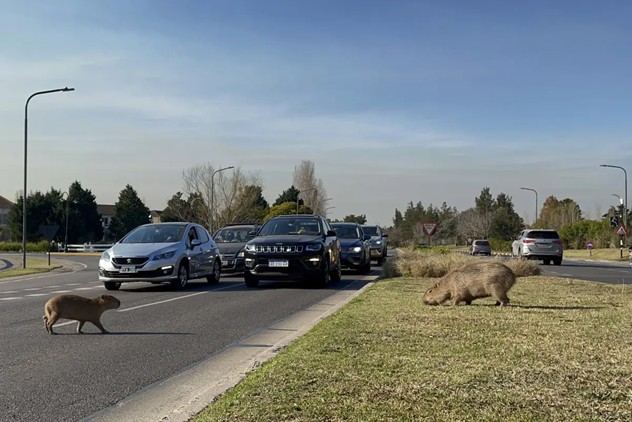
Earlier this week the NY Times carried an article by Jack Nicas about an invasion occurring in Argentina. Since the pandemic, “carpinchos,” as they are known, have proliferated in Nordelta, a ritzy gated community of 45,000 people north of Buenos Aires. Over the past two years, biologists estimate the capybara population has tripled to nearly 1,000 in this gated community, posing a test case for the urban coexistence of humans and wildlife. While most residents find them cute, they also cause traffic accidents, chomp their way through gardens, and have occasionally attacked some of the community’s smallest dogs. These actions have led to an effort to place controls on the animals. Veronica Esposito is one of a small group of neighbors leading a rebellion against the controls. They have protested in the streets, taken legal action against developers, and gathered 25,000 signatures for an online petition to protect the animals. “I believe their adorableness is a strategy of the species itself to survive.” said Silvia Soto, the most vocal neighbor. In February, the Nordelta organization told residents in an email that it was moving ahead with a “contraceptive vaccination program,” to sterilize 250 adult capybaras. It seems some do not want coexistence.
When I looked online, I found the future of wildlife depends on the willingness and capacity of human coexistence. To coexist means to live in a dynamic state where the needs and interests of both humans and wildlife living in proximity to each other are generally met. This coexistence may not be entirely free of negative interactions and may still contain some level of impact on both people and wildlife. Living together is especially dependent on a level of tolerance on the human side. Humans have lived alongside wildlife for thousands of years, but conflict arises when the presence or behavior of wildlife poses a direct or perceived threat to people’s needs, interests, and safety. As our planet becomes increasingly crowded, livable space is decreased by accelerated climate change, habitat loss, and competition for resources. What it means to share space with wildlife differs drastically from place to place and from species to species, which often makes moving toward coexistence a complex and ever-evolving target.
Thirty years ago, Nordelta was an untouched wetland where capybaras roamed free, hunted by pumas, jaguars, caiman, and sport hunters. Eduardo Constantini, the real estate developer who controls the Nordelta organization, began transforming the area in the late 1990’s, building housing, infrastructure, a shopping center, and a golf course designed by Jack Nicklaus. Construction has been nearly nonstop. Ms. Soto argued that the capybara population is only increasing because developers destroyed the animals’ wild habitat, forcing them out of the forest and into the suburbs. As capybara grazed on a playground, a married couple walking by held different views of the plight of the animals. Felipo Contigiani said he used to hunt capybara as a child and had little sympathy, “It’s a wild animal that came to live in the city.” His wife Lidia Schmidt corrected him, “No, the city came to settle where the wild animal was.” Coexistence seems a long way off.
THOUGHTS: To achieve some level of coexistence between people and wildlife, various stakeholders must partner together to address the challenges and devise solutions that focus on the benefits of living alongside wildlife. This is especially true for the local communities who are often directly negatively impacted by living with wildlife. The town of Churchill in northern Manitoba, Canada is most famous for the many polar bears that move toward the shore from inland in the autumn, leading to the nickname “Polar Bear Capital of the World”. Coexistence often means a willingness to think outside the box. Act for all. Change is coming and it starts with you.
 A travelers odyssey