
June 12, 2025
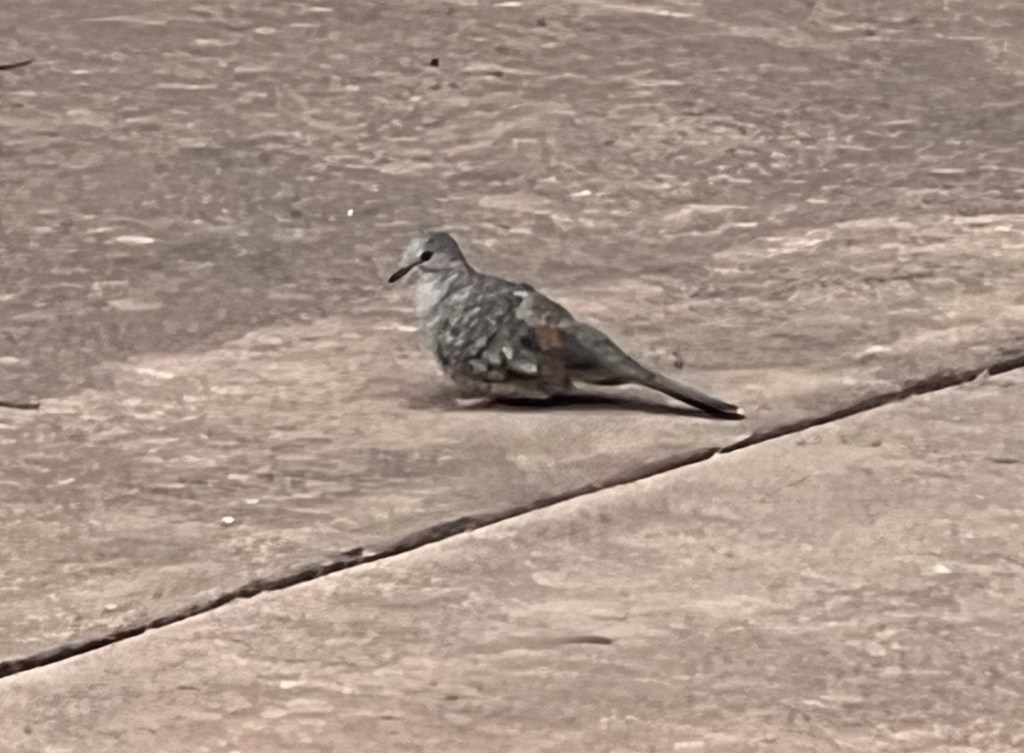
As I looked out my back window this afternoon, I saw a flash of copper as a bird flew from our window feeders to the pool deck. At first, I thought it was one of the elusive mourning doves (Zenaida macroura) I see and hear frequently around our property (but not at our feeders or been able to get a picture). The problem was that it seemed a little smaller than a mourning dove, and then there was that copper flash as the bird landed on the deck. I enjoy watching the small passerines that flock to our feeders in the morning and evening. I will even tolerate the common grackles (Quiscalus quiscula) that drive the other birds off and eat the entire feeder in short order. That is as long as they do not arrive en masse. I have watched them strip all eight feeders along the fence in less than 10 minutes. Now I have taken to occasionally send Loki out to scare them away. While he does not do anything except run into the yard, the grackles seem to be afraid of his size. The bird on the deck seemed to be a species I was unfamiliar with. I was able to get a photo of the bird before it flew off and I checked it against the google identification app. It turns out it was a new bird, an Inca dove.
When I went online, I found the Inca dove (Columbina inca), also called the Mexican dove, is a small New World dove first described by French surgeon and naturalist René Lesson in 1847. The Inca reaches 6.5 to 9.1 inches (16.5 to 23 cm) in length, weighs 1.1 to 2.0 ounces (30 to 58 g) and has an average wingspan of 11.2 inches (28.5 cm) and a max wingspan of 12.6 inches (32 cm). The Inca is a slender species, with a gray-brown body covered in feathers that resemble a scaled pattern. The tail is long and square and edged with white feathers that may flare out in flight. The underwings are reddish (hence the copper I saw) and on takeoff produce a distinctive, quiet rattling noise. The species ranges from Costa Rica in the south to the American Southwest in the north and is often common to abundant in suitable habitat. This terrestrial species forms flocks in desert, scrubland, and cultivated areas and may also be found in urban settings where they feed on grass seeds and take advantage of the availability of water from agricultural and suburban irrigation. During winter, Inca doves roost in communal huddles of 10 or more birds by making a pyramid formation that aids them retain body heat. They often flock outside of their territories, with flocks growing up to 100 birds. Its range has been expanding northward and southward in the past few decades.
Despite being named after the Inca Empire, the species does not occur in any of the lands where the Inca empire existed. When I looked at the range map for the Inca dove, I noticed it did not include Arkansas. The closest it came was toward the top of Texas, or several 100 miles (320 km) to the south and west. The Inca has in the past escaped or been deliberately released in the state of Florida in the US, but there is no evidence that the population is breeding. It may only persist due to more releases or escapes. The single bird I saw may have been blown off course by the current round of storms which have been coming up from Texas. Or perhaps it just wanted to be a tourist in the Natural State (i.e., Arkansas). Regardless, this qualifies as a rare bird sighting. A rare bird sighting is observance of bird species that are uncommon in a particular region or that are considered at risk of extinction. These sightings can include birds that are not typically found in a specific area due to changes in migration patterns, unusual weather conditions, or simply because they are very rare.
THOUGHTS: When I identified the Inca dove it became my first rare bird sighting. I was a little skeptical being a newbie birder, but my daily rare bird notification listed another Arkansas sighting as well. I posted the picture and have already gotten a Like. Being an amateur and posting on a site of experts made me nervous. Perhaps more of us should follow the advice of Eleanor Roosevelt – “Do one thing every day that scares you.” Act for all. Change is coming and it starts with you.
 A travelers odyssey