
July 14, 2025
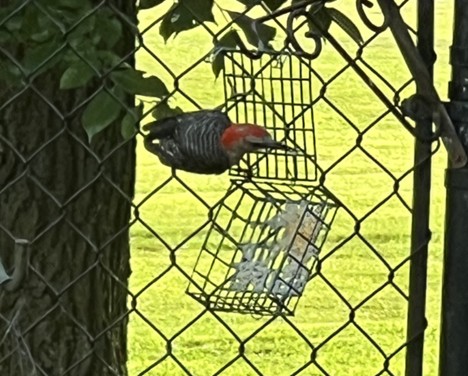
Last weekend Melissa called me into the kitchen to watch the large bird that had been battling two squirrels over “rights” to what was left in my soot feeder. I grabbed my camera and by the time I arrived the squirrels had been driven off, but the bird was still there. Melissa said she had watched the bird attack the two eastern gray squirrels (Sciurus carolinensis) for about 20 minutes. The bird alternately flew at both squirrels keeping them at bay. This was a new species identification for Melissa, and the bright red head led her to believe this was a red headed woodpecker (Melanerpes erythrocephalus). I occasionally see one of these birds at my feeders and had even identified one early in January (although without a photo). At first, I also thought it might be a red-headed woodpecker. My apps instead identified this as a red-bellied woodpecker.
When I went online, I found the red-bellied woodpecker (Melanerpes carolinus) is a medium-sized woodpecker of the family Picidae. While the species breeds mainly in the eastern US, it ranges as far south as Florida and as far north as Canada. The most prominent feature is a vivid orange-red crown and nape, but this is not to be confused with a separate species in the same genus, the red-headed woodpecker. The red-headed woodpecker has an entirely red head and neck, a solid black back, and white belly. Red-bellied woodpeckers are 9 to 10.5 inches (22.85 to 26.7 cm) long, have a wingspan of 15 to 18 inches (38 to 46 cm), and weigh 2 to 3 ounces (57 to 91 g). The red-bellied earns its name from the pale reddish tint on its lower underside. Adults are mainly light gray on their face and underparts and have black and white barred patterns on their back, wings, and tail. Adult males have a red cap going from the bill to the nape while females have a red patch on the nape and another above the bill. White patches become visible on the wings in flight. The reddish tinge on the belly is difficult to see in field identification.
I have never noticed the red spot on a red-bellied woodpecker and have instead identified them by the black and white barred pattern on their backs. I always wondered why they were called red-bellied, and now I know. Predators of adult, red-bellied woodpeckers include birds of prey such as sharp-shinned hawks (Accipiter striatus), Cooper’s hawks (Astur cooperii), black rat snake (Pantherophis alleghaniensis), and house cats (Felis catus). Known predators of nestlings and eggs include red-headed woodpeckers, owls (Order, Strigiformes), pileated woodpeckers (Dryocopus pileatus), black rat snakes, and eastern gray squirrels. When approached by a predator, the birds either hide from or harass the threat with alarm calls. They will defend their nests and young aggressively and may directly attack predators that come near. While this bird did not have a nest, it was aggressively defending its food supply.
THOUGHTS: By driving off the gray squirrels the red-bellied woodpecker was it was exerting its territorial rights. A defended territory is typical of songbirds but is also found in many other orders of birds. Territory may be held by one bird, a pair, or a flock and can be held for all or only part of a year. It may be very large (eagles) and provide all the resources the bird needs or be very small such as nesting territories. It may be vigorously defended or loosely guarded. Typically, territories are defended against others of the same species but may also be defended against other species. Humans also claim both small and large areas we define as ours and actively defend. These are also shared, but generally only with those we define as “us”. Globalization is forcing humans to make new choices on us and them. Cooperation and sharing resources may provide for all. Hoarding resources has and will always lead to conflict. Act for all. Change is coming and it starts with you.
 A travelers odyssey