
August 04, 2025
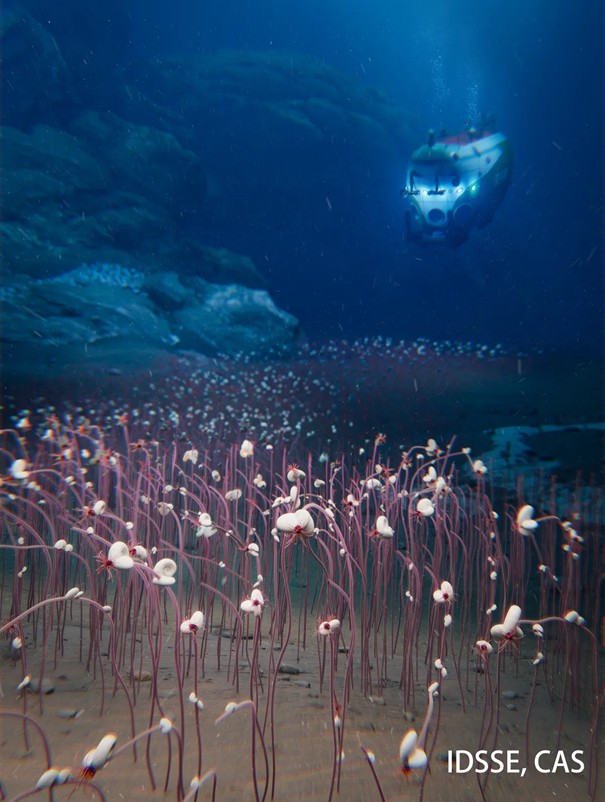
Inside the front section of Friday’s newspaper was a Reuters article about a new discovery in the northwest Pacific. Thriving communities of marine creatures turn chemicals into energy rather than eating organic matter. These chemosynthesis-based animal communities were dominated by tube worms (Riftia pachyptila) and clams (genus, Spisula) and were found during a series of dives aboard a crewed submersible to the bottom of the Kuril-Kamchatka and Aleutian trenches. The creatures are beyond the reach of sunlight and are nourished by fluids rich in hydrogen sulfide and methane seeping from the seafloor. These ecosystems were discovered at depths greater than Mount Everest (29,032 feet/8849 meters). The deepest ecosystem was 31,276 feet (9,533 m) below the ocean surface in the Kuril-Kamchatka Trench, or 25% deeper than such animals had previously been documented. The research was published on Wednesday in the journal Nature. Marine geochemist Mengran Du of the Institute of Deep-sea Science and Engineering, said, “What makes our discovery groundbreaking is not just its greater depth – it’s the astonishing abundance and diversity of chemosynthetic life we observed.” The discovered ecosystems exist in the hadal zone.
When I went online, I found the hadal zone, or hadopelagic zone, is the deepest region of the ocean found only within the oceanic trenches. The hadal zone ranges from around 3.7 to 6.8 miles (6 to 11 km) or 20,000 to 36,000 feet below sea level, in the long, narrow, topographic V-shaped depressions. The cumulative area occupied by the 46 individual hadal habitats worldwide is less than 0.25% of the world’s seafloor, but the trenches account for over 40% of the ocean’s depth range. Most hadal habitat is found in the Pacific Ocean, the deepest of the conventional oceanic divisions. The deepest ocean trenches are considered the least explored and most extreme marine ecosystems and are characterized by a complete lack of sunlight, low temperatures, scarce nutrients, and extremely high pressure exerted on an immersed body (hydrostatic pressures). The major sources of nutrients and carbon are fallout from upper layers, drifts of fine sediment, and landslides. Most organisms are scavengers and animals that subsist on decomposing plants and animal parts (detrivores). As of 2020, over 400 species are known from hadal ecosystems, many of which possess physiological adaptations to the extreme environmental conditions. There are high levels of a species being found in a single defined area (endemism).
While some marine animals have been documented at even greater depths, (36,000feet/11,000 m) below the surface in the Pacific’s Mariana Trench, those were not chemical eaters. In the new research, scientists used their submersible (the Fendouzhe) to journey down to the hadal zone. The hadal zone is where one of the continent-sized plates that make up Earth’s crust slides under a neighboring plate in a process called subduction. Marine geologist and study co-author Xiaotong Peng, said this environment harbored “the deepest and the most extensive chemosynthetic communities known to exist on our planet.” The newly observed ecosystems were dominated by two types of chemical-eating animals. Tube worms that were red, gray or white in color and around 8 to 12 inches (20-30 cm) long and clams that were white in color and up to 9 inches (23 cm) long. Some of these appear to be previously unknown species.
THOUGHTS: Even in the harsh environment of the hadal zone life has found a way of surviving and thriving. Some non-chemical-eating animals were also found living in these ecosystems. The study illustrates how life can flourish in the most extreme conditions on Earth (and beyond?). This makes it possible (even probable) that exploration will find life on Earth is not alone. The question will be how we handle the discovery. Act for all. Change is coming and it starts with you.
 A travelers odyssey