
November 11, 2025
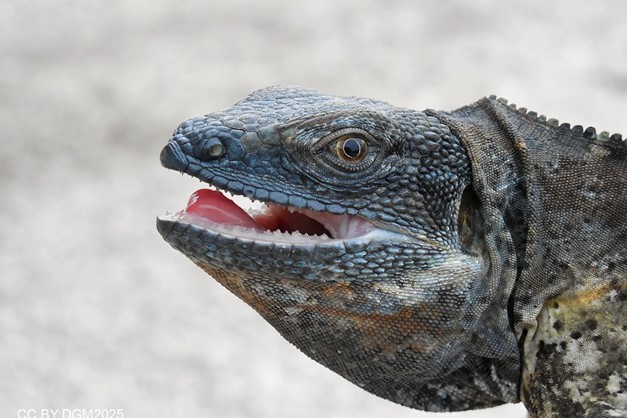
Credit…Daniel Mulcahy
The Morning Read of the NY Times feed included an article on a possible reprieve for a previously invasive reptile species. Biologists say DNA evidence proves the lizard landed on Clarion Island nearly half a million years ago, long before any humans might have transported them from the mainland. Researchers reported the discovery last month in the journal Ecology and Evolution, and the finding means that the animals should be able to continue living on Clarion Island, a remote, mostly uninhabited Mexican archipelago in the Pacific Ocean. There are around 100 iguanas there, and scientists and locals alike assumed that they had been introduced by humans in the late 20th century because they had gone unmentioned in prior accounts of the island’s fauna. “It was all speculative that they were introduced — no one ever tested it,” said Daniel Mulcahy, an evolutionary biologist at the Museum of Natural History in Berlin who is an author of the new study. The government was planning to exterminate the invaders to protect island’s delicate ecosystem. Mulcahy and his colleagues compared mitochondrial DNA, passed down maternally, from the Clarion iguanas and the mainland spiny-tailed iguanas and found a 1.5 % difference in their DNA. That meant these spiny-tailed iguana are genetically distinct and could not be recent invaders.
When I went online, I found the spiny-tailed iguana (Ctenosaura pectinata) is a species of is a species of iguanid lizard found in eastern Mexico and extreme western Guatemala. This iguana has distinctive keeled scales on its long tail, to which its common name refers. It is one of the larger members of the genus Ctenosaura, capable of growing to 4.3 feet (1.3 m) in total length (including tail), with females being slightly smaller than males at 3.3 feet (1.0 m). It usually has a brown or grey-brown colored back (dorsally), with a yellowish underbelly (ventral surface). It has a crest of long spines which extend down the center of its back. Mating generally occurs in spring with the male showing dominance and interest by head bobbing before chasing the female until he can catch her and subdue her. Within eight to ten weeks, the female will dig a nest and lay clutches of up to 24 eggs which hatch in 90 days with the babies digging their way out of the sand. Hatchlings are often bright green with no body pattern and juveniles are typically green with brown markings, although all-brown hatchlings have been recorded.
Some wonder how a 4-foot (1.2 m) black-and-yellow lizard went unnoticed on Clarion Island for decades. Clarion’s landscape has changed dramatically in recent years. The island was covered in prickly pear cactus (genus, Opuntiathat) that made exploration difficult, but was consumed by sheep (Ovis aries) and pigs (Sus domesticus) introduced by thew Mexican Navy in the 1970’s. Those animals are gone and a shrubland community (chaparral) remains. The iguanas are wary of humans and hide when approached. The destruction by sheep and pigs underscores the damage invasive animals can cause. Island ecosystems are particularly vulnerable. Rayna Bell, an evolutionary biologist at the California Academy of Sciences said, “This type of work is fundamental to conserving some of the world’s most unique and imperiled diversity.” Mulcahy’s colleagues are working to spread the news to government officials in Mexico to stop the eradication program.
THOUGHTS: The spiny-tail iguana is a traditional food in Mexico, listed as “Least Concern” by the IUCN Redlist, but the species is listed on the Mexican Red List as threatened and it is illegal to hunt them. Their presence on Clarion suggests a 700-mile trip on a floating mat of vegetation. It would be the second-longest known iguana aquatic journey, topped by another species of iguanas traveling 5,000 miles from North America to Fiji. Humans thought the 1947 Kon-Tiki expedition was amazing. We are always outdone by nature. Act for all. Change is coming and it starts with you.
 A travelers odyssey