
December 30, 2025
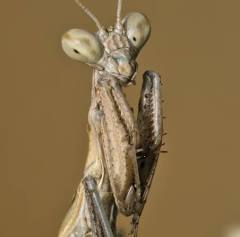
It seems fitting that just before New Years I come across an article on ending relationships. Female praying mantises are notorious for eating their mates during or after sex. According to Christopher Oufiero, head of the Towson University Mantis Lab, mantis has some of the most diverse camouflage strategies in the animal kingdom and much of mantis behavior, especially mating, remains a mystery. “Mantises are good at not being found. It’s kind of what they do,” says Lohitashwa Garikipati, a doctoral student at the American Museum of Natural History in New York. However, Oufiero and Garikipati were part of a study that found a dwarf mantis species in which males avoid this fate with an elaborate dance where it moves its abdomen. Sometimes this is sinuously like the coils of a serpent and sometimes jerkily like the tail of a rattlesnake. Their behavior inspires its name, the snake-tail mantis.
When I went online, I found the snake-tail mantises (Ameles serpentiscauda) are in an order of insects (Mantodea) that contain over 2,400 species in about 460 genera in 33 families. The discovery of the snake-tail mantis began with a chance encounter in the summer of 2024 when on a remote beach in Sardinia, an Italian island in the Mediterranean Sea. Battiston’s colleague Oscar Maioglio spotted some dwarf mantises on shrubs along the shoreline he thought resembled a known species of dwarf mantis (Ameles andreae), except that their wings were smaller than expected. He collected a few individuals to rear back in his lab. When he and Maioglio saw the specimens mating they knew these mantises did not belong to any other known species. The small wings and serpentine courtship dance of the collected specimens strongly suggested they belonged to a unique, never-before-documented species, and genetic analyses confirmed it.
One major open question is the function of these courtship displays. Whatever the deeper meaning, scientists theorize that performing a courtship dance reduces the male’s risk of the female eating him after mating. It seems to succeed as the researchers observed no sexual cannibalism among the lab-reared snake-tail mantises. “Why or how selection for this mating display may have occurred remains to be seen,” says Garikipati. “But I think it is an interesting clue that tells us that these little animals are probably a lot more complicated than we give them credit for.” There is some urgency behind Battiston’s eagerness to learn more about the snake-tail mantis. As far as he and his colleagues can tell, the new species is only found in a restricted area of a few hundred yards along the Sardinian coastline. While most of this habitat lies inside a protected area, increasing tourism and overgrazing by sheep and goats could threaten the entire species’ existence. To ensure the future of the snake-tail mantis, Battiston and his colleagues have proposed that the IUCN categorize it as Critically Endangered and recommended stricter measures to preserve its habitat.
THOUGHTS: While the male snake-tail mantis avoids the female abruptly ending the relationship, many human pairings end around Christmas and New Year’s. Psychology Today says the holidays highlight how reality may not match one’s ideal. The gift-giving, travel and parties also increase stress around money, a top area of conflict. Meeting parents or navigating whose family to visit creates further tension and pressure, along with a perceived pressure to “define” the relationship. The New Year acts as a natural reset point for evaluating life choices and can lead to a post-holiday breakup surge, causing January to become “breakup month”. While breaking up may seem like getting your head bitten off, at least you are not a (male) mantis. Relationships require work. Act for all. Change is coming and it starts with you.
 A travelers odyssey