
February 14, 2026
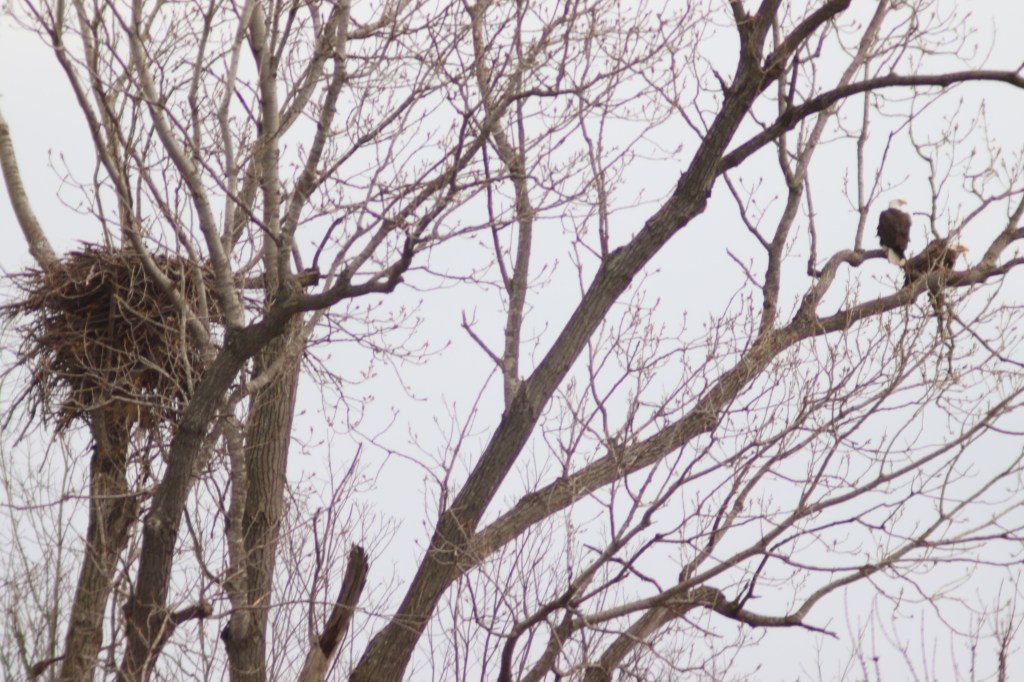
I found it appropriate that in the middle of the Great Backyard Bird Count 2026 (February 13 to 16, 2026) that my Sunday paper (delivered on Saturday) would have a USA Today article on an annual lottery for the bald eagle tour in Monroe, Michigan. There were approximately 1,200 entries for this year’s 30 lottery winners and their guests. “It’s the largest number since the event began in 2008. It shattered our previous record,” said Maddie Drury, park ranger with the US Fish & Wildlife Service who sponsors the tour. Winners were driven out to the wooded area on the south end of the power plant, where Plum Creek and the power plant’s warm water discharge meets Lake Erie. In winter the warm water draws fish, and the fish draw predators. Amanda Schaub, communications strategist for the plant said, “Consistent with our Michigan Public Service Commission approved plan, the plant is scheduled to retire in 2032.” DET Energy is committed to working closely with the community as they plan for the site’s future.
When I went online, I found several endangered or rare species have a home at the Detroit Edison (DTE) power plant facility. Since the mid-1990’s, DTE Energy has supported peregrine falcon (Falco peregrinus) reintroduction and breeding programs in southeastern Michigan and near their power plants. Employees assist with banding, tracking and rescuing at-risk chicks. Peregrines have been recorded nesting on the Monroe Power Plant grounds since 1994. Over 100 adult and juvenile bald eagles (Haliaeetus leucocephalus) have been counted near the shoreline at the Monroe Power Plant and nest regularly at the Fermi 2 Power Plant. Apprentice linemen install utility poles in various bird projects, such as eagle habitat at the Lake Erie Metropark and Humbug Island within the Detroit River International Wildlife Refuge, as well as a great blue heron rookery at Lyon Oaks County Park. These projects foster the bird population while giving apprentice linemen experience in installing tall poles without energized lines or power transmission equipment.
The DET Monroe Power Plant is home to other endangered species. The American lotus (Nelumbo lutea) is listed as a threatened species in Michigan. The plant naturally cleans the water in which it lives, which is important for the native fish and wildlife. In partnership with the Lotus Garden Club of Monroe, DTE Energy opens the Monroe Power Plant property for guided tours of the flowerbeds. Lake Sturgeon (Huso fulvescens) are the longest-living fish species in Michigan, with a lifespan of up to 100 years. They can be over eight feet (2.5 m) in length and weigh 800 pounds (363 kg). Sturgeons are listed as threatened or endangered by 19 of the 20 states within their original range in the US. DTE deposited 765 tons (694 mt) of coal cinders (a byproduct of coal combustion), cobble and broken limestone in the Detroit River off Belle Isle to create spawning beds. Common Terns (Sterna hirundo) once numbered in the thousands along the Detroit River but now only 250 breeding pairs can be found there. DTE Energy partnered with others to create an artificial nesting island and nesting habitat.
THOUGHTS: Drury, who is based at the Detroit River International Wildlife Refuge in Trenton, calls bald eagles the “most successful conservation story of the US”. For decades the insecticide DDT was widely used to kill insects. Fish ate treated vegetation, birds ate the fish, and affected bald eagles laid fewer viable eggs. In 1963, the continental US had just 417 mating pairs of bald eagles. DDT was banned in 1972, and the eagles have bounced back. In 2007, the US had 9,700 bald eagle mating pairs, and the bald eagle was removed from the endangered list. By 2020, there were 71,000 breeding pairs. The lottery for the DET Monroe Power Plant eagle tour typically opens right after Thanksgiving. Act for all. Change is coming and it starts with you.
 A travelers odyssey