
February 16, 2026
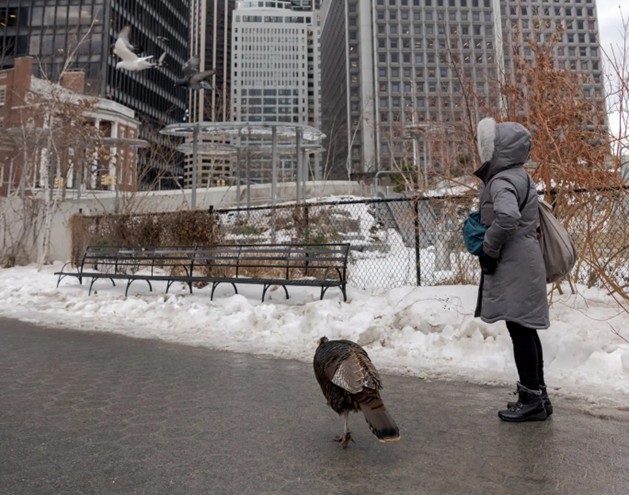
Scrolling the NY Times Headlines feed, I came across a bird who has captured the attention of New Yorkers. The bird arrived in Manhattan’s Battery Park and eventually settled in the area near the Sea Glass Carousel, just north of the Staten Island Ferry terminal. Three human women have become her self-appointed caretakers and visit her daily. New Yorker’s regularly fall in love with celebrity wildlife, including unusual ducks, a pair of coyotes, and Flaco the escaped owl in Central Park. Sunny Corrao, the deputy director of the city parks department’s wildlife unit, said, “She’s the only known turkey in Manhattan, “but this is not unusual.” A turkey was known to hang out in Inwood Hill Park in Upper Manhattan in the past and there are large flocks in the Bronx and on Staten Island. Smaller groups come and go to Queens and Brooklyn. Astoria got her name because she was first spotted in Astoria, Queens, before making her way to Roosevelt Island and, finally, Manhattan.
When I went online, I found Astoria is a descendant of the wild turkey (Meleagris gallopavo) first domesticated in Pre-Columbian Mexico. The Classical Nahuatl word for the turkey (huehxōlō-tl) and the Spanish guajolote are still used in modern Mexico. Mayan aristocrats and priests had a special connection to turkeys, with ideograms of the birds appearing in Mayan manuscripts. Spanish chroniclers Bernal Díaz del Castillo and Father Bernardino de Sahagún describe the multitude of food (both raw fruits and vegetables and prepared dishes) offered in the vast markets (tianguis) of Tenochtitlán, noting there were tamales made of turkeys, iguanas, chocolate, vegetables, and fruits. Turkeys were first exported to Europe via Spain around 1519 and gained immediate popularity among the aristocratic classes. English settlers brought turkeys to North America during the 17th century. There were an estimated 10 million turkeys in the US during the 17th century, but by the 1930’s only 30,000 remained. In the 1960’s and 1970’s, biologists started trapping wild turkeys and re-introducing them into other states.
The three self-appointed caretakers of Astoria coordinate their schedules in group chats and text messages, sharing photos and updates on Astoria’s location and condition. Keiko Komiya visits the turkey in the morning, and Stella Hamilton and Anke Frohlich are generally there in the afternoon, and for bedtime. Astoria spends her days strutting around on the ground, then every evening (at 20 minutes after sunset) she flies up into a tree to spend the night. Hamilton is a retired nurse and birder who was previously a big fan of Flaco, the Eurasian eagle owl set free from Central Park Zoo. Komiya is an English student and avid birder whose first New York City celebrity bird was the mandarin duck she photographed daily in 2018. Frohlich started photographing birds during the covid-19 pandemic and runs an alternative healing practice in Greenwich Village which allows her to give the birds priority. The women do not worry about Astoria, but everything and everyone else. Young kids chase her, dogs scare her, and people press on her for selfies. Astoria also crosses State Street to bask in the warmth emanating from the Starbucks on the corner and the friends fear she will be hit by a vehicle. Their fears are not unfounded.
THOUGHTS: While Astoria has grown a devoted fan club, she is not the only wild Turkey residing in New York. “New York City is actually great habitat for a wild turkey,” Jessica Wilson, the executive director of NYC Bird Alliance, said. She noted that the birds are native to the area, have plenty to eat here and do not necessarily need turkey friends. “They often join flocks, but they also are fine on their own — and in general, we try not to interfere with their social life.” Perhaps we should treat people with the same respect. Act for all. Change is coming and it starts with you.
 A travelers odyssey