
April 09, 2026
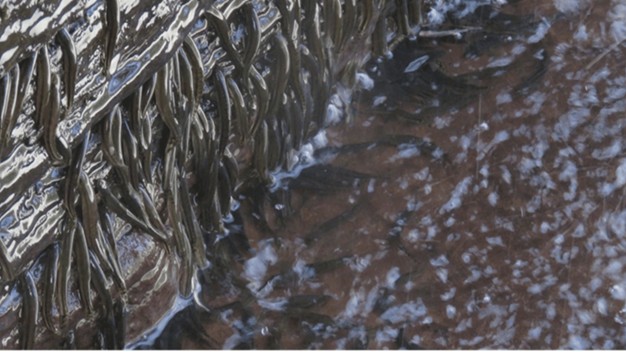
Inside the back section of my local newspaper was a Reuters article about 1000’s of small fish in Africa climbing up a 50-foot (15 m) waterfall. A researcher from the Université de Lubumbashi in the Democratic Republic of Congo first discovered them 17 years ago at Luvilombo Falls, a waterfall in the south. Pacifique Kiwele Mutambala, another researcher from the same institution, made the trek to the falls between 2018 and 2020 determined to document this African fish. Mutambala witnessed the epic climb but lost all his evidence. The fish had not been scientifically documented until a study was just published in Scientific Reports, with Mutambala as one of the lead authors. Locals have known about this fish for at least 50 years. In the local Sanga language, the shellear is called “kalumba,” which derives from a verb meaning “to stick.”
When I went online, I found the Parkouring shellear (Parakneria thysi) will spend hours crawling up a waterfall’s cliffside to reach better habitats. These tiny fish are about 1.4 to 1.9 inches (3.5 cm to 4.8 cm) long. The fish are remarkable for their endurance and adaptability, as they scale the cliff faces against strong water currents. To move upward, the shellear use hook-like growths on the undersides of their pectoral and pelvic fins to grip the rock, then rock their tails side-to-side to generate extra momentum. The climbing mostly happens between April and May (end of rainy season) when they move to better habitats. Scaling the cliff takes about 9 hours 45 minutes on average to climb the 50-foot-high cliffside of Luvilombo Falls. This is further broken down into about 15 minutes of active moment, 30 minutes of brief pauses, and nine one-hour respites. The process is not always successful as a sudden jet of water can knock them off, forcing them to restart the climb.
Biologists have several theories why the Shellear may attempt these excursions after hard rains wash them downstream. This may be a way for the fish to reach locations with less food competition and fewer predators like the silver butter catfish (Schilbe intermedius). Regardless of the reason, the climbing the waterfall makes the shellear susceptible to illegal fishing tactics. The area is at even greater risk of biodiversity loss due to potential plans to divert the river upstream to irrigate crops during the dry season. The shellear population could disappear entirely if conservation efforts in the Upemba National Park lose support. The study’s authors hope a better understanding of the fish will highlight both the region’s incredible ecosystems, as well as the need to protect them.
THOUGHTS: While the Parkouring shellear is the first scientifically documented African species to climb waterfalls, other fish species around the world have evolved similar abilities to scale vertical rock faces. In South America, several species in the order Characiformes (e.g., certain Corydoras catfish) and order Cichliformes (e.g., some cichlids) have been observed climbing waterfalls in the Amazon and Orinoco basins. These fish use similar fin structures and body movements to grip and propel themselves upward. In Southeast Asia, species such as the Asian climbing perch (Anabas testudineus) and certain mudskipper (Family, Oxudercidae) relatives can climb onto mudbanks or rocky substrates, though not always vertical waterfalls. Finally, Australian lungfish (Neoceratodus forsteri), and mudskippers have been documented moving over rocky surfaces, though their climbing is more horizontal or bank based. It seems the more humans research the more diverse our fellow Earth travelers are found to be. Unless we protect and preserve the fragile ecosystems where they reside, knowledge of their diversity will be lost. Act for all. Change is coming and it starts with you.
 A travelers odyssey