
June 11, 2026
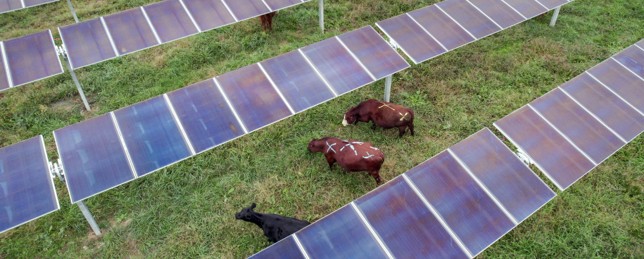
Last week’s Sunday newspaper carried a USA Today article on an innovative integration of ranching and energy production. A herd of ten cows and their calves are residents of a Christiana, Tennessee, solar farm. The 40-acre (16 ha) farm is the world’s only commercial scale solar energy plant co-located with cattle production. The farm is owned by Silicon Ranch, a 15-year-old company based in Nashville. The group has big plans to foster the integration of cattle and solar energy production thanks to a patented technology they are case testing in Tennessee. The company, and its team of interdisciplinary researchers who built the technology, believes the co-location of the two land uses is a win-win for the agriculture and energy sectors. This promise comes as both sectors have been forced to navigate unpredictable and sometimes volatile market conditions over the past few years. The software is called CattleTracker and offers a simple yet scalable solution to the venture.
When I went online, I found that CattleTracker “is a field-tested, evidence-based solution built to scale across America’s agricultural landscape that won the 2026 SEAL Sustainable Innovation Award.” The innovation is the culmination of research and development by a multidisciplinary team of experts in the practice of using the same land for both solar energy and agriculture (agrivoltaics), animal welfare scientists, regenerative ranchers, and soil and ecosystem scientists from across the country and around the world. The ranch builds and expands on Silicon Ranch’s nationally recognized work in sheep grazing, but the process needed innovation to adapt as solar panels can be vulnerable to damage from the greater weight and height of grazing cows versus compact sheep. The living laboratory at Christiana will enable researchers to study cattle behavior, welfare, and ecological impacts while simultaneously testing solar installation structures. According to Silicon Ranch’s website, “Christiana Solar is the latest proof that energy production and farming don’t have to compete—they actually work hand in hand, thriving together.”
Silicon Ranch launched its Regenerative Energy platform in 2018, introducing sheep grazing to its solar farms first in Tennessee and then in other locations. Now, the company owns the largest flock of sheep in Georgia. However, sheep are small and docile and easily coexist with solar modules. Cattle are large and heavy and do not fit under standard solar modules, and they tend to bump into things which could damage the expensive equipment. The advantage of making the cattle and solar modules work together is that the animals benefit from plentiful shade and grass to freely graze while the power companies have an easier time maintaining their solar farm. Solar modules work by rotating, tilting the panels to follow the sun’s movements throughout the day and can be almost vertical. Prohibitive costs of materials keep from just raising the modules above the cattle. The CattleTracker software is designed to prevent modules from tracking the sun if cattle are nearby. Nick de Vries, of Silicon Ranch, said ”We needed a design that would be good for agriculture, good for solar, good for the ecology, good for the community.” Silicon plans to continue to improve the CattleTracker technology to show how it could be used in communities across the U.S.
THOUGHTS: The locally produced CattleTracker technology carries over to all the solar equipment at the facility. The solar modules were made in Ohio by American company First Solar, while other parts were made in Alabama, Wisconsin and Virginia. The Nextpower tracker parts were made in Memphis, and the Shoals combiner boxes were made in Portland, Tennessee. The project illustrates that with innovation you can shop locally and focus on both the economy and ecology. Who knew. Act for all. Change will come and it starts with you.

