
September 04, 2026
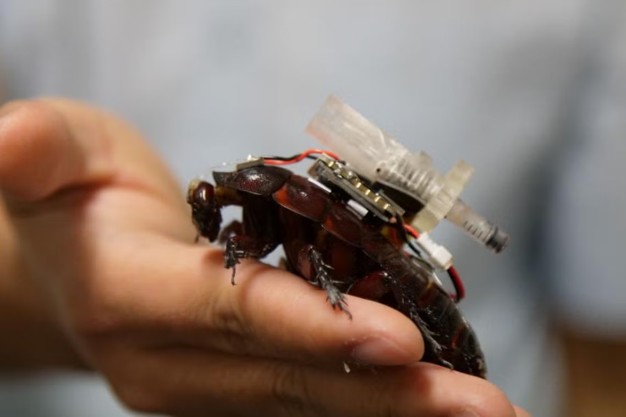
Inside of Sunday’s newspaper was a Reuters article about cockroaches being tested for use in disaster rescues. Researchers at the University of Queensland (UQ), Australia, developed remotely piloted cyborg cockroaches equipped with cameras and medical injectors that could be deployed at disaster sites. North Queensland giant burrowing cockroaches (Macropanesthia rhinoceros) were equipped with lightweight devices that provide visual feedback or remotely activated auto-injection devices designed to deliver emergency assistance when direct access to trapped people is not possible. The cockroaches are remotely controlled by humans through an electrode and microchip fitted to the insects. Dr. Thang Vo-Doan explained that “Once we implant electrode into the insect, we can apply a small electrical signal to activate or stimulate the nerve system so that they can respond to our command.” The hope is these Paraborgs, could be transformed into swarms of tiny rescue teams capable of delivering emergency care in tight spaces where humans cannot fit during search-and-rescue missions.
When I went online, I found Paraborgs is short for “paramedic cyborg cockroaches”. The bugs transformed are the giant burrowing cockroach (Macropanesthia rhinoceros), also known as the rhinoceros cockroach and Queensland giant cockroach, is a member of the family Blaberidae. This large cockroach is native to Australia and found in mostly tropical and subtropical parts of Queensland. These are the world’s heaviest species of cockroach and can weigh up to 0.7 to 0.8 pounds (30 to 35 g) and measure up to 3.1 inches (7.5 to 8 cm) in length. Unlike some other cockroaches, the giant burrowing cockroach does not have wings and is not considered a pest. The species plays a vital part in the ecosystem by consuming dead leaves and recycling other plant matter. They burrow down in soil to a depth of about 39 inches (1 m) to make homes and feed on collected dry leaf litter. The giant burrowing cockroach is the only cockroach in the world known to have permanent burrows in the soil and play a central ecological role by contributing to the recycling of nutrients in the wild. It is prominent in the wild and can also be sold and kept as a pet.
In proof-of-concept testing at UQ’s School of Mechanical and Mining Engineering, the Paraborgs achieved 95% success with close-range injection when positioned within 6 inches (15 cm) of the target and the complete navigation-and-injection task succeeded in 72% of trials. PhD candidate Hai Nhan Le said accurate positioning of the Paraborgs was one of the key engineering challenges, “The cyborg insect has to navigate to the target, position itself accurately and remain stable enough to perform the injection.” Le admitted a lot of people might not like the sight of a giant cockroach scurrying towards them (let alone a swarm of them) but if you’re trapped in rubble or stuck in a cave it could make the difference between life and death. Researchers hope to deploy the cyborg cockroaches to disaster zones within the next five to 10 years.
Thoughts: Reading about the Paraborgs it made me think about the 1975 movie, “Bug”. When a massive tremor opens a crack in the California desert a plague of foot-long (0.3 m) cockroaches are released. The mutant bugs have steel-like shells and rub their rear antennae together to start fires, then consume the ash. While most of them die, scientist James Parmiter (Bradford Dillman) is obsessed with studying the survivors, even crossbreeding them with above ground cockroaches. They ultimately return underground, taking Parmiter with them, and the fissure reseals. Even trapped I would think of the movie rather than being saved. When the device is removed, the cockroach lives a normal span of life, so perhaps a win-win? Act for all. Change is coming and it starts with you.

