Parrots

October 10, 2022

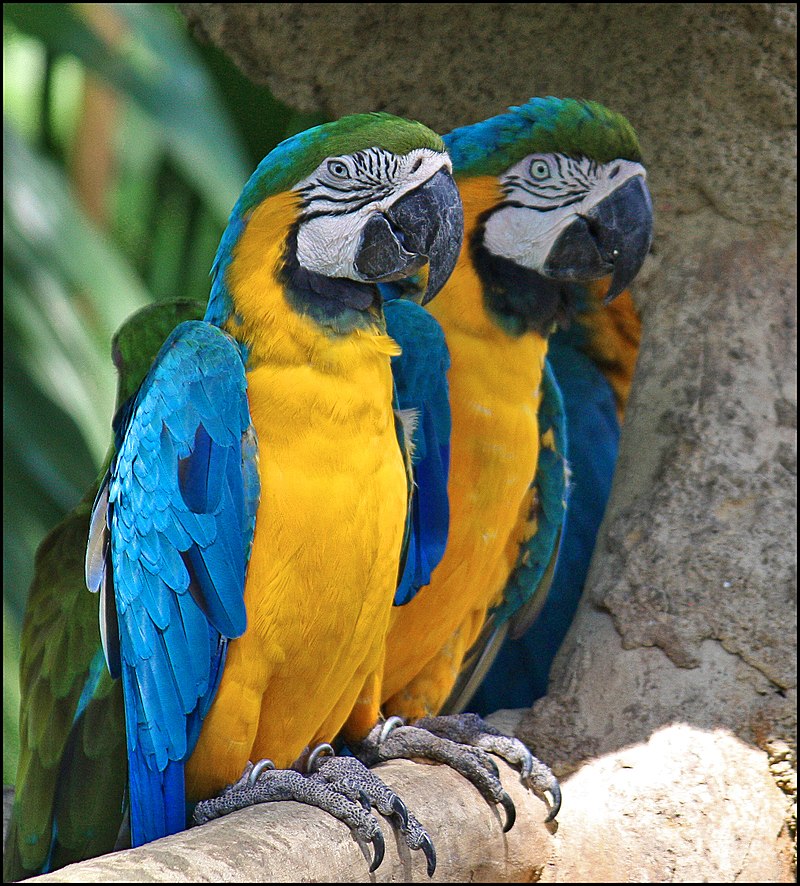
In the backstories of the US$billions of damages and loss of more than 75 lives from Hurricane Ian last week was an article about a flock of parrots that were saved from one of the outer islands.  Will Peratino and Lauren Stepp refused to leave their Pine Island refuge while authorities pleaded with residents because of damaged roads and a collapsed bridge that prevented deliveries of food, gas, and life-sustaining supplies.  The couple would not leave without their two lemurs and a flock of 275 parrots, including some of the world’s rarest.  The birds have been relying on food donated by wildlife officials since Ian hit, but the supply of fruit, peanuts and other edibles were becoming hard to come by because of the downed bridge and the scarcity of gasoline.  A rescue mission (dubbed “Operation Noah’s Ark”) was launched by Project Dynamo Tuesday to catch, cage, and ferry the birds off the island to persuade the couple to leave.  The parrots ranged from macaws to cockatoos to rare specimens of king parrots of which there are only two dozen known pairs in the US.

When I looked online, I found the Parrots (Psittacines) are birds of the roughly 398 species in 92 genera comprising the order Psittaciformes and found mostly in tropical and subtropical regions.  One-third of all parrot species are threatened by extinction, which is a higher aggregate extinction risk (IUCN Red List Index) than any other comparable bird group.  Parrots have a pantropical distribution, but several species inhabit the temperate regions in the Southern Hemisphere.  The greatest diversity of parrots is in South America and Australasia.  Characteristic features of parrots include a strong, curved bill, an upright stance, strong legs, and clawed feet with two toes pointing forward and two backward (zygodactyl).  Many parrots are vividly colored, and some are multi-colored.  Most parrots exhibit little or no visible sexual dimorphism (look the same).  They form the most variably sized bird order in terms of length.  The diets of most parrots are seeds, nuts, fruit, buds, and other plant material.

The Malama Manu Sancuary where the parrots lived has rescued many of their birds from homes that could no longer care for them, and some are used for breeding rare species.  The sanctuary is named from two Hawaiian words, “Malama” the word for protect and “manu” meaning bird.  In the hours before the storm, the sanctuary owners herded their flock of parrots and packed them into their home to shield them from the force of the elements.  Had they been left in their sanctuary cages they would have all been underwater.  While the focus of many search and rescue missions has been on human life, there have been pet rescues.  Bryan Stern, the founder and leader of Project Dynamo, said his team had already rescued at least six dogs, three cats, and three birds.  When asked why they performed the rescue, the director said, “We would not abandon them . . . If they cannot be fed or watered, they will die. And I can’t live with that.”  Obviously, this rescue skewed the numbers.

THOUGHTS:  When I lived in California’s Bay Area a rescue center was built for stray dogs and cats at the cost of over US$6 million.  This featured separate wings (one dogs, one cats) with separate rooms (not cages) for each animal and a communal play space for exercise.  The center was built entirely by donation.  Humans have a strong desire to give and receive affection and our pets freely give and are easy to love.  Animals have a positive effect on us and activate our feel-good hormones (oxytocin system) associated with empathy, trust, and relationship building.  Our pets make us feel better whether they are dogs, cats, birds, and yes, even reptiles.  We need to find the same level and compassion for other humans.  Act for all.  Change is coming and it starts with you.
Fear

October 08, 2022

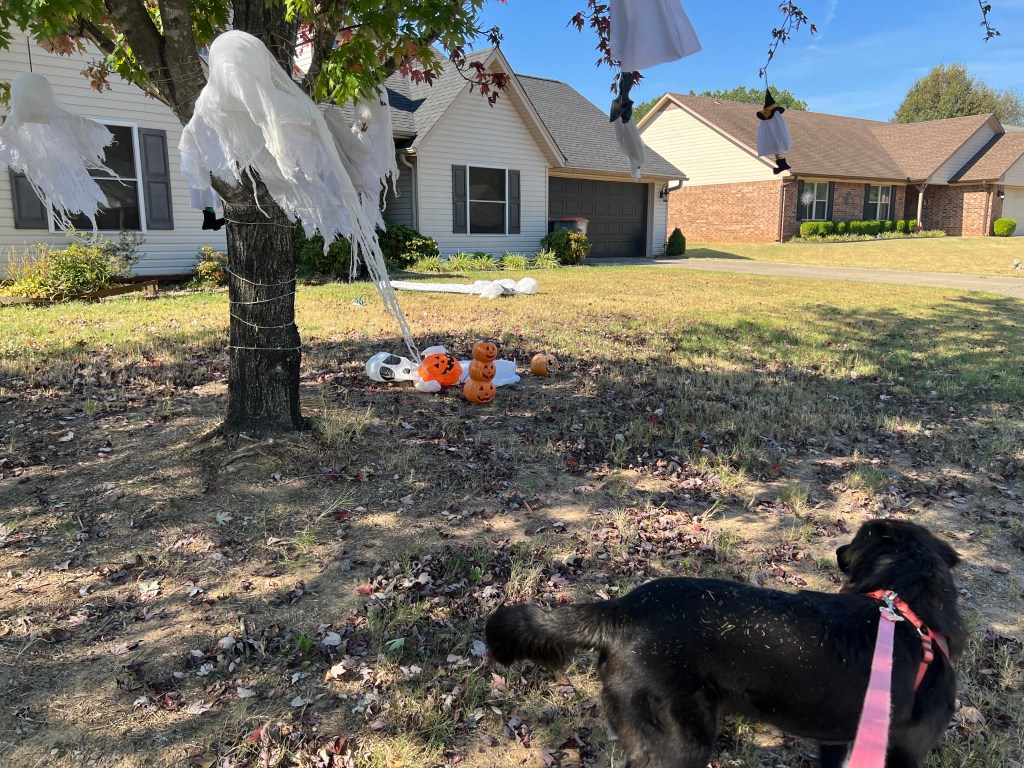
As Zena and I took our walks this week we were met with the Halloween yard displays that seem to pop up every year in our neighborhood.  I have mentioned how Zena does not like unexpected encounters on her walks, whether it is a mole or another dog.  One of the displays featured ghosts hanging from the branches of a tree in the front yard of a house.  Zena noticed this display half a block away and began to tense up.  As we got closer, she began to growl and then when we were across from the ghosts Zena started barking and lunging on her leash.  I decided I needed to let her get close so she could figure out what these scary looking objects were.  They had intruded on her walk, and I needed to reduce her fear of the unknown.

When I looked online, I found the science of fear comes from the emotions released that also give us pleasure.  Fear refers to an emotion or feeling induced by perceived danger or threat which produces a physiological change that evokes a behavioral response (e.g., fight, flight, or freeze).  When we face fear, our bodies will react with one of these responses, but our brains are also cognitively lazy.  When we get a “safe” fear (haunted house or horror movie) our brains will quickly evaluate the situation and tell us that we’re free from risk.  Many people seek a “controlled” fear because we know we are safe.  Fear produces a rush of endorphins and dopamine which can result in a pleasure-filled, opioid-like sense of euphoria.  Some people seek thrills to see how much fear they can tolerate.  Fear can also bring people closer together as a shared experience.  Teenage dating advice suggested taking a date to a scary movie because being frightened releases a biochemical flood that can yield a pleasurable outcome, which we often misattribute to the person we are with.  Others are curious about the “dark side” and fear of the unknown is one of the most natural and instinctive fears we have.  “Safe” fear gives us the rush and togetherness without any potential trauma.

When we approached the scary yard display Zena’s fear quickly dissipated.  She gave one of the ghosts hanging from the tree a sniff.  It probably smelled like the person who hung it, and while Zena did not understand why it was there, she did know this was not alive or a threat.  Having satisfied her curiosity, we were able to continue our walk.  I knew we had to retrace our steps back by the yard display to go home and I wondered how Zena would react the second time she saw the scary display.  As we approached her ears did pickup, but then she seemed to recognize the threat she had already investigated.  As we walked by this time Zena ignored the display.  Her fear had been resolved.

THOUGHTS:  When I was growing up, our one TV channel (yes, one) always carried a scary movie on Saturday afternoon.  These were the hokey B Movies produced in the 1950’s that emphasized radiation (A-Bomb), invasion (Red Scare), and extraterrestrials (space race).  I was the only one in the house as I watched one of these movies and it filled me with fear.  The robots would sneak up on people from behind and shoot a gamma ray from the “eye” in their head and disintegrate the hapless humans.  I recall peeking around the door at the TV when the scary parts came.  I was filled with fear, but unable to turn away from the action.  Unlike Zena, I was unable to put this fear behind me and move on.  Even now I can wonder if something might be sneaking up behind me to shoot me with a gamma ray.  When we are confronted by the uncontrolled (albeit unfounded) change in our lives it is easy to be filled with fear.  It is only when we face those fears and see “the man behind the curtain” that we realize we can safely move on.  Act for all.  Change is coming and it starts with you.

Graduation

October 07, 2022

As I took Zena to her final obedience training class today and was looking forward to her graduation.  We were scheduled to visit the big hardware store in town, but the treat man thought it might be too overwhelming for Zena as she is rarely in situations with other people.  He opted for a nearby farm supply store that might be less crowded and had more potential for other dogs to be present.  When we arrived, rather than the 3 or 4 cars expected, the lot was nearly full.  When we went inside, we found it was inventory day, and the aisles were crammed with checkers counting the product on the shelves.  Zena became anxious being around so many people, but we skirted the inventory aisles and quickly walked by most of the shoppers.  The trainer finally took her to the fenced outdoor patio and escaped from the commotion.  I worried this might be touch and go as far as her graduation went.   

When I looked online, I found Dog Obedience School graduation is usually a time to show all the other dog parents how well your dog behaves as compared to theirs.  That means following hand signals, moving through an obstacle course, and sitting quietly next to the other dogs in line.  The other idea to pop up was the possibility of ordering one of several available cards to commend Zena on her graduation from Dog Obedience School (US$3.79 includes envelope).  There were also graduation announcements that I could send out to all my (Zena’s?) friends.  While it is nice to mark these significant occasions in our (her) life, I often wonder if the real intent is to hint at the possibility of receiving a gift to honor the event.  While I thought the sentiment was nice, I decided to forego both possibilities.  I was already too late to send out the announcement and was not sure whether Zena would appreciate a card.  I decided to give Zena another treat instead.

Zena was able to handle all the obstacles she encountered at the farm supply store.  She maneuvered through the aisles like a trooper and while she took notice of the people, kept her real focus on the trainer.  Out in the yard she jumped up on a raised platform and practiced lay down and stay.  She did well but began to become overstimulated.  When we went inside there was a tiny yippie dog riding in a shopping cart that began to make a ruckus, but Zena ignored her and focused on the treats.  We weaved through the people on the way out of the store and she finally began to settle down when we got to a grassy area.  Time was up and the session was complete.  The trainer praised her work and said she had learned what she needed (I needed) to know, unless we wanted to make her a show dog, and he did not offer that training.  He took Zena’s picture, and the graduation was over.  While this was Zena’s first graduation (she is only 8 months after all), it will probably not be her last.

THOUGHTS:  I have experienced eight school graduations in my life, ranging from Primary School (this was before widespread Kindergarten) to my last graduate degree.  I believe the one I hold fondest in memory was when I graduated from Primary School.  The event was held in the second story of an abandoned dance hall in our small town that had a raised stage and curtains.  Everyone had their name called (all 12 of us) and we walked across the stage to receive our diploma.  While that was memorable, the best part was the homemade cookies and punch severed at the conclusion.  The next year I embarked on a regime that would comprise most of my next 50 years.  Melissa framed my four college degrees for one of my birthdays, but sadly the Primary School diploma had been lost.  Like much of life, it probably exists far better as a memory.  Holding onto memories can bring us joy, but we need to remember the lessons taught as well.  These memories help allow us to navigate through our present life.  Act for all.  Change is coming and it starts with you.
Mole

October 06, 2022

When Zena and I went out for our walk this morning we encountered a mole shuffling along the road gutter near our house.  While I my yards always seem to provide evidence of mole presence, this is the first mole I have ever seen above ground.  Zena is always curious about new encounters and immediately wanted to find out what this tiny intruder was in our walk environment.  Since my yard has been plagued by a mole (s?) my first thought was to get rid of it.  Then I remembered how the benefits of a mole (removing insects, grubs, and worms) are said to outweigh the runs and exit holes they leave in your yard.  I have an aversion to killing anything for no reason other than it is there, and rather than kill them I use sonic stakes to repel moles from my yard.  I diverted Zena’s attention with a treat, and we went on down the street.  My thought was it is too far to make it to my yard anyway.

When I looked online, I found the eastern mole ((Scalopus aquaticus), or the common mole, is a small mammal adapted to a subterranean lifestyle.  The word “mole” refers to any species in the family Talpidae, which means “mole” in Latin.  Moles are found in most parts of North America, Europe, and Asia, and the eastern mole is native to southeastern US.  The mole is about 6.3 inches (16 cm) in length including a 1¼ inch (3 cm) long tail and weighs about 2.6 ounces (75 g).  They have cylindrical bodies, reduced hindlimbs, and short, powerful forelimbs with large paws adapted for digging.  A fleshy, moveable snout projecting over the mouth with nostrils on the upper part is used as a touch organ.  The short, thick tail is is also used for touch when the mole moves backward in the tunnel.  The minute, degenerative eyes are hidden in the fur and the eyelids are fused, limiting sight to distinguishing between light and dark.  The small ear openings are concealed by fur, but hearing is acute.  A mole will stop digging when it hears humans or pets walking in the yard.

While gardeners see a mole as a pest, they have positive contributions including soil aeration, feeding on slugs and small creatures that eat plant roots, and providing prey for other wildlife.  The pelt of the eastern mole is small and does not dye well making it of no commercial value to the fur industry (lucky for the mole).  When a mole disfigures lawns, damages the roots of garden plants searching for food, or take sprouting corn, they are considered undesirable.  However, some homeowners report a mole eradicated other undesirable insect pests.  The species is listed as Least Concern on the IUCN Red List because of its wide distribution, large (assumed) population, occurrence in several protected areas, tolerance to habitat modification, and because it is unlikely to decline at a rate to qualify for listing in a threatened category.

THOUGHTS:  Today’s San Jose Mercury News reported a reporter finding a dead mole above ground on a hike in the nearby hills.  When the queried on Facebook, other hikers were finding the same thing.  The responses offered several solutions to the problem, but nothing definitive.  While it may be an interesting phenomenon with a solvable solution, the author likened it to finding missing socks (his dog takes them when he leaves the house).  I have found my socks missing while I am getting dressed, only to later find them out on the patio (Zena).  My traveling mole may be a mystery, but likely it was just moving to a new location.  Conspiracy theories often provide improbable explanations for easily understood events.  It seems the wilder the explanation, the more it spreads across the internet (and is believed?).  Act for all.  Change is coming and it starts with you.

Jimson

October 05, 2022

During our walks I have noticed piles of brush and limbs placed near the curb at several houses along our route.  These were left for a period and then mysteriously disappeared.  I asked a neighbor, and he told me brush removal was a function of our street department.  Yard waste is collected once a month if it met certain criteria.  It could be no longer than 8 feet (2 ½ m) long and no more than 4 inches (10 cm) in diameter.  Yard waste should be stacked, and bundles cannot exceed 24 inches (60 cm) in diameter.  Everything should be placed at the curb or no more than 10 feet (3 m) from the street.  Melissa had always placed our limbs and trimmings in the tree line at the back of the property and I had continued this course.  One pile that caught my attention was a pile of rose clippings as I had recently trimmed the rose bush in our front yard.  When we came by this morning the owner had added a freshly cut stack of vines containing spiny seed pods about 2 inches (3cm) in diameter on the pile.  When I showed this to Melissa, she said it looked like jimson weed.

When I looked online, I found jimson weed (Datura stramonium), known by the common names thorn apple, devil’s snare, or devil’s trumpet, is a poisonous flowering plant of the nightshade family Solanaceae.  Its likely origin was Central America, and it has been introduced in many warm regions of the world.  Jimson is an erect, annual, freely branching herb that forms a bush up to 2 to 5 feet (60 to 150 cm) tall.  The root is long, thick, fibrous, and white.  The stem is stout, erect, leafy, smooth, and pale yellow-green to reddish purple in color.  The stem forks off repeatedly and each fork forms a leaf and a single, erect flower.  The leaves are about 3 to 8 inches (8 to 20 cm) long, smooth, toothed, soft, and irregularly undulated.  The fragrant trumpet-shaped flowers have a pleasing odor, are white to creamy or violet, and 2 ½ to 3 ½ inches (6 to 9 cm) long.  The flowers open at night, emitting a pleasant fragrance, and are fed upon by nocturnal moths.  The egg-shaped seed capsule is 1 to 3 inches (3 to 8 cm) in diameter and covered with spines.  At maturity, it splits into four chambers, each with dozens of small, black seeds.  It is an invasive weed regarded as dangerous.

Like all Datura species, every part of the jimson plant contains deadly toxins (tropane alkaloids) that can kill animals (including humans) that ingest it.  All species of Datura are poisonous and potentially psychoactive, especially their seeds and flowers.  The leaves have a bitter and nauseating taste, which is imparted to extracts of the herb, and remains even after the leaves have been dried.  Ingestion can cause respiratory depression, arrhythmias, fever, delirium, hallucinations, and even death.  Due to their effect, Datura have been historically used as poisons, and as hallucinogens, by various groups.  Traditionally, psychoactive administration of Datura was often associated with witchcraft and sorcery, including the Western world.  Datura species have also been used ritualistically to enhance spiritual development by some Native American groups.

THOUGHTS:  Jimson weed grows naturally in West Virginia and has been used as a home remedy since colonial times.  Due to its easy availability and strong reaction with the nervous system, teens in some areas of the state are using jimson weed as a drug, either brewed, chewed, or eaten.  Side effects include rapid heart rate, dry mouth, dilated pupils, blurred vision, hallucinations, confusion, and combative behavior.  Severe toxicity has been associated with coma and seizures, although death is rare.  The Brooklyn Botanic Garden site named this the “weed of the month” for its lovely flowers.  “With all its extraordinary looks and lore, jimson weed is a fascinating plant to contemplate (but maybe not cultivate)!”  I wondered why this had been cultivated (and thrown onto the street) in our neighborhood.  Hopefully it will not be eaten.  Act for all.  Change is coming and it starts with you.
Echolocation

October 04, 2022

My Sunday newspaper carried a story of a ship located last week that had sent a wireless radio message warning the Titanic about the presence of icebergs on that fateful day in 1912.  The Titanic received the Mesaba’s message, the warning never reached the captain on the bridge and on April 15, the “unsinkable” liner hit an iceberg and sank with a loss of over 1,500 lives.  The SS Mesaba sank six years later in the Irish Sea as part of a convoy from Liverpool to Philadelphia on September 1, 1918.  The ship was torpedoed by a German U-boat and twenty people were lost.  The wreck of the merchant vessel was identified by researchers at Bangor University in Wales using multibeam sonar.  Sonar and echolocation are essentially the same process, but echolocation is the use of echoes to detect objects observed in natural creatures (biosonar) while sonar is (nautical) echolocation.

When I looked online, I found echolocation is used by bats and other animals to determine the location of objects using reflected sound.  This allows bats to navigate in pitch darkness to hunt, identify friends and enemies, and avoid obstacles.  Echolocation allows bats to fly at night and in dark caves.  Bats seem to have developed the skill to locate night-flying insects.  Bats make the sounds in their larynxes and emit them through their mouths.  Fortunately, most are too high-pitched for humans to hear as some bats can scream at up to 140 decibels, or as loud as a jet engine 30 miles (45 km) away.  Bats can use echolocation to detect an insect up to 5 miles (7.5 km) away, work out the insect’s size and hardness, and then to avoid limbs and wires as fine as a human hair.  The bat cranks up the calls to pinpoint the prey as it closes in for the kill.  To avoid being deafened by its own calls, a bat turns off its middle ear just before calling, then restores its hearing to listen for the echoes.

While echolocation is produced naturally by animals, human produced sonar uses machines to produce the sound waves that measure the distance between a sound source and the objects in its surroundings.  Humans also use sonar for navigation, communication, mapping, and frequently in underwater vessels.  The active sonar used by the Bangor researchers to map the seabed and identify the Mesaba wreckage, involves emitting pulses of sounds and listening for echoes.  The speed of sound is constant, so by measuring the amount of time between a chirp emitted and hearing its echo, a vessel can calculate the distance to the reflecting object.  The multibeam sonar used by the Bangor team enables seabed mapping at an increased level of detail which allows the details of structures such as shipwrecks to be observed.  One of the Bangor researchers described multibeam sonar as “a game-changer for marine archaeology.”

THOUGHTS:  “Echolocation” was coined by zoologist Donald Griffin in 1944 but reports of blind people being able to locate silent objects date back to 1749.  During the 1940’s experiments staged at Cornell Laboratory showed sound and hearing, not pressure changes on the skin, were what drove human echolocation.  Some passively use natural environmental echoes to sense details about their environment, but others actively produce mouth clicks to gauge information about their environment.  Both passive and active echolocation help blind people sense their environment.  Sighted people tend not to perceive the echoes due to echo suppression, but with training sighted individuals with normal hearing can learn to avoid obstacles using only sound.  Echolocation is a general human ability.  The human brain receives millions of stimuli every second from our surroundings.  The question is what to ignore and when to pay attention.  When it comes to creating unity with others, we need to actively pay attention.  Act for all.  Change is coming and it starts with you.
Purslane

October 03, 2022

Last week I noticed a beautiful flower had bloomed amid the weeds I have allowed to serve as groundcover in the mailbox planter.  The bed has been planted with types of bulbs that sprout and flower at different times of the year.  With the hot summer most of the cover (including weeds) had died back.  I kept thinking I needed to plant something, but I have also watched as other house owners in the neighborhood had been planted annuals.  They never lasted more than a couple of weeks before they died.  The weeds that are taking over in my planter appeared to be succulents, and I was surprised Melissa did not like them.  When I asked, the reason was that they had not been planted by her (or her mom?) and just grew on their own.  She knew exactly what the plants and the flower were, purslane.

When I looked online, I found Common purslane (Portulaca oleracea), also known as little hogweed, is an annual (tropical perennial in growing zones 10 – 11) succulent in the family Portulacaceae.  The species was recorded in 1753 by Carl Linnaeus in Species Plantarum.  Due to the great variability, of the species many of the subspecies and varieties have been instead described as separate species, but other publications list them all as variations.  The plant may reach 16 inches (40 cm) in height.  It has smooth, reddish, mostly prostrate stems and the leaves, which may be alternate or opposite, and are clustered at stem joints and ends.  The yellow flowers have five regular parts and are up 1⁄4 inch (6 mm) wide.  The flowers can appear at any time during the year depending on rainfall and open singly at the center of the leaf cluster for only a few hours on sunny mornings.  Purslane has a taproot with fibrous secondary roots and can tolerate poor soil and drought.  The fruits are the many-seeded capsules, and one plant can develop up to 193,000 seeds.  It is no wonder these succulents take over.

While purslane is best known as a weed it is also an edible and highly nutritious vegetable that can be eaten raw or cooked and contains about 93% water.  It has a slightly sour or salty taste, much like spinach and watercress.  Purslane can be found at farmers markets for use in crunchy salads or ethnic cuisine, and it can be cultivated for ornamental use.  Archaeobotanical finds of purslane are common at Mediterranean prehistoric sites.  Historically, , seeds have been retrieved from a protogeometric (1040 – 900 BCE) layer in Kastanas, Greece, as well as from the isle of Samos dating to the 7th century BCE.  In the 4th century BCE, Theophrastus names purslane (andrákhne) as one of the several summer “pot herbs” that needed to be sown in April.  The healing properties of purslane during antiquity were thought to be so reliable that Pliny the Elder advised wearing the plant as an amulet to expel all evil.  Purslane is high in many nutrients while low in calories, making it one of the most nutrient-dense foods on the planet.  I do not think I can convince Melissa to eat any of these weeds.

THOUGHTS:  Like many species of plants purslane is both a weed and miracle food.  The internet sites I found alternated between how to get rid of the plant and where to get the best price on seeds.  It all depends on the beholder and what you are accustomed to.  Migration is often treated in the same manner.  While some are moving into the suburbs, others are moving into urban areas, and both are creating diversity in what was perceived to have originally been homogeneous communities.  How change is perceived depends on the beholder.  The right to live where you want should not be afforded to only the elite.  Act for all.  Change is coming and it starts with you.

Treat Man

October 01, 2022

Yesterday I was able to take Zena to the trainer for a lesson.  We call him the “treat man” because she gets copious amounts of treats as rewards for doing what she is supposed to do.  She had not been to train in several weeks due to a variety of issues and I was hoping she would do alright.  I walk her in the mornings and although I know she has done fine by my standards, these were below the expectations of the trainer.  We showed up right on time and he was waiting in the drive of his house.  He told me to follow him, and we took off for the park.  Today’s lesson was going to be walking outdoors and encountering other people and dogs.  This is an area Zena and I have struggled with, and I was anxious to see what the treat man would do different than me.

When we arrived at the park we went to a fenced playground.  This was not gated but it was closed on three sides with a wide opening at the walkway entrance.  The treat man had brought his long leash and allowed Zena to run free will with the leash attached and dragging behind her.  That way we could catch her if she took off, but she would still feel like she was on her own.  Zena snuffled around until she got comfortable with her surroundings before he started the training.  She would run around the yard and then look back to check if he was still there.  That is when he would tell her to “come”, and when she did, she received a treat.  After working on this command for ten minutes Next Zena worked on paying attention to him as several dogs and people walked by on the other side of the gate.  Again, she did well but there were not too many people or dogs to distract her is this section of the park.  He decided to up the test and we moved to the other side of the park that had a walking trail around a small lake.  He assured me this would be more of a test.

The lake we went to had one of the community fishing lake signs posted by Game and Fish.  These small lakes are in urban settings and stocked with catfish four times a year.  Several also have trout stocked during the winter.  Every one of these signs is the same, listing the fish and creel limits for the lake.  Although they all list bass on the sign, I have never caught (or seen) a largemouth bass (Micropterus salmoides) at any of the lakes.  I laughed and told the trainer, but he contradicted me.  Last year he had caught a 6 inch (15 cm) crappie (Pomoxis annularis) and when he was reeling it in, it was engulfed by a five pound (2.3 km) bass.  The hook caught in the bass’ mouth, and he was able to reel them both in.  I do not know if this was just a fish tale, but they stock bluegill (Lepomis macrochirus) and not crappie in these community lakes.  Sour grapes, maybe the treat man was just a better fisher person than me.

THOUGHTS:  We finished Zena’s first three sessions with the treat man last spring and then took the summer off because it was so hot.  He was apprehensive about the restart not knowing if we had kept up the drills.  We had and Zena took up where she left off this month.  She still picks up the commands quickly and remembers them (when she wants to).  Even the treat man has commented on how smart she is.  Intelligent dogs are a lot like people.  They know what you want them to do, it is just a matter of whether they decide to do what you want.  The trick is to make doing the right thing in their best interest.  Treating others with justice is the right thing for them, but also is for you.  Act for all.  Change is coming and it starts with you.
Rattlesnake

September 30, 2022

𝘱𝘩𝘰𝘵𝘰 𝘤𝘳𝘦𝘥𝘪𝘵: 𝘋𝘢𝘯𝘯𝘪𝘦𝘭𝘭𝘦 𝘓𝘢𝘥𝘯𝘦𝘳

The Nation & World page of my local newspaper carried a USA Today article about a white rattlesnake on display at the Natural Science Museum in Jackson, Mississippi.  This is one of the rarest rattlesnakes most people will ever see.  Jamie Merrill, conservation associate biologist with the museum, said the snake has a genetic condition called T-positive, which is a reduction of pigment and not a total loss of pigment.  He is off-white with tan chevrons.  T-negative would be a total loss of pigment, which is a little rarer than T-negatives.  Herpetologist Terry Vandeventer of Jackson said the fact this rattlesnake survived to adulthood is so rare it cannot be calculated.  One out of several thousand timber rattlesnakes are born T-positive.  The odds of a normal juvenile rattllesnake living to adulthood in the wild are already low, but a T-positive snake not having camouflage to protect it from predators make the odds of survival considerably lower.  This snake survived to adulthood, was captured, and was relocated to the museum where it is now on display.

When I looked online, I found the timber rattlesnake (Crotalus horridus), also called the canebrake rattlesnake or banded rattlesnake, is a species of pit viper widespread throughout eastern North America.  All pit vipers are venomous, but this species can be highly venomous.  The timber is the only rattlesnake species in the heavily populated Northeastern US and is second only to only the prairie rattlesnake as the most northerly distributed venomous snake in North America.  Adults usually grow to the length of 36 to 60 inches (91 to 152 cm), with most adults measuring less than 45 inches (115 cm) in length and weighing between 1.1 and 3.3 pounds (500 and 1,500 g), and often towards the lower end of the range.  The maximum reported length is 74.5 inches (189.2 cm) and large specimens can reportedly weigh as much as 10 pounds (4.5 kg).  The back (dorsal) of the rattlesnake has a pattern of dark brown or black crossbands on a yellowish-brown or grayish background while the underbelly (ventral) is yellowish and either uniform or marked with black.

The white rattlesnake was discovered by Danielle Ladner of Yazoo County Mississippi as she was gathering muscadines (wild grapes) to make jelly.  She was about to leave and bent over to pick some of the muscadines she’d gathered and realized the snake was 2 feet (30 cm) from her face.  Ladner initially screamed and ran away, but she went back and photographed it.  After sharing the photos with a herpetologist, she realized the snake was a rarity and called the Mississippi Department of Wildlife, Fisheries and Parks.  Personnel from the agency captured the snake and took it to the museum.  The snake went into a reptile form of hibernation (brumation) where it did not eat for several months.  Once it began eating regularly, he was placed on display.  Ladner took her children to the museum to see the rattlesnake.  “We were excited.  I felt like he’d put on a good bit of weight.  He looked really good and healthy.  I’m not a snake person and never have been, but he’s a special snake.  I’m glad he’s safe and everybody can come see him.”

THOUGHTS:  When I directed the camp in Kansas, we had areas of timber and tall grass conducive to snakes and their prey.  Guests would often tell me about snakes they saw and expect me to “do something”.  When I researched, I found the area of Kansas where we were was unique in there were no venomous snakes in the county.  While different species of rattlesnakes and copperheads are common on the Kansas prairie, their range does not tend to overlap, and we sat right in the middle.  The rat snakes and black snakes that were reported may have looked ominous but were beneficial pest control.  I recall one old-timer telling me, “You don’t need a cat.  You’re better off with a black snake in the corn crib.”  I made a pamphlet on venomous snakes in Kansas to ease their fears.  Act for all.  Change is coming and it starts with you.
Bacteria

September 29, 2022

As the Hogs prepare for a top 20 showdown with the Tide, I was drawn to an article in my local newspaper about research done by the University of Alabama on bacteria and the origin of life.  This highlighted a professor who specialized in the “esoteric field of biomineralization”.  Alberto Perez-Huerta discovered a way to use a Local Electro Atom Probe (LEAP) to analyze a specific mineral in ancient rock that could only have been generated by a living bacterial organism.   Rock samples from about 3.5 billion years ago are known to bear a particular crystal that is only 60-80 nanometers in size, but no one could determine if the crystals were geologically formed or biologically formed.  Crystals formed by bacteria leave traces of organic components (carbon and nitrogen) that show they are biological.  Using a LEAP, he looked inside the crystals and found those made from bacteria have traces of organic compounds while crystals formed in the lab by non-biological processes did not.  This research lays a foundation for other scientists to build more accurate theories about early life.

When I looked online, I found bacteria (singular bacterium) are ubiquitous, mostly free-living organisms often consisting of one biological cell lacking a nucleus or membrane-bound organelles.  They are typically a few micrometers in length and were among the first life forms to appear on Earth.  Bacteria inhabit soil, water, acidic hot springs, radioactive waste, and the deep biosphere of Earth’s crust.  Bacteria are vital in many stages of the nutrient cycle by recycling nutrients, including decomposition of dead bodies.  Bacteria live in symbiotic and parasitic relationships with plants and animals and humans carry millions of bacteria.  Most are in the gut, but others are on the skin.  Most of the bacteria in and on the human body are harmless or rendered harmless by the immune system, and many are beneficial, particularly the ones in the gut.  Several species of bacteria are pathogenic and cause infectious diseases, including cholera, syphilis, anthrax, leprosy, tuberculosis, tetanus, and bubonic plague.  The most common fatal bacterial diseases are respiratory infections.

Antibiotics have been used against virulent strains of bacteria since ancient times.  Ancient notes on the beneficial effects of a topical application of moldy bread are found in Egypt, Nubia, China, Serbia, Greece, and Rome.  The first person to directly document the use of molds to treat infections was John Parkinson during the early 17th century.  Antibiotics revolutionized medicine in the 20th century.  Alexander Fleming discovered modern day penicillin in 1928 and widespread use proved beneficial during wartime.  However, the effectiveness and easy access to antibiotics have also led to their overuse and some bacteria have evolved a resistance to them.  The World Health Organization has classified antimicrobial resistance as a widespread “serious threat [that] is no longer a prediction for the future, it is happening right now in every region of the world and has the potential to affect anyone, of any age, in any country”.  Global deaths attributable to antimicrobial resistance numbered 1.27 million in 2019.

THOUGHTS:  There has been extensive use of antibiotics in animal husbandry despite legislation limiting its use.  In the US, the question of emergence of antibiotic-resistant bacterial strains due to use of antibiotics in livestock was raised by the US Food and Drug Administration (FDA) as far back as 1977.  The antibiotics used against bacteria in food animals are producing resistant bacteria, and both the antibiotics and resistant bacteria are passed through human consumption.  Abuse of the latest cure frequently leads to creation of its own pathogen.  Act for all.  Change is coming and it starts with you.