
September 25, 2024
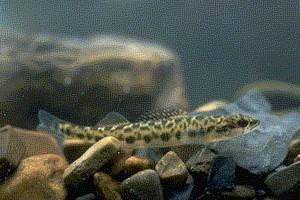
Last week the Arkansas Game and Fish Commission (AFGC) released 80 leopard darters into the wild with the help of state and federal partners along with Conservation Fisheries LLC, a private hatchery specializing in propagating rare and threatened species. According to Chance Garrett, fish ecologist for the AGFC, this release is the first of two scheduled for the Cossatot River in western Arkansas this year and is the first historical reintroduction effort of leopard darters anywhere. The fish were grown from broodstock taken from the Mountain Fork River which flows from Arkansas into Oklahoma. Another 250 fish are planned for release in early October. Garrett said, “They originally thought it was only found in Oklahoma, but some populations were found in the Rolling Fork and Cossatot after its listing. Those two populations are thought to no longer exist, so this effort to re-establish them is extremely important.” This is the second year of the project, but the first year saw a low survival rate as the hatchery and were added to the broodstock rather than being released. The leopard darters measured and an inch or two (2.5 to 5 cm) at stocking size and were transported from the hatchery to their destination in one day.
When I looked online, I found leopard darters (Percina pantherina) are a species of freshwater ray-finned fish, from the subfamily Etheostomatinae. The family (Percidae) also contains the perches (Genus, Perca), ruffes (Gymnocephalus cernua), and pikeperches (Genus, Sander). The species is native to the US and is only be found in the Little River drainage in Oklahoma and Arkansas. A typical habitat is medium to large streams with rubble and boulder substrate. The leopard darter feeds on small invertebrates on the riverbed and spawns in March and April. Adults rarely exceed 3 inches (8 cm) in length and have 11 to 14 large, dark spots on their sides, which contrast against a light background that ranges from pale olive on the back to yellowish olive on the underside. The back of the fish has numerous saddles and bars. The leopard darter is threatened by impoundment, habitat loss, and runoff from agricultural activity. It has never been a common species and has been listed as a threatened species in the US since 1978.
Transporting and releasing the leopard darter was a full day affair. They left the Conservation Fisheries hatchery in Knoxville, Tennessee in the morning, were met by AGFC personnel in Memphis, and driven to the other side of other side of Arkansas by 6:30 p.m. that evening. Once at the river, the fish had to be tempered to adjust to the river water. They arrived in bags which were floated to slowly acclimate to the temperature of the river water. Then some river water was let into the bags to help them adjust slowly to the chemistry of that location. Finally, they are ready for release. The staff scanned the release pool the next day and found many of the fish had dispersed. Garrett said. “Hopefully we’ll see them in future survey efforts . . . Ultimately our goal is to see some spawning activity in spring.” The leopard darters represent one of the longest-standing members of the Endangered Species Act.
THOUGHTS: Leopard darters typically live less than two years, but individuals older than three years have been found. Introduction of these 320 fish (total) could reintroduce a viable population into the Cossatot River, but the fragile species still faces the loss of habitat due to construction of reservoirs and population isolation, along with agricultural and industrial activity, that drove them to decline in the first place. Species reintroduction and preservation takes the combined efforts of government agencies, business, and individual landowners to be effective. While it may take a village to raise a child, it takes concerned communities to preserve endangered species. Act for all. Change is coming and it starts with you.
 A travelers odyssey