
January 31, 2025
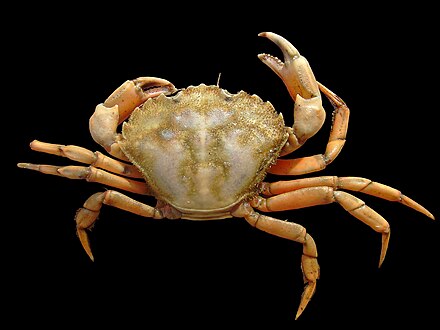
One of my NY Times feeds suggested a unique approach to stemming the advance of an invasive species which has taken over New England. The invasion is aided by the species being omnivores, scavengers, and cannibals, meaning they sustain themselves on almost any organic food. They have a high fecundity, with females releasing as many as 185,000 eggs a year. They survive in water temperatures from freezing (32F/0C) to 86F (30C) and tolerate sweet water zones where salt meets fresh. An adult can live more than 10 days out of water. Taken together, these characteristics explain why they were first documented along the United States coast in 1817 and continue their tour of the temperate world. The suggested remedy to control the European green crab was to eat them.
When I looked online, I found the European green crab (Carcinus maenas) is a common near shore (littoral) crab known by different names around the world. In North America and South Africa, it is called the European green crab, while in the British Isles it is referred to as the shore crab, or green shore crab. The crab is a widespread invasive species and is listed among the 100 of the World’s Worst Invasive Alien Species. The green crab is native to the north-east Atlantic Ocean and Baltic Sea, but has colonized similar habitats in Australia, South Africa, South America, and both Atlantic and Pacific coasts of North America. The adult crab grows to a carapace (back shell) up to 2.4 inches (60 mm) long and 3.5 inches (90 mm) wide. It can grow larger outside its native range, reaching 3.9 inches (100 mm) wide in British Columbia. The color of the green crab varies greatly, from green to brown, grey, or red. While this variation has a genetic component, it is largely due to local environmental factors. The crab feeds on a variety of mollusks, worms, and small crustaceans, and has affected the fisheries where it spread. The crab has been dispersed in a variety of ways, including on ships’ hulls, sea planes, packing materials, and bivalves moved for aquaculture.
In its native range, European green crab is mostly used as an ingredient in soups and sauces. Italian fisher people cultivate soft-shell green crabs (moeche in Venetian, moleche in Italian) and sell hard-shell crabs for their roe (masinette). Several groups in New England have successfully adapted these methods to produce soft-shell green crabs from the invasive species. Various groups have looked at using green crabs in cuisine. The Green Crab Cookbook (2019) was released and included recipes for soft-shell green crab, green crab roe, green crab stock, and green crab meat. Researchers at the University of Maine have actively been developing green crab products with the goals of driving business interest, stimulating a commercial green crab fishery, and alleviating predation effects. The same researchers developed a patty product made from minced green crab meat using restructuring additives (transglutaminase, dried egg white, isolated soy protein). Americans consume enormous amounts of seafood, and several favorites (like scallops, lobster, and salmon) can be too expensive for many households. The low-cost crabs are abundant, easy to catch, and are delicious, especially as a full-bodied stock that becomes the basis for ramen.
Thoughts: Some invasive species do not lend themselves to eating, but the European green crab is an exception. The one obstacle comes with the small size of the carapace. The tiny claws, legs and segmented body chambers people typically eat are difficult to pick. The small size is the one that has protected this crab from human consumption. The smaller make an excellent stock and seasoned and dried can be a crunchy hand food eaten whole, much like a potato chip. In the US, invasive species like the Asian carp (Family, Cyprinidae) and green crab are often seen as fertilizer, while they are eaten as a delicacy elsewhere. Climate change and invasive species might force a reassessment. The trick calling them something else and learning how to fix them. Act for all. Change is coming and it starts with you.
 A travelers odyssey