
February 05, 2025
Last night’s sleep was hard as our ship headed into the Aegean Sea. Melissa had worried about being on open water and prepared with a motion sickness remedy. The problem was, she did not take it in advance. I reserved an elegant Italian dinner in the ship-board restaurant, and we were seated next to a window to allow us to overlook the water. The meal started as we watched the rolling waves along with our first three courses. By the time we reached the main course melissa’s stomach was rolling along with the ocean. She excused herself and went back to our stateroom for the medicine. I finished the meal (it was amazing) and watched as the waves continued to roll. I thought nothing of the waves as I crawled into bed and lay down for what I thought was going to be a good night’s sleep. I was wrong. When I lay down all I could feel was the rolling of the ocean. Neither of us had been on a ship in the open ocean and we figured we were just being susceptible to the rolling waves.
When I looked online, I found most ocean waves are wind generated. Wind blowing across the water’s surface creates little disturbances or ripples (capillary waves) that start from gentle breezes. Capillary waves have a rounded crest with a V-shaped trough, and wavelengths around 1 inch (less than 1.7 cm). These small ripples give the wind something to “grip” to create larger waves as the wind increases. Once the wavelength exceeds 1 inch (1.7 cm) the wave transitions from a capillary wave to a wind wave. All waves are opposed by a restoring force that attempts to return the water to calm. The restoring force of capillary waves is the surface tension of the water, but for wind-generated waves the restoring force is gravity. As the energy of the wind increases, so does the size, length, and speed of the waves. There are three important factors determining how much energy is transferred from wind to waves, and how large the waves get. These are wind speed, wind duration, and distance the wind blows across the water in the same direction (fetch). Increasing any of these factors increases the energy of wind waves along with their size and speed. There is an upper limit to how large wind waves can get. As wind increases, the waves get larger, but when the wave height exceeds 1/7 of the wavelength, the wave becomes unstable and collapses, forming whitecaps.
The waves kept Melissa and I up for much of the night and we were tired the new day. While Melissa chose to stay on the ship, I set out on the day’s excursion to Dion, an archaeological site from the Classical Greek and Roman eras. Melissa asked several of the crew about the waves and none of them had noticed anything unusual (i.e., it was us). I traveled with other “landlubbers” who had experienced excessive waves. Over lunch, it was mentioned the rough seas had been created by the hundreds of earthquakes that rattled the Greek islands on the Aegean Sea. This “seismic swarm” could continue for weeks before diminishing. Santorini’s Mayor Nikos Zorzos told The AP Tuesday, “This phenomenon may play out with small quakes or a single, slightly stronger one, followed by gradual subsidence.” The quakes are credited with the rough sea and waves we experienced. There are thousands of residents and seasonal workers who have left the Cycladic Islands as quakes up to magnitude 5 have been recorded in the volcanic region since Friday.
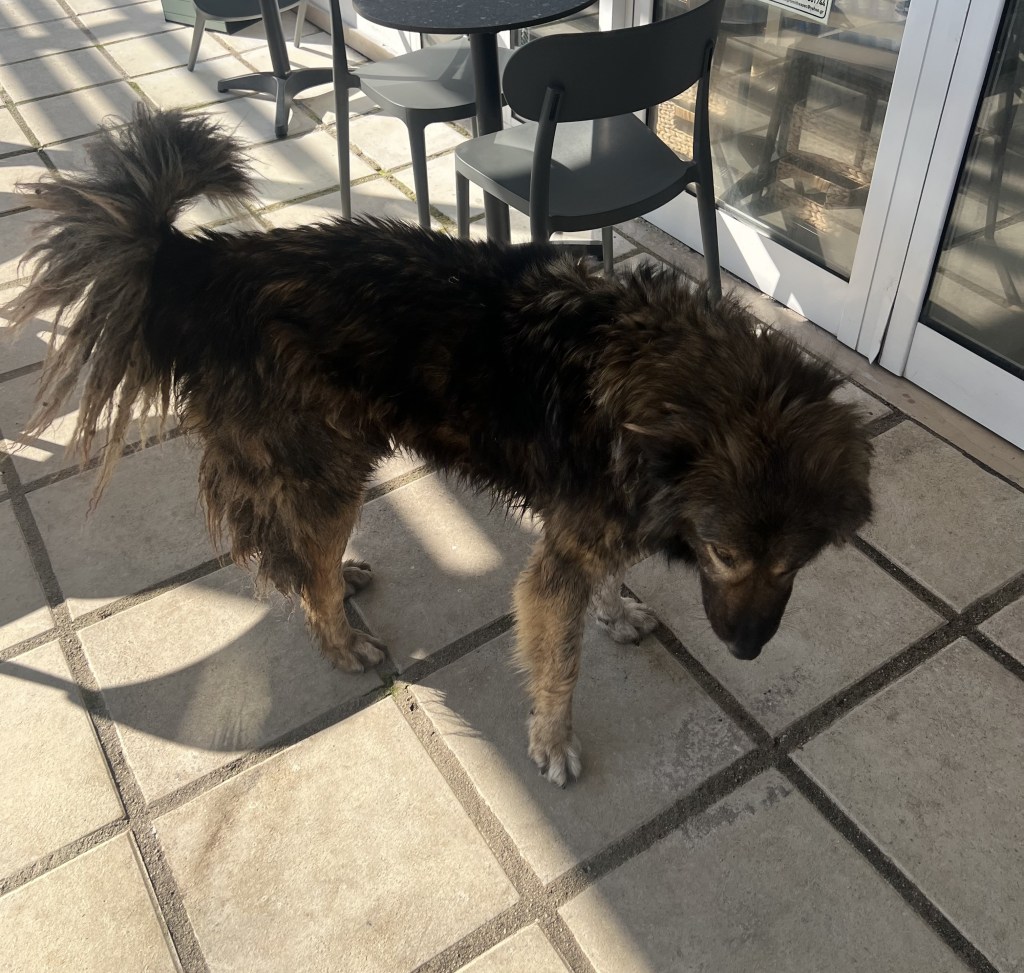
Thoughts: The waves we encountered the night before left melissa and I both seeking solace. Melissa found it lying on a beach chair on the ship overlooking the city of Volos. As I struggled to walk the site of Dion, I found it with a large dog. I stopped listening to the lecture and felt something on my hand. Looking down I saw a scraggly dog nudging me for attention. I stopped to pet him, and I did feel better. Animals have an uncanny ability to sense unease and try to make us feel better. I would be nice if humans could find the same compassion. Act for all. Change is coming and it starts with you.
 A travelers odyssey