
May 14, 2025
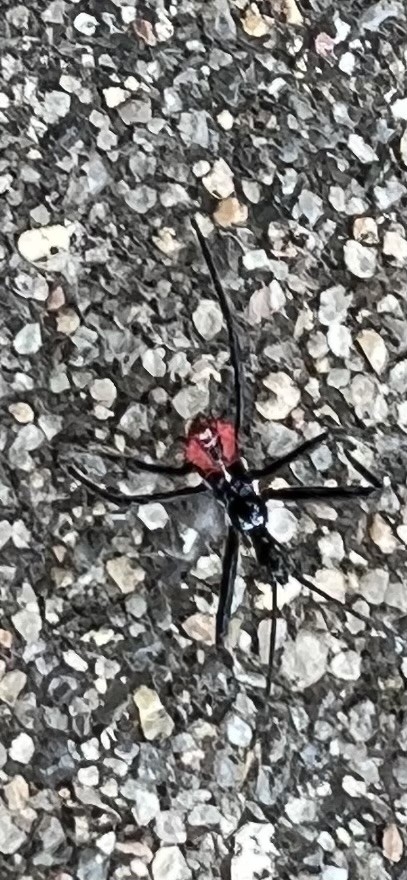
Last weekend I decided to weed the succulent bed beside the drive. Melissa planted the bed with white stonecrops (Sedum album) mats placed around the 4-foot by 3-foot (1.2 m by .9 m) bed. The bed sits under the Bradford pear (Pyrus calleryana) tree I had trimmed for the limbs and branches that made up the base layer of my hügelkultur raised beds made last year. The problem was the bed was filled with dead leaves and the invasive Bermuda grass (Cynodon dactylon) from the surrounding yard. After an hour of concentrated effort, I amassed a large pile of grass, leaves, and weeds on the driveway. I raked the debris into a pile and scooped it up to place in the trash bin (I do not have a large compost pile, yet). When I came back to blow the remaining debris onto the yard, I noticed a small insect with a red back scurrying across the drive. At first, I thought it was a Black widow (Latrodectus hesperus) spider dislodged from the debris. A closer look showed the creature had 6 legs, meaning it was an insect rather than a spider. I took a picture and googled the bug, and it was identified as an assassin bug, or more specifically a North American wheel bug.
When I went online, I found the North American wheel bug (Arilus cristatus), or simply wheel bug, is a species of large assassin bug in the family Reduviidae and the only species of wheel bug found in the US. It was described in 1763 by Carl Linnaeus. It is one of the largest terrestrial true bugs in North America and reaches up to 1.5 inches (38 mm) in length in its adult stage. It is sexually dimorphic with males slightly smaller than females. The characteristic feature of the species is the wheel-shaped armor on the first segment of the thorax which also bears the first set of legs. Adults are gray to brownish gray in color and black shortly after molting, but the nymphs (which have not developed the wheel-shaped structure) have bright red or orange abdomens. Wheel bugs prey on caterpillars and beetles by piercing them with their beak to inject salivary fluids that dissolve soft tissue. Wheel bugs are the most active in daylight but may feed at night in areas illuminated by lights. A wheel bug uses camouflage and hides in leafy areas (like my overgrown bed) whenever possible. Despite the prevalence of the wheel bug in many habitats, the information on the species is haphazard and incomplete. Most of its prey are pests, so the wheel bug is considered beneficial.
The wheel bug I found scurried off and I did not think any more about it until I noticed another one on my rake 20 minutes later. My app initially identified the insect as an assassin bug, but this refers to over 7,000 species of Reduviidae, a large wide-ranging (cosmopolitan) family of the suborder Heteroptera of the order Hemiptera (true bugs). Scanning pictures of the 5 different types of assassin bug, I determined it was a wheel bug, which also had 5 species. I narrowed this to the North American wheel bug because it was the only one native to North America. North American wheel bugs are highly regarded by organic gardeners because they consume a variety of insects, and their presence indicates a healthy, pesticide-free ecosystem. “They are the lion or the eagle of your food web,” according to Michael J. Raupp, an entomologist at the University of Maryland. I was glad I had left it alone.
THOUGHTS: The pictures of wheel bugs all showed a large black or gray adult, unlike the tiny (.25 inch/6 mm) insect I found. This was a nymph version of the wheel bug that hatches at the beginning of May and matures (after 5 molts) in July. That explains the second individual on my rake. I had disturbed a group of hatchlings hidden in the leaves. When I saw the wheel bug my first reaction was to squash it because it was unknown. Taking time to know, I found it was beneficial. Taking time to know (things or people) can often change our understanding. We just need to be willing to spend the time. Act for all. Change is coming and it starts with you.
 A travelers odyssey