
June 09, 2025
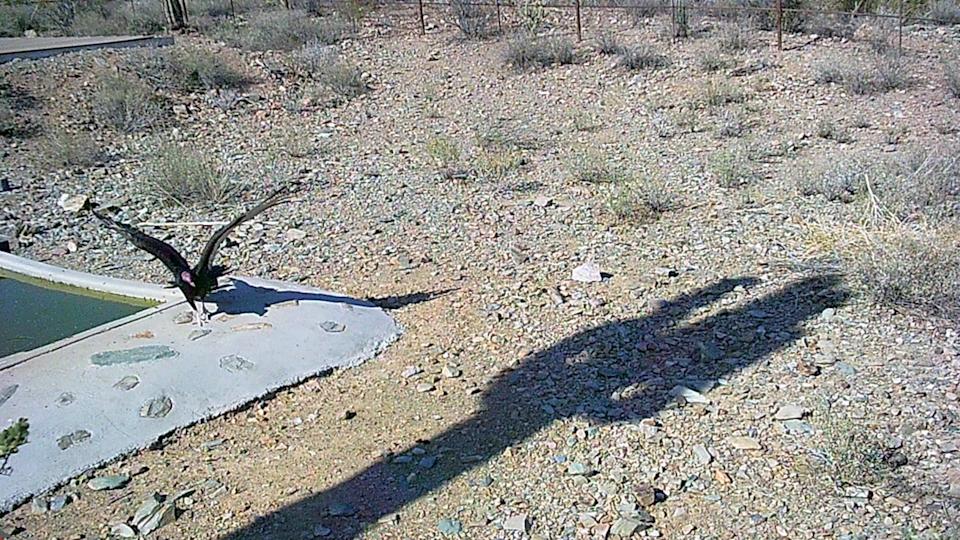
I found it fitting after blogging last month about the wildlife structures in Southern Colorado that allow animals to safely cross highways to come across an article in Sunday’s paper addressing the drought wildlife faces in the Arizona desert. The article began with the parade of animals coming to the human-made watering hole on a night in May. First a coyote (Canis latrans), then a gray fox (Urocyon cinereoargenteus), followed by a great horned owl (Bubo virginianus), and finally a herd of mule deer (Odocoileus hemionus). As dawn broke the watering hole began to serve its daytime visitors. These were the scaled quail (Callipepla squamata), ravens (Corvus corax principalis), vultures (Cathartes aura), doves (genus Streptopelia), and the occasional lizard (genus Tupinambis). This activity was recorded at the “Teddy Bear” water catchment, nicknamed for the teddy bear cholla (Cylindropuntia bigelovii) that grows around it. This is one of the thousands of catchments managed by Arizona Game and Fish (AGF) built to boost game numbers for hunting and compensate for habitat fragmentation. The catchments have satisfied thirsty animals since the 1940’s.
When I went online, I found Teddy Bear (catchment No. 436) was built to draw deer away from the Central Arizona Project (CAP) Canal. The site has a large sheet of metal that directs rainwater into a gutter and feeds it into an underground tank. The water resurfaces a few yards away as a square of slick green in the arid desert. A fence surrounds the catchment to keep livestock out yet allows wild animals in. Joe Currie, AGF habitat planning program manager, said the catchments are a great support for creatures who live in Arizona’s unforgiving deserts. Many animals can only live a few days without water or the water-rich food the catchments provide. When they were built, many of these watering holes thrived on the more consistent rain. Now, state officials say the drought has forced them to use trucks, and even helicopters, to keep the catchments full. Each year AGF hauls more than 1 million gallons of water to nearly 3,000 catchments. As severe drought deepened in Arizona in 2024, hauling has picked up.
After decades of long-term drought throughout the Southwest, Arizona suffered its hottest summer on record in 2024 and a near-record dry spell back-to-back. These short-term drought conditions persisted through the first half of 2025. Every region of Arizona has been under an official drought designation since January. The Forest Service and Bureau of Land Management own two-thirds of the catchments. Those departments used to have robust wildlife management programs but now have no budget to maintain the sites. Arizona has taken responsibility for the entire network, spending roughly US$1 million each year maintaining the catchments. Helicopter deliveries, with the same equipment used to dump water on wildfires, cost more than US$10,000 each. The AGF maintains a donation program where donors have contributed US$1.3 million since 2018.
THOUGHTS: Along with the catchments, Arizona has invested in wildlife structures for animals crossing highways and neighborhoods. Both allow animals to reach the water and food they need in dry times. The CAP also has 30 crossings dispersed along the canal system. These linkages also support genetic diversity in animal populations and allow wildlife to adjust to the effects of climate change. Deer are ruminants (like cows) and cud-chewing animals in dry areas struggle to digest the vegetation. Deer stuck in dry areas might also give birth to fewer fawns. The same goes for a range of other species. While hunting may provide emphasis (and funding) for the structures and the catchments, like most conservation projects they serve the entire ecosystem. If showing how such projects provide for human interests works, I say, “make it so #1!” Act for all. Change is coming and it starts with you.
 A travelers odyssey