
June 27, 2025
Earlier this month I commented on the pickling I was doing. That post mentioned the sliced cucumbers I use in a variety of salads. This year I decided to grow “pickling” cucumbers. I enjoy dill pickles, so I ended up canning 11 jars of dill pickle spears and three jars of dill pickle slices. The slices are the result of having to cut more off the ends of the spears to get them into the pint jars I used for canning. The cucumbers have excellent taste, and I am looking forward to trying my first jar of dill pickles. While some vegetables produce a single crop at around the same time, cucumbers do not. I waited for the cucumber to grow and discovered when a pickling cucumber gets large (over about 8 in/20 cm) the seed becomes a prominent feature of the eating experience. I now harvest daily to ensure the fruits do not grow too large. I bring in a bag of cucumber every morning.
When I went online, I found cucumber (Cucumis sativus) is a widely cultivated creeping vine plant in the family Cucurbitaceae that bears cylindrical to spherical fruits elongated with tapered ends. The fruit may grow as large as 24 inches (62 cm) long and 4 inches (10 cm) in diameter. Cucumber is considered an annual plant whose fruits consist of 95% water. There are three main types of cucumber (slicing, pickling, and seedless) within which several cultivars have been created. The cucumber originates in Asia, extending from India, Nepal, Bangladesh, China (Yunnan, Guizhou, Guangxi), and Northern Thailand. The plants are now grown on most continents and many different types of cucumber are grown commercially and traded on the global market. In botanical terms, the cucumber is classified as a type of botanical berry (pepo) with a hard outer rind and no internal divisions. Much like tomatoes (Solanum lycopersicum) and squashes (genus Cucurbita), cucumber is often perceived, prepared, and eaten as a vegetable.
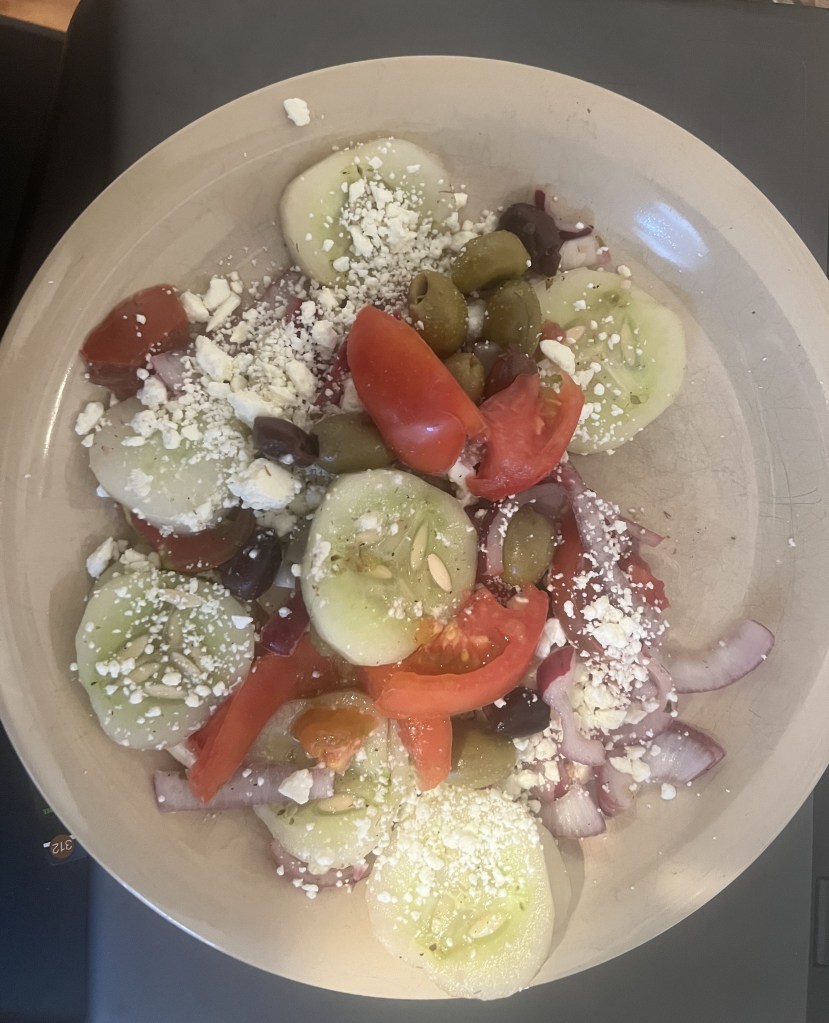
After pickling my two batches of cucumber I decided that was enough. Even there I gave a jar away to our gardening friend and to my sister-in-law. They have also been the recipients of cucumber and squash bags, as has my next-door neighbor. Melissa wants to use some of the fruit to make a sweet refrigerator pickle. I took 20 pounds (9 kg) of cucumber and 10 pounds (4.5 kg) of squash to the local food bank (and will no doubt take more). Still, the cucumber keeps coming which has gotten me to be more innovative with the cucumber. Last night I made a cucumber salad which we enjoyed along with fresh corn (local farmer) and squash I roasted on the grill. Melissa commented the salad did not look much different than the Greek salad we were served when we were there earlier this year. I took some of the salad, added tomato, feta cheese, and Kalamata olives and turned it into a passable version of a Greek salad. Since the larger cucumber gets seedy, I am going to remove the seeds and use the larger fruit to make one of our favorites, Tzatziki Sauce (it goes on everything!). I am looking forward to a long and fruitful summer.
THOUGHTS: Harvesting and eating fresh vegetables, like cucumber and tomato, is one of the reasons we grow our garden. I also like to share the harvest with others who do not have access or the ability to grow their own vegetables. Picking fresh vegetables off the vine or out of the soil to make dinner is its own reward. The produce is crisper, and you know exactly what went into the soil without the expensive “organic” label. Growing your own vegetables can be inexpensive, but if you want to grow a larger crop it does take up an investment (annually). Harvesting, processing, canning, and freezing the produce is another step toward reducing our carbon footprint. Act for all. Change is coming and it starts with you.
 A travelers odyssey