
July 11, 2025
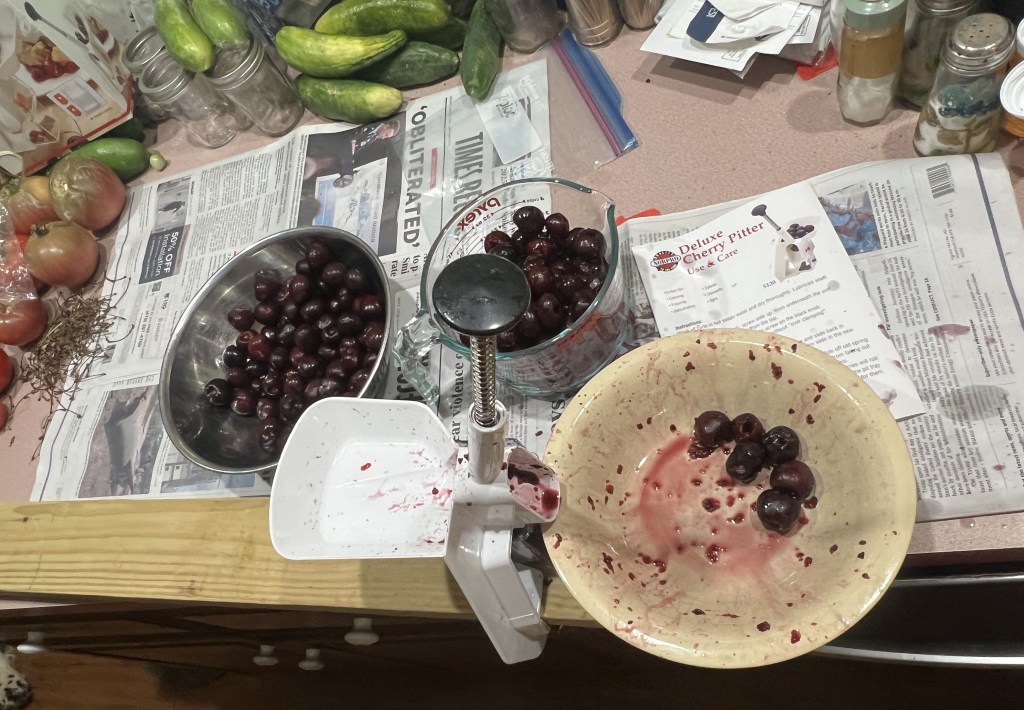
Our gardener friend is always on the lookout for fresh fruit and vegetables sourced from local farms and orchards. She often buys in bulk and then splits the cost (and produce) with Melissa. Several weeks ago, we got a baker’s dozen ears of corn (Zea mays), but we missed out on a bushel of fresh peaches (Prunus persica). She texted Melissa several days ago and said she had found another farm selling peaches nearby and she was going to get them. These were the free-stone variety that I really like, and I began to think of ways to use a half bushel of sweet Georgia peaches. After she bought them, she called Melissa and said she also had 10 pounds (4.5 kg) of cherries. When Melissa told me she was going to pick up the fruit, the only thought on my mind was, “What are we going to do with 10 pounds of cherries?”
When I went online, I found a cherry is the fruit of many plants of the genus Prunus and is a fleshy stone fruit (drupe). Commercial cherries are obtained from cultivars of several species, such as the sweet Prunus avium and the sour Prunus cerasus. The English word cherry derives from Old Northern French or Norman “cherise” from the Latin “cerasum”. These are a reference to the ancient Greek region of Kerasous near Giresun, Turkey, where cherries were first thought to be exported to Europe. The name ‘cherry’ also refers to the cherry tree and its wood and is sometimes applied to almonds and visually similar flowering trees in the genus Prunus, as in “ornamental cherry” (Prunus serrulate) or “cherry blossom”. The word “cherry” is also used for some species that bear fruits with similar size and shape even though they are not in the same Prunus genus. These include species like the “Jamaican cherry” (Muntingia calabura) and the “Spanish cherry” (Mimusops elengi). Cherries, along with many other fruiting trees and plants, probably first arrived in North America around 1606 in the New France colony of Port Royal, which is modern-day Annapolis Royal, Nova Scotia.
While Melissa was picking up the cherries, I googled to find out what to do with 10 pounds (4.5 kg) of cherries. I was surprised to find several sites attempting to address the exact issue. It seems unless you buy a controlled amount in the grocery store, they come in bulk. The obvious choice (other than eating them fresh) was to turn them into jellies, jams, or preserves. Melissa occasionally eats jam, but I rarely do, so 10 pounds of cherry jam seemed a bit much. Then there was cherry cheesecake and other cherry desserts. Again, we rarely eat dessert, let alone 10 pounds of such. That is when I came across a recipe for brandied cherries (brandy, water, sugar). This was said to be like maraschino cherries but with a wonderful flavor. The suggestion was to replace the maraschino in your favorite cocktail, but they could be used in a variety of ways. When the cherries arrived, it turned out to only be five pounds (2.25 kg), or 5 each. Our friend also lent us her cherry pitter. This quickly popped out the seed rather than cutting the pits out of a bulk of cherries with a knife. Five pounds (2.25 kg) of cherries is still a lot.
THOUGHTS: As we were pitting the cherries Melissa came up with several ways to use them. We made four cups into two pints brandied cherries, one of which was destined to become cheesecake. Another four cups were reserved to become cherry crisp. The last batch we left unpitted for Melissa to snack on. The first cherry pitter dates to the 1880’s as home cooks sought to simplify the task of cutting the stones out of the cherries for canning, baking, or other food uses. A straw or chopstick can also be used to push out the pit. The pitter I used reminded me of the cotton gin invented by Eli Whitney in 1793. Both were designed to speed up the process and reduce the tedious task of seed extraction. Mechanical ingenuity saves time. These savings could/should be put back into building your family or community. Act for all. Change is coming and it starts with you.
 A travelers odyssey