
August 21, 2025
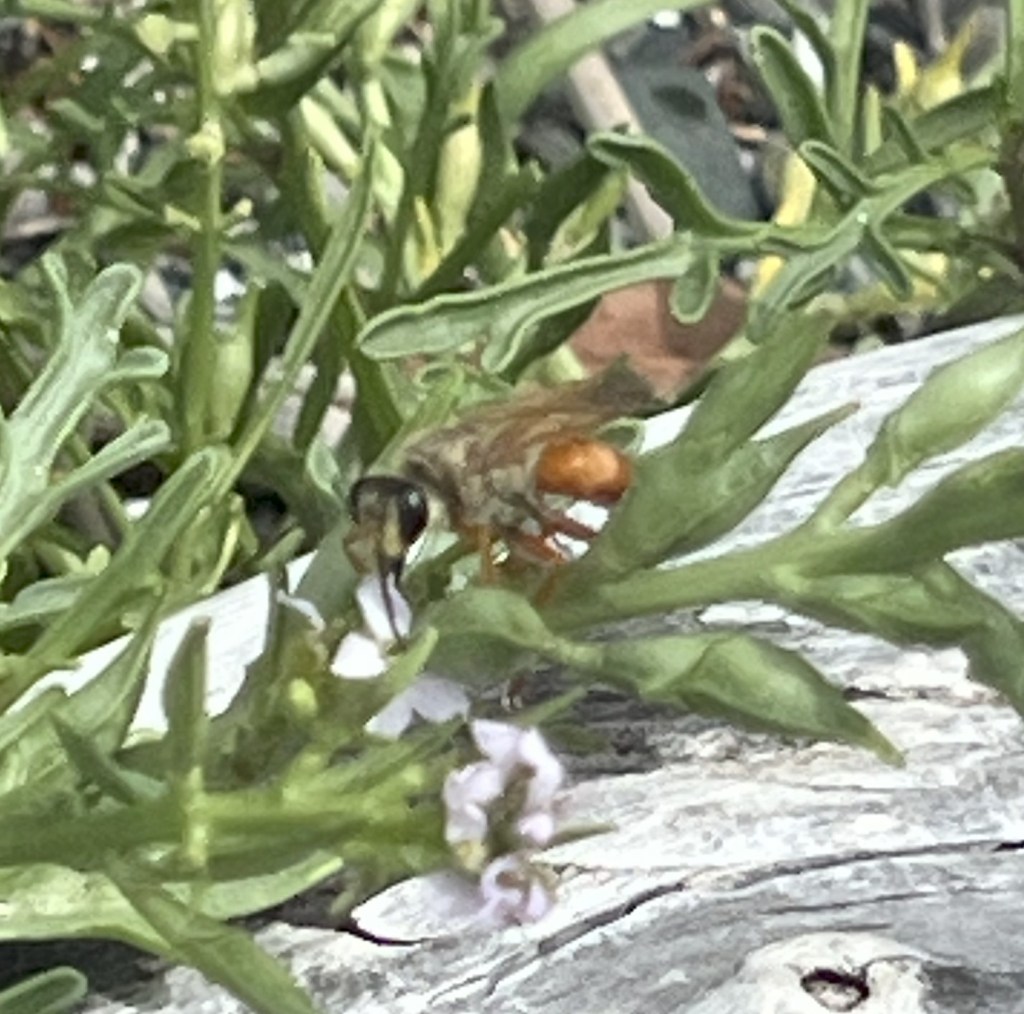
Following my disappointment fishing while at the coast last week I decided to walk through the beach community and see if I could spot some birds that were not yet on my list. I took the road through the community first to try and spot land birds. I was able to see two species I already recorded, an American Crow (Corvus brachyrhynchos) and a flock of house sparrows (Passer domesticus). It was not until I returned along the beach that I picked out several forms of gulls (California gull, Larus californicus; western gull, Larus occidentalis; short-billed gull, Larus brachyrhynchus) and a flock of white-winged scoter (Melanitta deglandi) ducks. The beaches along the Puget Sound tend to be small well-worn rock rather than the sand I associat with other coasts. This is harder to walk on, and it took me a while to get back to the house. When I arrived, my daughter-in-law showed me a picture of the unusual wasp they had encountered on their beach walk (other direction). It was a large golden digger sand wasp.
When I went online, I found the golden digger sand wasp (Sphex ichneumoneus), or great golden digger wasp or great golden sand digger, is a wasp in the family Sphecidae. The wasp’s name comes from the Greek word for “tracker,” and is most well-known for its parasitic nesting behavior. It is identified by the golden pubescence on its head and thorax (chest), its reddish orange legs, and partly reddish orange body. Golden hairs cover the head and thorax (hence “golden”). The digger has a long, slender waist (petiole). Their hind region (metasoma) is black with the first couple of segments a brilliant orange-red that matches their legs. Size varies from 1/2 to over 1 inch (1-1/4 to 2.5+ cm) long. This wasp is native to the Western Hemisphere, from Canada to South America, and provisions its young with various types of paralyzed Orthoptera (grasshoppers and crickets).
From May through August, great golden digger wasp females build their nests in sandy soils. These consist of a descending shaft and side chambers for the young at right angles. This makes it difficult to pull prey into a brood chamber without getting stuck and is one possible reason why the wasp always checks to ensure the path is clear before pulling its prey down by its antennae. Female wasps commonly build their burrows nearby those of other females of their species and may even share a nest. However, they will fight other wasps if they encounter them inside their burrow during prey retrieval. By inspecting the unattended nest, the wasp avoids risking an encounter with another wasp while carrying its prey. The digger will track and hunt their prey (i.e., tracker) and sting it with a paralyzing venom that keeps it alive, then flies (or drags) the prey to the nest. At the nest the digger wasp lays down their paralyzed prey and enters her tunnel and checks to ensure that all is well. Then she brings the prey down into a side chamber, lays an egg on the prey, and seals the chamber. When the egg hatches it feeds on the prey through the winter, and the new wasp emerges from its side chamber in the spring and begins the cycle again.
THOUGHTS: The golden digger sand wasp is like the cicada killer (Sphecius speciosus) I saw last week in Arkansas. Both are large, solitary, build nests in the ground, are harmless to humans, and do not defend their nest or behave aggressively. While they have stingers, they rarely sting humans unless they are stepped on. The digger is a pollinator that preys on insects that are harmful and are helpful to have around your garden (or beach house!). These are possibly the only wasps known to be attacked by birds. House sparrows and American robins (Turdus migratorius) will attack to force the digger to drop its prey for the bird to eat. I guess both the young and the birds are looking for an easy meal. Act for all. Change is coming and it starts with you.
 A travelers odyssey