
November 20, 2025
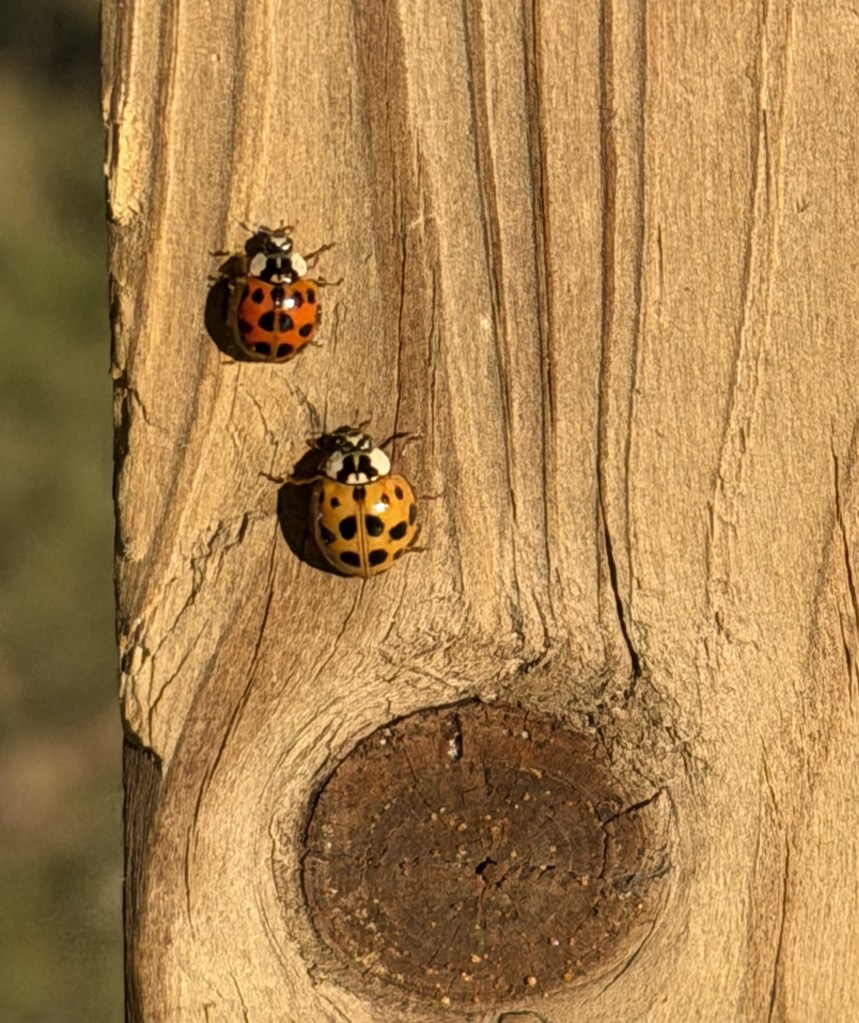
Last week Melissa and I were in a wooded area along the Arkansas River when we were inundated by flying insects. Many species overwinter as adults sheltering in culverts, under bridges, or cavities in trees. In the spring they will wake up and get along with starting the next generation. Other than the short cold snap last week, we have been having nice weather this fall so these fliers may not have even begun the process. Hibernating adults are also known to come out on unseasonably warm days. The temperature was uncommonly warm (high 70’sF/25+C) so it would not have surprised me to find some insects buzzing around, these were literally everywhere. I do not believe I have ever seen so many Asian lady beetle in one place.
When I went online, I found a lady beetle or ladybird (Harmonia axyridis) is a species commonly known as the harlequin, Asian, or multicolored Asian lady beetle. This is one of the most variable lady beetle species in the world with a wide range of color forms. The species is native to eastern Asia and has been artificially introduced to North America and Europe to control aphids (family Aphididae) and scale insects (Superfamily, Coccoidea). It is now common and spreading in those regions and has also been established in Africa and across South America. Individuals are beetles in shape and structure, being domed and having a “smooth” transition between their wing coverings (elytra), thorax (pronotum), and head. It ranges from 0.22 to 0.34 inches (5.5 to 8.5 mm) in size. The common color form is orange or red with 0 to 22 black spots of variable size. The bright color makes the species conspicuous in North America and may be known locally as the Halloween beetle as they often invade homes during October to overwinter.
The Asian lady beetle is considered one of the world’s most invasive insects, due in part to their tendency to overwinter indoors. They have an unpleasant odor and stain left by their bodily fluids when frightened or crushed, along with a tendency to bite humans. In Europe they are increasing to the detriment of indigenous species as its voracious appetite enables it to outcompete (and consume) other ladybugs. The Asian is highly resistant to diseases and carries a microsporidian parasite (it is immune) that can kill other lady beetle species. Native ladybug species often experience dramatic declines from the invaders. They were declared the fastest-invading species in the UK in 2015, spreading throughout the country after the first confirmed sighting in 2004. The Asian lady beetle has been reported to be a minor agricultural pest that has been inadvertently harvested with crops in Iowa, Ohio, New York State, and Ontario. This causes a detectable and distinctly unpleasant taste known as “lady beetle taint”. The contamination of grapes by the beetle has also been found to alter the taste of wine.
THOUGHTS: Various methods of control have been tried where the Asian lady beetle has been introduced, causing a threat to native species, biodiversity, and to the grape industry. These include insecticides, trapping, removal of beetles, and mechanically preventing entry to buildings. The best methods for dealing with the Asian lady beetle in private homes involve sealing openings they enter and sweeping or vacuuming if they are inside. Placing a nylon stocking inside the vacuum cleaner’s hose and securing it with a rubber band keeps the beetles from collecting (and being crushed) inside the machine. Despite the dozens of beetles that landed on Melissa and me we were not bitten. I have been bitten before and it was a sharp (but not lasting) pain. Once again importing a species to get rid of another caused more problems than it solved. Act for all. Change is coming and it starts with you.
 A travelers odyssey